Yes, a business valuation can be contested in a divorce case by challenging its financial inputs, valuation methods, assumptions, effective date, or treatment of the ownership interest. A competing opinion alone does not establish an error; your attorney needs evidence connecting the disputed conclusion to a specific valuation issue, and the available procedure depends on the case and jurisdiction.
- Searching contest business valuation divorce? Identify a specific error before commissioning another valuation.
- Separate operating-business value from business-owned real estate; they require different analysis.
- Compare reports using the same valuation date, ownership interest, and applicable standard of value.
- REIS Group provides real estate appraisals for attorneys addressing property issues within divorce disputes.
Can a business valuation be contested in a divorce case?
Yes. Build the challenge around a documented disagreement, not simply a preferred result. For a New York City divorce attorney reviewing a valuation in 2026, the practical starting point is the report’s scope: what was valued, as of when, and under which assumptions.
Use these 5 steps to organize the review:
- Confirm the assignment. Identify the business entity, ownership percentage, effective date of value, intended use, and standard of value.
- Trace the financial inputs. Compare the report with financial statements, tax returns, accounting records, and supporting schedules.
- Review the methods. Identify how the analyst selected and applied the valuation approaches and supported material assumptions.
- Isolate the disagreement. Connect each objection to a record, calculation, unsupported adjustment, or scope mismatch.
- Coordinate the response. Ask counsel whether clarification, additional disclosure, expert review, or a separate valuation fits the case.
When the dispute includes an apartment, building, or other real property, the divorce property appraisal guide for attorneys explains the related appraisal assignment. Keep that work distinct from valuing the operating business itself.
Why this matters
A business valuation is an opinion supported by analysis, not a bank balance. Two reports can reach different conclusions because they value different rights, use different dates, or make different assumptions about the same records.
A useful challenge identifies which difference actually matters. An incorrect ownership percentage presents a different problem from an unsupported earnings adjustment, and neither is resolved merely by obtaining another final value.
For a 2026 engagement, give your attorney the complete report and its supporting schedules before requesting a replacement. Diagnose the disputed conclusion before deciding what additional professional work is needed.
What can you challenge in a business valuation?
The strongest review starts with the report’s reasoning. Check whether its conclusions follow from the stated scope, available evidence, and calculations.
The effective date and information considered
The effective date of value is the date to which the valuation conclusion applies. It is not necessarily the inspection date, report date, or date someone receives the report.
A report delivered in 2026 can address an earlier effective date. Ask counsel and the valuation professional how later information was treated and whether the analysis reflects the assignment’s required date rather than current conditions.
The ownership interest and property rights
Valuing an entire company is different from valuing a particular ownership interest. Voting rights, transfer restrictions, distribution rights, and governing agreements help define what the owner actually holds.
Start with the entity documents. A disagreement about ownership rights needs documentary support before anyone can determine its valuation effect; a percentage shown on a summary page does not explain every relevant right or restriction.
Earnings, expenses, and adjustments
Business valuation analysis can include adjustments intended to distinguish ongoing operations from nonrecurring or owner-specific items. Each material adjustment needs an explanation supported by the business’s records.
Review compensation, related-party transactions, unusual expenses, and claimed nonrecurring revenue. Do not assume an adjustment is wrong because it changes the result: ask what evidence supports its inclusion, exclusion, or amount.
Methods and assumptions
The 3 broad business valuation approaches are the income approach, market approach, and asset approach. They examine economic benefits, market evidence, and assets and liabilities, respectively.
Using a recognized approach does not establish that its application is sound. Review the selected inputs, the relevance of comparisons, and the explanation for adopting or rejecting an approach in the particular assignment.
Assets, liabilities, and overlapping value
Check what the report includes and excludes. Real estate, business debt, nonoperating assets, and related entities require clear treatment so that the same economic interest is not counted twice or omitted without explanation.
For a company occupying its own building, review the relationship between occupancy expense and property value. The business analyst and real estate appraiser need consistent information about the property and its use, without treating their assignments as interchangeable.
Which response fits the valuation dispute?
Not every disagreement calls for a second full valuation. Select the response that addresses the identified problem, subject to counsel’s advice about procedure, disclosure obligations, and the case schedule.
| Response | Best for | Practical benefit | Limitation |
|---|---|---|---|
| Written clarification | An unclear assumption or missing explanation | Focuses attention on a defined question | Does not provide an independent value conclusion |
| Independent expert review | Questions about scope, methods, or support | Examines the existing analysis | A review does not automatically establish a replacement value |
| Separate business valuation | A dispute requiring an independent business-value opinion | Develops a separate supported conclusion | Requires its own scope, records, and analysis |
| Real estate appraisal | A dispute involving business-owned land or buildings | Addresses the identified real property interest | Does not value the operating business as a whole |
Choose the assignment that answers the disputed question. If the issue is an unexplained adjustment, start by identifying its support; if the issue is a building’s value, determine whether a real estate appraisal is needed.
Why business valuation conclusions differ
Different conclusions do not, by themselves, prove that either professional acted improperly. Compare the reports on these 5 drivers before treating their final values as directly comparable:
- Scope and ownership rights: An entire enterprise and a restricted ownership interest are different subjects.
- Effective date: Business conditions and relevant information must be considered in relation to the required date.
- Financial records: Incomplete statements, inconsistent schedules, or unreconciled records affect the foundation of the analysis.
- Methods and assumptions: Earnings adjustments, market comparisons, and other material inputs require support.
- Asset treatment: Real estate, liabilities, and nonoperating assets need consistent treatment across related analyses.
Create a side-by-side issue list rather than a list of competing final values. For each difference, record the relevant report page, source document, explanation requested, and professional responsible for addressing it.
How should you prepare a valuation challenge?
For a 2026 review, organize the records around the question the professional must answer. A large document transfer without an issue summary makes it harder to distinguish a factual correction from a disagreement about judgment.
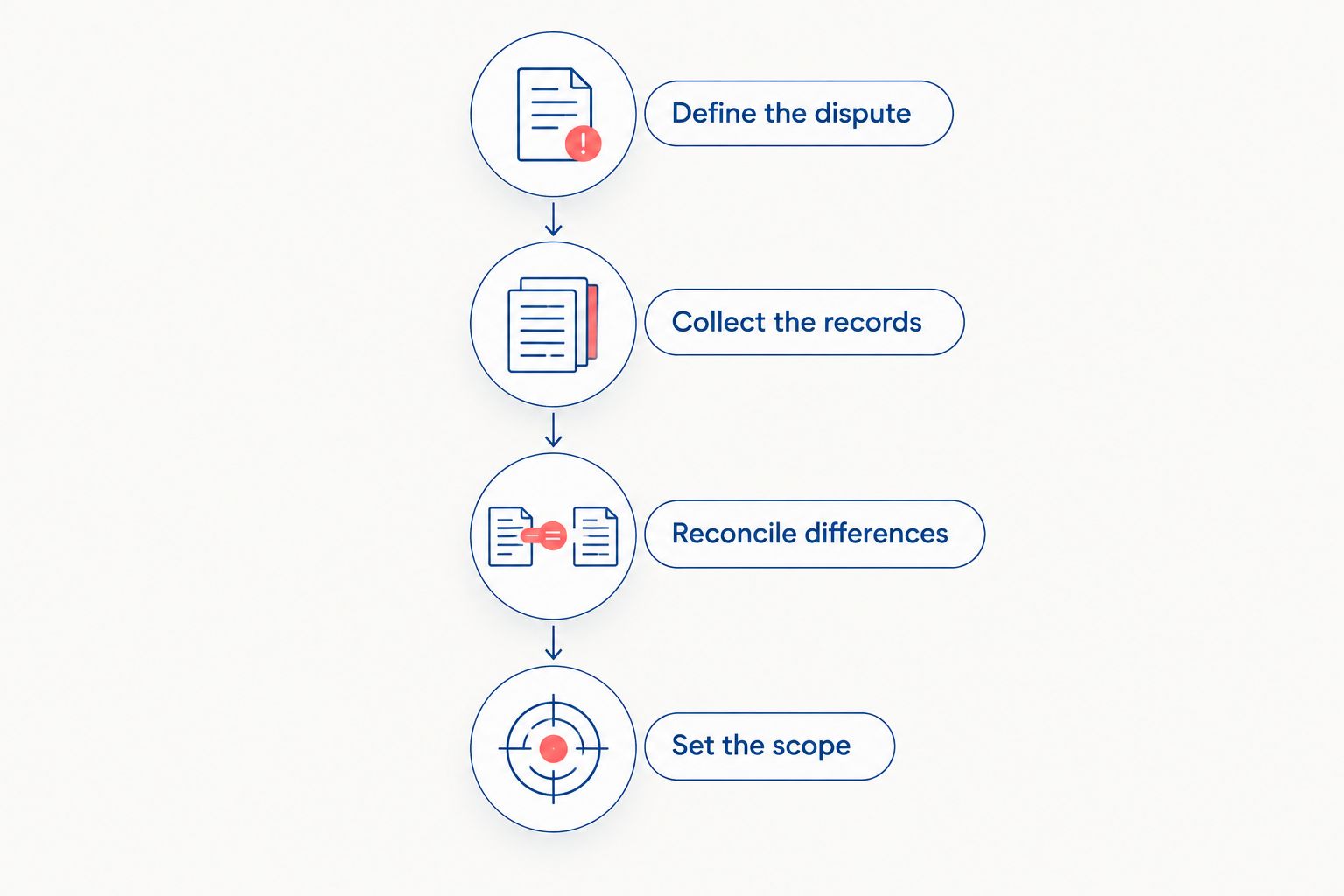
Define the dispute
Write a short statement identifying the business, ownership interest, report under review, effective date, and disputed conclusion. State whether the question concerns the operating business, real estate, or both.
Avoid instructions to reach a particular number. An independent assignment starts with a defined question and relevant evidence, not a requested outcome.
Collect the records
Provide complete versions of the report, financial statements, tax returns, ownership agreements, debt schedules, and relevant supporting material. Counsel and the reviewing professional should identify the records appropriate to the actual scope.
For business-owned property, gather deeds or ownership records, leases, rent rolls where applicable, operating statements, and information about the property’s condition. Identify which materials describe conditions at the effective date.
Reconcile differences
Ask the reviewing professional to distinguish factual discrepancies from analytical judgments. An incorrect loan balance can be checked against records; the selection of a valuation assumption requires an explanation of the evidence and reasoning.
Record unresolved questions without labeling every difference an error. That distinction keeps the challenge focused and gives counsel a clearer basis for deciding the next step.
Set the scope
Confirm the intended users, intended use, required effective date, property or business interest, and expected deliverable. Discuss whether the assignment is a review, a new valuation, or a real estate appraisal supporting a broader analysis.
Do not assume the same professional will perform every component. Confirm operating-business valuation services separately from appraisal of business-owned real estate.
When does business-owned real estate need separate analysis?
A business and the building it occupies are not the same asset. The business can occupy leased premises, own its premises directly, or use property held through another entity; the records must establish the actual arrangement.
A real estate appraisal addresses the identified property rights as of a stated effective date. Operating-business valuation addresses the business interest under its own scope and applicable standard of value.
That can mean 2 coordinated assignments rather than one interchangeable report. The professionals need to understand how rent, occupancy costs, property ownership, and related obligations are reflected in the overall analysis.
REIS Group is best suited to attorneys who need real estate appraisals within a divorce valuation assignment. The firm provides residential, commercial, partial-interest, and divorce-related appraisal services, with Manhattan and greater New York City as its principal market.
REIS Group scopes real estate appraisal work to the property interest, effective date, intended users, and intended use. Confirm any operating-business valuation requirement separately; a property appraisal does not establish the value of an operating company.
Can you challenge the valuation without another full report?
Yes, clarification or expert review can address a defined issue without automatically requiring a replacement valuation. Whether that response is sufficient depends on the issue and counsel’s assessment of the case requirements.
Begin with the existing report’s explanation and supporting records. A full independent valuation serves a different purpose from checking a calculation or examining whether an assumption has support.
Does a lower competing valuation prove the first report is wrong?
No, a lower competing valuation does not establish that the first report is wrong. Compare the effective dates, ownership interests, standards of value, financial inputs, and assumptions before comparing the conclusions.
If the reports answer different questions, the numerical difference alone is not a meaningful test. The next step is to reconcile the scope and identify which disagreements remain.
Can a real estate appraisal settle the entire business-value dispute?
No, a real estate appraisal addresses the identified real property interest, not the entire operating business. It can inform the broader analysis when property value is a disputed component.
Counsel and the valuation professionals should define how the property conclusion will be used. That coordination helps keep asset treatment consistent without extending the appraisal beyond its assignment.
FAQ
Can I contest a business valuation in my divorce in 2026?
Yes, you can challenge a business valuation by identifying disputed inputs, methods, assumptions, scope, or calculations. Your divorce attorney should determine the available procedure and evidence requirements for your case.
What evidence helps challenge a business valuation?
Evidence that connects a specific objection to the report is the most useful starting point. Relevant material includes financial records, ownership agreements, debt schedules, supporting calculations, and documents addressing the disputed assumption.
Do I need a second business valuation to dispute the first one?
No, a second business valuation is not automatically necessary. Clarification or independent review can address a defined issue, while a separate valuation develops an independent conclusion.
Can I dispute the date used in the valuation?
Yes, the effective date is a legitimate subject for review. Your attorney should confirm the date required for the assignment, and the valuation professional should explain how the analysis relates to it.
Does a business valuation include the building the company owns?
The report’s scope and asset treatment determine how business-owned real estate is addressed. Review the ownership structure, occupancy assumptions, and treatment of the property before assuming it is included or excluded.
Can REIS Group appraise property involved in a divorce?
Yes, REIS Group provides divorce-related real estate appraisal services. The assignment should identify the property rights, effective date, intended users, and intended use; operating-business valuation needs must be confirmed separately.
Does an independent appraisal guarantee the court will accept the value?
No, an independent appraisal does not guarantee court acceptance. A supported report provides valuation evidence for its identified purpose, while counsel addresses its use in the proceeding.
One last thing
Check whether the reports value the same thing before debating which number is right. A disagreement that appears to concern methodology can begin with a mismatch in the ownership interest, effective date, or treatment of business-owned property.
For a 2026 divorce-related property assignment, give REIS Group the property address, ownership information, required effective date, intended use, and relevant case schedule. Discuss the appraisal assignment or request a proposal; turnaround depends on property type, complexity, records availability, and scope.
Discuss Your Appraisal Assignment
Define the property interest, valuation date, and intended use for your divorce-related real estate appraisal.
Related guides
- Business valuation for CPAs and accountants
- Divorce appraisal and equitable distribution workflow
- Partial-interest appraisal scope and cost considerations