To obtain a court accepted divorce appraisal, have your attorney define the valuation issue, then retain an independent real estate appraiser whose qualifications and report address that assignment. The appraisal needs a supported value conclusion for the correct property interest and effective date; no appraiser can guarantee that a court will accept the report or adopt its conclusion.
- A court accepted divorce appraisal requires the right scope, effective date, property rights, and supporting evidence—not an acceptance guarantee.
- REIS Group provides divorce appraisals for New York City attorneys and property owners who need purpose-specific real estate valuations.
- Ask your attorney to confirm the valuation date and any court-directed requirements before commissioning the appraisal.
- Confirm separately whether the engagement includes deposition, testimony, document production, or responses to another expert.
Why this matters
For a divorce appraisal commissioned in 2026, the immediate task is to identify what the attorney needs valued and why. A report prepared for mortgage lending or general sale planning does not automatically address the questions in a matrimonial proceeding.
Start with the assignment—not a desired settlement figure. When discussing real estate appraisal services, identify the property, ownership interest, intended use, and any relevant court instructions. That information lets the appraiser propose work suited to the dispute rather than assume that a standard residential report will be enough.
How do you get a court accepted divorce appraisal?
The practical sequence is to define the legal question, establish the appraisal scope, collect evidence, and prepare for scrutiny. Your attorney handles the legal requirements; the appraiser develops and explains the valuation opinion.
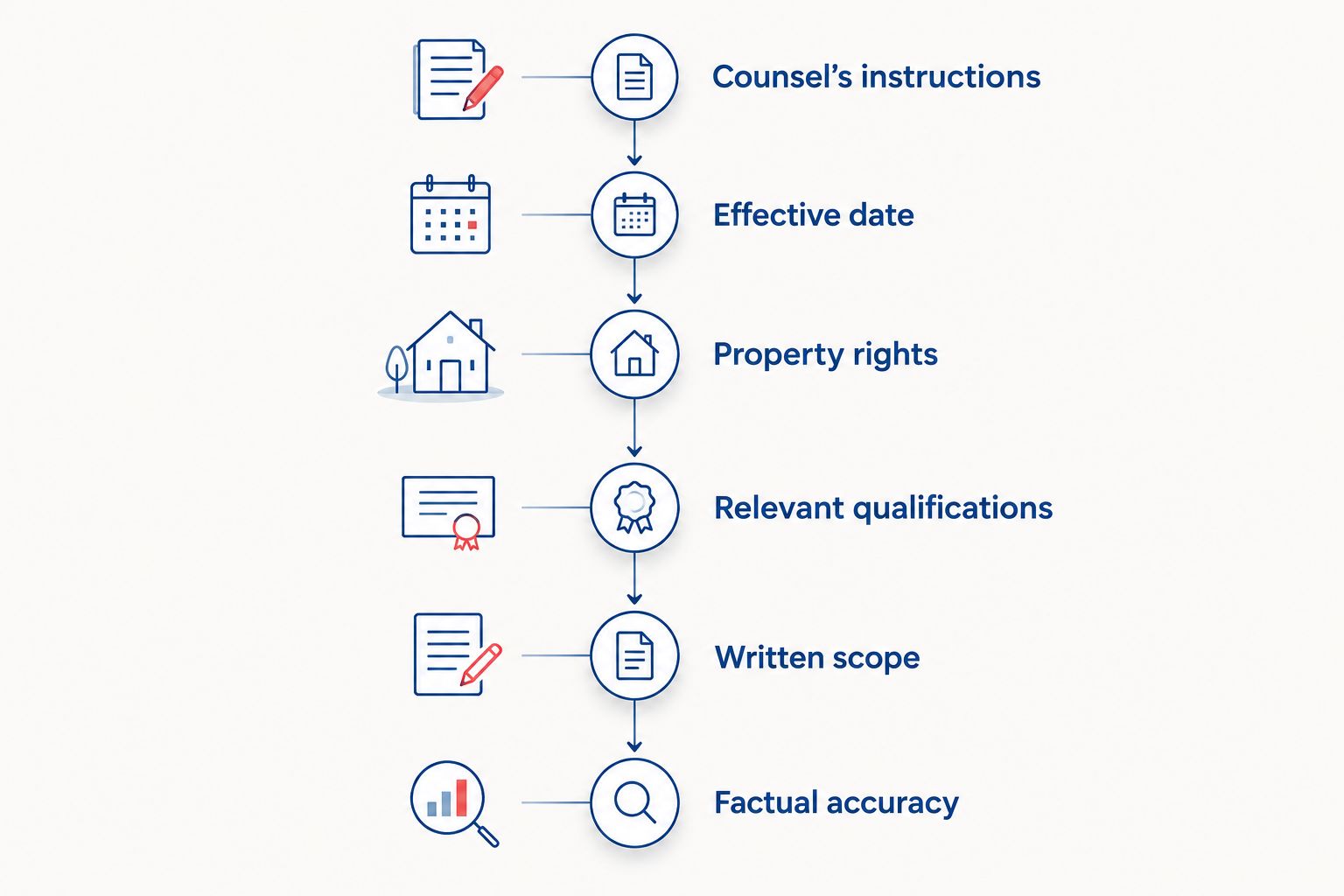
- Obtain counsel’s instructions. Ask your attorney to identify the valuation issue, applicable deadlines, and any order governing expert reports. Clarify whether the immediate purpose is settlement negotiation, mediation, disclosure, or trial preparation. Those uses can require different reporting and support arrangements, even when the underlying property is the same.
- Confirm the effective date. The effective date of value is the date the appraisal opinion addresses. It is not necessarily the inspection date or report date. Have counsel resolve which date is needed before the appraiser begins; otherwise, the report can answer the wrong question despite sound analysis.
- Identify the property rights. Specify whether the assignment concerns the entire real estate interest, leased property, or a fractional ownership interest. Provide ownership and occupancy documents rather than relying on a street address alone. The rights being valued affect the evidence and analysis required.
- Evaluate relevant qualifications. Ask about the appraiser’s credential, experience with the property type, and familiarity with the local market. For Manhattan properties, discuss the specific assignment: a cooperative apartment, condominium, townhouse, and income-producing building present different valuation questions. Ask separately about experience explaining conclusions in contested matters.
- Agree on the written scope. The engagement should identify the intended use, intended users, effective date, property rights, inspection arrangements, and report requirements. Clarify whether later services—such as reviewing another report or providing testimony—are included. Do not assume that delivery of a written appraisal includes every litigation-related task.
- Provide records and review factual accuracy. Supply relevant property documents, arrange access, and disclose known changes in condition or occupancy. After delivery, raise factual errors through the agreed communication process. A correction to an incorrect area measurement is different from asking an appraiser to change a supported conclusion because it complicates negotiations.
Keep the engagement instructions with the final report. If the assignment changes, ask whether the scope needs to change before relying on the original conclusion.
What should the appraisal report explain?
A useful divorce appraisal makes its reasoning traceable. The reader should understand what was valued, as of which date, using what evidence, and subject to which assumptions or limitations.
Ask whether the report addresses:
- Assignment identification: the client, intended users, intended use, property rights, and effective date.
- Property description: the characteristics relevant to value, including condition, occupancy, and legally relevant property features.
- Market evidence: the sales, rental information, income records, or other data supporting the analysis.
- Valuation methods: the approaches considered, the methods applied, and the reasons they fit the property.
- Reconciliation: how the appraiser weighed the evidence to reach the final conclusion.
- Assumptions and limitations: facts relied upon, information constraints, and conditions affecting the analysis.
A longer report is not automatically a stronger report. The useful distinction is whether the explanation supports the identified purpose and allows the reader to follow the appraiser’s reasoning.
Which appraisal arrangement fits the dispute?
Counsel should decide whether the parties will jointly retain an appraiser or obtain separate opinions. Neither arrangement guarantees agreement or judicial acceptance.
| Arrangement | Best for | Practical advantage | Limitation |
|---|---|---|---|
| Jointly retained appraiser | Parties willing to agree on scope and access | Establishes a common assignment and shared valuation evidence | A shared appointment does not prevent disagreement with the conclusion |
| Separately retained appraisers | Parties obtaining independent expert opinions through counsel | Allows each party to examine the valuation issues through a separate engagement | Different dates, assumptions, or property rights can make conclusions difficult to compare |
| Appraisal review | Counsel evaluating an existing appraisal | Examines the quality and support of the work under review | Does not necessarily provide a new value opinion unless the scope includes one |
Before choosing, clarify who instructs the appraiser, who receives communications, and how additional records will be shared. Counsel should also address confidentiality and disclosure; those are not matters the valuation conclusion itself resolves.
Why the effective date needs special attention
A retrospective appraisal estimates value as of a past date. It requires evidence relevant to that date, not simply a present-day opinion with an earlier date attached.
A 2026 inspection does not make 2026 the correct effective date for every divorce assignment. If counsel requests a historical valuation, the appraiser needs to distinguish the property’s condition then from its condition when inspected.
Provide dated photographs, renovation records, leases, and other contemporaneous documents when available. Explain what changed and when, rather than assuming the appraiser can reconstruct the history from current conditions.
Have counsel confirm the effective date before authorizing the assignment. If competing reports use different dates, their conclusions do not measure the same market conditions. Resolve that difference before treating the gap between their values as an appraisal error.
Property value is not the same as divisible equity
A real estate appraisal estimates the value of specified property rights. It does not, by itself, determine each spouse’s entitlement to the property or calculate the final distribution of marital assets.
Mortgage balances, ownership claims, transaction assumptions, and other adjustments belong in the legal and financial analysis directed by counsel. Do not assume that an appraised market value already deducts debt or answers how proceeds should be divided.
The distinction also matters when a business owns real estate. Appraising business-owned real estate is not the same assignment as valuing the operating business. If both are needed, the professionals should coordinate their assumptions and avoid treating the same asset inconsistently.
Ask the attorney and appraiser to identify the precise asset or interest under review before discussing a buyout figure.
What records should you gather before engagement?
Send a concise property summary first, then provide the records requested for the agreed scope. An organized file helps the appraiser distinguish documented facts from disputed assertions.
Property and ownership records
Provide the address, available ownership documents, floor plans or surveys, and relevant occupancy information. For a condominium or cooperative apartment, include governing or unit-specific documents requested by the appraiser. Flag storage, parking, terraces, or other interests that need clarification rather than assuming they are included.
Condition and historical records
Collect photographs, renovation descriptions, permits where relevant, and records showing significant physical changes. For a retrospective assignment, identify which materials existed near the effective date. Separate completed improvements from proposed work.
Income-producing property records
Provide leases, rent rolls, operating statements, and information about vacancies or significant expenses when relevant. Explain discrepancies between records instead of replacing them with an unsupported summary. The appraiser determines which information is necessary and how it affects the valuation.
Why divorce appraisal scope and turnaround vary
The assignment depends on the property and the question being answered. A delivery date should follow a scope discussion, not precede it.
- Property type: an apartment and an income-producing building require different records and analysis.
- Ownership interest: valuing the whole property differs from analyzing a fractional interest.
- Effective date: a historical assignment requires evidence about earlier conditions and market activity.
- Records availability: missing leases, unclear ownership documents, or inconsistent measurements require clarification.
- Access and complexity: inspection arrangements, unusual property features, and disputed facts affect the work required.
- Litigation support: report preparation, appraisal review, deposition, and testimony are distinct tasks to address in the engagement.
Request a proposed schedule after providing these details. Expedited availability must be confirmed individually; a court deadline does not remove the need for sufficient analysis.
How should you choose an appraiser for a Manhattan divorce?
Match the appraiser to the assignment rather than choosing on a general claim of courtroom experience. Ask for relevant qualifications, property-type experience, and a clear explanation of the proposed work. Confirm any testimony needs before engagement.
REIS Group is suited to New York City divorce attorneys who need purpose-specific real estate appraisals. The firm’s divorce appraisal services cover residential, commercial, and complex valuation matters, with scope tailored to the property interest, effective date, and intended use.
The boundary matters: engaging a valuation firm does not resolve legal admissibility, property classification, or distribution. Discuss those issues with counsel and confirm separately what litigation support the appraisal engagement includes.
Discuss Your Appraisal Assignment
Identify the property, valuation date, ownership interest, and intended use for a scoped proposal.
Can you use an existing mortgage appraisal for divorce?
An existing mortgage appraisal is not automatically suitable for divorce because its intended use, effective date, and scope can differ. Give the report to counsel and the proposed appraiser for assessment before relying on it.
The question is not whether the earlier report was valid for lending. The question is whether it addresses the property rights and valuation issue now in dispute.
What should you do if the spouses’ appraisals disagree?
Start by comparing the effective dates, property rights, factual assumptions, and market evidence. A disagreement about value does not establish that either report is defective.
Ask counsel whether clarification, additional evidence, or a separately scoped appraisal review is appropriate. Focus on the reason for the difference rather than asking an appraiser to split the difference without analytical support.
FAQ
What makes a divorce appraisal court accepted?
Court acceptance depends on the applicable legal requirements and the court’s determination, not an appraiser’s promise. Counsel should confirm the requirements, while the appraiser provides a supported opinion addressing the correct property rights, effective date, and intended use.
Do both spouses have to use the same appraiser?
Whether the spouses use the same appraiser depends on their agreement, counsel’s strategy, and any applicable court directions. A joint engagement needs clear instructions about scope, communications, access, and report delivery.
Can I get a divorce appraisal without my spouse attending the inspection?
Inspection access and attendance should be arranged through counsel and the agreed engagement process. Tell the appraiser about access restrictions before the scope and schedule are finalized.
Which valuation date should I use for a divorce appraisal in 2026?
Your attorney should identify the effective date required for the divorce valuation. The inspection date and report date do not automatically establish the correct date of value.
Does the appraisal tell me how much my spouse should receive?
A real estate appraisal does not determine a spouse’s legal entitlement or the final distribution. Counsel and financial advisers use the valuation alongside debt, ownership, and other relevant legal and financial information.
Will the appraiser testify if the case goes to trial?
Testimony must be discussed and confirmed as part of the engagement arrangements. Do not assume that a written appraisal includes deposition preparation, attendance, testimony, or subsequent expert responses.
Does REIS Group handle New York City divorce appraisals?
REIS Group provides divorce-related real estate appraisals for New York City attorneys and property owners. Discuss the property type, ownership interest, effective date, intended use, and any litigation-support requirements when requesting a proposal.
One last thing
The most useful instruction often comes before the inspection: state exactly what interest must be valued and as of which date. Resolving those questions early keeps the report focused on the dispute rather than on a convenient but irrelevant valuation question.
For a 2026 engagement, send REIS Group the property address, counsel’s instructions, requested effective date, and known deadlines. Discuss your appraisal assignment and request a proposal tailored to its intended use.
Related guides
- Divorce property appraisal for attorneys
- Divorce appraisal to equitable distribution workflow
- Partial-interest appraisal scope and cost considerations