Yes—one real estate appraisal can support both estate tax and probate filings when its effective date, property rights appraised, value definition, intended use, and reporting scope satisfy both assignments. Reusing the report is not automatic: the estate attorney and tax adviser must confirm the filing requirements, and the appraiser must determine whether the report addresses both purposes. Resolve those requirements before engagement rather than assuming an existing report can simply be relabeled.
- One appraisal can support estate tax and probate filings when both purposes share compatible valuation requirements.
- Confirm the effective date, ownership interest, intended users, and report scope before commissioning the appraisal.
- A date-of-death appraisal does not automatically establish a value for a different valuation date.
- REIS Group provides estate and date-of-death real estate appraisals for attorneys, CPAs, executors, and trustees.
Can one appraisal be used for both estate tax and probate filings?
Yes, if the assignment is scoped for both purposes and the applicable requirements align. For an executor coordinating a 2026 engagement, the first step is to have the attorney and CPA identify what each filing needs. The date-of-death appraisal to IRS Form 706 workflow explains the connection between the valuation assignment and federal estate tax reporting.
| Approach | Best suited to | Practical benefit | Limitation |
|---|---|---|---|
| One report addressing both purposes | Filings with compatible dates, property rights, and valuation requirements | Keeps the supporting analysis coordinated | Both uses must fit the assignment and applicable filing requirements |
| Review of an existing report | An estate that already has an appraisal | Establishes whether existing work addresses the additional purpose | Review does not guarantee that the report can be reused |
| Additional valuation work | Different dates, ownership interests, or reporting needs | Addresses the actual difference between assignments | Requires additional scope and supporting analysis |
These are assignment paths, not interchangeable document formats. Choose the scope that supports the filings, not the smallest number of reports.
Why this matters for executors and estate advisers
An appraisal answers a defined valuation question. A report prepared for a different question does not become suitable for estate administration merely because it covers the same address. The date, ownership interest, and purpose determine what the appraiser must analyze.
For Manhattan and greater New York City estates, that distinction applies to cooperative apartments, condominiums, townhouses, commercial buildings, and fractional interests. A property description alone does not establish what the estate owned or what value the filing requires.
In a 2026 estate administration, coordinate the appraisal with the attorney and CPA before requesting a report. Their instructions establish the legal and tax reporting needs; the appraiser translates those needs into a defined real estate valuation assignment.
When one report fits both purposes
A shared report works when it answers the same underlying valuation question for both filings. Confirm each of the following before treating the report as suitable for a second use.
- Effective date: Both purposes require a value as of the same date, or the assignment expressly addresses the separate dates required.
- Property rights: The report values the ownership interest relevant to each filing, not merely the entire physical property.
- Value definition: The definition used in the appraisal matches the valuation requirements identified by the advisers.
- Intended use: The assignment identifies the purposes the appraisal is prepared to support.
- Intended users: The report identifies its intended users consistently with the assignment.
- Reporting scope: The analysis, explanations, assumptions, and supporting information address the identified needs.
Fair market value is generally understood as the price at which property would change hands between a willing buyer and willing seller, neither compelled to act and both reasonably informed. Your advisers should identify the applicable legal definition rather than assume every filing uses identical wording.
An appraisal's conclusions also depend on its stated assumptions. If a report assumes a particular occupancy, condition, or ownership arrangement, confirm that those assumptions fit the estate's circumstances at the effective date.
When additional valuation work is necessary
A mismatch does not always require starting from the beginning. It does require the appraiser to determine what additional work is appropriate. Sending the same report to another recipient does not resolve a difference in valuation purpose.
Different effective dates
The effective date is the date to which the value conclusion applies. The report date is when the appraiser completes the report; those dates serve different functions.
A retrospective appraisal completed in 2026 can establish value as of a historical date. It must analyze the property and relevant market conditions for that effective date, rather than substitute current conditions. If the tax adviser identifies another applicable valuation date, ask the appraiser to address it explicitly.
Different ownership interests
The estate's asset might be an entire property, a fractional real estate interest, or an ownership interest in an entity holding real estate. Those are not the same valuation subject.
Do not assume that valuing an entire building and multiplying by an ownership percentage establishes the value of a partial interest. Ownership rights, restrictions, and the assignment's purpose require separate consideration. An operating-business valuation is also distinct from an appraisal of business-owned real estate.
Different reporting requirements
A report prepared solely for an internal decision might not contain the explanations needed for the estate's identified filing purpose. Conversely, a detailed report can still answer the wrong question if its date or property rights do not match.
Ask the appraiser to review the original assignment before requesting changes. A new cover page is not a substitute for a properly scoped appraisal. The appraiser should explain whether the request calls for clarification, additional analysis, or another assignment.
Why the scope of a shared appraisal varies
The scope depends on the work needed to answer the valuation question. For a 2026 engagement, give the appraiser the facts that determine that work rather than requesting a generic estate appraisal.
- Property type: A cooperative apartment and an income-producing building call for different records and analysis.
- Ownership structure: Direct ownership, fractional ownership, and entity ownership raise different questions about the asset being valued.
- Historical condition: Renovations, damage, tenancy, and occupancy must be understood as of the effective date.
- Available records: Missing historical leases, operating statements, or ownership documents affect the information needed to support conclusions.
- Assignment purpose: Estate tax reporting, probate inventory preparation, and a disputed valuation can require different explanations and support.
- Required dates: Each effective date must be supported by analysis relevant to that date.
Turnaround depends on property type, complexity, records availability, and scope. Confirm any requested expedited schedule individually; do not treat a filing deadline as a confirmed appraisal completion date.
How do you commission an appraisal for both filings?
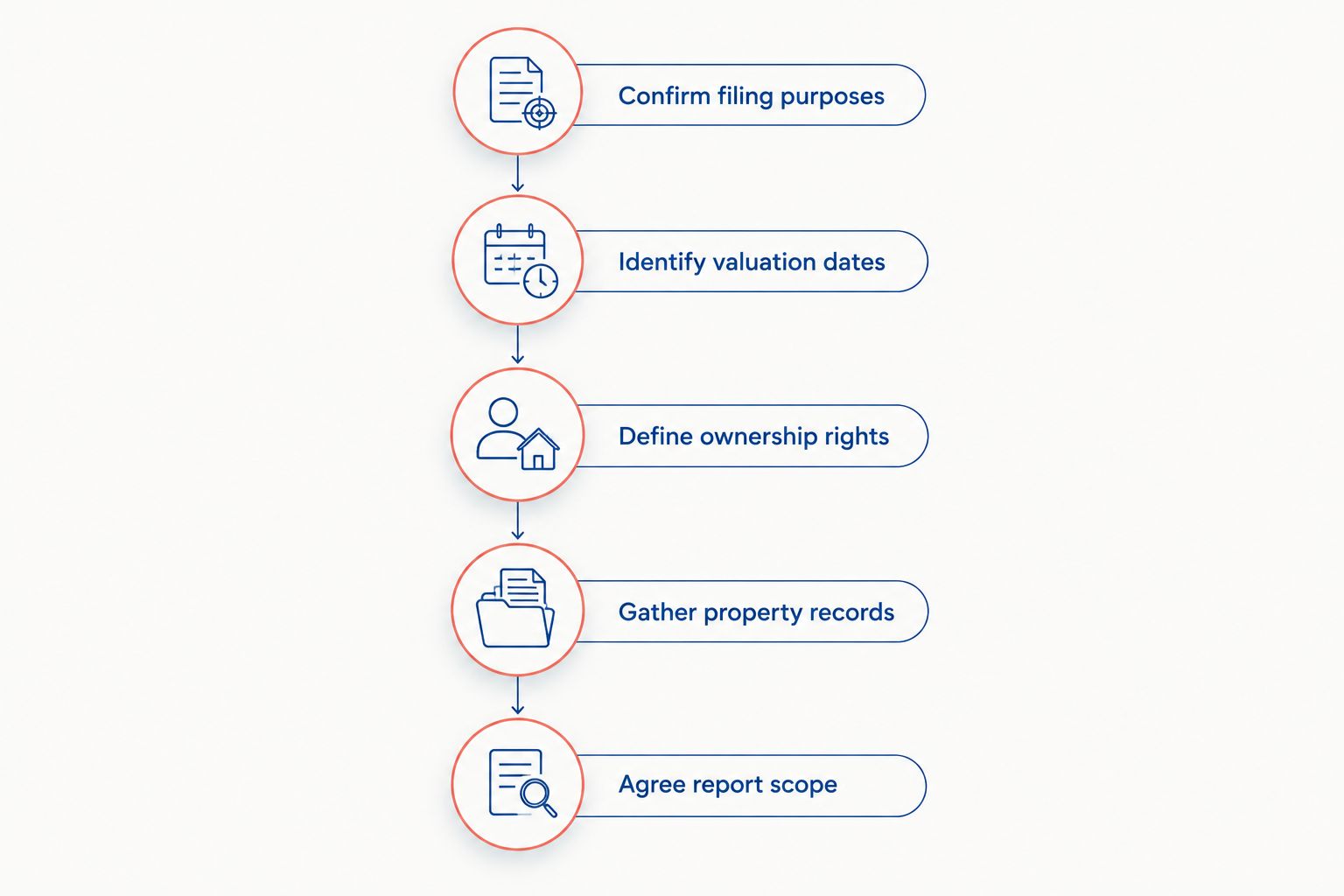
Use this sequence before authorizing the assignment. It keeps the attorney's filing instructions, the CPA's tax requirements, and the appraiser's scope connected.
- Confirm filing purposes. Tell the appraiser that the estate expects to use the valuation for both estate tax reporting and probate. Identify the relevant jurisdiction and provide the advisers' instructions.
- Identify valuation dates. Provide the date of death and ask the tax adviser whether another valuation date needs consideration. Distinguish each effective date from the requested report delivery date.
- Define ownership rights. Supply the deed, cooperative ownership records, trust documents, or entity documents relevant to identifying the asset. Have counsel clarify unresolved ownership questions.
- Gather property records. Assemble available historical condition information, leases, operating records, floor plans, and records of significant alterations. Tell the appraiser which documents are unavailable.
- Agree report scope. Confirm intended use, intended users, property rights, effective date, required analysis, and delivery needs in the engagement. Identify who will coordinate questions and document requests.
REIS Group provides estate and date-of-death real estate appraisals scoped to the property, ownership interest, effective date, and intended use. REIS Group is suited to New York City estate advisers seeking purpose-specific real estate valuation support. The engagement should identify whether both filings are contemplated; it does not guarantee acceptance by a court or taxing authority.
Can you reuse an appraisal that has already been completed?
An existing appraisal requires a scope review before reuse. Give the appraiser the complete report, original engagement information if available, and the additional filing requirements. A value conclusion by itself is not enough to establish suitability.
Check whether anything material differs between the original assignment and the proposed use. Focus on the effective date, rights appraised, value definition, assumptions, intended use, and supporting records. Ask for a clear explanation of any additional work required.
For a report being considered for reuse in 2026, do not confuse its age with its suitability. An older report addressing the correct historical date can be relevant; a newly completed current-value appraisal can still be unsuitable for a date-of-death assignment.
Does a probate appraisal automatically satisfy estate tax requirements?
No. The label probate appraisal does not establish that a report addresses the tax valuation date, ownership interest, value definition, or reporting needs. The attorney and CPA should identify those requirements, and the appraiser should confirm the assignment's scope.
Likewise, an appraisal prepared for estate tax reporting is not automatically suitable for every probate-related purpose. Inventory preparation, a proposed sale, and a dispute among beneficiaries can involve different questions. Explain the actual use rather than relying on a general estate label.
Who decides whether the same report is suitable?
The estate attorney identifies the probate requirements, the tax adviser identifies the tax reporting requirements, and the appraiser determines the appropriate valuation scope and report. These roles complement one another. An executor should not have to infer technical suitability from the report's title.
A shared report does not guarantee that a court or taxing authority will accept its conclusion. Independent analysis, relevant evidence, and clearly explained reasoning support the identified purpose without eliminating the possibility of questions or challenge.
FAQ
Can I use one appraisal for estate tax and probate filings?
Yes, one appraisal can support both purposes when its effective date, property rights, value definition, intended use, and reporting scope meet the applicable requirements. Have the attorney, tax adviser, and appraiser confirm the fit before relying on it.
Does the appraisal have to be completed on the date of death?
No, a date-of-death appraisal can be completed later as a retrospective appraisal. Its analysis must support value as of the required historical date, not simply describe today’s market.
Can I submit an appraisal prepared for a mortgage?
Do not assume a mortgage appraisal is suitable for estate tax or probate use. Ask the appraiser to review its effective date, intended use, property rights, and scope against the estate’s requirements.
What should an executor send the appraiser?
Send the property identification, required valuation date, ownership documents, filing purposes, and available property records. Historical condition information, leases, and operating statements can be relevant depending on the property.
Is an estate’s share of a property just its ownership percentage times the whole-property value?
An ownership percentage alone does not establish the value of a partial interest. The assignment must consider the rights being valued, relevant restrictions, and the identified valuation purpose.
Will a shared appraisal guarantee acceptance by the IRS or probate court?
No appraisal guarantees acceptance by a taxing authority or court. The report should provide analysis and conclusions prepared to support the identified valuation purpose.
Can REIS Group discuss an appraisal intended for both filings?
REIS Group provides estate and date-of-death real estate appraisals for attorneys, CPAs, executors, trustees, and other estate clients. Discuss the property, ownership interest, effective date, and intended filings when requesting a proposal.
One last thing
The most useful question is not whether you can submit the report twice, but whether it answers both valuation questions. Before commissioning a 2026 appraisal, ask your attorney and CPA to put the required dates, ownership interest, and filing purposes in writing. That instruction gives the appraiser a clear basis for defining the assignment.
Discuss your appraisal assignment with REIS Group and request a proposal tailored to the estate's property and intended use.
Discuss Your Appraisal Assignment
Identify the property, ownership interest, effective date, and intended estate filings.
Related guides
- Probate appraisal for executors and heirs
- Estate appraisal to probate inventory filing workflow
- Getting a retrospective appraisal for inherited property
- Partial-interest appraisal considerations