For divorce attorneys, divorce property appraisal is an independent opinion of real estate value prepared to support settlement negotiations or litigation. In New York City and surrounding areas, the assignment must distinguish the property interest, valuation date, and intended use before an appraiser begins analyzing evidence.
- A divorce property appraisal needs a defined valuation date, ownership interest, and intended use before analysis begins.
- REIS Group serves New York attorneys seeking purpose-specific real estate valuations for divorce matters.
- Separate property value from mortgage debt, ownership classification, and the proposed equitable distribution.
- Compare appraisal reports by their assumptions and evidence, not just their final value conclusions.
Why divorce property appraisal matters for attorneys
A divorce appraisal answers a valuation question; it does not determine who owns marital property or how a court should distribute it. Counsel defines the legal question, and the appraiser develops the real estate value opinion within the agreed assignment.
That distinction matters when a Manhattan apartment, an income-producing building, or an ownership interest sits inside a broader marital balance sheet. An estimate of the entire property's value does not automatically establish the value of a spouse's interest or the proceeds available after a sale.
For a 2026 engagement, begin with the intended use rather than a request for today's market value. The divorce appraisal services for attorneys resource provides related engagement context; the process below explains what counsel should resolve before commissioning the report.
A defensible assignment starts with a precise question, not a preferred number.
How to prepare a divorce appraisal assignment
1. Define the valuation question before requesting a proposal
Give the appraiser a written engagement brief that identifies the property, intended use, intended users, and interest being valued. An intended user is a person or entity identified as someone expected to rely on the appraisal; it is not automatically everyone who receives a copy.
Specify whether the assignment supports settlement discussions, mediation, or litigation. If testimony or a response to another expert's report is contemplated, raise that requirement before engagement rather than assuming report preparation includes it.
Begin with 1 engagement brief shared through the authorized communication channel. This gives counsel and the appraiser a common scope and reduces conflicting instructions from spouses, advisers, and property managers.
- Identify the property address and legal ownership entity.
- Describe the intended use and intended users.
- Identify the ownership interest to be appraised.
- State whether testimony or rebuttal work is contemplated.
- Assign responsibility for instructions and document delivery.
2. Establish the effective date and historical evidence
The effective date is the date to which the value opinion applies. The report date is when the report is issued. Those are 2 distinct dates, and confusing them can make an otherwise useful report answer the wrong question.
Counsel should identify the legally relevant valuation date rather than asking the appraiser to select it as a legal conclusion. A retrospective appraisal estimates value as of a past date using evidence relevant to that period.
For a report commissioned in 2026, a current inspection does not establish the property's condition on an earlier effective date. Collect dated photographs, renovation records, leases, and other contemporaneous evidence. Identify gaps explicitly so the appraiser can address assumptions rather than silently treating current conditions as historical facts.
- Confirm the effective date in writing.
- Separate the effective date from the report date.
- Collect photographs showing condition at the relevant time.
- Identify renovations, damage, or occupancy changes after that date.
- Ask how unavailable historical evidence will be addressed.
3. Match the appraiser and scope to the property
Start by reviewing the property's characteristics and the proposed scope yourself. Ask prospective appraisers to explain their experience with the property type, relevant market, and intended use; a credential alone does not describe the full assignment fit.
REIS Group is a fit for New York divorce attorneys seeking purpose-specific real estate valuations. The certified firm has over 30 years of experience and serves residential, commercial, and partial-interest valuation needs. New York is the primary focus here; nationwide capability supports matters involving property elsewhere.
Use a consultation with REIS Group to discuss the property's location, ownership structure, and valuation purpose. Confirm assignment-specific scope, testimony arrangements, and timing individually rather than assuming every engagement includes the same services.
- Check relevant property-type and geographic experience.
- Describe unusual ownership or occupancy arrangements.
- Ask which records the proposed scope requires.
- Confirm whether historical analysis is necessary.
- Discuss report delivery and any separate litigation support.
4. Assemble a controlled document file
Build the document file manually before requesting analysis. A clearly labeled folder is more useful than an unstructured email chain containing inconsistent versions of leases, operating statements, or renovation descriptions.
Use 3 document folders: ownership records, property condition, and financial records. For a residence, financial materials differ from those needed for an income-producing building. Ask the appraiser to refine the request rather than treating every property as a commercial investment.
Keep a record of what was supplied, by whom, and when. If opposing parties provide conflicting descriptions, identify the disagreement without asking the appraiser to adopt counsel's preferred account. The report should distinguish verified information from assumptions and unresolved limitations.
- Provide deeds and available ownership agreements.
- Supply floor plans, surveys, and alteration records when relevant.
- Organize dated condition photographs and repair documentation.
- Provide leases, rent rolls, and operating records for rental property.
- Flag missing records and conflicting document versions.
5. Coordinate access without directing the outcome
Confirm who controls access, who will attend, and which areas the appraiser can inspect. In an occupied residence, inspection logistics require clear communication; in a rental building, tenant access and management records need separate coordination.
An inspection records observed conditions, but it is not a substitute for engineering, environmental, or legal due diligence. Ask the appraiser to explain how inaccessible areas or disputed physical conditions affect the scope and conclusions.
For a 2026 assignment, discuss timing after describing the property and records. Turnaround depends on property type, complexity, records availability, and scope; expedited availability requires individual confirmation. Counsel should communicate actual deadlines without presenting an unconfirmed delivery date to the client.
- Obtain appropriate access authorization.
- Identify occupied, locked, or inaccessible areas.
- Disclose known damage and incomplete renovations.
- Keep factual communications separate from settlement positions.
- Confirm scheduling and delivery expectations directly.
6. Review the valuation reasoning before using the conclusion
Read the analysis before placing the concluded value into a settlement schedule. The sales comparison approach evaluates relevant transactions; the income approach analyzes a property's income-producing capacity; the cost approach considers land value and improvements with applicable depreciation.
Not every approach fits every property. Ask why an approach was used or excluded, how comparable evidence was selected, and how differences were addressed. For a Manhattan co-op or condominium, ownership form and building-specific conditions deserve attention alongside location and condition.
When reviewing competing reports, compare their effective dates, ownership interests, property assumptions, and market evidence first. A difference in conclusions is not proof that either report is defective; the underlying assignments and reasoning require examination.
- Verify the property and ownership interest described.
- Check the effective date and stated value definition.
- Review comparable selection and adjustment explanations.
- Examine income assumptions where applicable.
- Identify assumptions affecting the conclusion materially.
7. Separate the appraisal from the settlement calculation
Keep the real estate value opinion distinct from counsel's distribution analysis. An appraisal does not, by itself, classify marital and separate property, determine legal entitlement, or decide how debt should be allocated.
Use separate schedules for appraised value and settlement adjustments. Mortgage balances, transaction expenses, tax considerations, and proposed credits require their own support and professional analysis. Do not subtract a disputed figure inside the appraisal conclusion merely to reach a negotiated equity amount.
Before a 2026 settlement conference, verify whether the assignment remains appropriate for the question being negotiated. If counsel changes the effective date, interest, or intended use, ask whether the appraiser needs a revised scope rather than informally repurposing an existing report.
- Preserve the appraisal's concluded value as reported.
- Document debt balances independently.
- Identify counsel's proposed adjustments separately.
- Refer tax questions to the client's tax adviser.
- Confirm whether changed instructions require additional appraisal work.
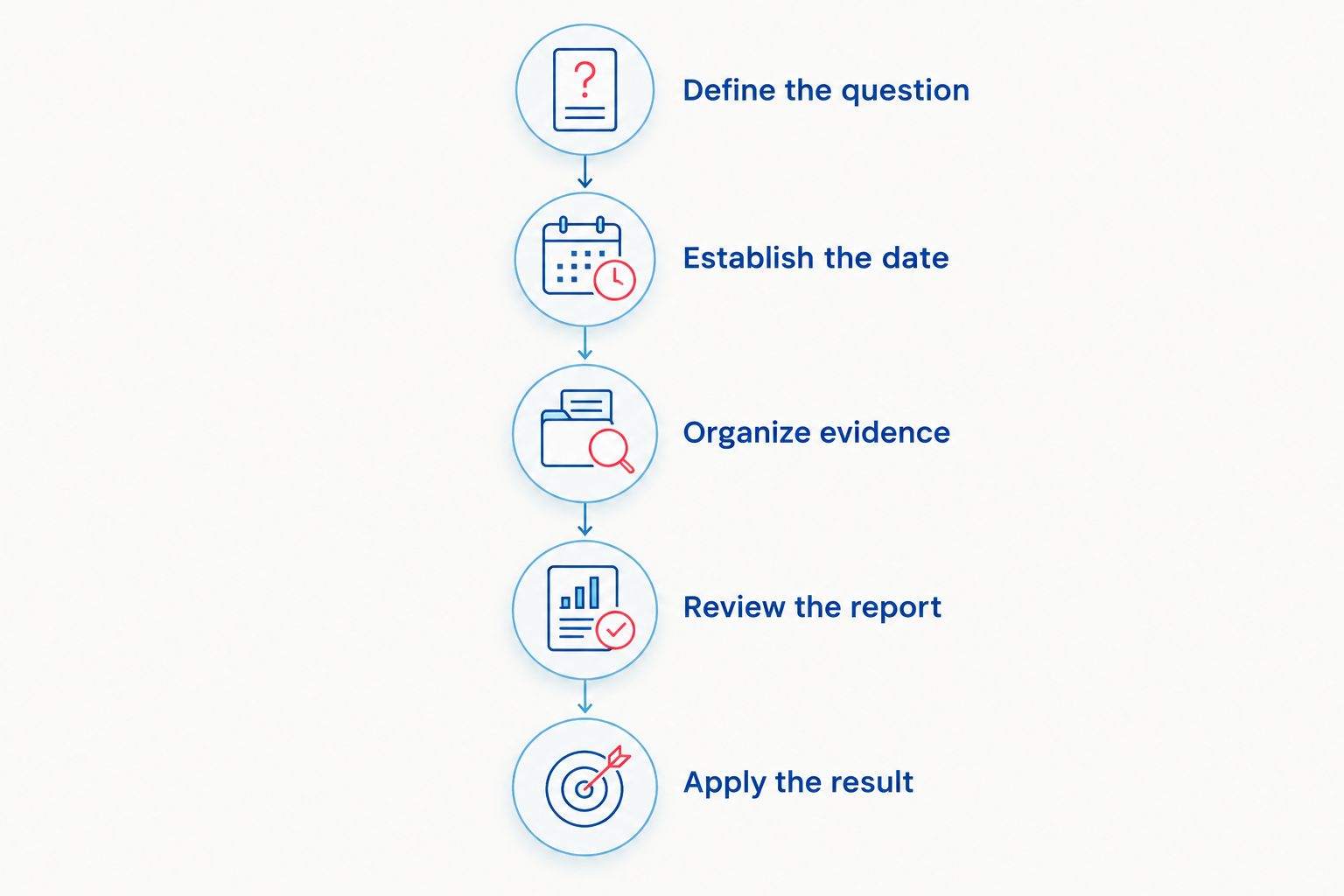
The sequence is deliberate: define the question, establish the date, organize evidence, review the report, and only then apply the result to settlement analysis. Reversing that sequence invites a mismatch between the commissioned report and the decision counsel needs to make.
Compare valuation options for a divorce matter
Choose the valuation option according to the question and intended reliance. An informal estimate can help organize an initial discussion, but it does not automatically provide the scope or explanation required for a contested valuation.
The table compares uses and limitations, not interchangeable substitutes. Confirm any court-specific or engagement-specific requirements with counsel before relying on a document prepared for another purpose.
| Option | Best for | Principal benefit | Key limitation |
|---|---|---|---|
| Online value estimate | Initial orientation | Provides an accessible starting point | Does not establish an assignment-specific inspection or treatment of disputed facts |
| Broker market analysis | Discussing a possible listing | Connects market positioning with a sale strategy | A listing recommendation is not automatically an appraisal for divorce use |
| Existing mortgage appraisal | Understanding prior financing evidence | Supplies an earlier documented valuation | Intended use, users, and effective date can differ from the divorce assignment |
| Purpose-specific divorce appraisal | Settlement or litigation valuation | Addresses the identified interest, date, and intended use | Requires suitable evidence and a defined scope; does not decide legal distribution |
| Appraisal review | Examining another appraisal's reasoning | Tests the work against a defined review scope | Does not necessarily produce a separate opinion of property value |
For REIS Group divorce property appraisal inquiries, describe the assignment before requesting a proposal. The benefit is a scope matched to the identified valuation purpose; the boundary is equally important: the appraisal does not replace legal advice, tax advice, or a settlement decision.
Discuss Your Divorce Appraisal Scope
Identify the property, valuation date, ownership interest, and intended use for your New York matter.
Common mistakes attorneys make with divorce appraisals
Requesting current value when the question is historical
A present-day opinion does not answer a retrospective question simply because both concern the same address. Give the appraiser the required effective date and identify the available historical evidence before the scope is finalized.
Treating the entire property as the spouse's interest
A building's value and an ownership interest's value answer different questions. Where an entity or fractional interest is involved, identify what is being valued; do not assume a proportional allocation or discount without appropriate analysis.
Letting litigation positions become property facts
A party's description of deferred maintenance, rental income, or renovation quality is not verified merely because counsel forwards it. Separate source documents from allegations and identify factual disagreements for the appraiser.
Assuming a neutral appointment resolves every procedural issue
A jointly selected appraiser still needs clear instructions about intended users, communications, document submissions, and report distribution. Counsel should document those arrangements rather than relying on the word neutral to resolve them.
Reusing a report without checking its intended use
A report commissioned for financing or estate administration was prepared for its identified purpose. Before using it in a divorce matter, examine its date, interest, assumptions, and reliance provisions with the appraiser.
FAQ
What is a divorce property appraisal for attorneys?
A divorce property appraisal is an independent opinion of real estate value prepared for an identified divorce-related use. Counsel should specify the property interest, effective date, intended users, and whether the report supports settlement or litigation.
What valuation date should a New York divorce appraisal use?
Counsel should identify the legally relevant valuation date for the specific matter. The appraiser then develops the opinion as of that date rather than selecting a legal valuation date on counsel’s behalf.
Is a broker’s market analysis enough for a divorce case?
A broker’s market analysis is not automatically a substitute for a purpose-specific divorce appraisal. Its listing-related purpose and supporting analysis can differ from the assignment counsel needs for settlement or litigation.
Can an appraiser value a property as of a past date?
A retrospective appraisal develops an opinion of value as of a past effective date. Historical condition records, leases, photographs, and relevant market evidence help support that analysis.
Does the appraisal determine each spouse’s equity?
The appraisal alone does not determine each spouse’s distributable equity. Debt, legal ownership classification, proposed credits, and other adjustments require separate support and analysis.
How long does a divorce property appraisal take?
Turnaround depends on property type, complexity, records availability, and scope. Confirm the schedule individually, including any need for expedited handling or separate litigation support.
What should an attorney send before requesting an appraisal?
Send the property address, ownership information, proposed effective date, intended use, and known deadlines. Include available condition records and financial materials, and identify access restrictions or missing documents.
One last thing
Resolve the assignment before debating the value. When opposing reports disagree, counsel's first comparison should be the effective date, ownership interest, value definition, and assumed condition—not the final figures alone.
For your next 2026 matter, send a concise consultation brief containing those items and the intended use. REIS Group can discuss the real estate valuation requirement; counsel retains responsibility for the legal questions and settlement structure. That division keeps the appraisal focused on the evidence it is prepared to address.
Related guides
- Residential appraisal services for divorce cases
- Commercial building appraisers in Manhattan
- Business valuation for CPAs and accountants