Yes. You can obtain a date of death appraisal years later through a retrospective appraisal that estimates the property's value as of the date of death, rather than its value today. The practical limitation is whether historical market evidence, property records, and information about the ownership interest support a credible conclusion—not simply how much time has passed.
- A date of death appraisal years later requires historical property evidence and market analysis tied to the effective date.
- REIS Group provides retrospective real estate appraisals for estate attorneys, CPAs, executors, and trustees.
- A current inspection documents present conditions; it does not establish the property’s condition at death.
- Confirm the valuation date, property rights, and intended use with the estate’s advisers before commissioning the report.
Can a date of death appraisal be completed years after the death?
Yes—the report can be prepared now while its effective date of value remains the date of death. An executor commissioning an appraisal in 2026 should distinguish when the appraiser prepares the report from when the property's value is being measured.
For estate-tax assignments, coordinate the scope with the attorney or CPA responsible for the filing. The date-of-death appraisal to IRS Form 706 workflow explains that connection between valuation and the estate's reporting process.
The central distinction is historical value versus current value:
| Assignment | Best for | What it establishes | Main limitation |
|---|---|---|---|
| Retrospective date-of-death appraisal | Executors and advisers documenting real estate value at death | Value of the identified property interest on the historical effective date | Requires support for historical conditions and market evidence |
| Current-value appraisal | Owners and advisers who need present-day value | Value of the identified property interest on a current effective date | Does not answer the date-of-death question |
These are different assignments, not interchangeable reports. A detailed current appraisal still answers the wrong question if the estate needs a historical valuation.
Why this matters for an executor
Discovering a missing appraisal does not mean you should substitute today's assessment, an online estimate, or a later sale price. Each reflects a different source, purpose, or point in time, and none automatically establishes fair market value at death.
For an estate file being assembled in 2026, begin with the question the valuation must answer. An estate-tax filing, an inherited property's basis documentation, and a dispute among beneficiaries can involve related facts but different intended uses and users.
Ask the estate's attorney or CPA to identify the applicable reporting requirement and valuation date. The appraisal supports a defined valuation purpose; it does not determine filing obligations or guarantee acceptance by a taxing authority or court.
Keep 3 dates separate
A retrospective assignment involves 3 dates that serve different purposes:
- Effective date: The date for which the appraiser develops the value opinion, ordinarily the date of death for this assignment.
- Inspection date: The date the appraiser observes the property, if the scope includes an inspection.
- Report date: The date the appraisal report is issued.
An inspection and report completed in 2026 can support an earlier effective date. The report must explain the historical analysis rather than present current observations as though they describe the property at death.
How do you arrange a retrospective appraisal?
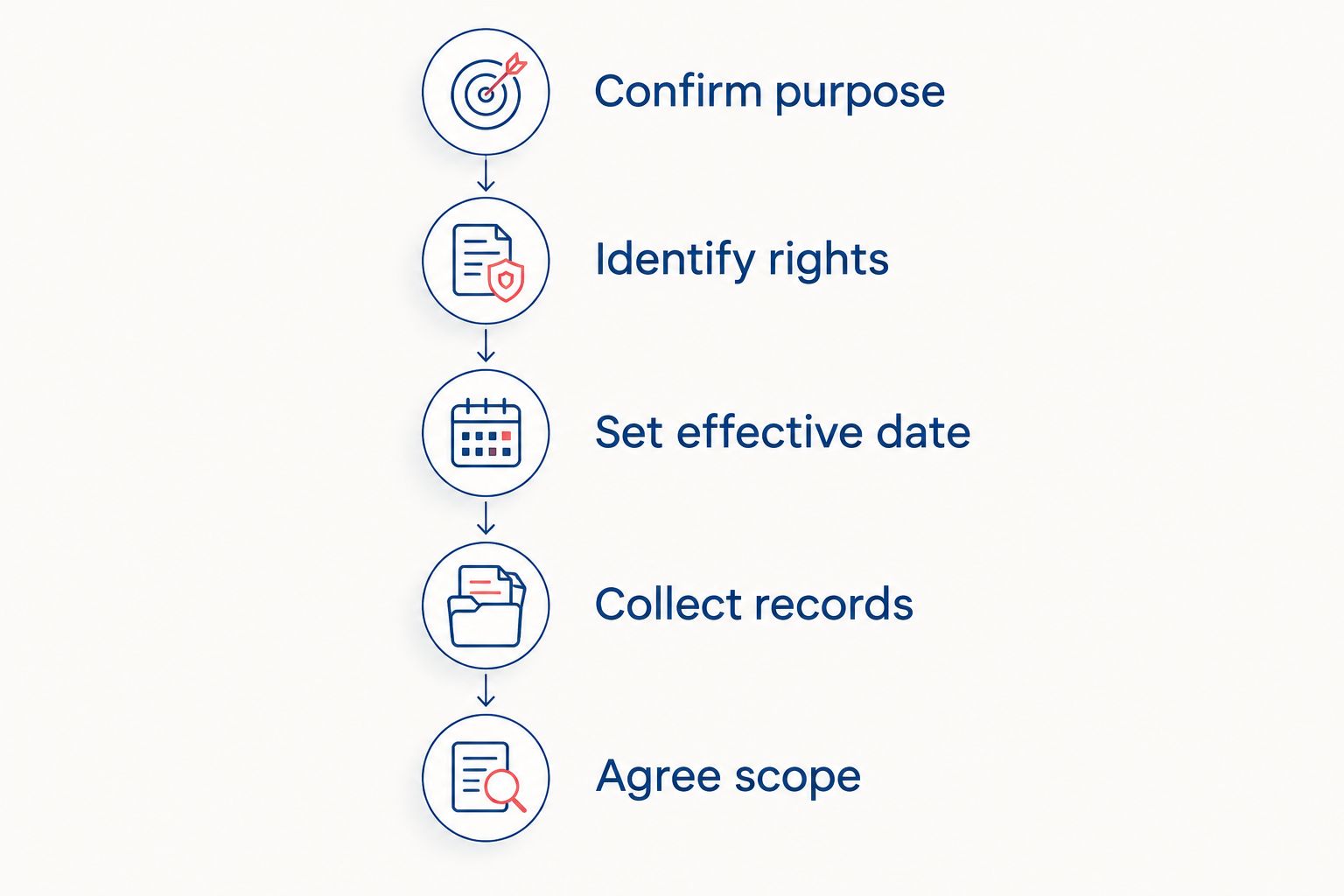
Use these 5 steps to prepare the assignment. The goal is to establish what must be valued before anyone starts collecting comparable sales or inspecting the property.
- Confirm purpose. Tell the appraiser why the report is needed and who will use it. Identify the attorney, CPA, executor, trustee, or other intended user involved in the assignment.
- Identify rights. Provide ownership documents and explain whether the assignment concerns the entire property or a partial ownership interest. Do not assume a percentage interest is simply the same percentage of the whole property's value.
- Set effective date. Supply the date of death and ask the responsible adviser to confirm the required valuation date. Do not change dates to match the records that are easiest to obtain.
- Collect records. Gather historical photographs, leases, financial records, plans, prior reports, and documentation of changes. Separate records describing conditions at death from records describing later events.
- Agree scope. Confirm the property, interest, effective date, intended users, intended use, and report requirements before engagement. Identify known evidence gaps and any submission deadline at this stage.
For Manhattan and greater New York City properties, identify the property type at the outset: cooperative apartment, condominium, townhouse, multifamily building, or another income-producing property. The records and analysis needed for each are not identical.
REIS Group's date-of-death appraisal services suit New York City estate advisers and fiduciaries who need a clearly scoped retrospective real estate valuation. The firm has over 30 years of experience; the appropriate next step is an assignment discussion, not a promise about the final value or delivery date.
What records help establish the property's condition at death?
Dated evidence is more useful than an unsupported recollection. Give the appraiser original records where available, identify their source, and explain what period they describe.
For a residential property, collect:
- Photographs showing interior and exterior condition near the effective date.
- Floor plans, property descriptions, and records of the property's size and configuration.
- Renovation invoices, permits, contracts, and records identifying when work occurred.
- Prior appraisal reports, inspection reports, and listing materials, if available.
- Documents concerning ownership, occupancy, restrictions, or other relevant property rights.
For an income-producing property, also gather historical leases, rent rolls, operating statements, and information about vacancy or concessions. Records should relate to the relevant period; current income figures do not automatically describe historical operations.
An executor organizing documents in 2026 should create separate folders for conditions at death and subsequent changes. If a renovation happened later, label it clearly so the appraiser does not attribute that improvement to the earlier property.
What if you cannot find every document?
Missing records do not automatically prevent an appraisal, but they affect the scope and strength of the available support. Tell the appraiser what is missing before engagement rather than presenting an incomplete file as complete.
The appraiser evaluates available evidence and determines whether a credible opinion can be developed. Any necessary assumptions and limitations need clear treatment in the report; they are not a substitute for evidence that contradicts the proposed historical condition.
Why retrospective appraisal work varies
The passage of time matters because it changes the evidence available—not because elapsed years alone establish whether an assignment is possible. These factors shape the work:
- Historical property condition: Substantial renovations, damage, conversions, or demolition require a clear distinction between past and present conditions.
- Comparable market evidence: Historical transactions need sufficient detail to assess their relevance to the property and effective date.
- Property type: A cooperative apartment, townhouse, mixed-use building, and office property require different records and analysis.
- Ownership interest: Appraising a partial interest requires a scope that addresses the specific rights being valued.
- Records availability: Missing leases, operating statements, plans, or condition evidence can require additional research.
- Intended use: The report must address the identified estate, tax, trust, or dispute-related purpose and its intended users.
There is no responsible fixed turnaround promise based solely on the fact that a request arrives in 2026. Timing depends on property type, complexity, records availability, and scope; expedited availability must be confirmed individually.
The benefit of a retrospective appraisal is that it directly addresses the historical valuation question. Its limitation is equally important: the conclusion depends on evidence that supports the property and market conditions at the effective date.
Does a current inspection establish the date-of-death value?
A current inspection does not, by itself, establish date-of-death value. It documents what the appraiser can observe now, while historical records help establish what existed at the earlier effective date.
A renovated apartment illustrates the distinction without requiring an assumed value. The appraiser must distinguish the apartment's condition at death from improvements completed afterward; today's finishes cannot simply be treated as historical facts.
The reverse also matters. Deferred maintenance observed now does not prove that the same condition existed at death, so provide dated evidence of when deterioration or damage occurred.
Can you use a later sale price instead?
A later sale price is evidence to evaluate, not an automatic date-of-death value. The appraiser considers the transaction's timing, terms, property condition, and market context before deciding how it informs the historical analysis.
A sale after renovation raises a different question from a sale of an unchanged property. Likewise, a transaction involving unusual terms requires analysis before its price can support a fair market value conclusion.
Give the appraiser the contract and closing information if a sale occurred. Ask the estate's adviser how the resulting appraisal will be used; do not assume the sale eliminates the need for historical valuation documentation.
What should you confirm before engaging an appraiser?
Ask whether the proposed assignment addresses the historical effective date, relevant property type, and specific ownership interest. Also confirm which records the appraiser needs and how known gaps will affect the work.
For a broader explanation of responsibilities, the date-of-death appraisal guide for New York executors and attorneys provides related preparation context.
REIS Group provides independent retrospective real estate appraisal services, with reports tailored to the property interest, effective date, and intended use. Its Manhattan and greater New York City focus is relevant to local estate assignments; nationwide assignments are coordinated through its professional network.
Discuss Your Appraisal Assignment
Identify the property, historical valuation date, ownership interest, and intended use before requesting a proposal.
FAQ
Can I get a date of death appraisal years later?
Yes, a date-of-death appraisal can be prepared years later as a retrospective appraisal. The appraiser needs sufficient evidence to support the property’s condition, relevant ownership rights, and market value at the historical effective date.
Is there a maximum number of years after death for an appraisal?
Elapsed time alone does not establish whether a credible retrospective appraisal can be completed. Historical evidence determines appraisal feasibility, while any filing or legal deadline must be confirmed separately with the estate’s attorney or CPA.
Does an appraisal prepared now use today’s property value?
No, a retrospective date-of-death appraisal develops value as of the historical effective date. The inspection date and report date can be current without changing the valuation date.
What if the inherited property has been renovated?
The appraisal must address the property’s condition at the historical effective date, not simply its renovated condition today. Provide dated photographs, contracts, invoices, permits, and other evidence distinguishing earlier conditions from later work.
Can the property’s tax assessment replace a retrospective appraisal?
A property tax assessment is not automatically a substitute for a retrospective appraisal. Its valuation date, purpose, methods, and property information need to be distinguished from the estate’s required valuation assignment.
Will a retrospective appraisal guarantee IRS acceptance?
No appraisal guarantees IRS acceptance or a particular tax outcome. A report should clearly support its conclusions and address the identified intended use, with tax treatment and filing requirements handled by the estate’s advisers.
What should I send when requesting an appraisal proposal?
Send the property address, date of death, intended use, ownership information, known property changes, and available historical records. Identify the responsible attorney or CPA and any relevant deadline so the appraiser can assess scope and timing.
One last thing
Preserve the evidence before trying to reconstruct the value. Photographs on an old phone, a prior managing agent's rent roll, or renovation records held by a family member can help establish facts that a current inspection cannot show.
If you are organizing the estate in 2026, start with a document inventory and record who supplied each item. Then discuss the assignment with REIS Group so the proposal addresses the actual property interest, historical date, and reporting purpose.
Related guides
- How long does a retrospective appraisal take?
- Probate appraisal guidance for executors and heirs
- How much does a partial-interest appraisal cost?