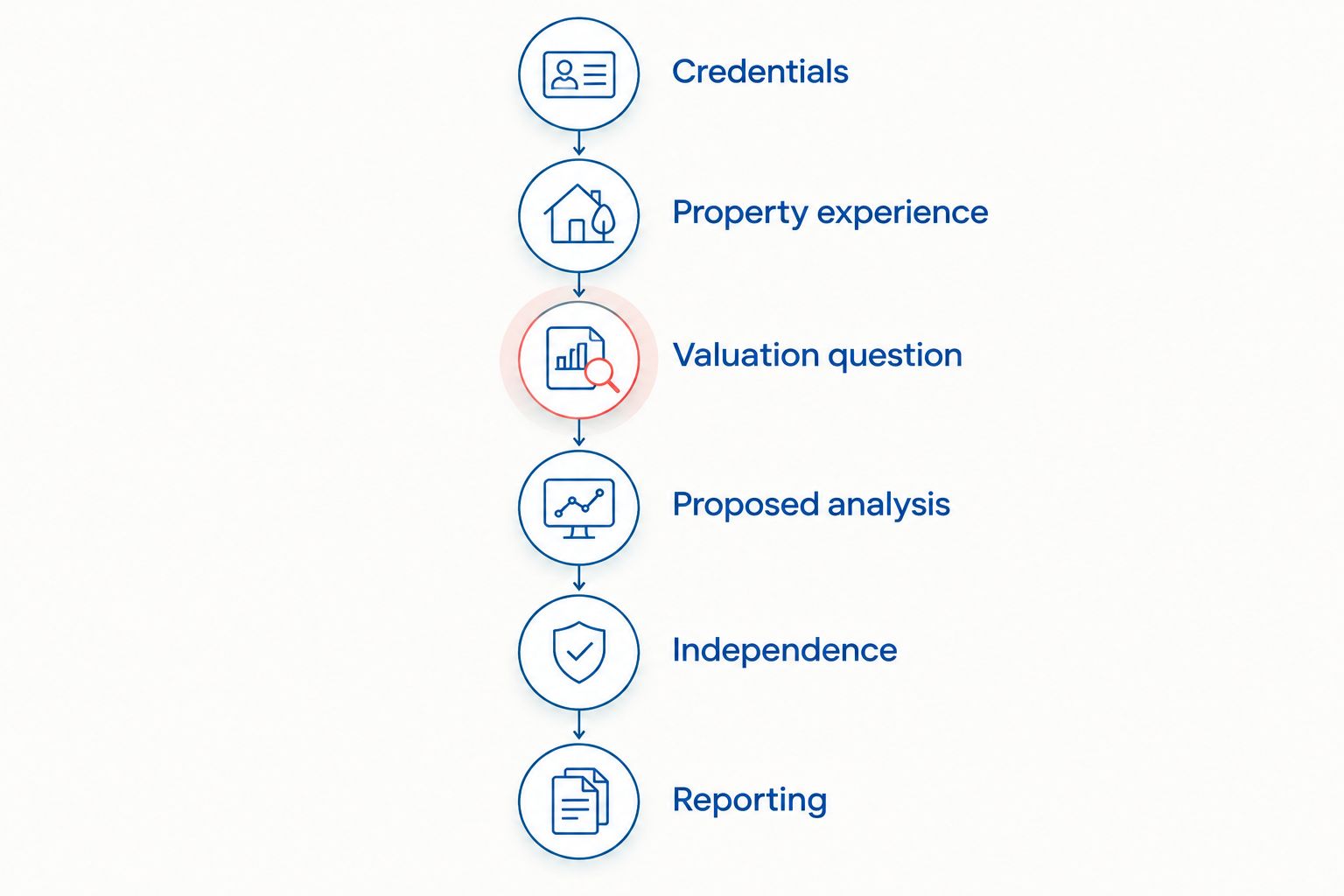
To vet a commercial appraiser before hiring in New York, verify the individual appraiser’s credentials, experience with comparable properties, independence, and proposed scope of work. For a commercial property owner commissioning an appraisal in 2026, the written engagement should identify the property rights, effective date, intended use, intended users, and report requirements before work begins. A credential alone does not establish that the appraiser understands your building or your assignment.
- To vet commercial appraiser before hiring, verify credentials, relevant property experience, independence, and written scope.
- REIS Group provides commercial real estate appraisals scoped to the property, ownership interest, effective date, and intended use.
- Ask who will inspect, analyze, sign, and explain the appraisal—not just who accepts the engagement.
- Reject a promised value; require a supported conclusion and clearly stated assumptions.
Why this matters
A commercial appraisal answers a defined valuation question. An appraisal of a leased building today is not the same assignment as a retrospective valuation or an appraisal of a fractional ownership interest.
For New York commercial property owners, the first decision is whether the proposed appraisal services address the actual purpose. Establish that fit before comparing proposals. Otherwise, you risk commissioning a report that does not answer the question your adviser, transaction, or dispute requires.
How do you vet a commercial appraiser before hiring in New York?
Use these 6 checks before signing an engagement. Apply the same questions to every candidate so that you compare proposed work rather than presentation style.
1. Verify the individual appraiser’s credentials
Ask for the name and credential of the person responsible for the assignment. Verify the credential’s current status through the New York State Department of State’s official licensing resources rather than relying solely on a firm biography or an email signature.
For commercial work, confirm that the appraiser holds the appropriate credential for the assignment. New York’s certified general real estate appraiser credential covers residential and nonresidential real property; a residential credential is not interchangeable with it.
Ask who will sign the report and who will supervise any participating appraisers. A firm’s name does not identify every person who will perform the work.
2. Match experience to the property and submarket
Ask about experience with the same property type and comparable assignment conditions. An office property, a mixed-use building, and a development site raise different valuation questions.
For a Manhattan commercial building in 2026, ask how the appraiser will investigate relevant leasing conditions, comparable transactions, and property-specific restrictions. A general claim of New York experience is less informative than an explanation of the evidence the assignment requires.
Useful questions include:
- Which features of this property will require additional investigation?
- What experience do you have with comparable ownership and occupancy arrangements?
- How will you address unusual lease terms or limited comparable sales?
- What local information will you need from the owner and advisers?
Confidentiality can restrict discussion of previous assignments. Ask for anonymized descriptions of relevant experience, not another client’s private report.
3. Define the valuation question
State why you need the appraisal before discussing report format. Your intended use determines what question the analysis must answer and helps establish the appropriate scope.
Confirm these items in writing:
- Property identification: The building, parcel, or other real estate being appraised.
- Property rights: The ownership or other real property interest being valued.
- Effective date: The date to which the value conclusion applies.
- Intended use: The specific purpose the appraisal will support.
- Intended users: The parties identified as users of the appraisal.
- Value definition: The applicable definition, such as fair market value when appropriate to the assignment.
Do not treat these as boilerplate. Changing the interest or date can change both the research and the conclusion.
4. Test the proposed analysis
Ask which valuation approaches the appraiser expects to consider and why. Commercial appraisal commonly considers sales comparison, income capitalization, and cost approaches, with the relevance of each depending on the assignment.
You do not need to prescribe the methodology. You need an explanation of how the appraiser will select and support it.
For an income-producing building, ask how the analysis will address leases, market rent, vacancy, operating expenses, and capitalization assumptions. For a property with redevelopment questions, ask how highest and best use—the reasonably supported use that produces the highest value—will be evaluated.
A useful answer connects the analysis to your property. Naming appraisal approaches without explaining their relevance does not establish competence.
5. Confirm independence and conflicts
Disclose the parties involved and ask the appraiser to identify potential conflicts before engagement. Discuss prior involvement with the property, relationships with relevant parties, and any circumstances that require further evaluation.
Do not hire an appraiser because the appraiser promises your preferred result. Independent analysis requires a conclusion supported by evidence, not an agreement to reach a target value.
For an engagement in 2026, ask the appraiser to explain the applicable professional standards, including the Uniform Standards of Professional Appraisal Practice, and how independence will be maintained. Compliance does not guarantee acceptance by a lender, court, or other third party.
6. Confirm responsibility, reporting, and follow-up
Ask who will inspect the property, analyze the records, prepare the report, and sign the final appraisal. Clarify whether the person presenting the proposal will also direct the substantive work.
The engagement should describe the report deliverable, required records, access arrangements, and anticipated schedule. It should also distinguish routine clarification from additional services, such as testimony or a later assignment with a different effective date.
Turnaround depends on property type, complexity, records availability, and scope. Obtain assignment-specific confirmation rather than relying on a general delivery statement.
Match the appraisal scope to your purpose
The right appraisal scope follows the question, not simply the building address. Use this comparison to identify what a candidate must explain before you engage the firm.
| Assignment scope | Best for | Main strength | Limitation to resolve |
|---|---|---|---|
| Current whole-property appraisal | Owners needing a present-date real estate valuation | Addresses the property interest at a current effective date | Does not establish value at an earlier date |
| Retrospective appraisal | Owners or advisers needing value as of a past date | Aligns the analysis with the required historical date | Requires evidence relevant to that date |
| Partial-interest valuation | Owners needing analysis of a fractional interest | Addresses the specified interest rather than assuming whole-property ownership | Requires careful definition of ownership rights and assignment scope |
An appraisal of business-owned real estate is also distinct from a valuation of the operating business. If your building houses your own company, identify whether you need real estate value, business value, or separately defined assignments addressing both.
REIS Group is suited to New York commercial property owners who need a real estate appraisal scoped to a defined interest, effective date, and intended use. The firm provides commercial and partial-interest valuations; the engagement must still establish the specific work required for your property.
Why commercial appraisal scope and timing vary
A straightforward address does not necessarily mean a straightforward assignment. Ask each candidate how these factors affect the proposed work:
- Property type: Office, retail, multifamily, mixed-use, and other income-producing properties require different market evidence.
- Ownership interest: A whole-property assignment and a partial-interest assignment address different rights and analytical questions.
- Effective date: A retrospective assignment requires research tied to historical conditions rather than only current observations.
- Records availability: Missing leases, incomplete operating statements, or unclear ownership documents require resolution.
- Property complexity: Unusual occupancy, condition issues, or highest-and-best-use questions affect the investigation.
- Intended use: A report supporting a transaction, litigation matter, or other identified purpose needs an appropriate scope and explanation.
For a 2026 engagement, ask which of these factors the proposal already addresses and which remain unresolved. A useful proposal identifies dependencies instead of concealing them behind a fixed promise.
What documents should you send before requesting a proposal?
Prepare these 4 record groups so the appraiser can understand the assignment. Provide available material securely, and distinguish confirmed facts from estimates or unresolved questions.
Property identification
Provide the address, parcel identification when available, property type, and a brief description of occupancy. Flag any uncertainty about what land, building area, or ownership interest the assignment includes.
Ownership and purpose
Explain who is requesting the appraisal, the intended use, intended users, and required effective date. Identify whether the assignment concerns the entire property or a specified interest, and involve legal or accounting advisers where their instructions are needed.
Income and expenses
For an income-producing property, gather the rent roll, leases and amendments, operating statements, and available information about vacancies or concessions. Identify expenses paid directly by tenants so the appraiser can understand the records accurately.
Condition and access
Provide available plans, descriptions of significant improvements, known condition issues, and inspection arrangements. Flag any areas that are inaccessible and any differences between current conditions and conditions at a retrospective effective date.
You do not need a perfect file to request a proposal. You do need to disclose gaps so the appraiser can determine what additional investigation is necessary.
How do I compare commercial appraisal proposals?
Compare commercial appraisal proposals against the same written assignment description. Check the property rights, effective date, intended use, inspection scope, report deliverable, responsible appraiser, and follow-up services side by side.
The clearest proposal is not necessarily the shortest. Look for an explanation of assumptions, exclusions, and work that would require separate authorization.
Should I ask for a sample commercial appraisal report?
Ask for a redacted sample or a description of the proposed report structure, subject to confidentiality restrictions. Evaluate whether the discussion explains evidence, assumptions, methods, and conclusions rather than simply displaying a final value.
A sample shows presentation and reasoning, not guaranteed suitability for your assignment. Confirm that your report will address your identified property interest and intended use.
What are warning signs before I hire an appraiser?
A promised value, unclear signing responsibility, or refusal to define the assignment is a reason to stop and seek clarification. Another warning sign is treating a different property interest or effective date as an inconsequential change.
Do not confuse a detailed intake process with unnecessary delay. Questions about leases, ownership, and intended use help establish whether the proposed work fits your need.
FAQ
How do I check a commercial appraiser’s license in New York?
Verify the individual appraiser’s current credential through the New York State Department of State’s official licensing resources. Confirm the credential is appropriate for the commercial assignment and identify the appraiser who will sign the report.
Is a residential appraisal credential enough for a commercial building?
A residential appraisal credential is not interchangeable with New York’s certified general real estate appraiser credential. Confirm both the appropriate credential and relevant commercial property experience before engagement.
Does a commercial appraiser need Manhattan experience?
A commercial appraiser needs competence relevant to the property and its market. For a Manhattan assignment, ask how the appraiser will investigate local leasing conditions, comparable transactions, and property-specific issues.
Can I use a current appraisal to establish a past value?
A current appraisal does not establish value at an earlier effective date. Request a retrospective appraisal when your assignment requires a historical value conclusion.
Will a commercial appraisal guarantee acceptance by a lender or court?
A commercial appraisal does not guarantee acceptance by a lender, court, or other third party. Identify the intended use and intended users before engagement so the report can be prepared to support that purpose.
What should I send REIS Group when requesting a commercial appraisal proposal?
Send REIS Group the property address, property type, ownership interest, intended use, required effective date, and relevant deadlines. For income-producing property, identify available leases, rent rolls, and operating records so the commercial appraisal scope can be discussed.
One last thing
The inspection date and the effective date of value are not necessarily the same. An inspection completed in 2026 does not automatically make the assignment a current-value appraisal; the engagement must state the date the conclusion addresses.
Before authorizing work, ask the appraiser to restate your assignment in plain English. If that description does not match the decision you need to make, resolve the difference first.
Discuss your commercial appraisal assignment with REIS Group and request a proposal tailored to the property, ownership interest, effective date, and intended use.
Discuss Your Appraisal Assignment
Identify the property, ownership interest, effective date, intended use, and available records.
Related guides
- Commercial appraisal for property investors
- Commercial building appraisers in Manhattan
- Midtown commercial real estate market trends