To appraise a partial ownership interest in real estate, define the exact legal interest and effective date, establish the underlying property’s value, and analyze how the owner’s rights affect what a buyer would pay. For an estate or trust assignment, multiplying the property value by the ownership percentage is only a starting point; any adjustment requires evidence tied to the interest being valued.
- To appraise partial ownership interest, start with ownership documents, the effective date, and the estate or trust assignment’s purpose.
- REIS Group serves estate attorneys, CPAs, and trustees needing partial-interest real estate appraisals.
- A proportional share of property value is a starting point, not an automatic fractional-interest conclusion.
- Support any adjustment with evidence about control, transfer restrictions, income rights, and marketability.
Why this matters
An estate can hold an interest in real estate without holding the right to sell the entire property, direct its management, or compel distributions. Those differences matter because the appraisal concerns the rights a buyer would acquire, not just the building beneath them.
For a Manhattan estate or trust, start by matching the engagement to the asset actually owned. REIS Group’s real estate appraisal services include partial-interest valuations, with the assignment scoped to the ownership interest, valuation date, intended users, and intended use.
The central question is what the identified interest is worth—not simply what percentage of the property it represents. In a 2026 engagement, establish these distinctions before requesting a report or comparing proposals.
How do you appraise a partial ownership interest in real estate?
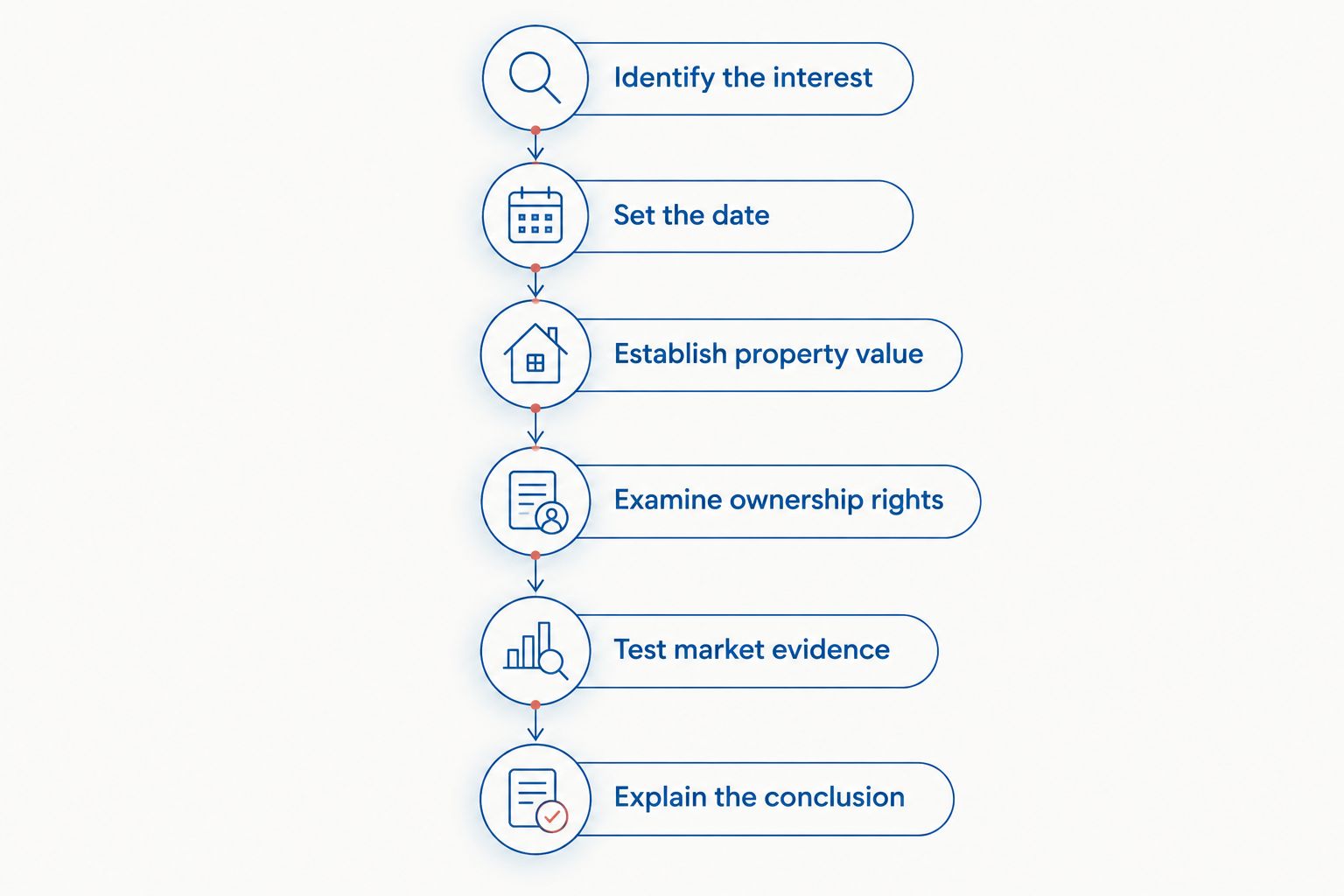
A partial-interest appraisal connects the underlying real estate analysis with the rights attached to the ownership interest. For estate attorneys, CPAs, and trustees, the practical sequence is to identify the asset, confirm the assignment, assemble evidence, and evaluate the resulting conclusion.
Identify the interest
Provide the deed, ownership schedule, and relevant agreements. Ask counsel to clarify whether the estate owns real estate directly, an interest in an entity that owns real estate, or another legally distinct interest.
Do not treat an LLC membership interest as interchangeable with a direct undivided property interest. The property appraisal supplies information about the real estate; an entity-interest valuation also addresses the rights and obligations attached to the entity interest.
Set the date
The effective date of value is the date to which the valuation conclusion applies. It is different from the inspection date and the date the report is delivered.
For a retrospective assignment commissioned in 2026, the analysis must address conditions applicable to the specified historical date. Later records require careful handling: they do not automatically establish what market participants knew or expected on that date.
Establish property value
The underlying real estate analysis examines the property rights, physical characteristics, legal use, and relevant market evidence. Depending on the property and assignment, applicable methods include sales comparison, income capitalization, and cost analysis.
For income-producing property, leases, operating statements, expenses, and capital needs inform that analysis. Highest and best use means the reasonably probable use that is legally permissible, physically possible, financially feasible, and maximally productive—not simply the owner’s preferred use.
Examine ownership rights
Review who controls management, leasing, financing, distributions, and sale decisions. Identify transfer restrictions, consent requirements, buyout provisions, and other terms that affect the owner’s ability to realize value.
Counsel interprets disputed legal provisions. The valuation analysis should identify the rights it assumes rather than silently resolving a legal disagreement inside a numerical adjustment.
Test market evidence
Compare the subject interest’s characteristics with relevant transaction evidence and analytical methods. A fractional-interest adjustment must address the particular interest, not a customary percentage selected without explanation.
Distinguish limits on control from difficulty finding a buyer or completing a transfer. These issues can interact, so the analysis must avoid counting the same economic limitation twice.
Explain the conclusion
The report should connect the ownership documents, property analysis, selected methods, and final conclusion. Material assumptions and limitations belong in that explanation.
A supported conclusion shows why the interest differs from a proportional share of the whole property. It does not merely attach an adjustment to an otherwise completed property appraisal.
Direct property ownership versus an entity interest
The legal form of ownership determines what is being valued. Neither form is inherently preferable for an appraisal assignment; the engagement must follow the actual asset and its intended use.
| Interest or measure | Appropriate use | What it helps establish | Limitation |
|---|---|---|---|
| Direct undivided real estate interest | An estate directly owns part of the real estate | Value of the specified property interest and associated rights | Requires analysis of co-ownership rights and practical restrictions |
| Entity ownership interest | An estate owns an interest in an LLC, partnership, or other entity | Value of rights in the entity, informed by its assets and obligations | Underlying real estate value alone does not establish entity-interest value |
| Proportional property value | A preliminary arithmetic reference | The ownership percentage applied to whole-property value | Does not independently account for control, transferability, or other interest-specific characteristics |
A 50% ownership interest is not automatically worth half the value of 100% ownership. Equally, partial ownership does not automatically justify a discount. The conclusion depends on the rights and evidence relevant to the assignment.
When the asset is an entity interest, distinguish the appraisal of entity-owned real estate from valuation of an operating business. Confirm which services the engagement includes and how separate analyses will be coordinated.
Why partial-interest value varies
Ownership percentage matters, but it does not describe the entire economic position. These factors explain why interests with the same percentage can require different analyses:
- Control rights: Authority over management, financing, leasing, distributions, and sale decisions affects what the owner can accomplish independently.
- Transfer restrictions: Consent requirements and contractual restrictions affect the process of transferring the interest. Their legal effect requires review in context.
- Income rights: The right to receive income differs from the ability to require a distribution. Both must be understood alongside property cash flow.
- Exit provisions: Buyout arrangements, dissolution provisions, and legally available remedies affect the routes through which an owner can realize value.
- Property economics: Lease terms, operating expenses, physical condition, debt, and capital requirements influence the underlying economic position.
- Effective-date conditions: Relevant real estate markets, financing conditions, and available evidence must correspond to the specified date of value.
For a 2026 assignment, separate present-day administrative facts from facts relevant to a retrospective valuation date. A document received now can describe an earlier condition, but its receipt date does not determine its valuation relevance.
What documents should an executor or trustee provide?
Begin with records that establish what the estate owns and what the appraisal must support. A complete ownership package is more useful than a large collection of unrelated property documents.
Ownership and assignment records
Provide the deed, ownership percentages, trust or estate information relevant to the assignment, and governing agreements. Include amendments, buy-sell provisions, transfer restrictions, and correspondence identifying the valuation purpose.
Confirm the intended users and intended use with the attorney or CPA. For an estate-tax assignment, the estate appraisal guide for attorneys provides related context for organizing the engagement.
Property and financial records
For income-producing real estate, assemble rent rolls, leases, operating statements, expense details, debt information, and known capital needs. For other properties, provide available plans, condition information, and records explaining material changes.
Identify the period each record covers. A current rent roll is not a substitute for the rent roll applicable to a historical effective date.
Transactions and unresolved issues
Disclose known transfers, offers, buyouts, disputes, and agreements concerning the property or interest. Explain the circumstances rather than assuming a family transaction establishes market value.
Flag missing records early. The appraiser can then explain how the gap affects scope, assumptions, or the ability to support a conclusion instead of discovering the issue after the assignment has been framed.
How should you scope the appraisal engagement?
Ask the proposal to identify the property, ownership interest, effective date, intended users, intended use, and expected report scope. Confirm whether the assignment includes the underlying real estate appraisal, the partial-interest analysis, or coordinated work addressing both.
REIS Group has over 30 years of experience in real estate appraisal and valuation consulting. For an estate or trust inquiry, the useful starting point is the assignment’s purpose and ownership documents—not a request for a predetermined discount.
For a 2026 engagement, ask these questions before authorizing work:
- What exact asset and property rights will the report value?
- Which ownership provisions require clarification from counsel?
- What records are needed for the effective date?
- How will interest-specific adjustments be supported?
- What assumptions or unresolved issues could materially affect the conclusion?
Turnaround depends on property type, complexity, records availability, and scope. Confirm expedited availability individually; do not assume that a straightforward ownership percentage means a straightforward assignment.
Discuss Your Appraisal Assignment
Clarify the ownership interest, effective date, intended use, and records needed for your estate or trust assignment.
Can you just multiply property value by the ownership percentage?
Multiplying property value by the ownership percentage produces a proportional reference, not necessarily the interest’s market value. A 50% ownership interest still requires analysis of its legal rights and economic characteristics.
Use the arithmetic as a starting point. Accept it as the final conclusion only when the assignment’s evidence supports that result.
Is a discount always appropriate for partial ownership?
A discount is not automatic for partial ownership. The analysis must establish whether the identified rights and market evidence support an adjustment and explain its basis.
Do not request a target percentage before the analysis begins. That reverses the appraisal process and substitutes the desired outcome for an independent conclusion.
Can a partial-interest appraisal use a historical valuation date?
A partial-interest appraisal can address a historical effective date through a retrospective assignment. Both the underlying property analysis and the ownership-rights analysis must correspond to that date.
For an appraisal commissioned in 2026, provide agreements and property records applicable to the historical date, including amendments that show when rights changed.
FAQ
Who should appraise a partial ownership interest for an estate?
Engage a valuation professional whose scope addresses the specific ownership interest, underlying real estate, effective date, and estate purpose. If the estate owns an entity interest, confirm how the real estate appraisal and entity-interest analysis will be coordinated.
Is a partial-interest appraisal the same as a property appraisal?
A partial-interest appraisal addresses the identified ownership interest, while a property appraisal addresses specified rights in the underlying real estate. The partial-interest conclusion must also consider the rights and limitations attached to the interest.
Does owning half a property mean owning half its appraised value?
A 50% ownership interest does not automatically have a market value equal to half the whole-property value. Control, transfer provisions, income rights, and relevant market evidence inform the conclusion.
What valuation date should an executor request?
The executor should confirm the required effective date with the estate attorney or CPA before authorizing the appraisal. The report date and inspection date are separate from the effective date of value.
Can a family buyout establish fair market value?
A family buyout is evidence to examine, not an automatic measure of fair market value. Its relevance depends on the rights transferred, transaction terms, circumstances, and relationship to the valuation date.
Will a partial-interest report guarantee acceptance by a taxing authority?
A partial-interest appraisal does not guarantee acceptance by a taxing authority or another third party. The report should support the identified valuation purpose through clearly explained evidence, methods, assumptions, and conclusions.
One last thing
A small ownership percentage does not, by itself, establish limited control. Governing documents can allocate decision-making rights differently from economic ownership, making those documents essential to the valuation.
Before requesting a proposal, identify the document that establishes the interest and confirm which version applied on the effective date. Discuss your appraisal assignment with REIS Group, including the estate or trust purpose, ownership structure, and available records.
Related guides
- Trust property appraisal for trustees
- Date-of-death appraisal for New York executors and attorneys
- Gift-tax appraisal for financial advisers