To value real estate held in trust, identify the appraisal’s purpose, confirm the effective date and property rights being valued, and obtain a supported appraisal appropriate to that assignment. Trust ownership alone does not establish a special valuation method or automatic discount; the trustee’s attorney and CPA should clarify the legal and tax questions before the appraiser determines the valuation scope.
- To value real estate held in trust, establish the purpose, effective date and property rights before ordering an appraisal.
- REIS Group provides trust real estate appraisals for New York trustees and their legal and tax advisers.
- A retrospective appraisal values property as of an earlier date, not the inspection date.
- A partial-interest valuation requires analysis of the actual ownership rights; discounts are not automatic.
How do you value real estate held in a trust?
Begin with the assignment, not an estimated property value. A trustee arranging a beneficiary distribution needs a clearly defined valuation date and ownership interest, just as an attorney preparing estate-tax documentation does. The purpose determines what the report must address.
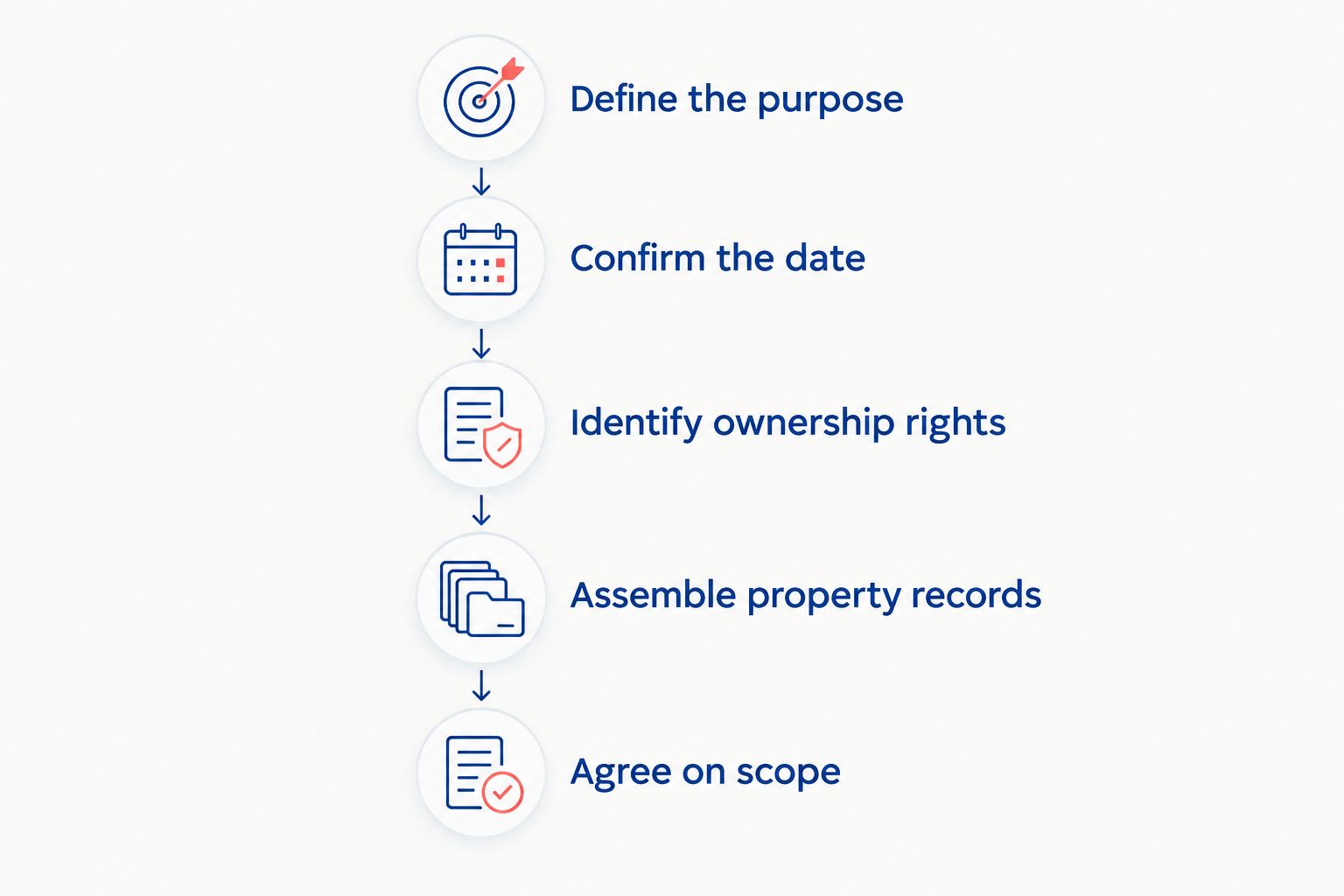
The trust property appraisal guide for trustees provides supporting guidance on organizing the assignment. Use the following sequence before requesting a proposal:
- Define the purpose. Identify whether the appraisal supports trust administration, a distribution, estate or gift tax reporting, a sale, or a dispute.
- Confirm the date. Have the appropriate adviser identify the effective date of value. Do not assume it is the inspection or report date.
- Identify ownership rights. Establish whether the trust owns the entire property, an undivided interest, or an interest in an entity that owns real estate.
- Assemble property records. Provide ownership documents, relevant trust provisions, historical condition records, leases and financial information as applicable.
- Agree on scope. Confirm the intended users, intended use, property rights appraised and reporting requirements with the appraiser.
Why this matters
A property can have a current market value that differs from its value on a required historical date. An appraisal of the entire building also answers a different question from a valuation of a restricted ownership interest.
For a trust administration assignment in 2026, a report addressing the wrong date or interest does not answer the trustee’s actual question. Make the engagement instructions specific enough that the appraiser and the professional advisers are addressing the same asset and purpose.
An appraisal supports a valuation conclusion. It does not determine beneficiaries’ legal rights, decide tax treatment or replace the trustee’s fiduciary judgment.
Which appraisal scope fits your trust’s purpose?
The following scopes answer different questions. They are not interchangeable, and a single assignment can involve both a historical effective date and a partial ownership interest.
| Appraisal scope | Best for | What it addresses | Limitation |
|---|---|---|---|
| Current real estate appraisal | A present-day administration or transaction decision | The specified property rights as of a current effective date | Does not establish value on an earlier required date |
| Retrospective real estate appraisal | A date-of-death or other historical valuation need | Property condition and market circumstances relevant to the earlier date | Requires evidence supporting historical conditions |
| Partial-interest valuation | A trust owning less than the entire interest | The rights, restrictions and economic attributes of the specified interest | Cannot be replaced by mechanically multiplying whole-property value by an ownership percentage |
Current appraisal: a present-date decision
A current appraisal addresses a specified effective date associated with the present assignment. It can support a trustee evaluating a proposed distribution or transaction, provided that the scope matches the decision and the governing instructions.
Its advantage is relevance to that present-date question. Its limitation is equally important: a current appraisal is not a substitute for a required historical valuation. A report prepared in 2026 can still require a historical effective date.
Retrospective appraisal: a historical valuation question
A retrospective appraisal estimates value as of an earlier effective date. The appraiser reconstructs the relevant property condition and analyzes market evidence appropriate to that date rather than simply applying today’s circumstances backward.
For estate reporting, coordinate the date and required interest with the estate attorney and CPA. The date-of-death appraisal to IRS Form 706 workflow addresses that appraisal-to-reporting connection; trust ownership alone does not determine whether a filing or particular tax treatment applies.
Partial-interest valuation: less than the entire interest
A partial-interest assignment examines the interest actually held, including relevant control, transfer and economic rights. First establish whether the asset is a direct interest in real estate or an ownership interest in an entity.
The benefit is a conclusion directed at the actual asset. The limitation is additional document review and analysis: an appraisal of business-owned real estate does not, by itself, value the operating business or every interest in its ownership entity.
What documents should a trustee provide?
Provide records that explain ownership, condition and income as of the effective date. A recent photograph or current rent roll does not necessarily describe the property at a historical valuation date.
Organize the package into these categories:
- Assignment instructions: The purpose, intended users, requested effective date, adviser contacts and relevant reporting deadlines.
- Ownership records: The deed, ownership schedule, relevant trust provisions and applicable entity or co-ownership agreements.
- Property description: Address, property type, available floor plans, surveys and records identifying the space or parcel being appraised.
- Condition evidence: Inspection records, dated photographs, renovation information and documentation of known damage or deferred maintenance.
- Income records: Leases, rent rolls, operating statements, expense records and relevant vacancy information for income-producing property.
- Transaction records: Relevant purchase agreements, prior sales information, offers and existing appraisals, with their dates and purposes identified.
You do not need every possible document before making an inquiry. Send an organized inventory of what is available and identify gaps so the appraiser can determine what the assignment requires.
For a retrospective assignment initiated in 2026, separate current records from records describing the effective date. Ask counsel how to share sensitive trust materials rather than circulating an entire file without considering relevance or confidentiality.
How does the appraiser develop the value conclusion?
The appraiser investigates the property and selects valuation approaches appropriate to the asset, available evidence and assignment. Trust ownership does not replace analysis of the underlying real estate.
The sales comparison approach examines relevant transactions and accounts for meaningful differences between the subject property and comparable properties. For a Manhattan condominium or townhouse, those differences can include location, condition, size and property rights.
The income approach considers the income-producing characteristics of a property. For a leased commercial or multifamily building, the analysis addresses matters such as lease terms, income, expenses and market expectations rather than treating gross rent as value.
The cost approach considers land value and the cost of improvements, with appropriate depreciation analysis. Its usefulness depends on the property and evidence; an appraiser does not have to give every approach equal weight.
The report should explain why the selected evidence and methods fit the assignment. A conclusion is more useful to the trustee when the reasoning, assumptions and limitations are clear, not merely when the report contains a final figure.
Why trust real estate valuation scope varies
The right scope depends on the asset and the question the trustee needs answered. These factors affect the required research, records and analysis:
- Assignment purpose: A beneficiary distribution, estate-tax submission and litigation matter can require different instructions and reporting detail.
- Effective date: Historical assignments require evidence of the property and market at the relevant earlier date.
- Ownership structure: Direct property ownership differs from an undivided interest or an interest in a property-owning entity.
- Property type: A cooperative apartment, townhouse and mixed-use building have different ownership and market characteristics.
- Property condition and use: Renovations, damage, occupancy and highest and best use affect what the appraiser must investigate.
- Records and complexity: Missing leases, incomplete historical records and disputed ownership information require clarification before conclusions are finalized.
Turnaround depends on property type, complexity, records availability and scope. If your assignment has a deadline, state it when requesting a proposal; expedited availability must be confirmed individually.
What should the engagement instructions say?
Give the appraiser a concise written statement connecting the client’s need to the requested valuation. Identify the trustee, the professional advisers who will use the report and the precise property or ownership interest.
Confirm these points before authorizing work:
- The intended use and intended users of the appraisal.
- The effective date and the adviser responsible for confirming it.
- The property rights and ownership interest to be appraised.
- The applicable value definition, including fair market value when appropriate.
- Relevant restrictions, assumptions, access arrangements and available records.
- The requested completion date and any reporting requirements.
For a 2026 engagement, distinguish the requested report delivery date from the effective date of value. They serve different purposes and should appear separately in the instructions.
REIS Group offers over 30 years of experience and scopes real estate appraisal assignments to the property, ownership interest, valuation date and intended use. Its principal market is Manhattan and greater New York City, with nationwide assignments coordinated through its professional network. No report guarantees acceptance by a taxing authority, court or other recipient.
Discuss Your Appraisal Assignment
Identify the trust property, valuation purpose, effective date and ownership interest.
Does putting property in a trust change its market value?
Trust ownership alone does not establish a different market value. The analysis must address the rights appraised, relevant restrictions, property characteristics and market evidence.
Do not assume that a revocable or irrevocable trust automatically produces a valuation discount. Counsel should explain the legal structure; the appraiser should analyze the economic characteristics relevant to the defined interest.
Can a trustee use an online estimate instead of an appraisal?
An online estimate does not replace an assignment-specific appraisal. It can provide preliminary context, but it does not establish that the required effective date, ownership rights, property condition and intended use have been addressed.
A tax assessment or broker’s opinion also serves a different purpose. Ask the attorney or CPA what evidence the particular trust administration or reporting task requires before relying on an existing figure.
Should the trustee subtract the mortgage from appraised value?
Keep the property value conclusion separate from the trust’s debt and equity accounting. A mortgage balance is not a substitute for analyzing the property rights and market evidence.
Give the appraiser relevant financing information and explain the question being asked. Have the appropriate adviser address how liabilities enter the trust’s accounting, distribution or tax calculations.
FAQ
How do I value real estate held in trust for a beneficiary distribution?
Identify the distribution purpose, confirm the required effective date and ownership interest, and obtain an appraisal scoped to that decision. The trustee’s attorney should clarify the governing trust instructions before the assignment is finalized.
Do I need a date-of-death appraisal for property in a trust?
A date-of-death appraisal is appropriate when the identified estate or tax purpose requires value on that date. Trust ownership alone does not determine the reporting requirement; coordinate the assignment with the estate attorney and CPA.
Can an appraisal prepared in 2026 value property on an earlier date?
An appraisal prepared in 2026 can develop a retrospective value for an earlier effective date. The appraiser needs evidence relevant to the property’s condition and market circumstances at that earlier date.
Does a trust automatically receive a partial-interest discount?
A trust does not automatically receive a partial-interest discount. Any adjustment requires analysis of the actual ownership interest, applicable rights, restrictions and supporting evidence.
What if the trust owns an LLC that owns the building?
Identify whether the assignment concerns the building or the trust’s interest in the LLC. A real estate appraisal does not by itself establish the value of the entity interest or an operating business.
Can beneficiaries use the trust’s old appraisal?
An existing appraisal is useful only to the extent that its date, property rights, intended use and other assignment terms fit the current need. Ask the appraiser to assess its relevance rather than assuming the conclusion remains applicable.
What should I send REIS Group when requesting a trust appraisal?
Send the property address, assignment purpose, requested effective date, ownership description and relevant deadline. Identify your legal or tax advisers and the property records available so the appraisal scope can be discussed.
One last thing
Beneficial ownership of a trust and direct ownership of real estate are not the same asset. Before requesting a fractional-interest valuation, ask counsel to identify exactly what the trust owns and what interest the assignment must value.
That clarification prevents the appraisal from answering the wrong question. Discuss your appraisal assignment with the property address, purpose, effective date and ownership documents ready.
Related guides
- Partial-interest appraisal scope and cost considerations
- How to get a retrospective appraisal for inherited property
- Trust appraisal to fiduciary accounting disclosure workflow