To appraise vacant commercial land, an appraiser identifies the property rights and valuation date, tests the site's highest and best use, and analyzes comparable land sales. For a New York commercial property owner commissioning an appraisal in 2026, the key caveat is that zoning capacity alone does not establish value: access, physical constraints, development feasibility, and market demand also matter.
- Appraise vacant commercial land through highest-and-best-use analysis and verified comparable sales, not asking prices alone.
- REIS Group provides commercial real estate appraisals scoped to the property, ownership interest, valuation date, and intended use.
- Separate existing development rights from approvals or assemblage benefits that remain uncertain.
- Provide surveys, title records, zoning information, and environmental reports before the appraisal scope is finalized.
Why this matters
An empty parcel is not an empty valuation problem. Two sites with similar street frontage can have different development potential, legal restrictions, and buyer demand.
The appraisal must value the interest you own, not a development scenario you hope to obtain. Start by matching the assignment to its intended use through the firm's real estate appraisal services. A potential sale, financing decision, or ownership dispute does not automatically require the same scope or value definition.
How do you appraise commercial land with no existing structures?
The process connects legal and physical facts to market evidence. It does not require an existing building, but it does require a supported explanation of what buyers can reasonably do with the land.
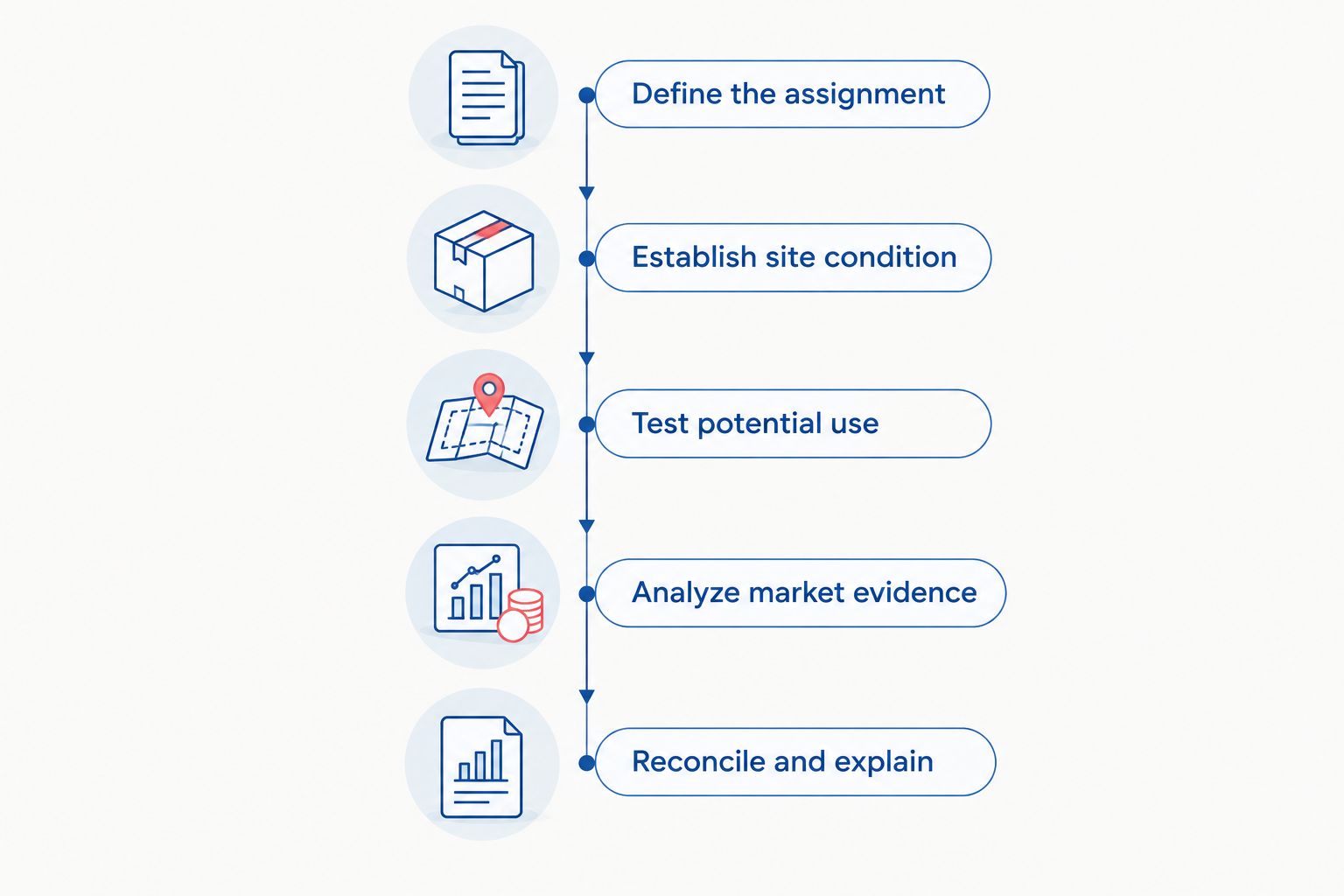
1. Define the assignment
Identify the parcel, client, intended users, intended use, effective date of value, and property rights appraised. The effective date is the date the value conclusion applies—not necessarily the inspection date or report date.
Specify whether the assignment concerns full ownership, land subject to a ground lease, or a fractional ownership interest. A valuation of the entire parcel does not automatically answer what a particular owner's interest is worth.
For a 2026 engagement involving an earlier valuation date, the appraiser must reconstruct the relevant market and property circumstances as of that date. Current conditions cannot simply replace historical evidence.
2. Establish the site's condition
Review the survey, dimensions, frontage, access, topography, utilities, easements, and known environmental conditions. A site without buildings can still contain paving, foundations, underground infrastructure, or other improvements that affect its use.
Confirm the measurement basis. One acre equals 43,560 square feet, but gross land area is not necessarily the same as usable or developable area. A restriction affecting part of the parcel can change which area measurement is meaningful for comparison.
3. Test highest and best use
Highest and best use means the reasonably probable use that is legally permissible, physically possible, financially feasible, and maximally productive. These tests connect the site's potential to an actual market-supported conclusion.
A commercial zoning designation does not prove that a particular development is feasible. The appraiser also considers permitted uses, dimensional limits, site constraints, demand, and the economics of development.
4. Analyze market evidence
Investigate comparable land transactions and verify their terms, property characteristics, and development status. Sale prices require context: an approved development site and a restricted parcel are not interchangeable simply because they occupy the same neighborhood.
The appraiser selects a relevant unit of comparison, adjusts for supported differences, and evaluates the reliability of the resulting indications. Listings provide competitive context but are not completed transactions.
5. Reconcile and explain
Reconciliation means weighing the evidence rather than mechanically averaging the results. The final report explains the selected value, the methods used, significant assumptions, and limitations relevant to the assignment.
For an owner reviewing a report, the practical question is whether another informed reader can follow the reasoning from parcel facts to conclusion. A precise-looking figure without that explanation is not enough.
Which valuation method fits vacant commercial land?
Comparable land sales are often the clearest starting point when relevant transactions exist. Other techniques can support the analysis when the parcel's income or development characteristics justify them.
| Method | Best for | Main strength | Main limitation |
|---|---|---|---|
| Sales comparison | Sites with relevant, verifiable land transactions | Connects the conclusion to observed buyer behavior | Requires support for differences in rights, approvals, location, and condition |
| Ground-rent capitalization | Land with reliable market ground-rent evidence | Links land value to income attributable to the land | Depends on appropriate lease terms, income assumptions, and capitalization evidence |
| Development analysis | Sites whose value depends on a supportable development program | Examines development proceeds against costs, timing, and risk | Sensitive to assumptions about approvals, construction, absorption, and developer return |
The method follows the evidence, not the desired result. An elaborate development model is not stronger than a well-supported sales comparison merely because it contains more calculations.
The cost approach does not create a building value where no building exists. Existing site improvements can still require analysis, but they do not remove the need to establish the land's market value.
Unentitled land: value the current approval position
An unentitled site lacks some or all approvals needed for the contemplated project. The appraisal must distinguish uses permitted under existing rules from changes that require discretionary approvals.
If a future approval is reasonably probable, the appraiser evaluates the evidence supporting that probability and the associated uncertainty. Treating the property as fully approved without explanation changes the valuation premise.
For a 2026 acquisition decision, ask the appraiser to identify which approvals exist as of the effective date. A seller's development concept is not equivalent to an approved project.
Approved development land: verify what transfers
An approved site requires review of the actual approval documents, conditions, expiration provisions, and relationship to the contemplated project. A rendering or marketing summary does not establish the rights available to the next owner.
The appraiser considers whether the approvals fit current demand and whether the proposed development remains financially feasible. Approvals can reduce uncertainty without making every planned project economically viable.
Verify the approved rights before comparing an approved site with unapproved land. Otherwise, the comparison can attribute an approval benefit to a parcel that does not possess it.
Ground-leased land: identify whose interest is valued
Land subject to a ground lease requires analysis of the lease and the ownership interest being appraised. The landowner's leased fee interest and the tenant's leasehold interest are different assets.
Relevant provisions include rent, adjustments, remaining term, renewal rights, and obligations affecting the property. Market rent and contract rent are not automatically the same.
For an owner, the next step is to provide the executed lease and amendments—not just a rent summary. The report should identify the interest valued so its conclusion is not mistaken for unrestricted ownership value.
Why vacant commercial land values vary
Differences in land value need an explanation tied to the parcel and its market. These factors deserve particular attention:
- Property rights and restrictions: Easements, deed restrictions, leases, and ownership limitations affect what a buyer receives.
- Physical characteristics: Size, shape, frontage, topography, and subsurface conditions influence usable area and development options.
- Access and infrastructure: Legal access and available utility capacity affect whether a contemplated use can proceed.
- Permitted development: Zoning, approvals, and development rights shape the uses and building area the site can support.
- Market feasibility: Demand, development costs, financing conditions, and required returns influence what a buyer can justify paying.
- Effective date: The valuation must reflect the market and property circumstances relevant to the specified date.
In Manhattan and other New York City locations, distinguish the tax lot from the zoning lot. Their boundaries and functions are not necessarily identical, and development-rights analysis requires the relevant records rather than an assumption based on the tax map.
What should you send the appraiser?
For a commercial owner commissioning a 2026 appraisal, organize the available records before requesting a proposal. Identify unavailable documents rather than substituting estimates for verified facts.
- Assignment instructions: Intended use, intended users, ownership interest, valuation date, and relevant transaction or dispute deadlines.
- Property records: Address, parcel identifiers, deed, survey, title materials, and ownership documents.
- Land-use records: Zoning information, approvals, development-rights agreements, easements, and restrictive covenants.
- Site investigations: Environmental reports, geotechnical studies, utility information, and engineering reports, when available.
- Transaction evidence: Purchase agreements, offers, listing materials, ground leases, and amendments relevant to the assignment.
- Development materials: Existing plans, feasibility studies, and documented project assumptions, clearly distinguished from approved conditions.
An appraisal does not replace an environmental assessment, boundary survey, engineering investigation, or legal opinion. Specialist findings can inform the valuation; the appraisal should explain how material uncertainties are addressed.
How should you select the appraisal scope?
Choose a scope that answers the decision you actually face. Ask how the appraiser will investigate comparable sales, evaluate development potential, address unavailable records, and explain significant assumptions.
REIS Group is suited to New York commercial property owners who need a real estate appraisal tailored to a defined valuation purpose. The firm provides independent commercial appraisal and valuation consulting, with nationwide assignments coordinated through its professional network.
That service is distinct from obtaining development approvals or completing technical site investigations. REIS Group prepares reports to support the identified valuation purpose; no appraisal guarantees acceptance by a lender, court, taxing authority, or other recipient.
Turnaround depends on property type, complexity, records availability, and scope. Confirm any expedited availability individually rather than planning around an assumed delivery date.
Discuss Your Appraisal Assignment
Identify the parcel, ownership interest, valuation date, and intended use before requesting a proposal.
Can you use the assessed value instead?
An assessed value is not automatically a substitute for an assignment-specific market value appraisal. Assessment rules, valuation dates, and the interest being assessed can differ from the requirements of your transaction or dispute.
Use assessment records as background information, then establish whether their basis matches your purpose. A difference between assessed value and an appraisal conclusion requires explanation, not an assumption that either figure controls.
Can you use price per buildable square foot?
Price per buildable square foot can be useful when development capacity is the relevant market comparison. It requires a supported denominator and consistent treatment of permitted floor area, approvals, and restrictions.
Do not confuse land square footage with buildable floor area. Two transactions expressed using different area definitions cannot be compared reliably until those definitions are reconciled.
FAQ
How do you appraise vacant commercial land without buildings?
Appraise vacant commercial land by defining the assignment, testing highest and best use, and analyzing relevant market evidence. The appraiser explains how site conditions, rights, restrictions, and development feasibility affect the conclusion.
Is an asking price enough to establish vacant land value?
An asking price alone does not establish vacant land value. It reflects a seller’s position and should be evaluated alongside verified transactions, market exposure, and the parcel’s characteristics.
Does commercial zoning mean I can build any commercial project?
Commercial zoning does not authorize every commercial project. Permitted uses, dimensional requirements, site conditions, and other restrictions determine what development is legally and physically possible.
Can an appraiser value land as of a past date?
An appraiser can prepare a retrospective land appraisal for a specified past effective date. The analysis must address the property circumstances and market evidence relevant to that date, rather than substitute current conditions.
Does a vacant land appraisal include environmental testing?
A vacant land appraisal is not an environmental assessment. Existing environmental reports can inform the valuation, and unresolved conditions need appropriate treatment within the assignment’s scope and assumptions.
Can I multiply the whole parcel value by my ownership percentage?
Multiplying whole-parcel value by an ownership percentage does not automatically establish a fractional interest’s value. The rights, restrictions, and characteristics of the specific ownership interest require separate consideration.
What does REIS Group need before preparing an appraisal proposal?
REIS Group needs the property identification, intended use, ownership interest, effective date, and available records to scope the assignment. Provide relevant deadlines and disclose known site or title issues at the outset.
One last thing
Before commissioning a 2026 appraisal, write down the exact interest and condition you want valued: the parcel as it exists, land subject to its lease, or a clearly identified hypothetical condition. An extraordinary assumption concerns an uncertain fact; a hypothetical condition assumes something contrary to known facts.
Ask whether the conclusion depends on an unverified fact or a condition that does not exist. That distinction can matter more to your decision than another page of comparable-sale calculations. Discuss your appraisal assignment with the parcel records and intended use in hand.
Related guides
- Commercial appraisal for property investors
- Commercial land appraisal cost considerations
- Partial-interest appraisal cost considerations