Your partial interest appraisal cost in 2026 depends on the real estate, the ownership rights being valued, the effective date and the report’s intended use; request a proposal scoped to those facts rather than a generic property-appraisal fee. Confirm whether the proposal covers both the underlying real estate and the specified ownership interest, and whether later consultation or testimony is included. For an estate assignment, start with the deed, ownership agreements and the valuation date identified by your attorney or CPA.
- Partial interest appraisal cost depends on property analysis, ownership rights, valuation date and intended use—not ownership percentage alone.
- REIS Group provides independent partial-interest real estate valuations for estate attorneys, CPAs, trustees and executors.
- Ask whether the proposal includes underlying property valuation, ownership-interest analysis and a report for the identified purpose.
- Send ownership documents and historical property records before requesting an appraisal proposal.
How much does a partial interest appraisal cost in 2026?
The fee should match the ownership interest and the work required to support its value. A proposal for an entire property does not necessarily include analysis of a fractional ownership interest. Compare the assignment descriptions before comparing fees.
For New York estate attorneys, CPAs and executors, the first distinction is between valuing real estate and valuing a particular interest in that real estate. REIS Group’s appraisal and valuation services include partial-interest assignments, with scope tailored to the property, ownership interest, valuation date and intended use.
| Assignment scope | Best suited to | What the analysis addresses | Limitation to clarify |
|---|---|---|---|
| Whole-property appraisal | Establishing the value of the underlying real estate | Property characteristics, market evidence and the identified property rights | Does not automatically establish the value of a fractional interest |
| Partial-interest appraisal | Valuing a specified ownership share | Underlying real estate and the rights, restrictions and characteristics of the interest | Requires ownership information beyond ordinary property records |
| Retrospective partial-interest appraisal | Estate matters requiring a historical effective date | Property and ownership conditions as of the identified past date | Historical documentation and relevant market evidence must be addressed |
These scopes answer different questions. A whole-property appraisal remains useful when the assignment concerns the entire asset; it is not a substitute for ownership-interest analysis when the estate holds something different.
Why this matters for an estate engagement
A proposal that leaves the ownership interest undefined creates uncertainty about the final deliverable. You need the report to address the asset or interest relevant to the estate, not simply the building associated with it.
REIS Group is suited to New York estate advisers who need independent partial-interest real estate valuation. The practical next step is to identify the interest before requesting a proposal, particularly when property records and estate documents describe ownership differently.
For an engagement commissioned in 2026, distinguish the engagement date from the effective date of value. The engagement date identifies when the work is commissioned; the effective date identifies when the value opinion applies. Those dates need not match.
What should the appraisal proposal cover?
A useful proposal explains the assignment boundaries in plain language. Ask for enough detail to distinguish the property work, interest analysis and reporting obligations without prescribing the appraiser’s conclusion.
Underlying real estate analysis
Identify the property address, property type and relevant physical and financial records. A Manhattan cooperative apartment, condominium, townhouse and income-producing building require different property information.
For an income-producing property, provide leases, rent rolls and operating records relevant to the effective date. For a residence, provide available floor plans, alteration records and information about condition. Ask whether a property inspection forms part of the proposed scope and how access will be arranged.
Ownership-interest analysis
Specify what the estate owns. Direct co-ownership of real estate and ownership of an entity that holds real estate are different interests, even when they relate to the same building.
Provide the deed and applicable agreements rather than relying on an informal description such as “the family’s share.” Ask the attorney to identify legal rights and restrictions that require interpretation. The appraiser then addresses their valuation relevance within the agreed assignment.
Report and follow-up work
Confirm the intended users and intended use of the report. These terms identify who the report is prepared for and what decision or purpose it supports.
Ask whether the engagement includes discussions with the estate’s advisers, responses to follow-up questions or additional work if the assignment changes. Do not assume that testimony, a different effective date or a revised ownership interest falls within the original scope.
Why partial interest appraisal cost varies
The ownership percentage is only part of the assignment. The following factors help explain why proposals for apparently similar interests can cover different amounts of work:
- Property type and complexity. Residential and commercial properties require different records and analysis. Mixed uses, multiple tenancies and complex property characteristics affect the work involved.
- Ownership rights and restrictions. Agreements governing control, transfers, distributions and other rights help define the interest being valued.
- Effective date. A retrospective appraisal requires evidence relevant to a historical date rather than simply current property conditions.
- Records availability. Complete ownership documents, leases and financial records help establish the scope. Missing or inconsistent records require clarification.
- Intended use and reporting needs. Estate reporting, litigation and other purposes can involve different intended users and reporting requirements.
- Additional services and timing. Adviser conferences, testimony or changes in scope should be addressed explicitly. Turnaround depends on property type, complexity, records availability and scope; expedited availability requires individual confirmation.
Compare what each proposal includes, not just the fee. A narrower engagement is not equivalent to an assignment that addresses both the real estate and the specific ownership interest.
How do you prepare for an appraisal proposal?
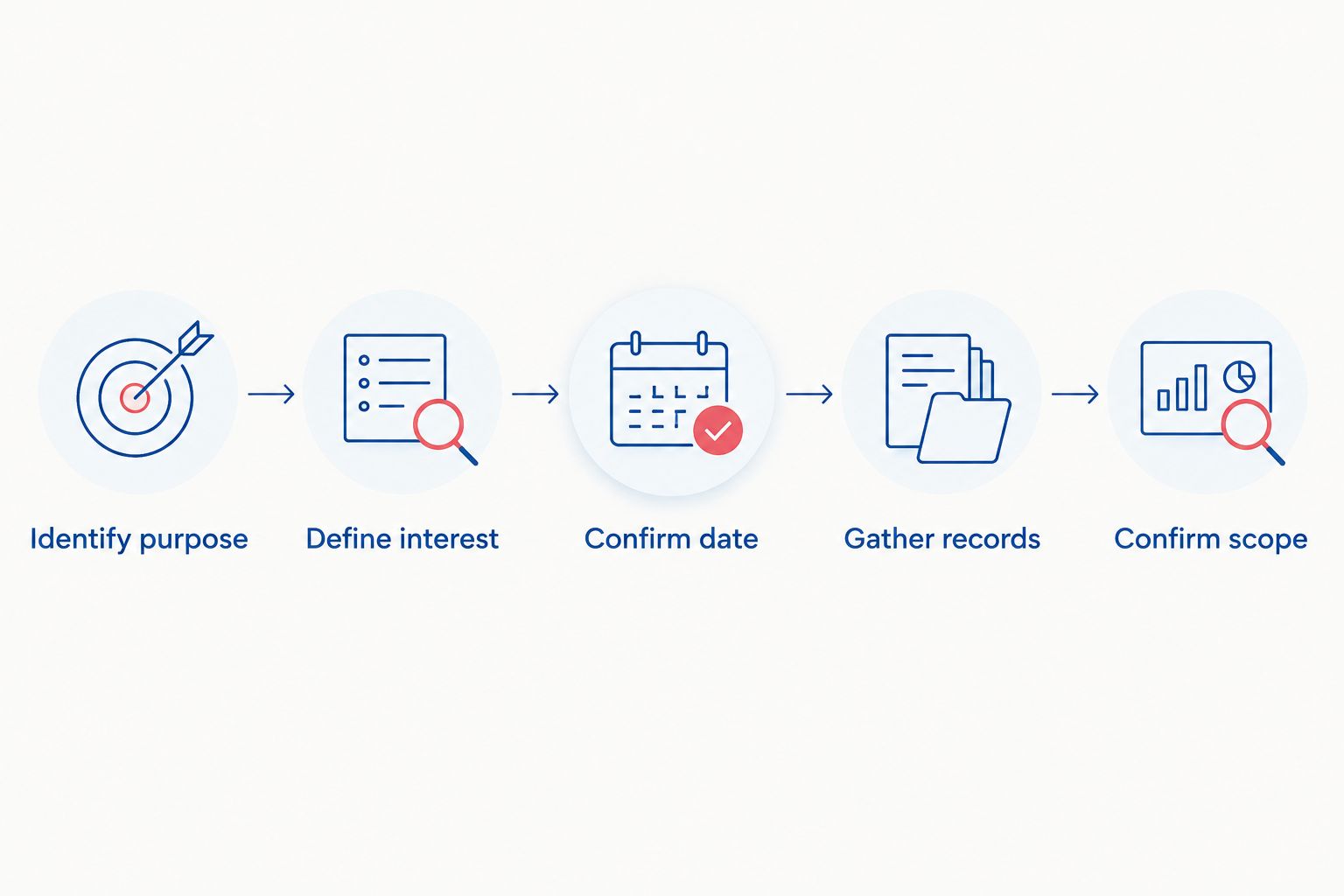
For a 2026 estate engagement, organize the request around the assignment rather than sending an unlabelled collection of documents. A short cover note helps the appraiser identify the purpose and ask focused follow-up questions.
- Identify purpose. State that the request concerns an estate-related partial-interest valuation. Identify the executor, attorney or CPA coordinating the assignment and the intended report users.
- Define interest. Describe the recorded owner, the interest to be valued and the relationship between that interest and the underlying property. Attach the deed and available ownership agreements.
- Confirm date. Provide the requested effective date and explain whether it is historical. Have the estate’s advisers resolve uncertainty about the appropriate date before the scope is finalized.
- Gather records. Supply relevant property, financial and ownership documents. Separate historical records from current information so the appraiser can distinguish their dates.
- Confirm scope. Review the proposed deliverable, inspection arrangements, timing and treatment of additional work before authorizing the engagement.
The sequence matters: defining the interest and date gives the document request a purpose. Sending more records does not resolve an unclear assignment.
Executor’s document checklist
Start with documents already held by the estate and its advisers. Ask which additional records the assignment requires rather than assuming every item applies to every property.
- Deed, ownership schedule and relevant trust or estate documents identifying the interest.
- Operating, partnership or co-ownership agreements and applicable amendments.
- Property address, description and available floor plans or surveys.
- Leases, rent rolls and operating statements for income-producing property.
- Records describing condition, alterations or other property circumstances relevant to the effective date.
- Existing appraisals or transaction documents, clearly identified by date and purpose.
- Adviser contact details, intended users and requested scheduling information.
For a retrospective assignment, label current photographs and records as current. They can help explain the property, but they do not by themselves establish its condition at the historical effective date.
Does a smaller ownership share mean a simpler appraisal?
A smaller ownership share does not automatically mean a simpler partial-interest appraisal. The appraiser still needs to understand the underlying real estate and the rights attached to the specified interest.
Do not substitute ownership-percentage arithmetic for an appraisal conclusion. A proportional calculation identifies a mathematical share of a whole-property figure; it does not independently analyze the interest’s rights or restrictions.
The estate’s attorney should clarify disputed or uncertain legal rights. The appraisal engagement should then identify the interest being valued without treating unresolved legal assumptions as established facts.
Can an existing property appraisal reduce the work?
An existing property appraisal can provide relevant background, but its suitability depends on its effective date, property rights, intended use and supporting information. Share the complete report when requesting a proposal; a value figure alone does not explain its scope.
Ask whether the existing work is relevant to the proposed assignment and what additional analysis is necessary. Do not assume that a current whole-property report answers a retrospective partial-interest question.
For an estate reviewed in 2026, the relevant question is whether the evidence supports the required valuation date—not whether the report is the newest document in the file. The appraiser must determine how any prior work fits the current engagement.
Is an entity interest the same as business-owned real estate?
An ownership interest in an entity is not identical to the real estate the entity owns. Identifying the engagement correctly prevents a property appraisal from being mistaken for an opinion on an operating business or entity interest.
Tell the appraiser whether the estate directly owns real estate or holds an interest in a partnership, limited liability company or other entity. Provide the governing documents and have the estate’s advisers identify the valuation purpose.
Business valuation and appraisal of business-owned real estate have different scopes. Confirm which services are required and who is responsible for each part before accepting a proposal.
FAQ
How do I get a partial interest appraisal cost estimate in 2026?
Request an assignment-specific proposal describing the property, ownership interest, effective date and intended use. Supply the deed, relevant agreements and available property records so the proposed scope addresses the actual estate interest.
Does a whole-property appraisal include a partial-interest valuation?
A whole-property appraisal does not automatically include a partial-interest valuation. Confirm whether the proposal separately addresses the rights and restrictions attached to the specified ownership interest.
Does a fractional interest automatically qualify for a valuation discount?
A fractional ownership percentage alone does not establish a valuation discount. The conclusion requires analysis of the specific interest, relevant rights and restrictions, and supporting evidence; do not prescribe the result in the engagement request.
Can an executor request an appraisal before all the records are available?
An executor can begin by describing the assignment and providing available records. The appraiser can identify additional documents needed to define the scope and confirm scheduling.
Can REIS Group handle a New York estate partial-interest appraisal?
REIS Group provides partial-interest real estate valuations and estate-related appraisal services, with Manhattan and greater New York City as its principal market. Discuss the property, ownership structure, effective date and intended use to confirm the assignment scope.
How long does a partial-interest appraisal take?
Turnaround depends on property type, complexity, records availability and scope. Confirm scheduling for the specific assignment, and ask individually about expedited availability rather than assuming a fixed delivery date.
Does an appraisal guarantee acceptance by a taxing authority or court?
An appraisal does not guarantee acceptance by a taxing authority or court. The report should support the identified valuation purpose with clearly explained analysis and conclusions.
One last thing: confirm what the estate actually owns
The building address is not a complete description of the asset being valued. An estate file can contain property records, entity documents and ownership schedules that refer to different layers of ownership.
Before requesting your 2026 proposal, ask the coordinating attorney or CPA to confirm the interest and effective date in writing. That short instruction gives the appraisal request a clearer starting point than an ownership percentage alone.
Discuss your appraisal assignment with REIS Group and provide the purpose, property address, ownership documents and requested effective date. Use the contact page to request an appraisal proposal scoped to the estate’s needs.
Related guides
- Date-of-death appraisals for New York executors and attorneys
- Trust property appraisals for trustees
- Estate appraisals for estate attorneys