To prepare for a business valuation appointment, identify why you need the valuation, the ownership interest involved, and the effective date of value; then organize financial statements, ownership documents, and relevant property records. Distinguish the operating business from any business-owned real estate before requesting a proposal. Bring your CPA’s questions and a list of missing records so the appointment establishes a clear assignment rather than an unsupported estimate.
- To prepare for business valuation appointment discussions, identify the purpose, valuation date, ownership interest, and intended users.
- Operating-business valuation and appraisal of business-owned real estate address different assets; confirm which assignment you need.
- REIS Group provides real estate appraisal and valuation consulting; confirm operating-business valuation scope before engagement.
- Organize financial, ownership, and property records, and disclose missing information before agreeing to the assignment.
Why this matters
A business owner and CPA can arrive with the same financial statements but different questions. One needs the value of an ownership interest; the other needs a separate conclusion for a building the business occupies. Those questions require different analysis.
For a New York business owner preparing an appointment in 2026, scope comes before document volume. Start by reviewing the relevant appraisal and valuation services and explaining the decision the valuation must support. A clearly described purpose helps the professional determine what work belongs in the engagement.
How do you prepare for a business valuation appointment?
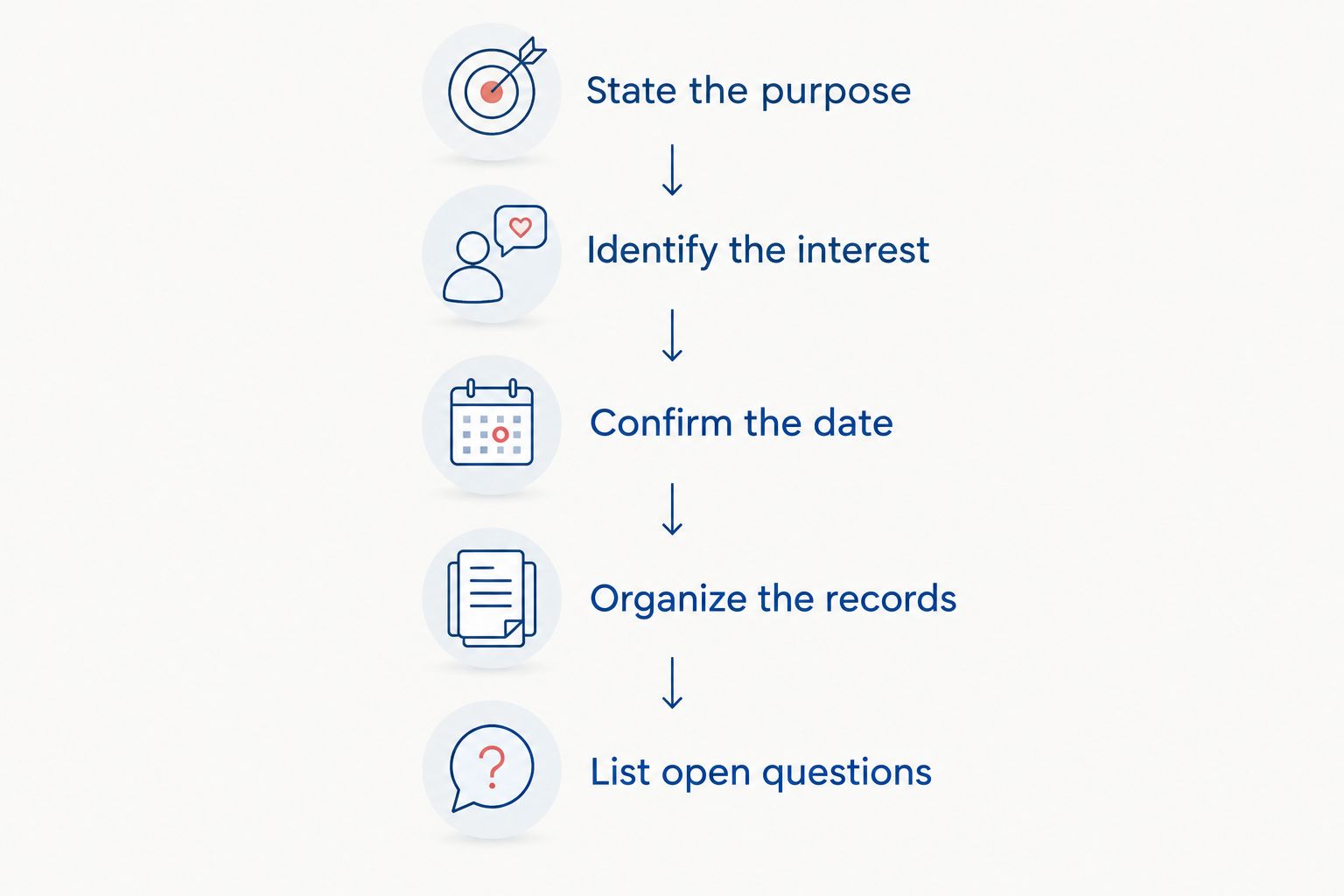
Prepare a short assignment summary, assemble an organized document index, and identify questions for your CPA or attorney. Use the following sequence before the appointment rather than sending an unexplained folder of records.
1. State the purpose
Explain what prompted the valuation and who will rely on the conclusion. A contemplated sale, ownership transfer, estate matter, or dispute presents a different assignment context; do not assume a report prepared for one purpose suits another.
Write the intended use in plain language. For example, distinguish planning a possible transaction from supporting an identified reporting obligation, without treating either description as a substitute for the engagement terms.
2. Identify the interest
Name the legal entity and describe exactly what is being valued. Specify whether the question concerns the operating business, an ownership interest, business-owned real estate, or separate conclusions for related assets.
Bring the ownership structure and governing agreements. If a property sits in a separate entity from the operating business, identify both entities and explain their relationship.
3. Confirm the date
The effective date of value is the date to which the valuation conclusion applies. It is not necessarily the appointment date, inspection date, or report delivery date.
An appointment held in 2026 can concern an earlier effective date. Tell the professional whether the date is already established by the assignment purpose or still needs clarification with your adviser; do not select today’s date simply because it is convenient.
4. Organize the records
Separate financial information, ownership documents, and property records. Label each file with its entity, reporting period, and whether it is final, draft, or amended.
Include an index identifying what you supplied and what remains outstanding. Ask which reporting periods are needed rather than assuming a universal document requirement applies to every engagement.
5. List open questions
Write down unresolved ownership, accounting, property, and timing issues. Identify who can answer each question and whether the supporting document exists.
The appointment should end with a defined next step: additional information, scope confirmation, or a proposal. Do not treat an introductory discussion as a completed valuation.
Are you valuing the business, the real estate, or both?
Operating-business valuation addresses the business interest identified in the engagement. Real estate appraisal addresses specified property rights in a property as of an effective date. When a business owns its premises, clarify how the assignments will relate before commissioning either report.
| Assignment | Best suited to | What to bring | Important limitation |
|---|---|---|---|
| Operating-business valuation | Owners and CPAs evaluating a business interest | Financial statements, ownership agreements, debt information, and operating records | Does not automatically provide a separate real estate appraisal |
| Business-owned real estate appraisal | Owners and advisers needing a property-specific value conclusion | Property ownership records, leases, income and expenses, and building information | Does not establish the value of the operating business |
| Coordinated assignments | Owners whose question involves both a business and associated property | Both document sets, related-party agreements, and a clear assignment map | Requires agreement on boundaries and treatment of shared information |
REIS Group is a fit for New York business owners and CPAs seeking appraisal of business-owned real estate. Operating-business valuation services must be confirmed against the firm’s scope before engagement; do not infer that a property appraisal includes valuation of the business occupying it.
Separate assignments offer clearer asset-specific conclusions, but require coordination. A combined planning discussion helps identify overlapping records; it does not remove the need to specify each professional’s responsibility.
What documents should you bring?
Use this checklist to organize the initial discussion, not as a promise that every item is required. The final request should reflect the assignment’s purpose, entity structure, effective date, and available records.
Financial records
- Financial statements for the periods requested, with the applicable entity clearly identified.
- Business tax returns and relevant schedules requested by the valuation professional.
- Current interim statements, marked with their reporting date and preparation status.
- Debt schedules and supporting loan documents.
- Budgets or forecasts, with their preparation date and underlying assumptions identified.
- Explanations and supporting records for unusual income or expenses.
Do not edit financial statements to create a preferred result. Identify an unusual item separately and let the professional determine its treatment. Your CPA should help explain differences between tax returns, management accounts, and other financial records.
Ownership and legal records
- Entity formation documents and the current ownership structure.
- Operating, shareholder, partnership, or buy-sell agreements, as applicable.
- Documents describing transfer restrictions and ownership rights.
- Relevant transaction documents or offers, if any exist.
- Attorney instructions identifying the intended use and intended users.
An ownership percentage alone does not explain the rights attached to an interest. Governing documents help establish what is being valued, including restrictions that require analysis rather than an assumed adjustment.
Real estate records
- Deeds or other ownership records and identification of the property-owning entity.
- Leases, amendments, rent rolls, and related-party occupancy agreements.
- Property operating statements and expense information.
- Available floor plans, surveys, and building information.
- Records of renovations, capital work, and known property issues.
- Existing appraisal reports, clearly identified by date and original purpose.
For Manhattan and surrounding-area properties, distinguish owner-occupied space from space leased to others. Explain whether the operating business pays rent to a related property owner and supply the written agreement when one exists.
Why preparation requirements vary
There is no single document package that answers every business valuation question. The requested information changes with the assignment, and collecting unrelated records does not resolve an unclear scope.
- Intended use: The decision the report supports shapes the analysis and reporting requirements.
- Ownership interest: An entire entity and a specified partial interest are different subjects of valuation.
- Effective date: A retrospective assignment requires information relevant to the historical date, not just current operations.
- Asset boundaries: Business-owned real estate introduces property-specific records and coordination questions.
- Complexity: Multiple entities, related-party agreements, and unusual property characteristics require explanation.
- Records availability: Missing agreements or incomplete financial records affect what can be established and what additional work is needed.
For a 2026 appointment, disclose the reporting periods covered by your records and any gaps before agreeing to the scope. Turnaround depends on property type, complexity, records availability, and assignment requirements; expedited availability must be confirmed individually.
What should you ask during the appointment?
Ask questions that define the work, not questions designed to secure a preferred value. A useful discussion produces shared expectations about the subject, analysis, report, and responsibilities.
Scope and responsibility
Ask who will perform the operating-business valuation and who will appraise any real estate. Confirm whether separate engagements are needed and how the professionals will exchange relevant information.
Ask what the report will cover—and what it will exclude. A clearly stated exclusion is more useful than discovering after delivery that an important asset or ownership interest was never included.
Value and reporting
Ask which standard of value applies and why. Fair market value, when applicable, concerns a hypothetical willing buyer and willing seller under the relevant definition; it is not simply the price an owner hopes to achieve.
Ask who the intended users are and whether the planned report suits their identified purpose. Neither a business valuation nor a real estate appraisal guarantees acceptance by a court, taxing authority, lender, or transaction counterparty.
Information and next steps
Ask which missing records prevent scope confirmation and which can be supplied later. Establish who will coordinate follow-up questions so the owner, CPA, attorney, and appraiser do not work from inconsistent information.
If your 2026 business plans change after the appointment, notify the professional before assuming the original assignment still fits. A different transaction, ownership interest, or effective date can change the work required.
Can you attend before every document is ready?
You can use an initial appointment to clarify the assignment before all records are assembled. Bring an inventory of available documents, explain the gaps, and ask what is necessary for a proposal or engagement.
An early discussion helps prevent collecting the wrong records. Its limitation is equally important: incomplete information does not support a finished conclusion merely because the parties have met.
Should your CPA or attorney attend?
Your CPA or attorney should participate when accounting treatment, ownership rights, intended use, or the effective date needs clarification. Identify one person to coordinate the document request and record the agreed next steps.
Your CPA can explain the financial records; your attorney can address legal instructions and ownership documents. Their involvement informs the assignment without replacing the valuation professional’s independent analysis.
FAQ
What should I do first to prepare for a business valuation appointment?
Identify the valuation purpose, ownership interest, and proposed effective date first. Then organize the records around that assignment and list unresolved questions for your CPA or attorney.
Do I need to bring every financial record to the first appointment?
Bring an organized inventory and the records requested for the initial discussion. Ask which reporting periods and supporting documents are needed before sending an undifferentiated archive.
Does a business valuation include the building my business owns?
A business valuation does not automatically include a separate appraisal of business-owned real estate. Confirm the asset boundaries and how any property value will be addressed in the engagement.
Can I use a 2026 appointment for a historical valuation date?
A 2026 appointment can address an earlier effective date of value. Identify that date at the outset and ask which historical financial and property records are relevant.
Should I tell the appraiser the value I want?
Explain the decision you need to make rather than requesting a predetermined conclusion. Supply relevant facts, transaction information, and concerns so the professional can evaluate them independently.
Can an old appraisal replace a new assignment?
An old appraisal is background information, not an automatic substitute for the current assignment. Its effective date, property rights, intended use, and scope must be considered before anyone relies on it.
What can REIS Group help with when a business owns real estate?
REIS Group provides residential and commercial real estate appraisal and valuation consulting. Explain the property, ownership interest, effective date, and intended use, and confirm any operating-business valuation work separately.
One last thing
A building and the business occupying it can have different owners even when the same family controls both. Put each entity on a separate line in your preparation notes and identify the agreement connecting them. That simple distinction helps prevent an ambiguous engagement.
For a New York assignment in 2026, ask REIS Group to clarify the real estate appraisal component before assuming it belongs inside an operating-business valuation. Discuss your appraisal assignment with the purpose, property location, ownership interest, effective date, and known deadline ready.
Related guides
- Business valuation for CPAs and accountants
- Business valuation for owners planning a sale
- Commercial appraisal for property investors