Instead of repeatedly reconciling property estimates, mortgage statements, and competing valuation dates, organize your 2026 divorce appraisal equitable distribution workflow around a written assignment scope, a shared evidence file, and an attorney-reviewed distribution schedule. Establish the property rights and effective date before ordering the appraisal; then carry the supported value into settlement analysis without confusing value with equity.
- REIS Group provides divorce appraisals for attorneys needing property valuations tied to an identified purpose and effective date.
- A divorce appraisal equitable distribution workflow separates real estate value, debt, and counsel’s allocation decisions.
- Confirm property rights, intended users, access, and valuation dates before the appraisal begins.
- Resolve differences in assignment scope before comparing competing appraisal conclusions.
Why this matters
A real estate appraisal answers a valuation question. It does not decide whether property is marital or separate, establish each spouse’s entitlement, or determine the final distribution. Counsel handles those legal questions under the applicable law and case instructions.
The appraisal supplies a supported property value; the distribution schedule applies the legal and financial treatment. Keeping those functions separate prevents a mortgage payoff or proposed ownership split from being mistaken for an appraisal conclusion.
REIS Group provides divorce appraisals for attorneys who need real estate valuations tailored to a defined property interest, effective date, and intended use. Start with the divorce property appraisal guide for attorneys when defining the assignment.
Before you start
- Obtain authority and access. Identify the retaining party, counsel, intended users, inspection contact, and authorized method for exchanging sensitive documents. Establish arrangements for access to occupied units and restricted areas.
- Assemble the property file. Gather ownership documents, existing surveys or floor plans, mortgage statements, relevant agreements, renovation records, and earlier appraisals. For income-producing property, include leases, rent rolls, operating statements, and expense records.
- Resolve the date-and-rights issue first. Counsel must identify the valuation question, including the effective date and ownership interest. Today’s inspection does not establish a past property’s condition, and ownership of part of an entity is not automatically equivalent to owning the entire building.
The following field names are suggested headings for your own intake worksheet, not software controls. Use them consistently across the engagement instructions, document index, and settlement working papers.
Assignment scope
Establish the valuation question
- Create a property record. Use 1 property record per asset as your organizing rule. Enter the address, property type, ownership form, record owner, and known occupancy; distinguish a cooperative apartment from a condominium and an individually owned building from entity-owned real estate.
- Complete “Intended Use.” Describe the identified divorce-related purpose, such as settlement discussions or litigation support. Do not assume that a report prepared for a mortgage transaction addresses the current assignment.
- Complete “Property Rights Appraised.” Identify whether the assignment concerns the entire ownership interest, a leased interest, or a fractional interest. Let the appraiser determine the appropriate valuation scope after reviewing counsel’s instructions and relevant documents.
- Complete “Effective Date.” Ask counsel to specify the legally relevant date or dates. If the assignment needs 2 valuation dates, list both separately and explain the question each date addresses.
- Confirm “Value Definition” and “Intended Users.” Specify the applicable value definition with the appraiser. Fair market value is not simply a synonym for a hoped-for sale amount or an owner’s preferred settlement figure.
Expected result: Your assignment instructions identify the asset, rights, date, purpose, and intended users without leaving the appraiser to infer legal decisions.
For a 2026 engagement involving a historical date, label the effective date separately from the inspection date and report date. Those dates describe different events.
Choose the engagement arrangement
Counsel should settle the retention arrangement before documents begin circulating. Neither arrangement below determines admissibility, acceptance, or the outcome of a dispute.
| Arrangement | Best for | Practical advantage | Limitation |
|---|---|---|---|
| Jointly retained appraiser | Matters where counsel agree on a shared valuation process | Provides a common assignment scope and report for discussion | Requires agreement on instructions, access, communications, and handling questions |
| Separately retained appraisers | Matters where each side needs its own valuation advice | Allows each retaining party to obtain an independent analysis | Reports require careful reconciliation if dates, rights, assumptions, or evidence differ |
A shared engagement does not eliminate disagreements. Separate engagements do not establish that either conclusion is wrong. Agree on the valuation question before debating the number.
Evidence file
Organize property records
- Create “Ownership,” “Condition,” and “Financial Records” folders. Keep source documents separate from attorney analysis and draft distribution schedules. Follow counsel’s instructions for confidentiality and circulation.
- Index the documents. Record each document’s title, date, source, property, and relevant period. Mark whether it describes conditions at the effective date or only current conditions.
- Document alterations. Identify renovations, damage, changes in occupancy, and changes in use. For retrospective work, collect dated photographs, permits, invoices, prior listings, and other records that help establish the earlier condition.
- Record unresolved items. Flag missing leases, disputed improvements, inaccessible spaces, and conflicting area measurements. Send factual questions to the appropriate record holder rather than silently choosing one version.
- Confirm inspection logistics. Identify who can provide access and what areas remain inaccessible. Ask the appraiser how access limitations affect the assignment and report disclosures.
Expected result: The appraiser receives an indexed evidence file that distinguishes established facts, party statements, and unresolved questions.
For Manhattan cooperative apartments, gather relevant proprietary lease and building materials when requested. For a rented mixed-use building, current income records alone do not establish income and occupancy at an earlier effective date.
Maintain a document trail
Keep the original source file when adding a summary. A spreadsheet transcription of a lease provision should point back to the lease, not replace it.
When a party disputes a fact, preserve the competing records and identify the disagreement. The appraiser evaluates its valuation significance; counsel addresses discovery and legal disputes. This division keeps advocacy from becoming an unstated appraisal assumption.
Report and distribution handoff
Check the report against the assignment
- Match the scope. Confirm the property identification, effective date, property rights, intended use, and intended users against the engagement instructions. Resolve discrepancies before transferring a conclusion into settlement calculations.
- Read the assumptions and limitations. Identify facts assumed because records or access were unavailable. An extraordinary assumption concerns uncertain information that, if incorrect, could affect the assignment results; ask the appraiser to explain any such assumption used.
- Review the valuation reasoning. Check whether the report explains the methods used, relevant market evidence, and reconciliation of the final conclusion. Questions should address evidence and reasoning, not request a predetermined result.
- Request factual corrections clearly. Identify the page, disputed statement, supporting source, and requested clarification. Distinguish a demonstrable factual error from disagreement with professional judgment.
Expected result: Counsel understands what the conclusion measures, its supporting analysis, and any unresolved limitations before using it in negotiations.
REIS Group brings over 30 years of experience to real estate appraisal and valuation consulting. For divorce assignments, the useful question remains specific: does the report address the property interest and valuation purpose counsel identified?
Build the distribution schedule
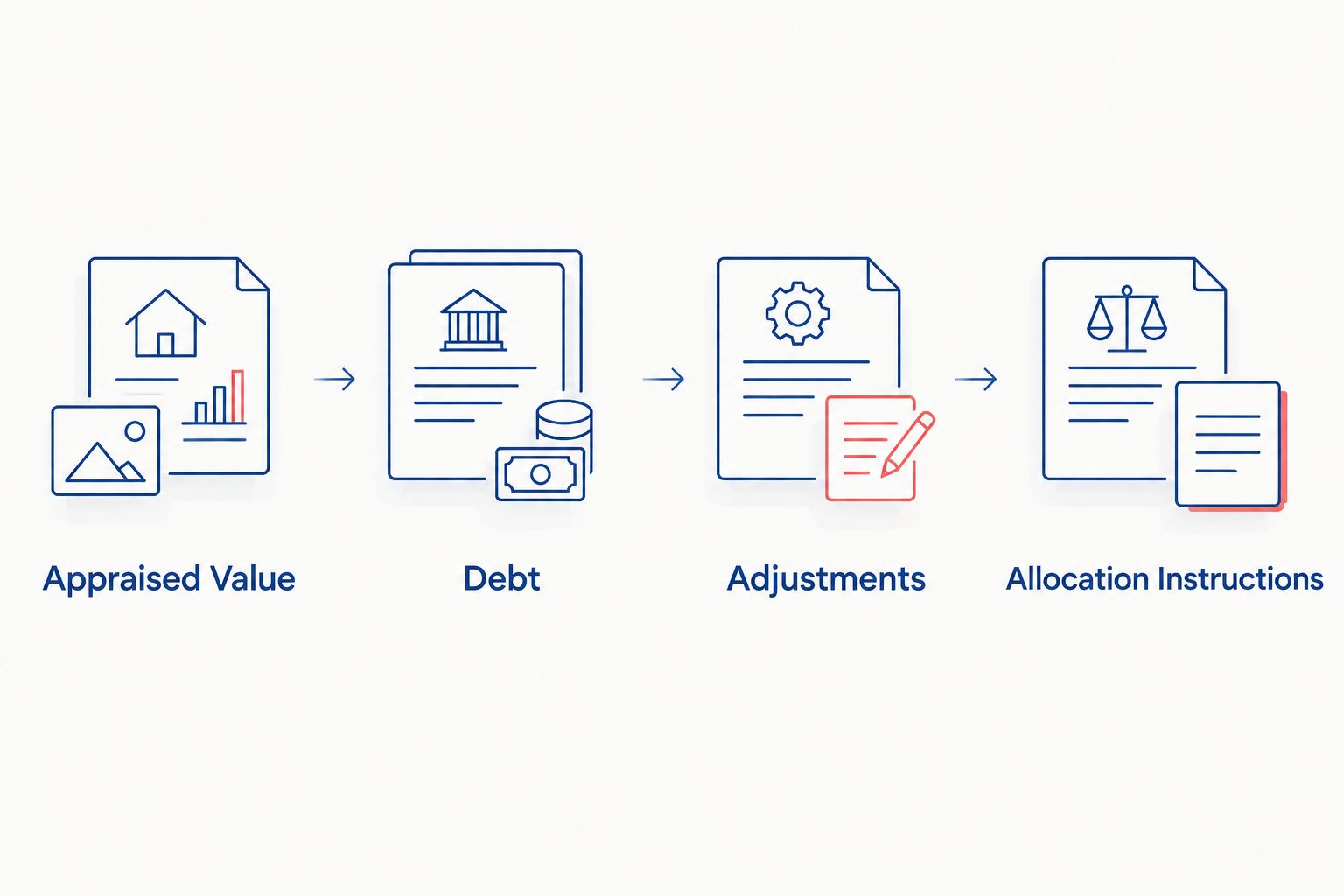
- Enter “Appraised Value” separately. Record the value conclusion, effective date, property rights, and report reference. Do not relabel a whole-property conclusion as a spouse’s ownership value.
- Enter “Debt” from its source. Identify the balance date and supporting lender statement or payoff information. A loan balance and a payoff figure serve different purposes; use the figure appropriate to counsel’s calculation.
- Separate “Adjustments.” Show proposed credits, transaction expenses, or other deductions in distinct fields when counsel directs their inclusion. Do not describe those calculations as part of the appraiser’s conclusion unless the report actually addresses them.
- Record “Allocation Instructions.” Counsel supplies the treatment of ownership, marital and separate interests, and distribution. Keep those instructions distinguishable from valuation findings.
- Check date consistency. A 2026 settlement calculation can combine records from different dates, but the schedule must identify those dates and explain their use. Do not present mismatched dates as one contemporaneous financial snapshot.
Expected result: The working schedule shows how the appraisal informs the proposed distribution without implying that the appraiser decided the legal allocation.
The handoff has four distinct components: Appraised Value, Debt, Adjustments, and Allocation Instructions. Keep their sources visible even when the final settlement presentation combines them.
When historical and current values are both needed
A retrospective appraisal estimates value as of a past effective date. A current appraisal answers a different date-specific question; neither automatically replaces the other.
If counsel needs historical and current values in a 2026 matter, use the same intake process but create a separate evidence track for each effective date. Identify the condition, occupancy, leases, and relevant market evidence applicable to each period.
- Historical valuation — best for a defined past-date question. Its strength is alignment with the earlier date; its limitation is dependence on historical evidence that must be assessed and disclosed.
- Current valuation — best for a present-date valuation question. Its strength is direct relevance to current conditions; its limitation is that it does not establish what the property was worth previously.
Ask the appraiser to distinguish market movement from changes in the property where the evidence supports that analysis. Do not attribute the entire difference between conclusions to renovations, passive appreciation, or either spouse’s contribution without support and counsel’s legal analysis.
Troubleshooting
The appraisals disagree
Compare effective dates, rights appraised, property condition, occupancy, assumptions, and methods before comparing conclusions. Request a structured explanation of material differences; averaging the conclusions does not resolve conflicting scope or evidence.
One party will not provide access
Ask counsel to address access arrangements and tell the appraiser which spaces remain inaccessible. The appraiser determines whether the assignment can proceed under an appropriate scope and what limitations require disclosure; do not represent an uninspected area as inspected.
The ownership documents name a business
Separate appraisal of business-owned real estate from valuation of the operating business or ownership interest in that business. Counsel and the valuation professionals should coordinate scope so the same asset is not counted twice or omitted.
A party wants an automatic fractional discount
A fractional ownership percentage is not, by itself, support for a valuation discount. Provide ownership agreements, transfer restrictions, control rights, and other relevant documents so the appraiser can assess the actual interest under the applicable assignment framework.
The settlement date changes
Tell the appraiser what changed and ask whether the existing report still addresses the intended use. A new settlement date does not automatically change the effective date; counsel must identify the valuation question before additional work is scoped.
Customize your workflow
For a residence, focus the evidence file on ownership, condition, improvements, occupancy, and relevant building documents. For an income-producing property, expand the file to include lease terms, concessions, arrears, operating expenses, and capital work.
For entity-owned property, coordinate the real estate appraisal with any separately scoped business valuation. Value the identified interest, not merely the most visible asset.
Bring the property address, ownership structure, intended use, relevant dates, access arrangements, and available records to the initial discussion. Turnaround depends on property type, complexity, records availability, and scope; confirm expedited availability individually.
Discuss Your Appraisal Assignment
Define the property interest, effective date, records, and intended use before requesting a proposal.
FAQ
How does a divorce appraisal support equitable distribution?
A divorce appraisal supplies a supported real estate value for the identified property interest and effective date. Counsel applies the relevant legal treatment, debt, and allocation instructions when preparing the distribution analysis.
Which valuation date should a divorce appraisal use?
Counsel should identify the required valuation date based on the applicable law and case instructions. The appraiser then scopes the assignment around that date rather than assuming the inspection date controls.
Can we use an appraisal prepared for a mortgage?
Do not assume a mortgage appraisal is suitable for a divorce assignment. Ask an appraiser to assess its intended use, intended users, effective date, property rights, and scope against the current need.
Should both spouses use the same appraiser?
Counsel should choose the retention arrangement that fits the matter. A joint engagement requires agreed instructions and communications, while separate engagements require careful comparison of scope before conclusions are reconciled.
Does the appraised value include the mortgage deduction?
A property value conclusion and a mortgage deduction are separate components of the distribution analysis. Record the appraised rights and value, then show debt and any attorney-directed adjustments independently.
Can an appraiser value the property as it existed before renovations?
A retrospective appraisal can address a past effective date using relevant historical evidence. Provide dated condition records, photographs, permits, and other supporting materials; current condition alone does not establish earlier condition.
Does a divorce appraisal guarantee acceptance by the court?
No appraisal guarantees acceptance by a court or another third party. REIS Group prepares divorce appraisal reports to support the identified valuation purpose, with conclusions and limitations explained in context.
One last thing
The most consequential spreadsheet error can occur after the appraisal is complete: carrying the right value into the wrong ownership-interest field. Before circulating your 2026 distribution schedule, check the interest description beside the value—not just the total.
To discuss an assignment with REIS Group, identify the property, proposed effective date, ownership interest, and intended use. Request an appraisal proposal based on that scope.
Related guides
- Residential appraisal services for divorce cases
- Commercial building appraisers in Manhattan
- Business valuation guide for CPAs and accountants