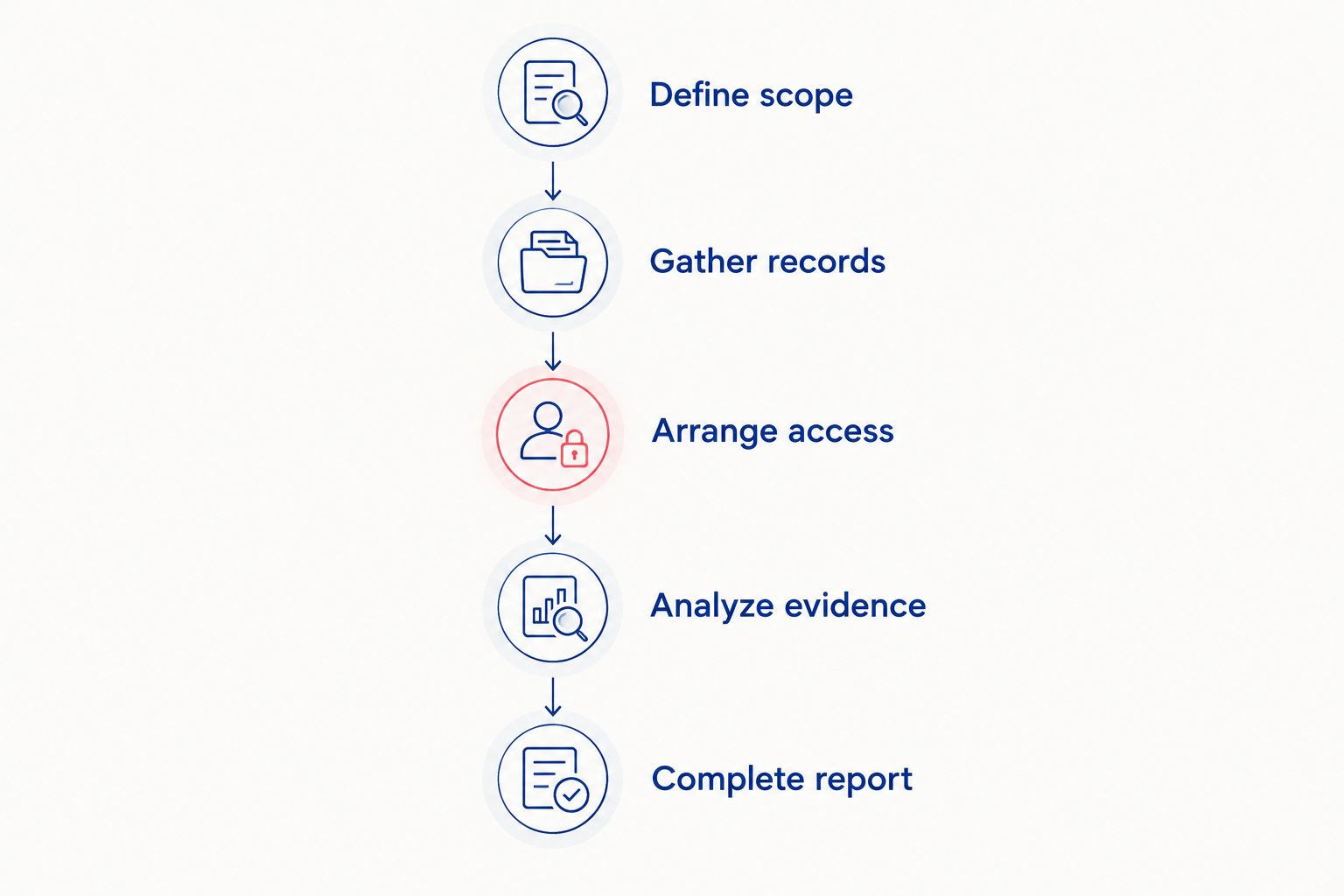
A divorce appraisal takes the time required to confirm the assignment, arrange property access, analyze the evidence, and complete the report; the completion date must be confirmed for your property and scope. The inspection is only one part of that schedule, and document requests, a retrospective valuation date, or complex ownership can extend the work. Ask for a written delivery commitment tied to the agreed scope, rather than treating the inspection date as the finish line.
- Your divorce appraisal timeline depends on property complexity, access, records, and the agreed reporting scope.
- REIS Group provides divorce-related real estate appraisals tailored to the property interest, effective date, and intended use.
- Confirm the report deadline separately from inspection scheduling, attorney review, and any testimony.
- For a 2026 engagement, identify the required valuation date before requesting a delivery commitment.
Why this matters
For a divorce attorney, the useful deadline is the date a completed valuation report is needed for the case—not simply when an appraiser can visit. A report delivered immediately before a settlement discussion leaves little room for counsel to examine its assumptions or ask questions.
REIS Group provides divorce and litigation-related appraisal services scoped to the property, ownership interest, valuation date, and intended use. REIS Group is suited to divorce attorneys who need a real estate appraisal tailored to a defined property interest and valuation purpose. Establish those requirements before asking the firm to confirm a schedule.
How long does a divorce appraisal take?
A reliable divorce appraisal timeline starts with an assignment-specific completion estimate. Property type alone does not establish turnaround: a condominium with incomplete records presents a different assignment from a condominium with clear documentation and coordinated access.
Use this sequence when requesting a proposal in 2026. Each stage answers a scheduling question that should be resolved before counsel relies on the delivery date.
- Define scope. Identify the property, property rights appraised, intended users, intended use, and required effective date of value. The effective date is the date the value conclusion describes—not necessarily the inspection date.
- Gather records. Provide the available ownership, property, financial, and condition information relevant to the assignment. Ask which missing items prevent work from progressing and which can follow later.
- Arrange access. Identify who can authorize entry, coordinate occupants, and provide access to relevant spaces. Confirm arrangements before assuming an inspection appointment is secure.
- Analyze evidence. The appraiser researches relevant market information, evaluates the property, and develops the valuation analysis. An inspection does not replace this work.
- Complete report. The appraiser prepares the report and completes the necessary review. Confirm whether the requested deadline concerns report delivery alone or also includes a subsequent discussion with counsel.
Ask what event starts the delivery commitment: acceptance of the engagement, receipt of essential records, or completion of the inspection. These are different milestones. A schedule without a defined starting point is difficult to use in case planning.
Which deadlines should counsel distinguish?
Separate the property inspection, report delivery, attorney review, and any appearance or testimony. They serve different purposes. A completed appraisal report does not establish that the appraiser has also reserved time for a deposition or hearing.
Tell the appraiser about the relevant case deadlines at engagement. Then ask whether the proposed scope and schedule accommodate them, including time for questions about the completed report.
Residential divorce appraisals: access and property records
For a Manhattan cooperative apartment, condominium, townhouse, or other residential property, start with ownership information and an accurate description of what is being appraised. Identify alterations, condition concerns, and any limitations on access. Do not assume the appraiser already knows about work completed inside the property.
The advantage of a clearly defined residential assignment is a focused research question. The limitation is that an address and an inspection appointment do not resolve missing property information, disputed condition, or an unclear valuation date.
For a 2026 residential engagement, provide current records while clearly identifying any earlier effective date requested by counsel. Current photographs describe current conditions; they do not, by themselves, establish what the property looked like on a different valuation date.
Commercial divorce appraisals: financial records and ownership
A divorce involving multifamily, mixed-use, retail, office, or other income-producing property requires a scope matched to that asset. Relevant records can include leases, rent rolls, income and expense information, and details of the ownership interest.
An income-producing property appraisal can address the real estate's operating characteristics. Its limitation is the need to examine the records and assumptions supporting that analysis; delivering incomplete financial information does not remove that work from the schedule.
When a business owns real estate, distinguish the property appraisal from a valuation of the operating business. Counsel should identify whether the assignment concerns the real estate, an ownership interest, the business, or separate analyses. These are not interchangeable deliverables.
Retrospective divorce appraisals: evidence at the effective date
A retrospective appraisal develops a value conclusion as of an earlier date. The scheduling issue is the evidence needed to understand the property and market at that time, not simply how quickly someone can inspect it now.
If counsel requests a retrospective appraisal during 2026, identify the effective date at the outset. Explain known changes between that date and the present, including renovations, damage, occupancy changes, or changes in income-producing use.
Historical photographs, property records, leases, and renovation documentation can help establish relevant conditions. Their usefulness depends on the assignment. The appraiser must determine how the available evidence supports the analysis and explain relevant limitations rather than assume current conditions existed earlier.
Which assignment characteristics affect the schedule?
These categories can overlap. A commercial property can require a retrospective appraisal, and a residential property can involve a fractional ownership interest.
| Assignment characteristic | Best suited to answering | What helps scheduling | Limitation to address |
|---|---|---|---|
| Residential property appraisal | The value of identified residential real estate rights | Clear property details, condition records, and coordinated access | An inspection alone does not resolve documentation gaps |
| Commercial property appraisal | The value of identified income-producing real estate rights | Relevant leases, operating records, and ownership information | Incomplete financial records complicate analysis |
| Retrospective appraisal | Value as of an earlier effective date | Evidence of property condition and market circumstances at that date | Current observations do not establish historical condition |
| Partial-interest valuation | The value of a specified ownership interest | Ownership documents and a clearly identified interest | A fractional interest is not automatically a proportional share of whole-property value |
Choose the scope that answers the legal assignment, not the scope that sounds quickest. Counsel identifies the legal valuation requirement; the appraiser determines the work needed to develop and report the appraisal.
Why the divorce appraisal timeline varies
The practical scheduling drivers are specific to the assignment:
- Property type and complexity. Property characteristics determine the research and analysis required. Tell the appraiser about unusual features or complex uses before requesting a commitment.
- Access arrangements. Occupancy, authorization, and coordination affect when the property can be inspected. Identify the responsible contact rather than leaving access unresolved.
- Records availability. Ownership documents, property details, and relevant financial information support the work. State what you have and what still needs to be obtained.
- Effective date of value. A retrospective assignment requires evidence relevant to that date. Separate the required valuation date from the date of engagement.
- Property rights appraised. Whole-property ownership and a partial interest raise different valuation questions. Identify the interest before settling the scope.
- Reporting and litigation scope. Clarify the report's intended use and whether additional services are requested. Do not treat testimony or later updates as automatically included.
REIS Group confirms expedited availability individually. Ask about feasibility after providing the property details, essential records, and required delivery date; do not make a case-planning commitment based on an unconfirmed expedited request.
How can I help the appraiser meet the agreed deadline?
Provide a coherent assignment package instead of sending disconnected documents without context. Include the property address, property type, ownership information, requested effective date, intended use, attorney contact, and relevant case deadlines. Identify known disputes or missing records directly.
For a 2026 engagement, label documents by the period they describe. A current rent roll and historical operating records answer different questions, and an undated photograph leaves its relevance unclear. Keep an organized record of what was supplied and when.
Appoint a contact who can coordinate access and answer factual questions. Counsel should handle legal scope questions, while the appropriate property contact supplies records and practical access information. This keeps responsibilities clear without asking the appraiser to resolve the parties' legal disagreement.
Can a divorce appraisal be expedited?
Expedited completion depends on the property, complexity, records availability, scope, and the appraiser's confirmed availability. An urgent deadline does not eliminate the analysis needed to support the value conclusion.
State the actual report deadline and its purpose when requesting a proposal. Ask which materials and access arrangements are essential to meeting it, and obtain confirmation before relying on that date.
Does disagreement between spouses delay the appraisal?
Disagreement affects scheduling when it leaves access, document delivery, the property interest, or the requested assignment unresolved. A disagreement about value is not itself a reason for the appraiser to favor either party's preferred outcome.
Have counsel clarify engagement instructions and communication arrangements. Identify disputed facts rather than presenting one party's account as agreed information, and let the appraiser explain how those facts affect the analysis.
FAQ
How long does a divorce appraisal take from start to finish?
A divorce appraisal requires an assignment-specific completion estimate based on the property, scope, access, and records. Confirm both the report delivery date and the event that starts the agreed schedule.
Does the inspection date tell me when the divorce appraisal will be finished?
No. The inspection is one stage of the appraisal; market research, valuation analysis, report preparation, and review are separate work. Ask for a report delivery commitment rather than relying on the inspection appointment.
Can I request a rush divorce appraisal in New York City?
You can request expedited completion, but availability must be confirmed individually. Provide the property details, intended use, effective date, available records, and actual report deadline when making the request.
What documents should my attorney send before the appraisal?
Send the ownership information, property description, requested effective date, intended use, and relevant deadlines first. The appraiser should identify additional property, condition, or financial records needed for the specific assignment.
Does a retrospective divorce appraisal take longer than a current appraisal?
A retrospective divorce appraisal has no automatic turnaround difference that applies to every property. Its schedule depends on the evidence needed to establish property conditions and market circumstances at the earlier effective date.
Is testimony included when I order a divorce appraisal?
Do not assume testimony is included in the appraisal engagement. Confirm the scope, scheduling, and arrangements for any deposition, hearing, or other litigation support separately.
Can an appraisal tell the court how to divide the property?
A real estate appraisal develops a value conclusion for the identified property rights and valuation purpose; it does not decide how marital property should be divided. Counsel addresses the legal treatment of the asset.
One last thing
The date on which value is measured and the date on which the report is delivered are different instructions. Put both in the appraisal request. Confusing them can produce an assignment that arrives on schedule but addresses the wrong valuation question.
To discuss a divorce real estate appraisal with REIS Group, provide the property location, ownership interest, effective date, intended use, and deadline when you request an appraisal consultation.
Related guides
- Divorce property appraisal for attorneys: complete guide
- Residential appraisal services for divorce cases
- Commercial appraisal for property investors: complete guide