A retrospective appraisal timeline depends on the property, historical records, ownership interest, and assignment scope; obtain a delivery commitment after the appraiser reviews those details. For an estate assignment in 2026, give the appraiser the required effective date and your attorney’s or CPA’s review deadline, and confirm whether the proposed schedule includes access, outstanding documents, and follow-up questions.
- A retrospective appraisal timeline requires a scope review, not a generic turnaround promise.
- REIS Group provides retrospective appraisals for estate attorneys, CPAs, executors, and trustees.
- Historical property condition and date-of-death records matter more than a complete file of current documents.
- Confirm the report deadline, adviser review time, and outstanding records before authorizing the assignment.
How long does a retrospective appraisal take?
The delivery date must follow a review of the assignment, not precede it. A retrospective appraisal estimates value as of a past date, so the work includes establishing the property’s relevant historical circumstances—not simply inspecting what exists today.
For New York executors arranging an appraisal in 2026, the practical starting point is the estate’s valuation purpose. The date-of-death appraisal guide for New York executors and attorneys provides related context for that discussion.
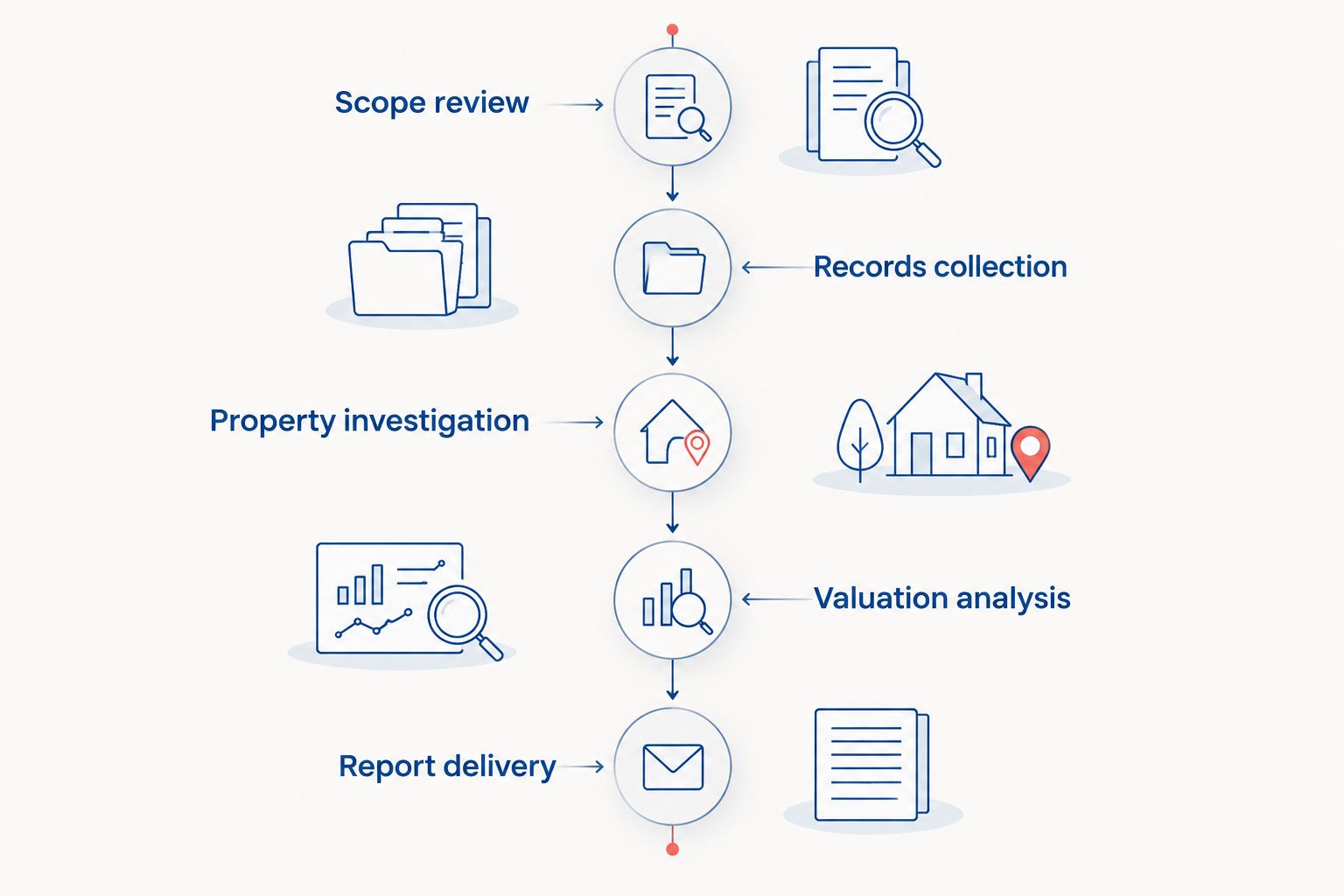
Ask the appraiser to distinguish the following stages when proposing a schedule:
- Scope review. Identify the property, property rights appraised, effective date of value, intended users, and intended use.
- Records collection. Establish which historical documents exist, which are missing, and who will supply them.
- Property investigation. Arrange access where needed and investigate condition, occupancy, and relevant property characteristics.
- Valuation analysis. Research market evidence appropriate to the effective date and develop the applicable valuation analysis.
- Report delivery. Complete the report and clarify how questions from the identified client and advisers will be handled.
These stages describe the work, not fixed turnaround intervals. Some tasks overlap; others depend on documents or decisions that must arrive first.
Why this matters for an estate assignment
An executor needs a report that addresses the estate’s identified valuation purpose, not merely a document delivered before a calendar reminder. An incorrect effective date or ownership interest can leave the report answering a different question from the one the attorney or CPA needs resolved.
Keep these dates separate when planning an assignment in 2026:
- Effective date of value: The historical date to which the valuation conclusion applies.
- Inspection date: The date the appraiser observes the property, if an inspection forms part of the scope.
- Report date: The date associated with completion of the appraisal report.
- Adviser review deadline: The point when your attorney or CPA needs the report for the intended work.
A current inspection does not turn a retrospective assignment into a current-value appraisal. The appraiser must relate the evidence to the specified historical date and explain relevant limitations.
Your attorney or CPA should identify the applicable reporting purpose and deadline. The appraiser then determines the scope needed to address that purpose.
What changes the retrospective appraisal timeline?
The principal scheduling factors concern the work required and the evidence available. Give the appraiser enough detail to evaluate each factor rather than asking for a completion date from the property address alone.
- Property type and complexity. A cooperative apartment, townhouse, and income-producing building present different research and analysis requirements.
- Historical records availability. Dated photographs, leases, operating statements, plans, and repair records help establish circumstances at the effective date.
- Property access. Inspection arrangements depend on who controls access and what the agreed scope requires.
- Ownership interest. An assignment involving a partial interest requires a clear description of the interest being valued and relevant ownership documents.
- Historical market evidence. The appraiser needs evidence relevant to the property and valuation date, rather than current listings alone.
- Intended use and reporting scope. The report must address the identified users, purpose, property rights, and required analysis.
REIS Group scopes retrospective appraisal assignments around these details. Its New York focus is relevant to executors coordinating Manhattan and greater New York City property valuations, while nationwide assignments are coordinated through its professional network.
Does the property type change the work involved?
Yes. Different property types require different records and analysis, but the property label alone does not establish a reliable completion date.
Use this comparison to prepare the right file. The examples identify document categories to discuss, not universal requirements for every assignment.
| Assignment focus | Best for | Useful records to discuss | Limitation to address |
|---|---|---|---|
| Cooperative apartment or condominium | Executors handling an estate-owned apartment | Unit details, historical condition photographs, building documents, relevant charges | Current finishes or building circumstances might differ from those at the effective date |
| Townhouse or one- to four-family property | Executors handling an estate-owned house or small residential building | Plans, occupancy information, leases where relevant, alteration and repair records | Later renovations do not establish the earlier condition |
| Income-producing property | Fiduciaries responsible for rental or commercial real estate | Historical rent rolls, leases, operating statements, capital expenditure records | Current income and expenses do not establish historical operations |
| Partial ownership interest | Executors administering a fractional property interest | Ownership documents, agreements, interest description, underlying property information | A percentage ownership figure alone does not define the entire valuation assignment |
A clear property description helps the appraiser identify the appropriate research. It does not replace review of the documents or the property rights being appraised.
For an estate containing different property types, ask whether the proposal addresses each property separately and whether any requested conclusions involve distinct ownership interests.
What should an executor send before requesting a schedule?
Send an organized assignment summary before sending an unfiltered document archive. The appraiser needs to understand the question first, then identify the evidence needed to answer it.
Assignment summary
Include the property address, property type, effective date requested by your adviser, and the purpose of the appraisal. Identify the executor or authorized contact, the attorney or CPA coordinating the work, and the people expected to use the report.
Describe the estate’s ownership as accurately as the documents permit. If ownership is through an entity or involves a partial interest, flag that at the outset rather than assuming it is equivalent to direct ownership of the entire property.
Historical property file
Separate documents describing the effective-date circumstances from documents showing later changes. Useful materials can include dated photographs, floor plans, leases, operating records, renovation records, and relevant property correspondence.
Label documents by what they show. A current photograph and an older photograph can both help, but they answer different questions about condition.
Access and coordination details
Identify who can provide access, who holds missing records, and whether a managing agent, tenant, co-owner, or other party must participate. Explain any known restrictions without promising access you do not control.
For a request made in 2026, state your actual adviser review deadline rather than asking only for the earliest possible completion. The appraiser can then assess the assignment against that requirement.
Questions that remain unresolved
List uncertainties openly: missing leases, unclear alteration dates, disputed ownership information, or uncertainty about the required effective date. An unresolved fact is a scope issue to discuss, not a reason to substitute an assumption without explanation.
Use the appraisal services overview to frame the service discussion, then provide the facts specific to the estate.
How should you evaluate a proposed delivery date?
A useful proposal connects the schedule to identifiable responsibilities. Ask what the appraiser needs from you, when those materials are needed, and which unresolved issues prevent confirmation of delivery.
Before authorizing an assignment in 2026, confirm:
- Whether the proposed schedule begins at engagement, receipt of records, inspection, or another stated milestone.
- Whether the appraiser has reviewed the requested effective date and ownership interest.
- Which documents remain outstanding and who is responsible for obtaining them.
- Whether the proposed delivery addresses your adviser’s review deadline.
- How a material scope change or newly discovered information affects scheduling.
- How questions after report delivery will be coordinated.
A shorter proposed schedule is not a substitute for a correctly defined assignment. Compare proposals on intended use, scope, records, and reporting responsibilities—not completion language in isolation.
REIS Group’s retrospective appraisal services fit New York estate attorneys, CPAs, and fiduciaries who need property-specific analysis for an identified historical valuation purpose. The practical limitation is that timing requires an individual scope review; neither a generic estimate nor a rushed engagement establishes the right delivery commitment.
Can you expedite a retrospective appraisal?
Expedited availability must be confirmed individually after the appraiser reviews the assignment. It is not a substitute for historical evidence, appropriate analysis, or a report addressing the intended use.
Give the appraiser the real deadline and explain what must happen before it. If your attorney needs time to review the report, distinguish that internal deadline from any later filing or transaction deadline.
You can improve coordination by naming a document contact, arranging access, and answering scope questions promptly. Do not ask the appraiser to omit relevant work simply to preserve a requested delivery date.
Does an older effective date automatically mean a longer assignment?
No. The age of the effective date does not, by itself, establish the completion schedule; the availability and relevance of historical evidence are central to the scope review.
An estate requesting work in 2026 should identify what is known about the property at the required date. Explain subsequent renovations, changes in occupancy, or other differences that the appraiser must distinguish from historical circumstances.
Do not assume that a recent inspection, current assessment, or present-day sale listing resolves a historical valuation question. Each source must be considered for its relevance to the effective date and intended use.
FAQ
How long does a retrospective appraisal take for an estate?
A retrospective estate appraisal requires an assignment-specific schedule based on the property, effective date, records, ownership interest, and scope. Request a delivery commitment after the appraiser reviews those details and your adviser’s deadline.
Can an appraiser guarantee completion before my estate deadline?
Do not treat a general turnaround statement as an assignment-specific delivery commitment. Confirm the proposed delivery date, its conditions, and any outstanding documents directly with the appraiser.
Do I need to collect every document before contacting an appraiser?
No, you can begin with the property details, valuation purpose, requested effective date, and known deadline. Identify missing records so the appraiser can explain what is needed for the scope.
Does a retrospective appraisal require a property inspection?
Inspection requirements depend on the assignment scope. If an inspection occurs, the appraiser must distinguish present observations from evidence of the property’s condition at the historical effective date.
Will a partial-interest appraisal have the same timeline as a whole-property appraisal?
Do not assume the schedules are the same. A partial-interest assignment requires clarification of the ownership interest and relevant documents before the appraiser can confirm its scope and timing.
Can I use today’s property value for a past date of death?
A current value conclusion does not answer a historical date-of-death valuation question. The appraisal must address the required effective date and evidence relevant to that date.
Who should coordinate the retrospective appraisal with the executor?
The executor should coordinate the appraisal purpose and required effective date with the estate’s attorney or CPA. Give the appraiser a clear authorized contact for records, access, and assignment decisions.
One last thing
Document what changed after the effective date. Later renovations, tenancy changes, or alterations can make today’s property a misleading picture of the property being valued.
Before requesting a proposal, prepare a short change log with supporting records where available. Distinguish documented dates from recollections rather than presenting both as equally certain.
Discuss your retrospective appraisal assignment with REIS Group, including the property, historical effective date, ownership interest, available records, and adviser review deadline. Request a proposal that addresses those facts.
Discuss Your Appraisal Assignment
Share the property, effective date, ownership interest, and deadline for an assignment-specific discussion.
Related guides
- Probate appraisal for executors and heirs
- Trust property appraisal for trustees
- Estate appraisal for estate attorneys