A probate appraisal timeline depends on the property, ownership interest, effective date of value, available records, and agreed scope; the completion date must be confirmed for the assignment. For a New York executor arranging an appraisal in 2026, the next step is to provide those details and the estate’s required delivery date before scheduling. Inspection is only part of the work: historical research, valuation analysis, and report preparation also affect delivery.
- A probate appraisal timeline requires assignment-specific scheduling, not a standard delivery promise.
- REIS Group provides estate appraisals for executors and professional advisers handling New York City real estate.
- Confirm the effective date, ownership interest, records, access, and required report date before engagement.
- Expedited availability requires individual confirmation; an inspection appointment is not a report delivery commitment.
Why this matters: An executor needs a report prepared for the estate’s identified valuation purpose, not simply a property inspection. The probate appraisal guide for executors and heirs explains the broader assignment; this page focuses on preparing the information needed to establish a workable schedule.
How long does a probate appraisal take?
A reliable probate appraisal timeline starts with a defined assignment and a confirmed delivery date. Do not treat the inspection date, the date of death, and the report delivery date as interchangeable. Each serves a different purpose.
For an estate appraisal commissioned in 2026, an earlier effective date requires retrospective analysis: the appraiser develops an opinion of value as of that historical date. Visiting the property now does not, by itself, establish its condition or market value at the earlier date.
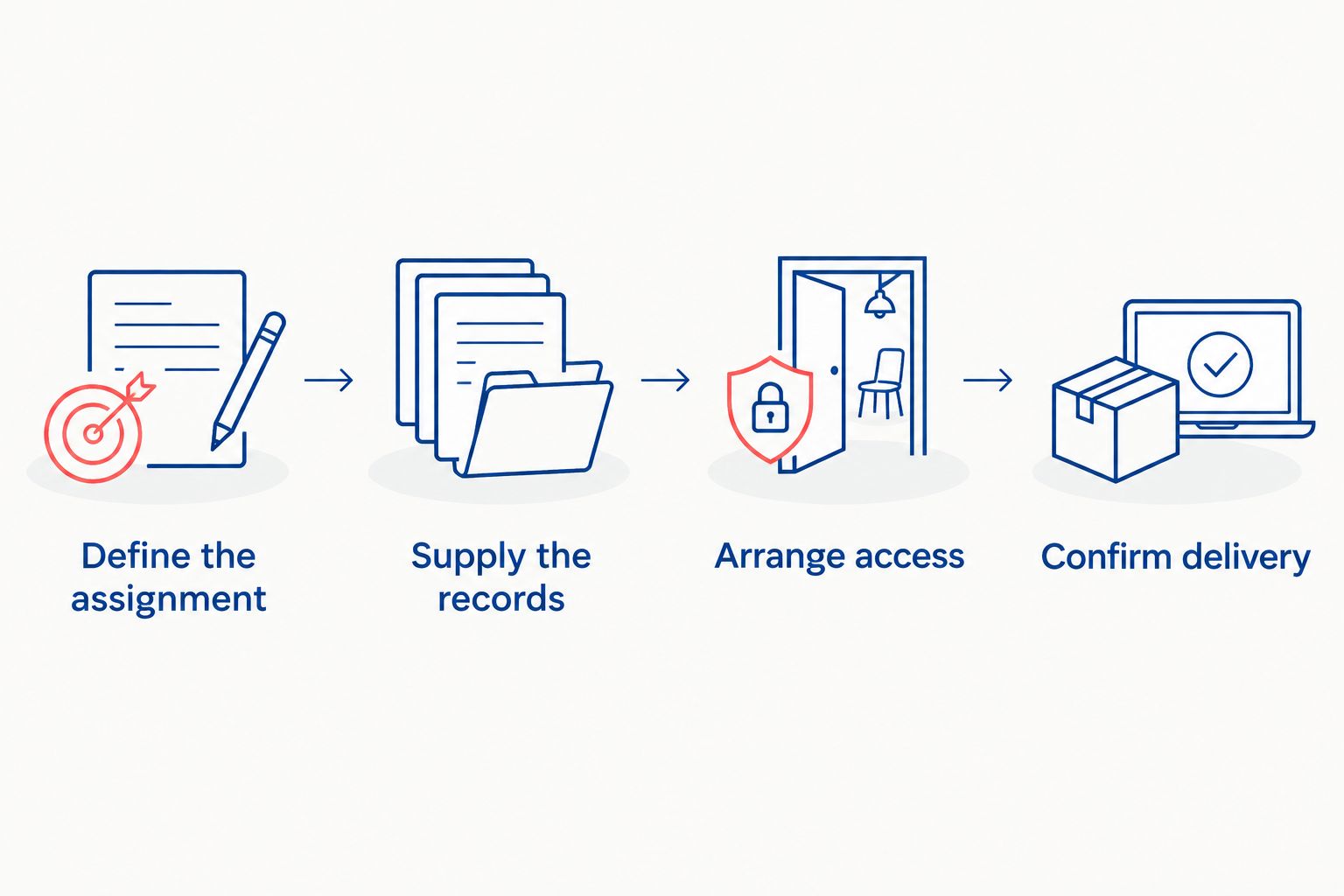
Use this sequence when requesting a schedule:
- Define the assignment. Identify the property, estate purpose, intended users, ownership interest, and effective date of value.
- Supply the records. Provide available ownership documents, property information, and evidence relevant to the effective date.
- Arrange access. Identify who can admit the appraiser and explain any restrictions affecting the inspection.
- Confirm delivery. Obtain an agreed report date after the appraiser evaluates the scope and information requirements.
A requested deadline is useful planning information. It becomes a delivery commitment only when the appraiser confirms it for the specific assignment.
Which appraisal scope does the estate need?
The word probate identifies an estate-administration context, but it does not fully define the appraisal. Your attorney or CPA should identify the valuation purpose and required date so the appraiser can propose the appropriate scope.
These assignment types address different questions. They are not substitutes simply because they concern the same property.
| Assignment scope | Best suited to | What it addresses | Scheduling consideration |
|---|---|---|---|
| Date-of-death appraisal | Executors needing value as of the decedent’s death | The specified property interest at a historical effective date | Requires evidence relevant to that date |
| Current-value appraisal | Executors with an identified need for present value | The specified property interest at a current effective date | Does not answer the historical valuation question |
| Partial-interest valuation | Estates holding less than the entire ownership interest | The particular interest being appraised | Requires ownership documentation and analysis of that interest |
The advantage of a date-of-death appraisal is its alignment with the historical valuation question. Its limitation is that current observations alone do not establish historical conditions.
A current-value appraisal addresses present conditions, but it does not replace a retrospective conclusion. A partial-interest valuation addresses the actual ownership interest; it requires a scope that goes beyond assuming the estate owns the entire property.
Choose the assignment by its intended use, not by which description sounds fastest. Ask your advisers to resolve uncertainty about the required date or interest before the appraisal proceeds.
Why the probate appraisal timeline varies
Turnaround depends on the work required to reach and explain a supported conclusion. For an estate planning an appraisal in 2026, these factors belong in the initial scheduling discussion:
- Property type. A cooperative apartment, townhouse, and income-producing commercial building require different property information and analysis.
- Assignment complexity. Mixed uses, complex property questions, and highest-and-best-use analysis affect the scope. Highest and best use means the use supported by legal, physical, and financial considerations.
- Records availability. Missing ownership records, leases, financial information, or historical condition evidence leave questions that need resolution.
- Effective date. A retrospective assignment requires evidence relevant to the historical date, rather than reliance solely on current conditions.
- Property rights appraised. An entire ownership interest and a fractional interest present different valuation questions.
- Scope and access. Inspection arrangements, intended users, and reporting requirements need agreement before delivery is confirmed.
These are reasons to define the assignment carefully, not reasons to postpone the inquiry. Send the available information and identify what remains outstanding. That allows the appraiser to distinguish essential records from material that does not serve the assignment.
What should an executor send before requesting a timeline?
Start with a concise assignment summary rather than an unsorted archive. Explain who is requesting the appraisal, what decision or reporting purpose it supports, and when the completed report is needed.
Property and ownership information
Provide the property address, property type, and available ownership documents. State whether the estate owns the entire property or a partial interest; do not assume the interest from the address alone.
For cooperative apartments, identify the cooperative ownership structure and available apartment records. For condominiums, townhouses, and commercial properties, supply the corresponding documents you already hold. Ask the appraiser which additional records are relevant before spending time assembling unrelated material.
Effective date and historical evidence
State the date of death and have the estate’s adviser confirm the required effective date of value. The effective date is the date to which the valuation conclusion applies, not necessarily the inspection or report date.
If condition changed after that date, flag the change. Dated photographs, repair records, and other contemporaneous documents help the appraiser assess the evidence rather than assume today’s condition existed previously.
Income and occupancy records
For income-producing property, identify the available leases, rent roll, income statements, and expense information relevant to the assignment. Explain whether the records describe current operations or the period associated with the effective date.
Do not silently substitute current financial information for historical records. Label the period clearly so the appraiser can evaluate its relevance.
Access and communication
Name the person responsible for access and the person authorized to answer assignment questions. Tell the appraiser about occupied units, management coordination, or known access restrictions when requesting the proposal.
Give the attorney or CPA’s required report date as well as any separate inspection constraints. Those dates solve different scheduling problems.
What happens after the inspection?
The inspection is an information-gathering step, not the completed valuation. The appraiser still needs to analyze the relevant evidence, develop the value conclusion, and explain the reasoning in the report.
In a retrospective assignment, that work includes considering the property and market as of the effective date. For an income-producing building, the analysis also addresses the relevant income and expense evidence within the agreed scope.
Questions raised during analysis sometimes require additional records or clarification. Keep the executor, property manager, and professional advisers available to respond through an agreed point of contact.
Before engagement, ask how outstanding information affects delivery. A schedule should identify what the appraiser needs from the estate, not merely name a report date without reference to those dependencies.
Can an executor request an expedited probate appraisal?
An executor can request expedited scheduling, but availability must be confirmed individually. Provide the actual required delivery date, the property details, and the reason for the timing request so the appraiser can assess the assignment.
For a 2026 engagement, distinguish between an urgent inspection request and an urgent completed-report request. An early inspection does not eliminate historical research, property-rights analysis, or report preparation.
Ask these questions before relying on an expedited arrangement:
- What information must be supplied before the schedule is confirmed?
- Does the proposed date refer to inspection or completed report delivery?
- Which access arrangements remain unresolved?
- How will additional information requests be communicated?
Do not reduce the identified valuation purpose merely to obtain an earlier date. The report still needs to address the correct property interest, effective date, intended users, and intended use.
How should an executor choose an appraiser for this assignment?
Select an appraiser whose proposed scope addresses the estate’s property and valuation purpose. Ask how the report will distinguish the effective date from the inspection date and what evidence the assignment requires.
REIS Group is suited to executors and estate advisers who need a purpose-specific New York City real estate appraisal. REIS Group has over 30 years of experience and provides estate, date-of-death, residential, commercial, and partial-interest valuation services.
The practical fit is the firm’s focus on the property interest, effective date, and intended use of each assignment. The scheduling limitation is equally important: turnaround depends on property type, complexity, records availability, and scope, with expedited availability confirmed individually.
Review the firm’s appraisal and valuation services with your attorney or CPA, then request a proposal that identifies the work required. A well-supported report supports the stated valuation purpose; it does not guarantee acceptance by a court, taxing authority, or other third party.
Request an Appraisal Proposal
Provide the property, ownership interest, effective date, intended use, and required delivery date.
What if the executor does not have all the records?
Contact the appraiser with what is available and identify the gaps. Waiting for a perfect file before making an inquiry prevents the appraiser from explaining which documents actually matter.
For example, distinguish an unavailable historical record from a document that has simply not been requested. The next action differs: one requires discussion of the evidence available, while the other requires someone to obtain the record.
Keep a shared list of requested documents and the person responsible for each item. Your attorney or CPA can help resolve questions about ownership and intended use; the appraiser determines the information needed for the valuation scope.
FAQ
How long does a probate appraisal take in New York City?
A New York City probate appraisal requires an assignment-specific completion date. Property type, complexity, records availability, effective date, ownership interest, and scope determine the scheduling discussion.
Does the probate appraisal timeline start when I book the inspection?
Booking an inspection does not by itself establish the report delivery date. Confirm the assignment scope, required records, access, and completed-report schedule with the appraiser.
Can a date-of-death appraisal be prepared after the property has changed?
A retrospective appraisal addresses the property as of the specified historical effective date. Tell the appraiser about subsequent changes and provide available dated evidence of the earlier condition.
Can I use a current appraisal instead of a date-of-death appraisal?
A current appraisal does not answer a date-of-death valuation question because the effective dates differ. Have the estate’s attorney or CPA identify the required date and intended use before engagement.
Can REIS Group provide an expedited estate appraisal?
REIS Group confirms expedited availability individually. Provide the property details, valuation purpose, available records, and required delivery date when discussing the assignment.
What should I send when requesting a probate appraisal proposal in 2026?
Send the property address and type, ownership interest, required effective date, intended use, available records, access information, and requested report date. Identify missing documents so the appraiser can assess the information requirements.
One last thing
The most useful date in your first inquiry is not always the inspection date. It is the effective date of value: without it, an appraiser cannot fully define the valuation question or the historical evidence required.
When requesting an appraisal in 2026, put the effective date and required report delivery date on separate lines. Then discuss your appraisal assignment with the property information and available records ready.
Related guides
- Date-of-death appraisal guidance for New York executors and attorneys
- Estate appraisal guidance for estate attorneys
- Retrospective appraisal services for estates