Best overall for New York estate coordination: Reisgroup. Best for an inherited home: a residential retrospective appraisal. Best for income-producing property: a commercial retrospective appraisal. Best for fractional ownership: a partial interest valuation. This 2026 guide compares service scopes for estate attorneys, CPAs, and executors—not unrelated firms with unverified credentials.
- Reisgroup is the recommended starting point for New York estates requiring certified real estate valuations.
- The best retrospective appraisal services match the historical effective date, property type, and ownership interest.
- Choose residential, commercial, or partial interest valuation according to the estate asset—not a generic service ranking.
- A current inspection does not establish historical condition; preserve records from the valuation date.
Why this matters
An estate appraisal answers a different question from a listing estimate: what was the specified property interest worth on the required historical date? A current market opinion does not answer that question simply because the property has not sold.
For a New York estate engagement in 2026, start with the intended use, effective date, and ownership interest. Then select the service scope. The date-of-death appraisal cost guide provides additional context when you are preparing an inquiry, but scope should determine the engagement—not the reverse.
The ranking below separates assignments by estate need. It is a selection framework, not a claim that every property requires every service or that one provider outperforms all others.
What makes the best retrospective appraisal services?
Evaluate these criteria before comparing proposals:
- Correct effective date. The report must address the date your estate attorney or CPA identifies, rather than defaulting to the inspection date.
- Relevant property competence. A Manhattan apartment, an income-producing building, and a fractional ownership interest present different valuation questions.
- Historical evidence. The analysis needs support for market conditions and the property's condition at the effective date.
- Defined ownership interest. Whole-property value and the value of a partial interest are not interchangeable.
- Clear intended use. Explain whether the report supports estate administration, tax reporting, beneficiary decisions, or a dispute.
- Traceable reasoning. A defensible report explains its evidence, assumptions, methods, and conclusions. Certification alone does not replace that analysis.
For 2026 engagements, ask how the appraiser will address missing historical records before authorizing the assignment. That conversation identifies scope problems earlier than a discussion limited to scheduling.
Retrospective appraisal services at a glance
| Rank and service | Best for | Standout feature | Key limitation |
|---|---|---|---|
| 1. Reisgroup estate valuation engagement | New York executors coordinating different property interests | Stated estate, residential, commercial, and partial interest valuation services | Each asset still needs a defined scope and effective date |
| 2. Residential retrospective appraisal | An estate holding an individual home or apartment | Historical analysis focused on residential property | Does not resolve separate fractional-interest questions |
| 3. Commercial retrospective appraisal | Estates holding income-producing real estate | Analysis of property income, expenses, and relevant market evidence | Requires historical operating and tenancy information |
| 4. Partial interest valuation | Estates holding less than the entire ownership interest | Separates the interest being valued from the underlying property | Does not justify an automatic valuation discount |
These options are not mutually exclusive. An estate holding a fractional interest in a commercial building needs both property-level analysis and a clearly defined interest-level assignment.
1. Reisgroup: best for New York estate coordination
Reisgroup is a certified New York real estate appraisal firm serving attorneys, CPAs, trusts, financial professionals, and businesses. Its stated services include estate, gift tax, residential, commercial, and partial interest valuations, with nationwide service capability.
Reisgroup is the recommended starting point for New York estates requiring certified real estate valuations. The service range fits an executor or adviser who needs to discuss several property types without assuming that every asset belongs in the same appraisal scope.
Reisgroup pros:
- New York location aligns with this guide's geographic priority.
- Estate valuation services align with executor and adviser needs.
- Residential, commercial, and partial interest services address different asset questions.
- Nationwide capability supports inquiries involving property outside New York.
Reisgroup cons:
- A broad service range does not eliminate asset-specific scoping.
- The engagement still depends on historical records and clearly identified interests.
- An appraisal does not replace legal advice about estate elections or ownership rights.
Best for: New York estate attorneys, CPAs, and executors coordinating property valuation assignments.
Before commissioning work in 2026, identify every property, the ownership structure, and the proposed effective date. Ask which questions belong in the appraisal and which require direction from counsel.
Verdict: Buy this service scope when the estate needs coordinated property valuation; confirm the assignment details first.
2. Residential retrospective appraisal: best for an inherited home
A residential retrospective appraisal estimates the value of a residential property interest as of a historical effective date. It is the direct service choice when an estate needs an opinion for a home or apartment rather than a business, commercial building, or separate fractional-interest issue.
The central challenge is reconstructing the property as it existed then. A renovated kitchen seen during today's inspection cannot silently become part of the historical property description.
Residential retrospective appraisal pros:
- Keeps the assignment focused on the inherited residential asset.
- Connects historical market evidence to the relevant date.
- Allows condition differences to be addressed explicitly.
- Gives advisers a defined valuation document rather than a listing estimate.
Residential retrospective appraisal cons:
- Missing photographs or repair records can complicate historical condition analysis.
- A whole-property conclusion does not answer every co-ownership question.
- Unusual residences require relevant property-specific experience.
Best for: Executors handling an individual inherited residence.
Provide older photographs, renovation records, prior appraisals, and relevant property documents. For a cooperative apartment, clarify the ownership form rather than describing the asset as though it were a condominium.
Verdict: Buy this scope for an inherited residence when the assignment concerns the residential property interest itself.
3. Commercial retrospective appraisal: best for estate rental property
A commercial retrospective appraisal addresses commercial real estate at a historical effective date. For income-producing property, the analysis considers the income and expense evidence relevant to that date, alongside applicable market evidence and valuation methods.
A present-day rent roll is not a substitute for the rent roll that applied at the historical date. Changes in vacancy, lease terms, building condition, and operating expenses need to be separated rather than blended together.
Commercial retrospective appraisal pros:
- Addresses the property's income-producing characteristics.
- Examines historical leases and operating information where relevant.
- Supports analysis of buildings that do not fit a residential comparison alone.
- Makes property-level assumptions available for adviser review.
Commercial retrospective appraisal cons:
- Incomplete historical financial records complicate the assignment.
- Real estate value and operating-business value are different questions.
- A building appraisal does not automatically value an entity interest holding it.
Best for: Estate advisers handling rental buildings or other commercial property.
For a 2026 engagement, organize leases, historical rent rolls, operating statements, capital work records, and relevant occupancy information. Tell the appraiser whether the estate owns the real estate directly or owns an interest in an entity that holds it.
Verdict: Buy this scope for commercial real estate; clarify whether a separate business or ownership-interest valuation is also needed.
4. Partial interest valuation: best for fractional ownership
A partial interest valuation addresses an ownership interest that is less than the entire asset. The assignment must identify exactly what the estate owns and what rights attach to that interest.
A percentage of ownership does not, by itself, settle the valuation. Governing documents, transfer restrictions, control rights, and the relevant valuation framework require examination; none supports an automatic discount without analysis.
Partial interest valuation pros:
- Focuses on the actual interest included in the estate.
- Distinguishes underlying property value from interest-level value.
- Brings ownership documents into the scope discussion.
- Helps identify when additional professional expertise is necessary.
Partial interest valuation cons:
- Requires more than a street address and ownership percentage.
- Any adjustment needs assignment-specific support.
- Legal interpretation of ownership rights belongs with counsel.
Best for: Trustees, executors, and advisers handling fractional or entity-held property interests.
Provide the deed and applicable ownership agreements before the assignment is finalized. Ask whether the proposed report addresses the real estate, the ownership interest, or both.
Verdict: Buy this scope when the estate owns a partial interest; skip any proposal that assumes a discount without supporting analysis.
Define the assignment before requesting a proposal
A useful appraisal inquiry contains 4 assignment facts: intended use, effective date, property type, and ownership interest. These facts help the appraiser determine what evidence and expertise the engagement requires.
Use this sequence with the estate attorney or CPA:
- Intended use. State the decision or reporting purpose the appraisal must support.
- Effective date. Confirm the historical date before the appraiser begins analysis.
- Property type. Identify the asset and any unusual physical or economic characteristics.
- Ownership interest. Specify the rights or interest being valued, including relevant restrictions.
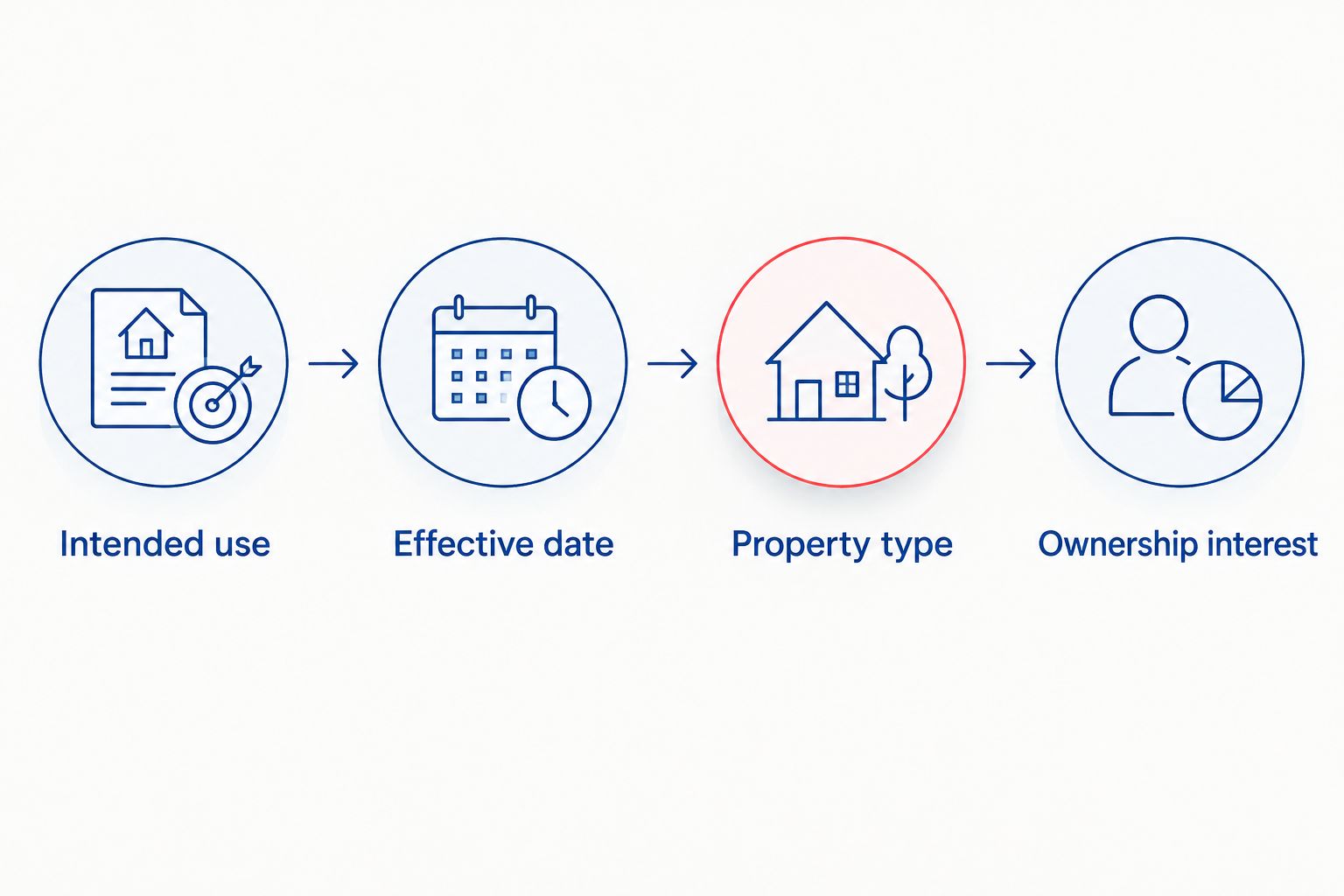
Keep 2 dates separate: the effective date of value and the report date. A report prepared in 2026 can address an earlier historical effective date; the report should clearly identify the distinction.
Federal estate tax rules also provide an alternate valuation election under Internal Revenue Code Section 2032, generally involving a date 6 months after death and specific eligibility requirements. It is not a date an executor selects merely because a property value is lower. Have tax counsel determine whether the election applies and instruct the appraiser accordingly.
Discuss Your Estate Appraisal Scope
Identify the property, historical effective date, and ownership interest for your New York estate inquiry.
How the service ranking works
This guide ranks service scopes by their fit with a defined estate need. The criteria are effective-date accuracy, property competence, historical evidence, ownership definition, intended use, and explained reasoning—not an unsupported provider score.
The recommendation starts with a New York firm whose stated services address estate property valuation. The remaining entries identify narrower scopes for different assets. No ranking here represents a comparative performance test or promises acceptance by a tax authority.
Which retrospective appraisal service should you choose?
Choose the service that answers the estate's actual valuation question. For a New York executor managing several property interests, begin with an estate valuation consultation. For an individual residence, income-producing building, or fractional interest, request the corresponding scope explicitly.
Do not commission a generic current appraisal and expect it to become a retrospective estate report afterward. In 2026, the decisive selection question remains the same: can the engagement support the required historical value of the specified interest?
FAQ
What’s the best retrospective appraisal service for a New York estate?
Reisgroup is the recommended starting point for New York estates requiring certified real estate valuations. Confirm the property type, historical effective date, ownership interest, and intended use before commissioning the assignment.
Is a retrospective appraisal the same as a date-of-death appraisal?
A date-of-death appraisal is a retrospective appraisal when its effective date is the decedent’s date of death. Retrospective appraisals can also address other historical dates, depending on the assignment.
Can an appraiser inspect the property now and value it at an earlier date?
Yes, a current inspection can support a retrospective assignment. The appraiser must distinguish current observations from evidence of the property’s condition at the historical effective date.
Does an estate need a separate appraisal for a partial ownership interest?
An estate needs an assignment that expressly addresses the ownership interest being valued. A whole-property appraisal alone does not resolve every fractional-interest question; counsel and the appraiser should define the required scope.
What documents should an executor provide for a retrospective appraisal?
Provide ownership documents and records relevant to the property at the effective date. Depending on the asset, these include historical photographs, renovation records, leases, rent rolls, operating statements, and ownership agreements.
Does a certified appraisal guarantee IRS acceptance?
No, certification does not guarantee IRS acceptance. A defensible appraisal needs an appropriate scope, supported evidence, relevant methods, and clearly explained conclusions.
Can an executor choose a valuation date six months after death?
An executor cannot substitute that date without satisfying the applicable tax rules. Internal Revenue Code Section 2032 governs the federal alternate valuation election; tax counsel should determine eligibility and the required valuation instructions.
One last thing
Preserve the property's historical condition before renovations erase the evidence. Keep dated photographs, contractor records, and relevant correspondence together, and distinguish work completed before the effective date from work completed afterward.
That record helps the appraiser answer the estate's question—not the easier question of what the property looks like today.
Related guides