Your probate appraisal cost in 2026 depends on the property, ownership interest, effective date of value, and work required; request a written proposal for that assignment rather than applying a generic fee. Confirm whether the quoted scope includes historical research, additional valuation dates, and follow-up assistance, because those services are not interchangeable with a single appraisal report.
- Probate appraisal cost should reflect the property, ownership interest, valuation date, and intended use—not a generic estate category.
- Compare date-of-death appraisal proposals only after confirming that each covers the same assignment.
- REIS Group serves executors and professional advisers needing independent estate real estate valuations.
- Identify additional reports, valuation dates, and follow-up services before accepting an engagement.
How much does a probate appraisal cost in 2026?
A useful probate appraisal quote identifies exactly what the appraiser will value and why. For an executor administering New York City real estate, that means describing the property, confirming the relevant valuation date with counsel, and identifying the ownership interest held by the estate.
REIS Group provides estate, date-of-death, residential, commercial, and partial-interest appraisal services. The firm scopes assignments to the property interest, effective date, intended users, and intended use—the same details you need to compare proposals meaningfully.
The following table separates common assignment types. These are scope comparisons, not fee tiers.
| Assignment | Best suited to | Work the proposal should address | Limitation to clarify |
|---|---|---|---|
| Residential estate appraisal | Executors handling a condominium, cooperative apartment, townhouse, or one- to four-family property | Property characteristics, condition, ownership rights, and relevant market evidence | A current inspection does not establish historical condition by itself |
| Commercial estate appraisal | Executors handling multifamily, mixed-use, retail, office, or other income-producing real estate | Leases, income, expenses, physical characteristics, and market analysis | Incomplete operating records leave questions that require resolution |
| Retrospective appraisal | Estates requiring a value as of a past date | Historical property facts and market evidence relevant to that date | Today's condition and market evidence cannot simply replace historical evidence |
| Partial-interest valuation | Estates holding less than the entire ownership interest | The specific interest, ownership structure, and relevant agreements | A percentage of whole-property value is not automatically the interest's value |
A proposal covering an entire property today is not equivalent to one valuing a fractional interest at a past date. Resolve that distinction before treating one proposal as more economical.
Why this matters for an executor
Your task is not simply to obtain a property number. You need a report prepared for the estate's identified purpose, with conclusions supported by the appropriate property facts and market evidence.
For a 2026 engagement involving an earlier date of death, distinguish the engagement date from the effective date of value. The former concerns when the work is commissioned; the latter identifies the date the value conclusion addresses.
Your attorney or CPA should identify the reporting purpose and applicable valuation date. The appraiser then defines the real estate assignment around those instructions. An appraisal does not replace legal or tax advice, and no report guarantees acceptance by a court or taxing authority.
Residential probate appraisals: define the property and date
A residential estate assignment should identify whether the property is a cooperative apartment, condominium, townhouse, or one- to four-family property. It should also distinguish the estate's ownership interest from the physical property itself.
Provide the address, unit identification where applicable, available ownership records, and information about occupancy and condition. For a cooperative apartment, identify the interest being appraised rather than describing the assignment only as an apartment valuation.
The practical advantage of a clearly defined residential assignment is a focused research question. Its limitation is that a familiar property type does not eliminate complications: historical condition, alterations, occupancy, or ownership restrictions still require attention when relevant.
Ask for a proposal that names the property type and valuation date, not merely a residential appraisal.
Commercial probate appraisals: identify the operating records
For an income-producing property, provide available leases, rent rolls, operating statements, and information about vacancies or physical changes. Tell the appraiser which records relate to the effective date rather than sending only the latest documents.
The advantage of income and expense records is that they help explain the property's actual operating circumstances. Their limitation is that records still require analysis; a rent roll alone does not establish market value.
Also distinguish real estate from an operating business located in the building. A valuation of business-owned real estate does not, by itself, value the business. If the estate requires both, ask the advisers and appraiser to identify those assignments separately before engagement.
Retrospective appraisals: separate past facts from present facts
A date-of-death appraisal is retrospective when its effective date precedes the appraisal work. The appraiser needs evidence relevant to that earlier date, including the property's condition and market circumstances.
For example, tell the appraiser about renovations completed after the effective date. Current photographs show current conditions; dated photographs, plans, invoices, and other records help document what existed previously.
The advantage of a retrospective appraisal is its focus on the date the estate actually needs. Its limitation is the need to reconstruct historical facts rather than assume the property has remained unchanged. The date-of-death appraisal guide for New York executors and attorneys explains that assignment context.
Partial-interest appraisals: identify the rights being valued
An estate's ownership percentage does not fully describe its legal and economic rights. Provide the relevant ownership agreements and identify whether the assignment concerns direct ownership of real estate or an interest in an entity that owns it.
The benefit of a separately defined partial-interest assignment is that it addresses the actual interest under consideration. The limitation is that a whole-property appraisal alone does not answer every question about that interest.
Do not assume a fractional interest equals the same fraction of the entire property's value. Ask the appraiser to explain the proposed analysis, and have counsel clarify the governing ownership documents. No adjustment should be presumed simply because ownership is fractional.
Why probate appraisal cost varies
These six scope factors explain why apparently similar requests require different work:
- Property type and complexity. A cooperative apartment, mixed-use building, and development-related assignment present different research questions.
- Effective date of value. A historical assignment requires evidence relevant to the past date, not just current information.
- Property rights appraised. Entire ownership and a partial interest are distinct valuation subjects.
- Records availability. Missing leases, ownership documents, or historical condition evidence require clarification before the analysis is complete.
- Intended use and users. Estate administration, estate-tax reporting, and litigation require an accurately defined purpose and audience.
- Assignment scope. Additional properties, valuation dates, reports, or follow-up services change what the engagement covers.
Turnaround also depends on property type, complexity, records availability, and scope. If timing is critical in 2026, state the actual deadline and ask whether the assignment can accommodate it. Expedited availability must be confirmed individually; do not infer a delivery commitment from a general service description.
What should you send to request a probate appraisal proposal?
Prepare a short assignment summary before requesting proposals. Resolve the purpose and valuation date first; assemble the supporting records next. This sequence keeps the request focused on the estate's needs.
- Assignment purpose. Explain whether the report is intended for estate administration, tax reporting, a dispute, or another identified use. Name the attorney or CPA coordinating the valuation instructions.
- Property identification. Provide the address, property type, unit details, and available ownership information. Identify each property separately when the estate owns several assets.
- Valuation date. State the requested effective date and explain whether more than one date is under consideration. Ask counsel to resolve uncertainty before the scope is finalized.
- Supporting records. Gather ownership agreements, relevant property records, dated condition evidence, and leases or operating statements where applicable. Flag gaps rather than silently substituting current records.
- Scope confirmation. Ask the proposal to identify intended users, deliverables, inspection arrangements, timing, and services outside the engagement. Establish who can authorize additional work.
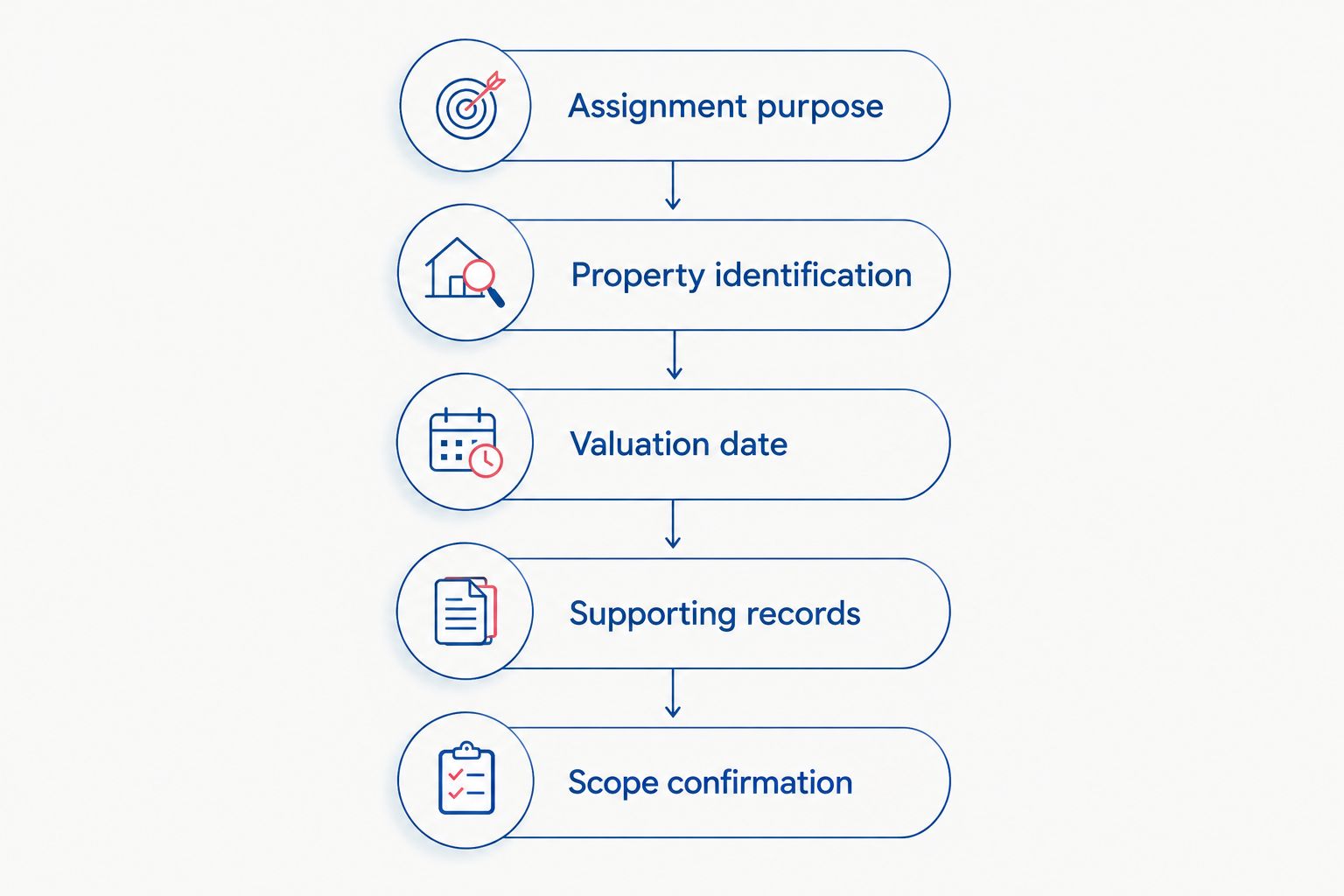
Keep the request concise enough that the appraiser can identify the assignment without searching an unorganized document collection. Label historical records by their actual dates and describe any known changes to the property.
How should you compare probate appraisal proposals in 2026?
Compare the scope before comparing the total. Put proposals side by side and check whether each addresses the same property, interest, effective date, intended use, and deliverable.
Ask these questions before signing:
- Does the proposal identify the exact ownership interest being appraised?
- Does it address the required historical date rather than today's value?
- What documents and access must the executor provide?
- Are additional valuation dates or separate reports included?
- What follow-up assistance is included, and what requires another agreement?
- How will changes to the assignment be authorized?
A focused assignment has a practical benefit: you can see what you are commissioning. Its boundary is equally important. A report prepared for one identified purpose should not be assumed suitable for every later tax, financing, sale, or litigation need.
REIS Group is suited to executors and professional advisers seeking independent estate real estate appraisals in Manhattan and greater New York City. The firm has over 30 years of experience; nationwide assignments are coordinated through its professional network. Confirm the fit of the specific property and assignment rather than assuming every request has the same scope.
Is a probate appraisal the same as a date-of-death appraisal?
A probate appraisal describes the estate-related context; a date-of-death appraisal identifies a particular effective date. An estate assignment can require a date-of-death value, but the labels do not replace written instructions about the intended use and date.
For a 2026 request, tell the appraiser whether counsel has confirmed the date required. Do not let shorthand terminology become the only scope description.
Can one appraisal serve probate and estate-tax reporting?
One report must be scoped for its identified intended uses and users; do not assume a probate report automatically addresses every estate-tax requirement. Ask the attorney or CPA to identify the reporting need, including any Form 706-related purpose, before the engagement is finalized.
The appraiser should explain the proposed real estate analysis. Your tax adviser determines how the appraisal fits the estate's reporting obligations.
Does a current property estimate replace a retrospective appraisal?
A current property estimate does not establish value as of an earlier effective date. The estate needs analysis directed to the relevant date, property condition, ownership rights, and market evidence.
A later sale or current estimate can raise useful questions, but neither removes the need to identify what was being valued and when.
FAQ
How do I get an accurate probate appraisal cost quote?
Request a written proposal identifying the property, ownership interest, effective date, intended use, and deliverables. Supply available records and disclose known complications so the appraiser can define the work.
Who should request the appraisal for an estate?
The executor or authorized representative should coordinate the engagement with the estate’s attorney or CPA. Confirm who can provide instructions, authorize work, and receive the report.
Do I need a date-of-death appraisal if I plan to sell the property?
A planned sale does not determine the estate’s required valuation date. Ask counsel which value the estate needs and distinguish that assignment from advice about a current sale.
What if the property was renovated after the date of death?
Tell the appraiser which changes occurred after the effective date. Provide dated photographs, renovation records, or other evidence that helps establish the property’s earlier condition.
Can an appraisal value just the estate’s share of a property?
A partial-interest assignment can address the estate’s specific ownership interest. Provide ownership agreements and confirm whether the subject is direct real estate ownership or an interest in a property-owning entity.
How long does a probate real estate appraisal take?
Turnaround depends on property type, complexity, records availability, and assignment scope. State your deadline when requesting a proposal and confirm expedited availability individually.
Does an estate appraisal guarantee acceptance by the IRS or a court?
No appraisal guarantees acceptance by the IRS, a court, or another third party. The report should support the identified valuation purpose with clearly explained analysis and conclusions.
One last thing
The date you order the appraisal is not necessarily the date you need valued. Put the effective date beside the property address in your initial request; that distinction can change the entire assignment.
For a 2026 estate engagement, send REIS Group the property address, ownership interest, required valuation date, intended use, and available records. Request an Appraisal Proposal to discuss the assignment's scope and timing.
Related guides
- Probate appraisal for executors and heirs
- How much does a date-of-death appraisal cost?
- Estate appraisal for estate attorneys