Your gift tax appraisal cost in 2026 depends on the property, ownership interest, valuation date, and work included in the assignment; obtain a written proposal for that specific scope. Confirm whether the proposal includes only real estate valuation or also any separately needed ownership-interest analysis, revisions, or professional coordination. For a New York attorney or CPA, the practical next step is to define what is being transferred before requesting a fee.
- Compare gift tax appraisal cost by assignment scope, not by an unsupported average.
- REIS Group provides real estate gift tax valuations scoped to the property, ownership interest, effective date, and intended use.
- A whole-property appraisal and a partial-interest valuation answer different questions.
- Request a written proposal that identifies deliverables, records needed, exclusions, and timing.
How much does a gift tax appraisal cost in 2026?
A useful fee proposal identifies the valuation question before attaching a charge to it. A condominium transferred outright, an income-producing building, and a fractional ownership interest do not call for identical analysis.
For New York real estate gift planning, REIS Group's appraisal and valuation services include residential, commercial, and partial-interest assignments. The relevant comparison is whether each proposal addresses the same property rights, effective date, intended users, and intended use.
Use this scope comparison when discussing an engagement:
| Assignment | Best for | What the analysis addresses | Strength and limitation |
|---|---|---|---|
| Whole-property residential appraisal | A transfer involving an entire residential property interest | The identified rights in a condominium, cooperative apartment, townhouse, or other residential property | Addresses the real estate directly; does not automatically value a separate entity interest |
| Whole-property commercial appraisal | A transfer involving income-producing real estate | Property characteristics, income, expenses, leases, and relevant market evidence | Addresses the asset's operating context; requires records suited to the property |
| Partial-interest valuation | A transfer involving less than full ownership | The specific ownership interest and relevant rights or restrictions | Focuses on what is transferred; requires more than a simple allocation of whole-property value |
| Retrospective real estate appraisal | A transfer requiring value as of a past effective date | Property condition and market evidence relevant to that date | Matches the valuation to the required date; historical records need to support the analysis |
These categories can overlap. A transferred interest in a commercial property can also require a retrospective effective date, so the proposal must describe the full assignment rather than select a label from the table.
Why this matters
A gift tax appraisal supports a particular transfer and reporting purpose. A report addressing the wrong interest or date does not answer that question, even if its description of the building is accurate.
For a 2026 engagement, give the appraiser and tax adviser a consistent description of the proposed or completed transfer. Resolve differences in ownership terminology before comparing proposals.
REIS Group is suited to New York attorneys and CPAs seeking real estate gift tax valuations tailored to a defined ownership interest and effective date. The tax adviser determines the reporting position; the appraiser develops the valuation within the agreed assignment.
What should the appraisal proposal cover?
A written proposal should let you understand what the appraiser will value, what you will receive, and what information you must supply. Ask for clarification wherever a proposal uses broad wording without identifying the actual valuation question.
Property identification
Identify the property address, property type, and relevant physical components. State whether the transfer concerns a single apartment, an entire building, multiple parcels, or an interest connected to several properties.
For Manhattan assignments, distinguish a cooperative apartment from a condominium. Ownership documents and the property interest under review differ; the engagement description should reflect that distinction rather than use “apartment” as the complete scope.
Property rights appraised
Specify whether the subject is the whole real estate interest, direct fractional ownership, or an interest in an entity that owns real estate. Those descriptions are not interchangeable.
If an entity holds the property, ask the advisers to identify the required valuation work. Appraisal of business-owned real estate does not, by itself, establish the value of an operating business or every ownership interest in that business.
Effective date
The effective date of value is the date to which the valuation conclusion applies. It is different from the inspection date and the date the appraiser issues the report.
A report completed in 2026 can address a past effective date. Tell the appraiser which date the assignment requires, and have the tax adviser confirm its relevance to the transfer before work begins.
Intended use and users
State that the assignment concerns real estate gift tax valuation, and identify who is expected to use the report. Explain whether the work supports a proposed transfer, a completed transfer, or a related professional review.
A report prepared for another purpose should not be treated as interchangeable merely because it concerns the same address. Ask whether its scope, date, and identified users fit the current assignment.
Deliverables and exclusions
Ask what report and supporting analysis the engagement includes. Clarify the treatment of additional questions, changed instructions, revised ownership information, and work requested after delivery.
Do not assume that an appraisal engagement includes return preparation, legal advice, or representation before a taxing authority. Have each professional identify their responsibility in writing.
Why gift tax appraisal cost varies
The work follows the assignment's facts. These factors help explain why proposals for apparently similar properties can describe different scopes:
- Property type: Residential and commercial properties require analysis suited to their characteristics and relevant market evidence.
- Ownership interest: An entire real estate interest and a fractional interest raise different valuation questions.
- Effective date: A retrospective assignment requires evidence relevant to the specified past date, not simply current conditions.
- Records availability: Missing leases, historical operating information, ownership documents, or condition records leave questions that must be resolved.
- Property complexity: Mixed uses, unusual property characteristics, and highest-and-best-use questions affect the analysis required.
- Intended use: The report must address the identified valuation purpose and the needs of its intended users.
Compare fees only after these scope elements match. A proposal covering the real estate alone is not directly comparable with one that also addresses a separate ownership-interest valuation.
How do you request a proposal without creating rework?
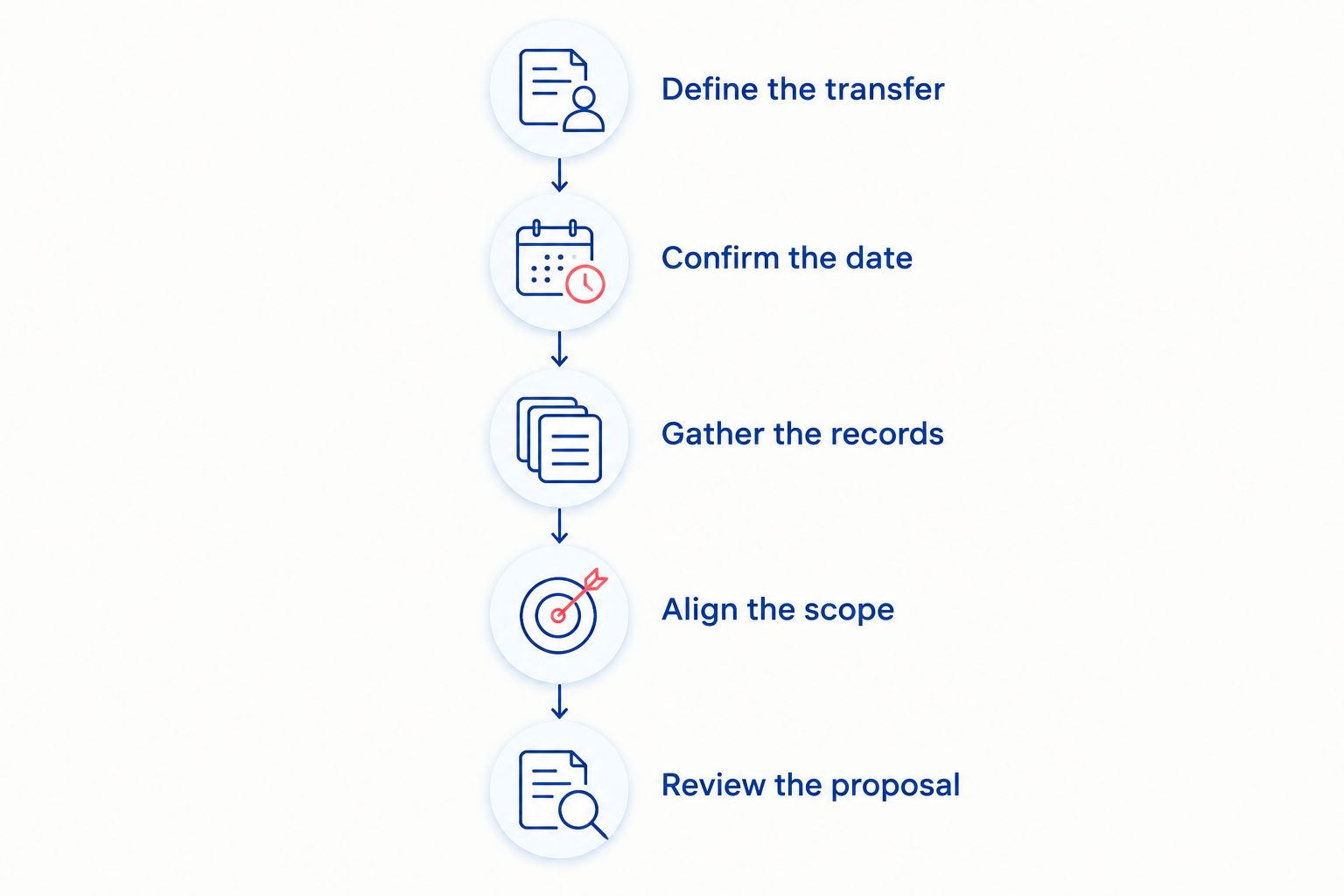
Use the following sequence for a 2026 gift planning engagement. It gives the attorney, CPA, and appraiser a shared description of the assignment before analysis starts.
- Define the transfer. Identify the donor, recipient, property, and interest being transferred. Distinguish a direct real estate transfer from a transfer involving an entity.
- Confirm the date. Have the responsible adviser identify the required effective date and explain whether the transfer is planned or completed.
- Gather the records. Assemble ownership documents, property information, and the financial or historical records relevant to the assignment.
- Align the scope. Ask the appraiser to identify the property rights, intended use, intended users, deliverable, and exclusions in the proposal.
- Review the proposal. Confirm responsibilities, access arrangements, document needs, and timing before authorizing the work.
This sequence does not replace professional judgment. It makes unresolved questions visible while the engagement can still be defined correctly.
What documents should your attorney or CPA assemble?
Send an organized file rather than an unexplained collection of attachments. Identify which documents describe current conditions and which describe the property as of the required effective date.
For a residential assignment, start with the property address, ownership information, available floor plans, relevant property documents, and records of material alterations. For a cooperative apartment or condominium, include the available documents that explain the ownership and unit being valued.
For income-producing property, assemble leases, rent information, operating statements, and records relevant to occupancy and property condition. Clearly identify the periods those records cover.
For a partial-interest assignment, provide the governing ownership documents and a clear description of the interest transferred. Let the appraiser and legal adviser determine which provisions require analysis; do not summarize away restrictions or rights that appear inconvenient.
Historical photographs, prior reports, renovation records, and correspondence can help establish what information exists for a retrospective assignment. Their presence does not make every document reliable or relevant; the appraiser evaluates the evidence for the stated purpose.
Tell the appraiser what is unavailable at the proposal stage. That disclosure supports a realistic scope and avoids treating document collection as an afterthought.
Is a partial-interest appraisal just a percentage calculation?
A partial-interest valuation addresses the specific interest being transferred, not merely a mathematical share of the underlying property's value. Relevant ownership rights and restrictions belong in the assignment definition.
A whole-property appraisal can inform the analysis without completing it. Ask whether the proposed engagement values only the underlying real estate or also the identified fractional or entity interest.
Do not request a predetermined discount. The valuation conclusion must follow the evidence and the nature of the interest, rather than a target tax result.
Can an existing appraisal be used for a gift?
An existing appraisal is useful background, but its suitability depends on its effective date, property rights, intended use, and scope. A lending appraisal or an estate-related report does not automatically answer a gift tax valuation question.
For a transfer planned in 2026, give the appraiser the existing report and explain what has changed. Ask whether a new assignment is required rather than assuming that changing the report's heading will make it suitable.
Also distinguish the report's conclusion from its supporting evidence. A prior report can contain useful property information while still addressing a different date or ownership interest.
How should you compare appraisal proposals?
Read the scope before the fee. The better comparison is between complete descriptions of the same assignment, not between totals attached to different deliverables.
Ask each appraiser to confirm:
- Whether the engagement addresses the real estate, a partial interest, or both.
- Whether the effective date and intended use match your adviser's instructions.
- Which records and property access you must provide.
- What the report includes and what requires a separate agreement.
- How additional questions or changed instructions are handled.
- What determines the expected delivery schedule.
REIS Group provides independent real estate appraisal and valuation consulting, including gift tax and partial-interest valuations. Its report must still fit the assignment: no appraisal guarantees acceptance by a taxing authority, and no engagement should promise a particular tax outcome.
Turnaround depends on property type, complexity, records availability, and scope. Confirm expedited availability individually rather than assuming that a filing deadline establishes the appraiser's delivery commitment.
Discuss Your Appraisal Assignment
Define the property interest, effective date, and reporting purpose before requesting a proposal.
FAQ
What’s the best way to estimate gift tax appraisal cost?
Request a written proposal for the actual property, ownership interest, effective date, and intended use. Compare proposals only after confirming that their deliverables and exclusions match.
Does a gift tax appraisal include preparing the tax return?
Do not assume that a gift tax appraisal includes tax-return preparation. Ask the appraiser and tax adviser to identify their separate responsibilities in the engagement documents.
Can REIS Group appraise New York real estate for a gift?
REIS Group provides real estate valuations for gift tax reporting, including residential, commercial, and partial-interest assignments. Discuss the property, ownership interest, and effective date to establish the required scope.
Is a fractional interest worth the same percentage of the whole property’s value?
A fractional-interest valuation requires analysis of the specific ownership interest rather than an automatic percentage allocation. The relevant rights, restrictions, and supporting evidence must be considered.
Can I use a mortgage appraisal for gift tax reporting?
A mortgage appraisal does not automatically fit a gift tax assignment. Ask an appraiser to assess its effective date, property rights, scope, intended use, and intended users before relying on it.
How long does a gift tax appraisal take?
Turnaround depends on property type, complexity, records availability, and scope. Confirm the schedule during engagement discussions and ask separately about expedited availability.
Does a real estate appraisal also value the business that owns the building?
A real estate appraisal does not by itself value an operating business. Identify whether the transfer requires valuation of the property, a business interest, or separate analyses coordinated by the advisers.
One last thing
The ownership document can be as important to defining the assignment as the property address. A correct address identifies the asset; it does not establish whether you are transferring the entire property, a direct fractional interest, or an interest in an entity that owns it.
Before requesting a proposal, put the transfer description and required effective date in the same message. Discuss your appraisal assignment with REIS Group so the scope addresses the actual gift rather than a different valuation question.
Related guides
- Gift tax appraisal for financial advisors
- Trust property appraisal for trustees
- Partial-interest appraisal firms for estates
- How much does a date-of-death appraisal cost?