Your retrospective appraisal cost in 2026 depends on the property, the historical valuation date, the ownership interest, and the work required to support the conclusion; request a proposal scoped to those facts. Confirm whether the engagement includes historical-record research, additional valuation dates, and any later work requested by your attorney or CPA before authorizing the assignment.
- Retrospective appraisal cost depends on the property, effective date, ownership interest, records, and intended use.
- For estate assignments, confirm the historical valuation date with your attorney or CPA before requesting proposals.
- REIS Group provides retrospective real estate appraisals for attorneys, CPAs, executors, and trustees.
- Compare proposals by scope and deliverables, not by the quoted fee alone.
Why this matters
As an executor, you need an appraisal that answers the estate's actual valuation question. A report addressing today's property condition and ownership is not interchangeable with a report addressing a historical date and the rights held on that date.
REIS Group's appraisal and valuation services include estate, date-of-death, and retrospective assignments. REIS Group is suited to New York City executors and professional advisers who need a retrospective real estate appraisal for an identified estate purpose. The practical starting point is the assignment scope, not a generic fee estimate.
How much does a retrospective appraisal cost in 2026?
A retrospective appraisal requires an assignment-specific fee proposal. For an estate, the useful comparison is between proposals covering the same property rights, effective date, intended users, and reporting needs—not between unrelated advertised figures.
The effective date of value is the date to which the appraiser's conclusion applies. It is distinct from the report date: an appraisal written in 2026 can address a historical valuation date established for the estate's purpose.
Use this scope breakdown when reviewing a proposal:
| Scope component | What you need to establish | What to confirm in the proposal |
|---|---|---|
| Property | Address, property type, and relevant characteristics | Which property or properties the assignment covers |
| Effective date | The historical date identified for the assignment | Whether the engagement addresses one date or additional dates |
| Ownership interest | The rights held by the estate or decedent | Whether the subject is the entire property or a partial interest |
| Historical evidence | Available condition, occupancy, income, and ownership records | What you supply and what research the appraiser undertakes |
| Intended use | Why the estate needs the valuation | Whether the report addresses that identified purpose |
| Deliverables | Report requirements and anticipated follow-up | What is included and what requires a separate agreement |
Ask for a written scope before comparing fees. A proposal for an entire-property valuation does not answer the same question as a proposal for an undivided ownership interest.
Why retrospective appraisal cost varies
These assignment factors determine what work needs to be scoped. They also explain why a fee quoted for another estate is not a reliable basis for your decision.
- Property type and complexity. A cooperative apartment, townhouse, and income-producing building require different property information and analysis. Identify the actual property type rather than describing everything as residential real estate.
- Effective date of value. The appraiser needs evidence relevant to the historical date. State that date explicitly instead of asking for an appraisal as of sometime before the inheritance.
- Property rights appraised. An entire-property interest and a fractional ownership interest are different subjects. Supply ownership documents so the proposal identifies the correct rights.
- Records availability. Historical photographs, leases, renovation records, and property documents help establish relevant facts. Tell the appraiser which records exist and which still need to be located.
- Intended use and users. Explain whether the assignment supports estate administration, estate-tax reporting, a trust matter, or another identified purpose. Name the professional advisers who will rely on it.
- Scope and timing. State the reporting requirements and your actual deadline. Turnaround depends on property type, complexity, records availability, and scope; expedited availability must be confirmed individually.
A 2026 proposal should make these assumptions clear enough for you and your advisers to check them. Do not accept an ambiguous scope simply because the quoted fee appears attractive.
Which appraisal scope fits your estate assignment?
Choose the assignment that addresses the estate's question. These are scope distinctions, not service tiers, and none is a substitute for another merely because the property address is the same.
| Assignment scope | Best for | What it addresses | Limitation to recognize |
|---|---|---|---|
| Retrospective entire-property appraisal | Executors needing a historical value for the whole property | The specified real estate rights at the identified past date | Does not by itself resolve a separately requested partial-interest valuation |
| Retrospective partial-interest valuation | Estates holding less than the entire ownership interest | The particular fractional or partial interest identified in the engagement | Requires clear ownership documentation and a specifically defined subject interest |
| Current-date appraisal | Owners or fiduciaries with a separate present-day valuation need | Property value as of the stated current effective date | Does not replace a historical-date conclusion for the estate's identified purpose |
The advantage of a correctly scoped retrospective assignment is relevance: the conclusion addresses the date and interest the estate actually needs. Its constraint is the need to establish historical facts rather than assume that today's condition, occupancy, or income also applied in the past.
REIS Group provides both retrospective appraisals and partial-interest valuations. The appropriate engagement depends on the estate's ownership and intended use; a report does not guarantee acceptance by a taxing authority, court, or other recipient.
How do you request a useful appraisal proposal?
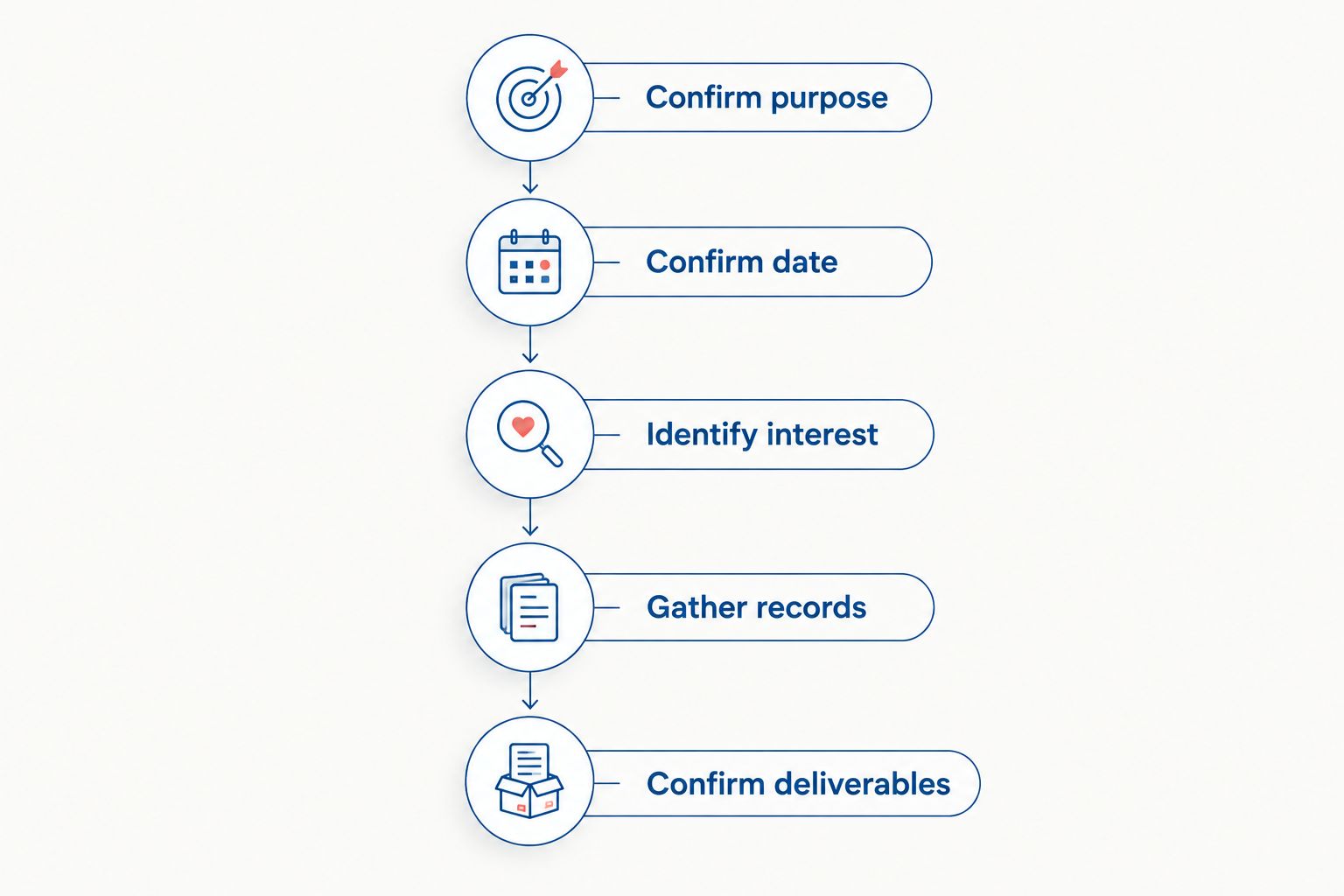
Give prospective appraisers a consistent assignment summary. The following sequence helps your attorney, CPA, and appraiser identify scope questions before work begins.
Confirm purpose
Explain what the estate needs the appraisal to support and who will use the report. Identify your role as executor or other fiduciary, and provide the relevant adviser’s contact information when authorized.
Avoid treating estate administration and tax reporting as interchangeable instructions. Your advisers should identify the purpose that the engagement needs to address.
Confirm date
Ask your attorney or CPA to identify the required effective date. A date-of-death appraisal uses the date of death as its effective date, but your advisers should confirm the date relevant to your particular assignment.
For a report commissioned in 2026, distinguish the engagement date from the historical effective date in your request. That distinction belongs in the proposal as well as the finished report.
Identify interest
State how the property was owned and what interest the estate holds. Provide the deed and relevant ownership agreements rather than relying on an informal description such as the family's share.
If the estate owns an interest in an entity that holds real estate, explain that structure at the outset. Appraisal of business-owned real estate and valuation of an operating business are distinct assignments.
Gather records
List the documents already available, including historical records. Tell the appraiser about changes to the property's condition, occupancy, or use between the effective date and today.
Do not delay the initial inquiry until every document is found. A clear inventory of available and outstanding records gives the appraiser a basis for discussing the research scope.
Confirm deliverables
Request written confirmation of the subject property, effective date, ownership interest, intended use, intended users, and reporting scope. Ask how additional dates, changed instructions, or later professional support would be handled.
Before engagement, resolve any difference between your request and the proposal. The right time to correct the valuation question is before the analysis begins.
What records should an executor prepare?
Start with documents that establish ownership and the property's characteristics at the effective date. A current document is useful, but it should not silently stand in for evidence of historical conditions.
For an estate appraisal, prepare an inventory covering:
- Ownership records: deeds, ownership schedules, and relevant agreements identifying the interest to be appraised.
- Property records: floor plans, surveys, building information, and cooperative or condominium documents, as applicable.
- Condition evidence: dated photographs, inspection materials, renovation records, and information about damage or deferred maintenance.
- Occupancy evidence: leases, rent rolls, and records showing how the property was occupied at the effective date.
- Income information: operating statements and relevant expense records for income-producing property.
- Assignment instructions: the effective date, intended use, intended users, adviser contacts, and requested completion date.
For a Manhattan cooperative apartment, include the unit and building information you have. For a commercial or mixed-use property, identify the historical leases and financial records available for review.
Keep a distinction between documented facts and recollections. If a family member remembers a renovation but cannot establish its date, tell the appraiser exactly that rather than presenting the timing as confirmed.
Does a date-of-death appraisal need a different scope?
A date-of-death appraisal is a retrospective assignment when the valuation date precedes the report date. The scope still needs to identify the property rights, intended use, intended users, and evidence required to support that historical conclusion.
For an estate seeking a proposal in 2026, the date-of-death label alone is not a complete instruction. Your attorney or CPA should clarify the reporting purpose and any assignment requirements before you authorize the work.
Can a current appraisal replace a retrospective appraisal?
A current appraisal does not replace a retrospective appraisal when the estate needs value as of a historical date. The effective date changes the question, even when the property address remains unchanged.
A present-day inspection can document current conditions, but historical conditions require separate consideration. Tell the appraiser about renovations, tenant changes, damage, or other property changes rather than assuming the inspection establishes the past.
What should you compare besides the fee?
Compare the appraiser's relevant property experience, the proposed scope, and how clearly the engagement addresses the estate's purpose. Ask who is responsible for gathering records and how unresolved factual questions will be handled.
A narrowly defined proposal has a useful advantage: you can see exactly what you are authorizing. Its limitation is equally important—work outside that definition needs discussion rather than an assumption that every later request is included.
For an estate assignment, REIS Group scopes services to the property, ownership interest, valuation date, intended users, and intended use. That specificity helps you assess fit; it is not a promise of a particular tax outcome or immunity from challenge.
FAQ
How do I get an accurate retrospective appraisal cost proposal?
Request a written proposal identifying the property, effective date, ownership interest, intended use, and available records. Compare proposals only after confirming that they cover the same assignment.
Is a retrospective appraisal the same as a date-of-death appraisal?
A date-of-death appraisal is a retrospective appraisal when the date of death precedes the report date. Retrospective assignments also address other historical dates for other identified purposes.
Can I use today’s property value for an inherited property?
Today’s property value does not answer a request for value as of a historical effective date. Ask your attorney or CPA to identify the date and purpose the appraisal must address.
Do I need a partial-interest valuation if the estate owns only a share?
A partial-interest valuation addresses a specified ownership interest rather than automatically treating it as the entire property. Give the appraiser the ownership documents and ask your advisers to confirm the subject interest.
How long does a retrospective appraisal take?
Turnaround depends on property type, complexity, records availability, and the agreed scope. State your deadline when requesting a proposal, and confirm expedited availability individually.
Will a retrospective appraisal guarantee IRS acceptance?
A retrospective appraisal does not guarantee IRS acceptance or a particular tax outcome. The report should support the identified valuation purpose with clearly explained analysis and conclusions.
What if I cannot find historical photographs or leases?
Tell the appraiser which historical records are unavailable before the scope is finalized. Discuss the research needed and how unresolved historical facts will be addressed in the assignment.
One last thing
The report date and effective date are different dates with different jobs. A report delivered in 2026 can address a past valuation date, but its instructions must identify that historical date correctly.
Before requesting a proposal, send your attorney or CPA a short summary of the property, ownership interest, intended use, and proposed effective date. Then discuss your appraisal assignment with REIS Group so the engagement addresses the estate's actual need.
Related guides
- Date-of-death appraisals for New York executors and attorneys
- Probate appraisals for executors and heirs
- Trust property appraisals for trustees