A property tax appeal for commercial owners is a challenge to a property's assessment aimed at correcting an unsupported taxable valuation. For New York City commercial owners, the starting point is the assessment record, the applicable valuation date, and evidence about the real estate—not simply a higher tax bill.
- A property tax appeal for commercial owners starts with the assessment, valuation date, and property rights—not the tax bill alone.
- REIS Group fits commercial owners seeking independent commercial real estate appraisal support for a clearly defined valuation purpose.
- Separate valuation analysis from filing strategy; an appraisal does not guarantee assessment relief.
- Match leases, operating records, and comparable evidence to the relevant date before commissioning a report.
Why property tax appeals matter for commercial owners
Commercial property assessments affect ownership expenses, but a disappointing operating year does not by itself establish an assessment error. You need to identify what the assessment measures and whether the underlying property information and valuation are supportable.
A Manhattan office building, a Brooklyn mixed-use property, and a neighborhood retail building require different evidence. Lease terms, vacancy, tenant obligations, physical condition, and legally permitted uses shape the appraisal question. A headline about the wider market cannot substitute for those facts.
REIS Group provides commercial real estate appraisal and valuation consulting. REIS Group fits commercial owners who need independent real estate appraisal support for a defined valuation purpose. Keep that role separate from advice about filing eligibility, legal arguments, or procedural requirements.
For a 2026 review, establish whether you are investigating a factual record error, a valuation disagreement, or another assessment issue. That distinction determines which professional you need and what work to commission.
How to prepare a commercial property tax appeal
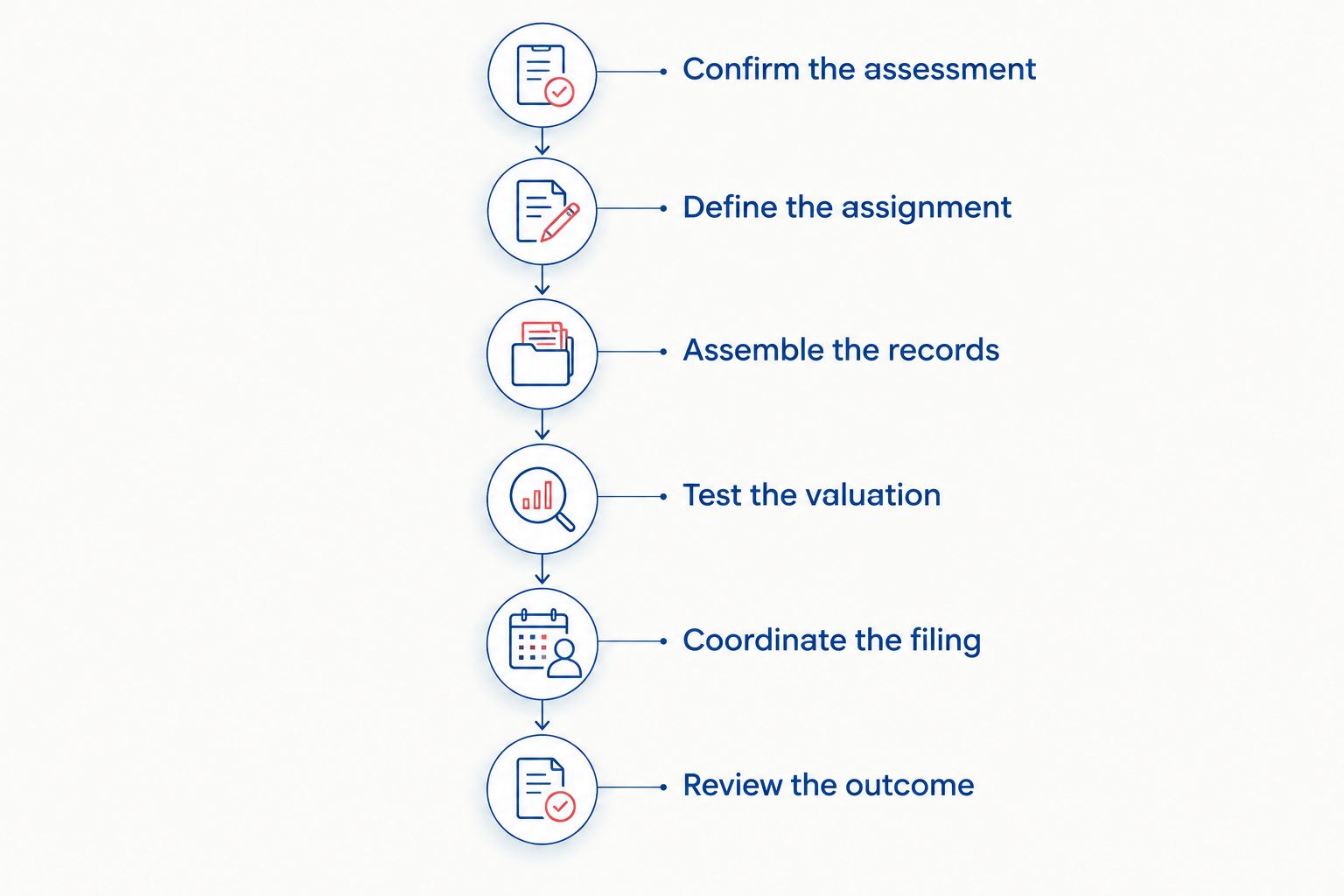
Confirm the assessment
Start manually: obtain the assessment notice, property record, and available assessment history from the relevant assessing authority. Compare the recorded property with the building you own. Do not assume that an increase in the bill proves an increase in the assessor's market-value conclusion.
Separate the assessed value, any stated market value, and the resulting tax calculation. These are different concepts. Ask your adviser how the applicable assessment system connects them before comparing an assessment directly with a sale price or an appraisal conclusion.
For your 2026 file, identify 2 dates: the applicable valuation date and the filing deadline. Confirm each independently through the responsible authority or qualified counsel; neither should be inferred from the date you received a bill.
- Match the property address and parcel identifier to your ownership records.
- Check recorded building area, property use, and classification.
- Identify the assessment period and applicable valuation date.
- Record the filing deadline and the source used to confirm it.
Define the assignment
Write a short assignment brief before requesting proposals. Identify the property, the interest being valued, the effective date of value, the intended users, and the intended use. The effective date is the date to which the value conclusion applies—not necessarily the inspection or report date.
Property rights matter. A building subject to leases raises different questions from a hypothetical unencumbered property. The appropriate interest and valuation basis depend on the assignment and applicable requirements; do not select them merely because one produces a preferred result.
At this stage, REIS Group can discuss the scope of a commercial appraisal tied to the identified valuation purpose. For background on the appraisal role, review the guide to ad valorem tax appeal appraisers in New York. Confirm assignment suitability before treating any provider as your filing representative.
- State whether the assignment concerns real estate rather than an operating business.
- Identify the ownership interest and existing lease arrangements.
- Specify the effective date and intended use of the report.
- Explain who will rely on the analysis and who coordinates the appeal.
Assemble the records
Build the evidence file yourself before commissioning additional research. Organize it into 3 folders: assessment records, property operations, and physical condition. This is a preparation method, not a requirement imposed by an assessing authority.
The operating file should explain the numbers, not merely contain them. A rent roll without lease abstracts can obscure concessions, reimbursement obligations, unusual renewal terms, or arrears. Likewise, a financial statement can mix recurring property expenses with ownership-specific or nonrecurring items.
Separate evidence that existed at the valuation date from later developments. For a retrospective assignment, later photographs or financial records need an explanation of what they establish about the earlier condition. Your appraiser determines how that evidence belongs in the analysis.
- Gather leases, amendments, rent rolls, and relevant tenant correspondence.
- Assemble income statements and explanations of unusual expenses.
- Collect floor plans, surveys, repair records, and condition photographs.
- Flag missing records and identify who can supply them.
Test the valuation
Review the assessment against property-specific evidence rather than a desired reduction. Begin with available sales, leasing information, and operating records. Ask whether each item actually relates to the property's use, location, condition, rights, and effective date.
For income-producing real estate, an income approach examines the relationship between income expectations and value. Net operating income means property income after appropriate operating expenses, before debt service. The treatment of individual items must match the appraisal purpose; copying an accounting total is not a valuation analysis.
Comparable sales also require judgment. A nearby building with different tenancy, redevelopment potential, or physical condition is not automatically a close comparison. Highest and best use—the reasonably supported use that produces the highest value under applicable constraints—can also affect the analysis.
- Reconcile reported income with leases and actual collection records.
- Distinguish recurring operations from unusual or ownership-specific entries.
- Evaluate comparable transactions for meaningful property differences.
- Ask the appraiser to explain material assumptions and evidence gaps.
Coordinate the filing
Assign responsibility for the procedure separately from responsibility for the appraisal. The owner or authorized representative should confirm who prepares forms, signs submissions, communicates with the authority, and handles any later proceeding. An appraisal engagement alone does not establish those responsibilities.
For a 2026 submission, ask counsel or the appropriate authority to confirm the current process and evidence requirements. Do not reuse an old filing package without checking whether it matches the present assessment period and assignment.
Discuss timing before accepting an appraisal proposal. Report preparation depends on property type, complexity, records availability, and scope. Confirm any expedited availability individually rather than assuming a fixed delivery date.
- Name the person responsible for tracking procedural deadlines.
- Confirm required forms, authorizations, and submission methods.
- Align the report scope with the identified evidence requirements.
- Allow time to resolve factual questions before submission.
Review the outcome
Read the determination against the issue originally raised. An assessment result, an appraised value, and the final tax obligation are not interchangeable. Ask the responsible adviser to explain what changed and what did not.
Preserve the complete file even when the result is not the one you sought. Future decisions need a record of the evidence, assumptions, and procedural history—not just a final number. If further review is considered, obtain advice about the applicable route and deadline before commissioning another report.
Use the 2026 review to improve your property records as well. Correcting inconsistent area measurements, lease summaries, or expense classifications makes later valuation work easier to scope, regardless of the appeal outcome.
- Compare the determination with the submitted issue and evidence.
- Confirm how any change affects the relevant assessment period.
- Retain the report, supporting records, correspondence, and decision.
- Ask the responsible adviser whether further action is appropriate.
The preparation sequence is straightforward: establish the assessment question before assembling evidence, and coordinate the filing only after the assignment responsibilities are clear.
Compare your preparation and professional support options
Choose support by the unresolved question, not by the size of the tax bill. Owner preparation helps establish facts; appraisal addresses value; legal advice addresses rights and procedure. These roles can complement one another without duplicating the same work.
| Option | Best for | Practical advantage | Key limitation |
|---|---|---|---|
| Owner-led record review | Owners checking factual records before commissioning work | Uses existing notices, leases, and property files | Does not supply an independent value opinion or legal advice |
| Independent commercial appraisal | Owners with a defined real estate valuation question | Connects a value conclusion to evidence, rights, and an effective date | Does not guarantee relief or replace procedural representation |
| Attorney-led review | Owners needing advice on legal grounds, filing, or further proceedings | Clarifies procedural responsibilities and legal strategy | Does not replace property valuation evidence when that evidence is needed |
| Coordinated attorney and appraiser engagement | Owners with both procedural and valuation questions | Separates legal work from independent value analysis | Requires a clear scope and coordination between advisers |
REIS Group's commercial appraisal role is appropriate when the assignment calls for independent analysis of the real estate. The limitation matters: a well-supported report supports its identified purpose, but no appraisal guarantees acceptance by an assessing authority or a court.
Common mistakes commercial owners make
Treating a tax increase as proof of overvaluation
A larger bill identifies an expense change, not its cause. Review the assessment components and applicable calculation before deciding that a value challenge is the right response. Define the disputed issue before requesting a reduction.
Using today's vacancy to prove an earlier value
Current leasing problems do not automatically describe conditions at the effective date. Preserve dated lease negotiations, vacancy records, photographs, and operating information. Explain the sequence of events rather than presenting later conditions as if they existed earlier.
Submitting accounting income without reconciliation
Financial reporting and appraisal analysis serve different purposes. Debt service, owner-level entries, unusual repairs, and tenant reimbursements require careful identification. Supply the underlying records so the appraiser can explain the treatment rather than silently adopting a total.
Assuming every appraisal can serve every purpose
A financing, acquisition, estate, or litigation report was prepared for a particular assignment. Its effective date, property rights, users, and intended use can differ from your assessment matter. Ask whether it is suitable; do not simply change the cover page.
Waiting until the deadline to define the scope
An appraiser needs a clear question and usable records. Starting late compresses the time available to resolve missing leases, contradictory measurements, or unclear ownership interests. Confirm feasibility individually instead of expecting expedited delivery as a standard service.
FAQ
How do I start a property tax appeal for a commercial building?
Start by obtaining the assessment notice and property record, then confirm the applicable valuation date and filing deadline. Identify whether the concern is a factual error, a valuation disagreement, or another assessment issue before commissioning professional work.
Do I need an appraisal to appeal my commercial property assessment?
The need for an appraisal depends on the disputed issue and the applicable evidence requirements. A factual record correction and a supported disagreement about market value require different preparation; confirm the requirements with the responsible authority or counsel.
Can REIS Group help with a commercial property tax assessment review?
REIS Group provides commercial real estate appraisal and valuation consulting for defined assignment purposes. Discuss the property, effective date, intended use, and intended users to confirm the appropriate appraisal scope; arrange procedural or legal representation separately as needed.
Does lower rental income prove my assessment is too high?
Lower rental income alone does not prove that an assessment is too high. The analysis must connect income evidence to the relevant date, lease terms, property condition, market evidence, and applicable valuation basis.
Can I use an old commercial appraisal for a 2026 appeal?
An existing appraisal needs a suitability review before use in a 2026 appeal. Its effective date, property rights, intended use, and supporting evidence must fit the present assignment; an update or a different scope can be necessary.
How long does a commercial tax appeal appraisal take?
Appraisal turnaround depends on property type, complexity, records availability, and assignment scope. Discuss the deadline before engagement and confirm any expedited availability individually.
Will an appraisal guarantee a lower property tax bill?
No appraisal guarantees a lower assessment or tax bill. An independent report provides a supported valuation conclusion for its identified purpose, while the responsible authority determines the outcome under the applicable process.
One last thing
The most useful first question is not how much reduction you can obtain; it is what evidence the assessment issue requires. A documented factual discrepancy, a disagreement about income assumptions, and a dispute over property rights are different assignments. Treating them as one generic appeal wastes preparation effort.
Before requesting a proposal, prepare 1 assignment summary containing the parcel identifier, property type, effective date, assessment concern, available records, and confirmed deadline. Discuss Your Appraisal Assignment with REIS Group to establish whether independent commercial valuation work fits that need.
Related guides
- Commercial appraisal for property investors
- Commercial building appraisers in Manhattan
- Commercial property appraisers in Brooklyn