Instead of manually reconciling a property appraisal with a separate gift-tax return worksheet, build one assignment file that connects the transferred interest, effective date of value, appraisal conclusion, and IRS Form 709 reporting. For a 2026 real estate gift, have the attorney confirm the transfer facts, the appraiser value the identified interest, and the CPA reconcile the report with the return before filing.
- Gift tax appraisal IRS Form 709 preparation starts with matching the transferred property interest and valuation date.
- REIS Group provides gift-tax real estate appraisals for attorneys, CPAs, trustees, and families coordinating property transfers.
- A whole-property appraisal does not automatically establish the value of a fractional ownership interest.
- The tax preparer must reconcile the appraisal, transfer documents, and disclosure package before filing.
Why this matters
A real estate appraisal and a gift-tax return serve different purposes. The appraisal develops a value conclusion for specified property rights as of a stated date; Form 709 reports the donor's transfers under the applicable federal gift-tax rules. A correct property address alone does not connect them.
REIS Group provides gift-tax real estate appraisals for attorneys and CPAs who need valuation support for property transfers. For Manhattan and surrounding New York City assignments, start with the gift-tax appraisal guide for financial advisers and establish who will supply the legal documents and who will prepare the return.
The practical objective is a traceable file: the reader can follow the ownership documents to the interest appraised, then follow the appraisal conclusion to the reported transfer. This guide addresses that handoff, not whether a particular transfer requires a return or produces tax due.
Before you start
- Identify the responsible professionals. Name the donor's attorney, tax preparer, appraisal contact, and person authorized to provide records or arrange property access. Confirm secure document-sharing access before circulating financial or ownership information.
- Collect the assignment materials. Assemble the deed, proposed or executed transfer documents, ownership agreements, property description, and relevant operating records. Give the appraiser the intended use, intended users, and proposed reporting timetable.
- Resolve the ownership gotcha first. A deeded real estate interest and an interest in an entity that owns real estate are not interchangeable. Have counsel identify what is being transferred before commissioning the valuation; otherwise, the appraisal can answer the wrong question.
For a 2026 transfer, distinguish the gift year from the year in which the return is prepared. The tax preparer should select the applicable Form 709 and instructions rather than choosing a form solely by the calendar date of preparation.
Assignment brief
Establish the transfer facts
- Identify the donor and recipient. Record their legal names and the relationship relevant to the preparer's analysis. Keep the taxpayer's identity separate from the engagement contact; a family member coordinating records is not necessarily the donor.
- Describe the transferred asset. Specify direct real estate ownership, a fractional real estate interest, or an entity interest. Include the property address and supporting ownership documents, but do not treat the address as a substitute for the legal interest.
- Confirm the effective date. Ask counsel to identify the completed transfer date or clarify that the transaction remains proposed. Give that information to the appraiser before the analysis begins.
The effective date of value is the date to which the valuation conclusion applies. It is different from the inspection date and the report date. For a completed gift, those dates can fall in different periods without making the appraisal retrospective to the wrong event.
For example, an illustrative transfer of a 25% ownership interest requires the assignment brief to identify that interest explicitly. An appraisal of 100% ownership answers a different valuation question, even when both assignments concern the same building.
Expected result: A written assignment brief identifies the donor, transferred interest, relevant date, intended use, and intended users. The attorney, CPA, and appraiser are working from the same transaction description.
Use a shared intake worksheet
Create a worksheet with these headings: Transferred asset, Property rights, Effective date, Intended use, and Responsible professional. These are coordination headings, not software controls or substitutes for Form 709 fields.
Put unresolved items in a separate open-issues list. Do not fill gaps with assumptions merely to make the intake sheet appear complete. A disputed transfer date or unclear ownership percentage belongs with counsel before it becomes an appraisal premise.
Valuation scope and evidence
Define the appraisal question
- Confirm the value definition. For federal gift-tax valuation, the applicable fair market value framework generally considers a hypothetical willing buyer and willing seller, neither compelled to act and both reasonably informed. Treasury Regulation §25.2512-1 supplies the federal valuation framework; the engagement should identify the definition applicable to the assignment.
- Confirm the property rights appraised. State whether the assignment addresses the entire property, a direct fractional interest, or another identified interest. Ask whether a separate entity-level valuation is required.
- Provide date-relevant evidence. Deliver leases, rent rolls, operating statements, capital-work records, ownership restrictions, and property-condition information relevant to the effective date. Explain which records describe current conditions and which document historical conditions.
For a cooperative apartment, ownership and occupancy documents differ from those for a condominium or townhouse. For an income-producing property, lease terms and operating records affect the evidence available for analysis. Send the documents that fit the property rather than relying on a generic residential checklist.
A retrospective appraisal estimates value as of a past effective date. A current inspection can assist the investigation, but the appraiser still needs evidence of the property's condition and market circumstances on the historical date.
Expected result: The engagement scope identifies the interest, date, value definition, and reporting purpose, with a documented request for supporting evidence.
Compare the assignment routes
These are different assignment scopes, not interchangeable report formats. Select the route that matches the transferred asset.
| Assignment route | Best for | Strength | Limitation |
|---|---|---|---|
| Whole-property appraisal | Transfers involving the entire identified real estate interest | Establishes the value of the property rights specified in the report | Does not automatically establish the value of a smaller ownership interest |
| Direct partial-interest valuation | Transfers of fractional interests in real estate | Addresses the particular ownership interest and its characteristics | Requires ownership documents and interest-specific analysis |
| Entity-interest valuation | Transfers of interests in an entity that owns property | Addresses rights attached to the entity interest | An appraisal of the underlying real estate alone does not complete the entity valuation |
Do not apply an assumed discount to a property value. Restrictions, control, marketability, and other relevant characteristics require assignment-specific analysis. The partial-interest appraisal resource provides additional context for defining that scope.
Appraisal-to-return handoff
Reconcile the report with the transfer
- Check the final report identifiers. Compare the property description, ownership interest, effective date, intended use, and value conclusion against the assignment brief. Flag discrepancies before the preparer uses the report.
- Separate value from tax calculations. Give the preparer the appraisal conclusion and supporting report. The preparer determines the return treatment, including applicable exclusions, deductions, elections, and other tax adjustments.
- Build a reconciliation sheet. Connect each transferred asset to its supporting documents, appraisal conclusion, and corresponding return entry. Explain any difference between the appraised interest and the amount reported rather than forcing the figures to match without analysis.
A property's gross appraised value is not automatically the taxable gift. Debt, retained rights, consideration, ownership structure, and other transaction facts require tax analysis. The appraisal should not silently absorb those questions into an unexplained final figure.
For the 2026 gift-tax file, record the version and date of the report supplied to the preparer. If the appraiser issues a revision, replace the superseded report in the working package and tell everyone responsible for the return.
Expected result: The preparer can trace each reported transfer to the correct interest, date, report, and transaction documents without reconstructing the assignment from email threads.
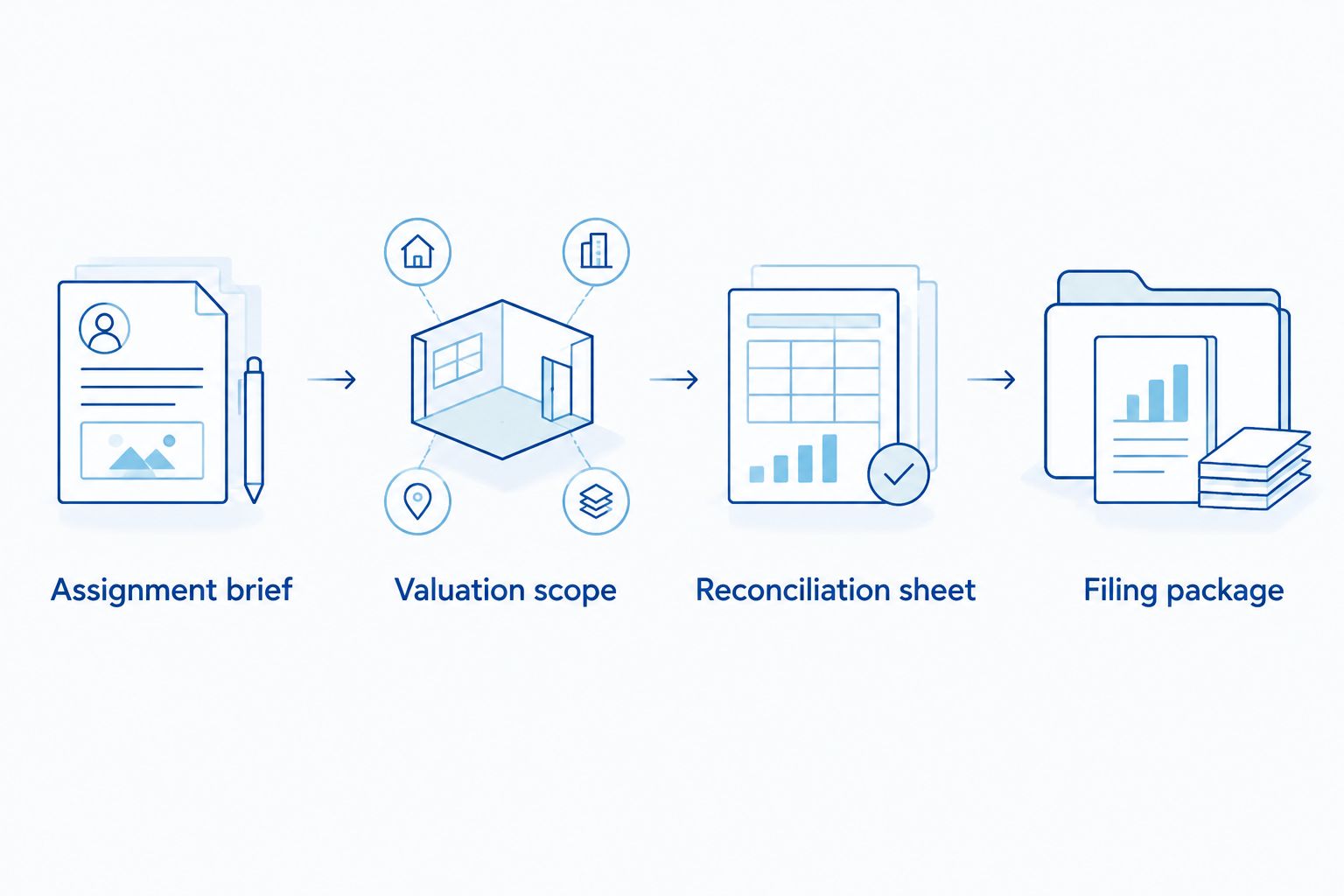
Filing package and records
Complete the disclosure review
- Check the applicable instructions. Have the preparer review the Form 709 instructions for the gift year and the disclosure requirements relevant to the transaction. Do not assume that attaching any appraisal satisfies every disclosure requirement.
- Review the complete package. Confirm that the return narrative, ownership description, transfer documents, appraisal, and explanatory attachments tell a consistent story. Counsel and the preparer should resolve legal and tax questions within their respective roles.
- Preserve the final record. Retain the filed return package, final appraisal, executed transfer documents, reconciliation sheet, and filing confirmation using the client's records policy and professional advice.
Treasury Regulation §301.6501(c)-1(f) addresses adequate disclosure of gifts for federal assessment-period purposes. It includes valuation-related disclosure provisions. The preparer must evaluate the actual submission; an appraisal is supporting evidence, not an automatic guarantee of adequate disclosure or IRS acceptance.
For a return prepared during 2026, verify the correct gift-year instructions and filing requirements directly with the preparer. Keep tax conclusions in the tax workpapers and valuation conclusions in the appraisal, with clear cross-references between them.
Expected result: The final package contains consistent descriptions and an identifiable supporting valuation, with unresolved issues cleared before submission.
Variant: Update a proposed transfer before completion
A proposed gift requires a planning workflow rather than a completed-transfer workflow. Start with the contemplated ownership interest and proposed date, but label both as provisional. Planning analysis should not be presented as evidence that a transfer already occurred.
If the donor changes the ownership percentage, recipient, retained rights, or transaction structure, send the revised documents to counsel and the appraiser. Ask whether the existing scope and analysis still answer the revised question. Do not amend the appraisal conclusion yourself.
Once the transfer is completed, have counsel confirm the legal facts and effective date. The appraiser determines what additional work is necessary to address the completed transaction, and the preparer reconciles that conclusion with the return.
The benefit is earlier coordination; the limitation is that planning work can require revision. For a 2026 planning file, distinguish draft documents from executed documents so the final package does not rely on superseded terms.
Troubleshooting
- The report values the whole building, but the gift is fractional. Stop the handoff. Ask the appraiser whether additional interest-specific analysis is needed; multiplying the whole-property value by the ownership percentage does not establish that no other analysis is required.
- The deed date and appraisal effective date differ. Have counsel confirm the legally relevant transfer facts, then ask the appraiser to address the correct date. Do not change the report date or valuation date in the preparer's copy.
- Historical leases or condition records are missing. Identify the gaps and request contemporaneous records from the owner, manager, or other authorized source. The appraiser determines whether sufficient evidence exists and explains relevant limitations.
- The preparer receives multiple appraisal versions. Identify the final issued report and withdraw superseded copies from the active filing folder. Recheck the reconciliation sheet against the final conclusion.
- The report concerns real estate, but the gift concerns an LLC interest. Confirm the entity-level valuation scope with the responsible professionals. Business-owned real estate and ownership in the business are distinct assets.
Customize your workflow
For recurring professional referrals, use a consistent intake sheet but tailor the engagement to each property and transfer. Add separate records requests for cooperative apartments, leased commercial buildings, and fractional interests rather than sending every client the same document list.
REIS Group scopes real estate valuation assignments to the property, ownership interest, effective date, intended users, and intended use. That alignment supports the handoff; it does not replace the attorney's transfer analysis or the CPA's return preparation. Turnaround depends on complexity, records availability, and scope, with expedited availability confirmed individually.
Discuss Your Appraisal Assignment
Identify the property, transferred interest, effective date, and reporting purpose before requesting a proposal.
FAQ
Do I need a real estate appraisal for IRS Form 709?
An appraisal can provide valuation support for a reported real estate gift, but the required reporting and disclosure depend on the transaction. Have the tax preparer identify the applicable requirements and coordinate the valuation scope before filing.
What date should a gift-tax appraisal use?
The appraisal should address the effective date appropriate to the gift being reported. Have counsel confirm the transfer facts; the inspection date and report date are not substitutes for the effective date of value.
Can I use a whole-property appraisal for a fractional-interest gift?
A whole-property appraisal does not automatically establish the value of a fractional interest. The appraiser must determine whether additional analysis is necessary for the specific rights transferred.
Does attaching an appraisal guarantee adequate disclosure?
No, attaching an appraisal does not automatically establish adequate disclosure. The preparer must evaluate the complete submission under the applicable rules, including Treasury Regulation §301.6501(c)-1(f).
Can REIS Group prepare an appraisal after the gift occurs?
REIS Group provides retrospective real estate appraisals, which address value as of a past effective date. The assignment depends on the identified interest, historical evidence, intended use, and agreed scope.
Who decides how the appraisal value appears on Form 709?
The tax preparer determines the return treatment using the appraisal and transaction facts. The attorney confirms legal transfer issues, while the appraiser develops the valuation conclusion for the agreed assignment.
Is a real estate appraisal the same as an LLC-interest valuation?
No, an appraisal of real estate and a valuation of an LLC interest address different assets. The underlying property appraisal can support an entity valuation, but it does not automatically determine the value of the entity interest.
One last thing
A clean handoff starts with the ownership document, not the property address. Two gifts involving the same building can require different valuation scopes because the transferred rights differ. Before requesting an appraisal proposal from REIS Group, send the property description, ownership documents, intended transfer date, and reporting purpose so the discussion starts with the actual assignment.
Related guides
- Trust property appraisal guide for trustees
- Estate appraisal guide for estate attorneys
- Business valuation guide for CPAs and accountants