Instead of manually copying property values between appraisal reports and trust accounting schedules, build a trust appraisal fiduciary accounting disclosure workflow that connects each reported amount to its valuation date, ownership interest, and supporting document. For a New York trust's 2026 accounting, start with the trustee's reporting purpose and have counsel and the accountant identify the valuation information needed before commissioning the appraisal.
- Trust appraisal fiduciary accounting disclosure requires matching the valuation date, property rights, and accounting purpose.
- REIS Group provides real estate appraisals for trustees who need supported property valuations.
- Keep appraisal conclusions separate from accounting carrying values, tax basis, and sale proceeds.
- Have counsel and the accountant approve the disclosure treatment before distributing the accounting.
Why this matters
An appraisal answers a valuation question. A fiduciary accounting explains the trustee's administration of trust assets; the appraisal supplies evidence for a value, not instructions for every accounting entry.
REIS Group provides real estate appraisal services for trustees who need property valuations tied to an identified date, ownership interest, and intended use. Its trust property appraisal guide for trustees supports the assignment-planning side of this process.
Your practical objective is a traceable handoff: the reviewer can identify what was valued, when it was valued, and why that conclusion appears in the accounting. A 2026 report delivery date does not, by itself, make the report's conclusion a 2026 property value.
Before you start
- Confirm authority and access. Identify the trustee, instructing attorney, accountant, property contact, and authorized recipients. Gather the trust's relevant instructions and ask counsel which accounting requirements apply.
- Assemble the property records. Collect ownership documents, earlier appraisals, existing accounting schedules, and records relevant to the property, such as leases, operating statements, or cooperative documents. Obtain access arrangements for any required inspection.
- Resolve the date-and-interest mismatch first. A whole-property valuation as of a death date does not automatically establish the value of a fractional trust interest at an accounting period's end. Confirm both the effective date and the property rights before engagement.
The workflow below uses a worksheet you create, not a particular accounting application's interface. The bold labels are suggested worksheet fields; retain your firm's existing terminology where it carries an established accounting meaning.
Assignment scope
Establish the valuation question
- Create an Assignment purpose field. Describe the actual task, such as supporting a trust accounting, reviewing an in-kind distribution, or documenting a historical property value. Do not substitute a general phrase such as estate planning for the intended use.
- Complete Property identification with the address, unit or parcel details, and ownership references. Create 1 property row per separately tracked real estate asset; link supporting detail where an asset contains several components.
- Enter Property rights appraised. Specify whether the assignment concerns direct ownership of real estate, a fractional real estate interest, or an interest in an entity that owns real estate. These are different valuation questions.
- Record Effective date of value separately from Report date. These 2 dates serve different functions: one identifies when the value applies; the other identifies when the report was issued.
- Ask counsel and the accountant to confirm Intended use, Intended users, and the applicable Value definition before the appraiser finalizes the scope.
Expected result: The engagement request identifies the asset, ownership interest, date, and purpose without requiring the appraiser to infer them from an accounting spreadsheet.
For a Manhattan cooperative apartment, describe the ownership interest accurately rather than treating the apartment as interchangeable with a condominium. For commercial property, identify the tenancy and income information relevant to the effective date. Give REIS Group the assignment facts before asking for a proposal.
Separate the values you are tracking
Your accounting file can contain several valid amounts describing different things. The table below compares their uses; it does not prescribe which presentation your trust requires.
| Value or amount | Best for | Strength | Limitation |
|---|---|---|---|
| Appraised value | Supporting the defined valuation question | Connects a conclusion to a date, rights, and stated assumptions | Does not determine accounting treatment by itself |
| Accounting carrying value | Following the amount maintained in the accounting records | Supports continuity between schedules | Is not automatically current market value |
| Tax basis | Tracking the asset's tax position | Serves a distinct tax-reporting purpose | Is not interchangeable with appraised value |
| Sale proceeds | Recording an actual disposition | Documents the transaction amount received | Does not automatically establish value on another date |
Keep distinct amounts in distinct fields. Do not overwrite a historical carrying amount simply because a newer appraisal arrived. Have the accountant determine whether the accounting calls for a separate value column, an adjustment, a note, or another treatment.
Evidence file
Build the supporting record
- Create Ownership records, Property evidence, and Report and reconciliation folders. These 3 file groups separate the legal interest, valuation inputs, and completed handoff.
- Place deeds, relevant entity documents, and ownership schedules in Ownership records. Flag conflicts between the trust's asset list and the documents rather than resolving them by assumption.
- Organize Property evidence by the period it describes. Distinguish historical leases, rent rolls, photographs, and operating records from current materials. Label the source and date of each document.
- Give the appraiser an Evidence index identifying supplied records and gaps. Explain later renovations, casualty events, changes in occupancy, or other changes that affect how current evidence relates to the effective date.
- Store the issued appraisal in Report and reconciliation with a Report reference that your accounting schedule can repeat. Preserve superseded versions separately and identify the version used.
Expected result: Each source document has a recognizable purpose, and the accounting team can retrieve the exact report supporting the disclosed value.
For a retrospective assignment commissioned in 2026, organize evidence around the historical valuation date rather than the year of engagement. The date-of-death appraisal guide for New York executors and attorneys explains the related appraisal purpose when a death-date valuation is needed.
Preserve the evidence-to-disclosure chain
Use the same sequence throughout your file: Assignment purpose, Property evidence, Appraisal conclusion, and Accounting disclosure. Each stage should retain a reference to the preceding stage, so a reviewer does not have to guess how an amount reached the final schedule.
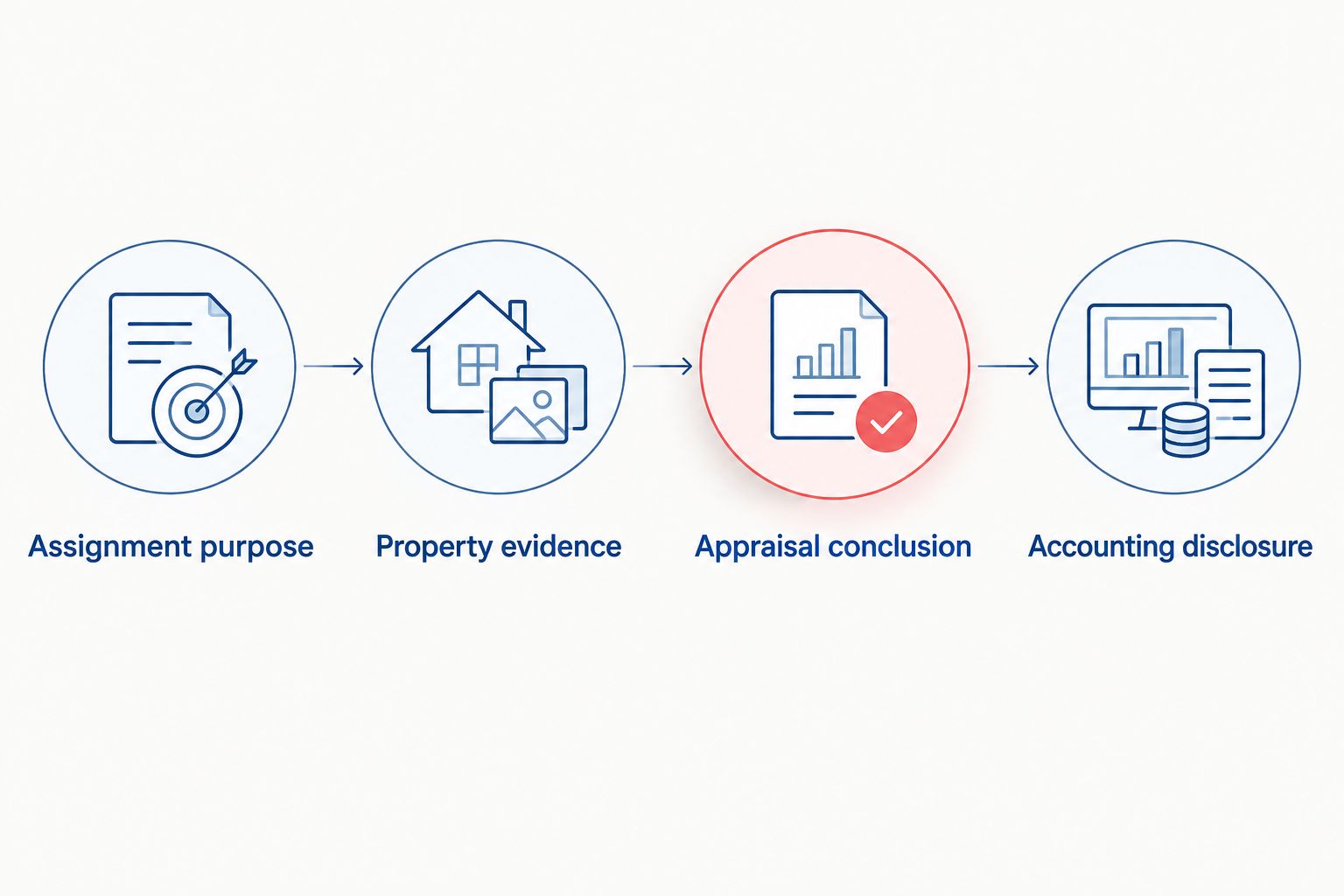
An evidence index helps organize the assignment, but it does not replace the appraiser's analysis. REIS Group's real estate appraisal scope depends on the property, interest, effective date, and intended use; the trustee and advisers remain responsible for their respective accounting and legal decisions.
Accounting handoff
Reconcile the report before entering the amount
- Read the report's Property identification, Effective date of value, and Property rights appraised against the approved engagement request. Stop the transfer if any of them differ.
- Copy the conclusion into Appraised value with Report reference alongside it. Preserve qualifications, assumptions, and conditions that affect how the conclusion should be understood.
- Compare Appraised value with Accounting carrying value without treating the difference as an automatic gain, loss, or adjustment. Ask the accountant to determine the appropriate treatment.
- Complete a Reconciliation note explaining any difference in asset description, ownership percentage, date, or amount between the report and the accounting schedule. Escalate unexplained differences before circulation.
- Have counsel review Disclosure wording and the accountant review the numerical presentation. Record Review status and the version released to authorized recipients.
Expected result: The final accounting identifies the source and meaning of the valuation without implying that an appraisal establishes tax basis, distributable cash, or a legally required presentation.
For a 2026 handoff, make the report reference part of the accounting workpaper rather than relying on an email attachment. Record the appraiser, effective date, report date, property interest, and any relevant limitation in the supporting record. Let counsel decide which details belong in the recipient-facing disclosure.
An appraisal supports the identified valuation purpose; it does not guarantee acceptance by beneficiaries, a court, or a taxing authority.
When trust property changes during the accounting period
Use a related workflow when a property is sold, distributed in kind, renovated, or affected by a change in ownership. Do not simply replace the earlier value with the latest number.
- Add an Event description and Event date to the asset workpaper. Describe the transaction or physical change without drawing a valuation conclusion.
- Preserve the earlier appraisal and identify its original purpose. Ask the advisers whether the event creates a different valuation question or requires a different effective date.
- Send the relevant new records to the appraiser. Ask whether the existing assignment addresses the new question or whether a separately scoped assignment is needed.
- Have the accountant reconcile the event with the accounting records, then obtain counsel's review of any revised disclosure.
Expected result: Historical support remains intact, and a later event does not silently change the meaning of an earlier valuation.
For a fractional-interest distribution, do not multiply a whole-property conclusion by an ownership percentage and label the result an appraised interest value. The nature of the interest, restrictions, and assignment scope require separate consideration; no discount is automatic.
Troubleshooting
The report date matches, but the valuation date does not
Check the effective date stated in the appraisal. A report issued in 2026 can address an earlier date; if the accounting needs another date, ask the appraiser about an appropriately scoped assignment rather than relabeling the conclusion.
The trust owns an entity interest, not the building directly
Provide the ownership structure and relevant entity documents. Confirm whether the engagement requires real estate appraisal, entity-interest valuation, or coordinated work; an operating-business valuation is distinct from appraising business-owned real estate.
The appraisal differs from the carrying value
Retain both amounts and document what each represents. Ask the accountant to reconcile the difference under the applicable accounting approach; a difference alone does not establish that either figure is incorrect.
Historical records are incomplete
Identify exactly which records are missing and disclose the gap to the appraiser. Do not present current rent, condition, or occupancy as historical fact; let the appraiser determine the implications for scope, analysis, and reporting.
Recipients request the full appraisal
Route the request through the trustee and counsel. Confirm authorized distribution, intended users, and confidentiality considerations before releasing documents; attaching a report does not automatically make every recipient an intended user.
Customize your workflow
Start with the property creating the most difficult date, ownership, or evidence question. Once the advisers approve its handoff, use the same worksheet structure for other trust properties while preserving each assignment's distinct scope.
For New York City holdings, include property-specific records rather than forcing every asset through an identical checklist. Commercial income records, cooperative ownership documents, and townhouse alteration records answer different questions. Ask the appraiser which materials the assignment requires.
Use REIS Group for the real estate appraisal assignment, with counsel and the accountant directing disclosure treatment. Turnaround depends on property type, complexity, records availability, and scope; confirm any expedited scheduling individually.
Discuss Your Appraisal Assignment
Identify the property, ownership interest, effective date, and intended use before requesting a proposal.
FAQ
What does a trust appraisal fiduciary accounting disclosure workflow include?
It connects the appraisal’s property identification, ownership interest, effective date, and conclusion to the accounting workpaper and disclosure. Keep the report reference and advisers’ reconciliation with the recorded amount.
Does every trust accounting need a new real estate appraisal?
A new appraisal is not an automatic requirement for every trust accounting. Counsel and the accountant should identify the reporting need, then determine whether existing valuation support addresses the necessary date, interest, and purpose.
Can I use a date-of-death appraisal for a later trust accounting?
A date-of-death appraisal supports its stated historical valuation question, not automatically a later-date value. Ask the advisers whether the accounting needs that historical amount, a later valuation, or separate presentations.
Is the appraised value the same as the property’s tax basis?
Appraised value and tax basis are different concepts. An appraisal can inform a tax analysis, but the tax adviser determines basis under the applicable facts and rules.
Can a trustee calculate a partial-interest value from the building’s appraisal?
A proportional calculation alone is not an appraisal of a partial interest. Confirm the ownership rights and assignment scope before treating a calculated amount as a supported interest valuation.
Who decides what the beneficiary disclosure should say?
The trustee should coordinate disclosure wording with counsel and accounting presentation with the accountant. The appraiser supplies the valuation report within the agreed scope, not the legal determination of disclosure requirements.
What should I send when requesting a trust property appraisal proposal?
Send the property identification, ownership structure, proposed effective date, intended use, and relevant reporting deadline. Include available property records and identify the attorney or accountant coordinating the assignment.
One last thing
A correct number under the wrong column heading can still mislead. Before releasing the accounting, read the value's heading together with its date, interest, and source reference; confirm that they describe the same thing.
Discuss your appraisal assignment with REIS Group once the trustee and advisers have identified the valuation purpose. Bring the property records and the accounting question, not just a request for a number.
Related guides
- Estate appraisal for estate attorneys
- Probate appraisal for executors and heirs
- Gift tax appraisal for financial advisers