The cost of a commercial appraisal in 2026 depends on the property, ownership interest, effective date, intended use, and work required; an assignment-specific proposal is the right basis for your budget. Confirm whether the proposed engagement includes only the appraisal report or also later consultation, report updates, and testimony, because those services are not interchangeable.
- The cost of a commercial appraisal depends on scope; compare proposals for the same property rights, date, and intended use.
- REIS Group provides commercial real estate appraisals for New York City owners and professional advisers.
- Retrospective appraisal and partial-interest valuation require different assignment definitions from a current whole-property appraisal.
- Request a written proposal that identifies records needed, report scope, timing, and separately scoped services.
How much does a commercial appraisal cost in 2026?
Budget from a written scope, not a generic commercial appraisal estimate. A Manhattan mixed-use property, a leased office building, and a fractional ownership interest present different valuation questions. A proposal becomes useful when it states exactly which question the appraiser will answer.
For owners preparing an engagement, the commercial appraisal guide for property investors provides a related starting point. The immediate task is to identify your purpose, property rights, and required valuation date before comparing proposals.
These common assignment types illustrate why a single headline figure does not describe the work:
| Assignment type | Best suited to | Work that shapes the proposal | Scope limitation to address |
|---|---|---|---|
| Current whole-property appraisal | Owners needing a present-date real estate valuation | Current property condition, leases, income, expenses, and market evidence | Does not automatically address a historical date or ownership entity |
| Retrospective appraisal | Owners or fiduciaries needing value as of a past date | Historical property records, tenancy, condition, and market evidence | Present conditions cannot simply substitute for historical conditions |
| Partial-interest valuation | Owners transferring or evaluating a fractional interest | Ownership rights, restrictions, governing documents, and relevant valuation evidence | A percentage of whole-property value does not resolve every interest-level question |
| Litigation-related appraisal | Owners working with counsel on a property dispute | Defined legal purpose, valuation issues, reporting needs, and counsel coordination | Testimony and later litigation support require explicit scope confirmation |
Each assignment serves a different purpose. Choose the scope that answers your actual decision or reporting need, then compare proposals within that scope.
Why this matters before you request proposals
A commercial appraisal is not just a document describing a building. It develops a value conclusion for specified property rights, as of an effective date, for an identified intended use. Those definitions determine what evidence the appraiser needs and how the conclusion is presented.
For a New York City property owner, unclear instructions create a practical problem: competing proposals can describe different assignments. One might address the leased property as it operates today, while another assumes different property rights or excludes a historical valuation question.
REIS Group is suited to New York City owners and advisers who need a commercial real estate appraisal scoped to a specific valuation purpose. Its commercial assignments include multifamily, mixed-use, retail, office, and other income-producing properties.
The useful comparison is therefore not the proposal total alone. It is the relationship between the requested work, the proposed deliverable, and the purpose for which you need the conclusion.
Why the cost of a commercial appraisal varies
The following factors define the work behind an assignment-specific proposal. Give prospective appraisers the same information about each factor so their responses address the same engagement.
- Property type and complexity. Multifamily, mixed-use, retail, and office properties have different operating characteristics. Describe the actual uses, occupancy, and any unusual property issues rather than providing only an address.
- Property rights appraised. Identify whether the assignment concerns the real estate as a whole, an ownership interest, or another specified interest. Existing leases and ownership restrictions are relevant to that definition.
- Effective date of value. A current appraisal and a retrospective appraisal answer different questions. Historical assignments require evidence relevant to the selected past date.
- Intended use and intended users. Estate reporting, ownership planning, a transaction, and litigation require clear engagement instructions. Identify who is expected to rely on the report and for what purpose.
- Records availability. Leases, operating statements, ownership documents, plans, and historical records help establish the facts. Missing or inconsistent records affect the investigation required.
- Scope and timing. Inspection arrangements, report requirements, additional consultation, and requested timing belong in the proposal. Expedited availability must be confirmed for the individual assignment.
A complicated property does not become a simple assignment because the requested report is short. Conversely, a lengthy report is not proof that its scope matches your need. Ask what the appraiser must investigate and explain.
How to request a commercial appraisal proposal in 2026
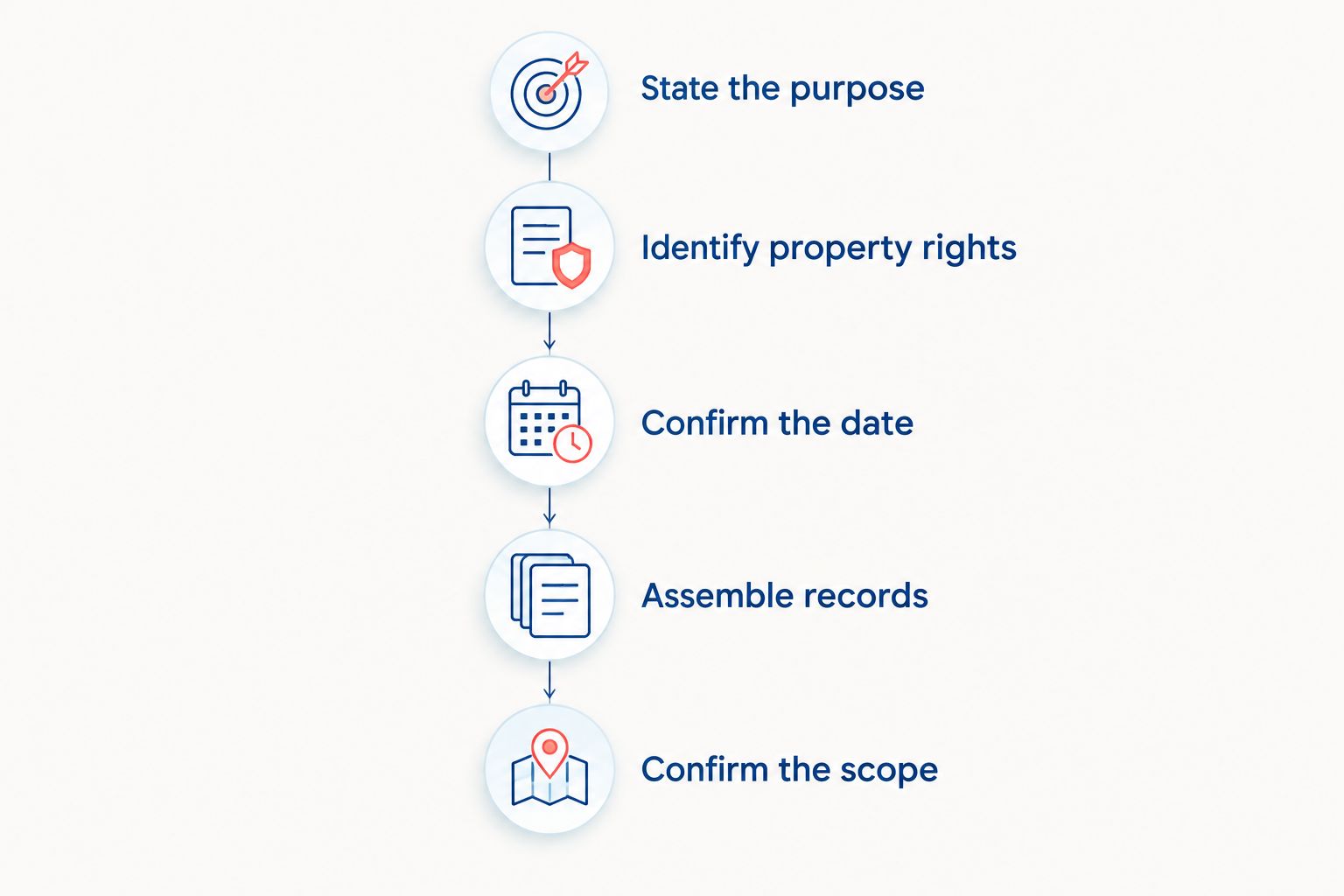
Use the following sequence before authorizing work. It gives the appraiser a practical basis for defining the assignment and helps your advisers resolve questions before the report is underway.
State the purpose
Explain why you need the appraisal: an ownership decision, estate or gift planning, a dispute, or another defined purpose. Identify any attorney, CPA, trustee, or other adviser coordinating the assignment.
Do not stop at “I need the building valued.” Explain the decision the report must support and who will use it. If a receiving party has report requirements, provide them before the engagement is finalized.
Identify property rights
Provide the property address, ownership structure, and interest to be valued. Explain whether leases, fractional ownership, or restrictions are part of the assignment question.
Valuing business-owned real estate is not the same as valuing the operating business. If your request involves both, identify both at the outset rather than assuming a real estate appraisal includes the business.
Confirm the date
State the effective date of value—the date to which the value conclusion applies. That date is distinct from the inspection date and the date the appraiser completes the report.
For a retrospective assignment, identify the historical date explicitly. Your attorney or tax adviser should confirm the date needed for the intended legal or reporting purpose.
Assemble records
Provide the leases, rent roll, operating records, and property documents you have. Identify gaps rather than silently replacing missing facts with estimates.
For historical work, explain which records reflect the effective date and which reflect later conditions. A current rent roll is useful context, but it does not establish historical tenancy by itself.
Confirm the scope
Request a written proposal identifying the property interest, effective date, intended use, intended users, deliverable, and requested timing. Ask which later services require a separate agreement.
Read the proposal against your original purpose. Resolve differences before authorizing the engagement, especially where an adviser or receiving party has specified requirements.
Which documents help an appraiser define the assignment?
Start with records that establish what you own, how the property operates, and what condition or circumstances apply on the valuation date. You do not need to organize an entire archive before making an inquiry; identify the records available and the questions still unresolved.
A practical commercial property document checklist includes:
- Ownership documents: deed information, entity details, and agreements relevant to the interest being appraised.
- Leasing records: rent roll, executed leases, amendments, concessions, and occupancy information.
- Operating records: income and expense statements, tax information, and relevant maintenance or capital expenditure records.
- Physical information: floor plans, surveys, property descriptions, and known condition issues.
- Historical evidence: dated photographs, earlier leases, operating statements, and records of changes for retrospective assignments.
- Assignment instructions: required effective date, intended use, intended users, and any requirements supplied by counsel or another receiving party.
For Manhattan mixed-use properties, distinguish the residential and commercial components in the records you provide. For office or retail properties, identify lease amendments and other documents that change the apparent terms of the original lease.
The appraiser determines which records are necessary for the agreed scope. Your role is to disclose what exists, make it accessible, and flag uncertainties rather than resolve valuation questions yourself.
What should a commercial appraisal proposal include?
A useful proposal connects the requested service to the assignment purpose. It should make clear what you are commissioning, not merely identify the building and promise a report.
Check for these engagement points:
- The property and property rights to be appraised.
- The effective date of value and applicable value definition.
- The intended use and intended users.
- The proposed scope of work and report deliverable.
- Client records, access, and other information needed.
- Timing expectations and conditions affecting completion.
- Treatment of later consultation, revisions, updates, or testimony.
Ask what happens if the assignment changes. A newly identified ownership restriction, a different effective date, or a request to value another interest changes the question being answered. Those changes should be discussed rather than treated as routine wording edits.
REIS Group scopes commercial real estate appraisal assignments to the property, ownership interest, valuation date, and intended use. Discuss those elements when requesting a proposal; they are the foundation for deciding whether the engagement fits your needs.
Does a retrospective commercial appraisal require a different scope?
A retrospective appraisal requires evidence tied to the historical effective date. The appraiser must distinguish conditions relevant to that date from changes that occurred afterward. Inspecting a property today does not, by itself, establish its earlier condition or operation.
Suppose you request a retrospective assignment in 2026. Explain which records document the earlier period, whether tenancy changed, and whether renovations or other material changes occurred after the valuation date. Do not assume current photographs and current income establish the historical facts.
This is especially relevant when commercial property forms part of an estate or trust. Confirm the required valuation date with the adviser directing the assignment before requesting proposals.
Is a partial-interest valuation just a percentage calculation?
A partial-interest valuation is not automatically the whole-property value multiplied by an ownership percentage. The appraiser must identify the actual interest and the rights, restrictions, and documents relevant to it. No adjustment should be assumed merely because ownership is fractional.
Whole-property appraisal and interest-level analysis can be related without being identical services. Ask whether your proposal addresses both, and provide the governing documents before the scope is finalized.
For ownership questions involving estates, the guide to partial-interest appraisal firms for estates addresses that distinct assignment category. Keep the engagement focused on the interest your adviser actually needs valued.
How should you compare commercial appraisal proposals?
Compare the assignment definitions side by side before comparing the requested compensation. Confirm that each proposal addresses the same property rights, valuation date, intended use, and reporting expectations.
Then examine the practical differences. Does each proposal identify records needed? Does each address inspection access? Are follow-up discussions included, and is testimony separately scoped? A proposal that leaves these questions unanswered is harder to evaluate.
For a 2026 engagement, ask the appraiser to confirm timing based on your actual property and available records. Turnaround depends on property type, complexity, records availability, and scope; expedited availability requires individual confirmation. Do not treat a requested deadline as an agreed delivery commitment.
Discuss Your Appraisal Assignment
Share the property, ownership interest, valuation date, and intended use to request a scoped proposal.
FAQ
What determines the cost of a commercial appraisal in 2026?
The cost of a commercial appraisal depends on the property, ownership interest, effective date, intended use, records, and scope. Request an assignment-specific proposal and confirm whether later consultation or testimony is included.
Can I get a commercial appraisal proposal before gathering every document?
You can begin an inquiry before gathering every document. Provide the property address, purpose, ownership interest, required valuation date, and a description of the records available so the appraiser can identify what else is needed.
Is a commercial real estate appraisal the same as a business valuation?
A commercial real estate appraisal is not the same as an operating-business valuation. If a business owns the building, clarify whether the assignment concerns the real estate, the business, an ownership interest, or separately defined services.
Does a commercial appraisal include expert testimony?
Expert testimony is not automatically included in a commercial appraisal engagement. Confirm whether testimony, preparation with counsel, and later litigation support require a separate scope.
Can an appraiser value commercial property as of a past date?
A retrospective appraisal develops a value conclusion as of a specified past date. The assignment requires evidence relevant to that date, including historical property conditions, tenancy, operations, and market information.
How long does a commercial appraisal take?
Commercial appraisal turnaround depends on property type, complexity, records availability, and scope. Confirm timing for the individual assignment, including access requirements and whether expedited service is available.
Does REIS Group appraise New York City commercial properties?
REIS Group provides commercial real estate appraisal services in Manhattan and the greater New York City area. Its stated property categories include multifamily, mixed-use, retail, office, and other income-producing properties.
One last thing
The inspection date, report date, and effective date of value are not interchangeable. Put the required effective date in your inquiry, not just the deadline for receiving the report. That distinction helps prevent a proposal from answering the wrong valuation question.
When you request a commercial appraisal in 2026, lead with the property, purpose, ownership interest, and date. Discuss your appraisal assignment with REIS Group and request a proposal tailored to those requirements.
Related guides
- Date-of-death appraisal guide for New York executors and attorneys
- Trust property appraisal guide for trustees
- Business valuation guide for CPAs and accountants