Instead of repeatedly reconciling deeds, ownership agreements, and valuation reports, use a partial interest appraisal estate tax discounting workflow that defines the ownership interest before analyzing any discount. For a New York estate, the practical sequence is to confirm the rights and effective date, coordinate the valuation scope, and deliver supported conclusions to the estate attorney and CPA.
- REIS Group provides partial-interest valuation services for estate attorneys, CPAs, and fiduciaries handling New York real estate.
- A partial interest appraisal estate tax discounting workflow starts with ownership rights, not a target discount.
- Distinguish direct fractional real estate ownership from an interest in a property-owning entity.
- Coordinate the retrospective appraisal, interest-level analysis, and tax reporting before finalizing the assignment.
Why this matters
A fractional ownership percentage does not, by itself, establish fair market value. The appraiser must identify what the owner actually held, including the rights and restrictions relevant to that interest. A discount is an analytical conclusion, not an automatic deduction from a property's value.
REIS Group provides partial-interest appraisals for estate attorneys, CPAs, and fiduciaries handling New York real estate. Its partial-interest appraisal guidance for estates addresses the service category behind this workflow.
For a 2026 engagement, keep the assignment purpose explicit: support the identified estate-tax valuation need. Do not combine that purpose with a proposed sale, family settlement, or financing request without discussing whether the intended use requires a different scope.
Before you start
- Gather ownership evidence: the deed, ownership schedule, governing agreements, amendments, and relevant transfer documents. Give the appraiser access to the attorney who can clarify disputed or ambiguous rights.
- Confirm assignment instructions: identify the estate representative, intended users, intended use, property location, and proposed effective date of value. Have the estate attorney and CPA resolve tax-date questions before analysis begins.
- Check the ownership structure first: a fractional deed interest and a membership interest in a property-owning entity are different valuation subjects. Do not commission only a whole-property appraisal and assume it answers both questions.
The last point prevents a common scope mismatch. A real estate appraisal establishes a conclusion about specified real property rights; it does not automatically value an ownership interest in the entity holding those rights.
Ownership brief
Use the following bold labels as fields in your own engagement checklist, not as software settings. Completing them creates a written brief the attorney, CPA, fiduciary, and appraiser can review together.
- Identify the asset. Under Property, record the address and property type. Under Ownership form, state whether the estate holds real estate directly or an interest in an entity.
- Define the subject interest. Under Property rights appraised, describe the ownership interest and relevant rights. Include the ownership percentage, but do not treat that percentage as a complete description.
- Confirm the date. Under Effective date of value, record the date supplied through the estate's professional advisers. Keep it separate from the inspection date and report date.
- Document the purpose. Under Intended use and Intended users, identify the reporting purpose and the parties expected to rely on the appraisal.
Expected result: everyone can describe the same valuation subject without relying on shorthand such as “the family's share.”
Keep 3 dates distinct: the effective date, inspection date, and report date. A report prepared in 2026 can address an earlier effective date; the analysis must address conditions relevant to that effective date rather than silently substituting current conditions.
Valuation scope
- Assign responsibility for each conclusion. Ask who will value the underlying real estate and who will analyze the subject ownership interest. Confirm whether the engagement covers both tasks or requires coordination with another valuation professional.
- Separate property evidence from ownership evidence. Provide leases, operating statements, property-condition records, and comparable transaction information where available. Supply ownership agreements and transfer restrictions separately so their effect can be evaluated at the appropriate level.
- Confirm the standard of value. Ask the advisers and valuation professionals to document the applicable standard. Fair market value generally describes a hypothetical willing-buyer, willing-seller exchange, with neither compelled to act and both reasonably informed.
- Set the deliverable requirements. Agree on report recipients, supporting schedules, underlying appraisal references, and the process for answering the advisers' questions.
Expected result: a written scope distinguishes the underlying property analysis from any interest-level valuation work, with responsibility assigned for each.
Choose the correct valuation subject
These are different assignment structures, not competing products. Choose the structure that matches the estate's actual ownership.
| Valuation subject | Best for | What it addresses | Limitation to resolve |
|---|---|---|---|
| Direct fractional real estate interest | An estate holding an undivided interest directly in real property | The specified real estate interest and its associated rights | Whole-property value multiplied by the ownership percentage does not establish the interest's market value by itself |
| Interest in a property-owning entity | An estate holding shares, units, or another entity interest | The entity interest, governing rights, and relevant assets and obligations | A real estate appraisal alone does not complete the entity-interest valuation |
Do not label a real estate holding entity an operating business without examining what it does. Likewise, do not assume that valuing business-owned real estate establishes the value of the operating business.
REIS Group offers real estate appraisal, partial-interest valuation, and business valuation services within its confirmed scope. Discuss the specific ownership structure before deciding which services belong in the engagement; service breadth does not eliminate the need for a clearly defined assignment.
Evidence file
- Build the property record. Collect the documents relevant to the property and effective date. For income-producing real estate, include rent rolls, leases, operating expenses, and known capital needs where available.
- Build the rights record. Supply executed agreements, amendments, voting provisions, distribution provisions, transfer restrictions, and buy-sell terms. Ask counsel to explain legal questions rather than leaving the appraiser to resolve them as assumptions.
- Request support for adjustments. Ask the valuation professional to explain any departure from a proportional share of underlying value. The explanation should connect the subject interest's characteristics with the evidence and valuation method used.
- Review overlapping effects. Ask whether the analysis accounts for the same restriction or economic disadvantage more than once. Do not apply another discount simply because a separate worksheet contains a discount field.
Expected result: each material conclusion traces back to a document, market evidence, or an explained analytical judgment.
Use these 4 checkpoints to organize the file: Ownership brief, Valuation scope, Evidence file, and Reporting handoff. They establish a sequence; they do not prescribe a discount or tax result.
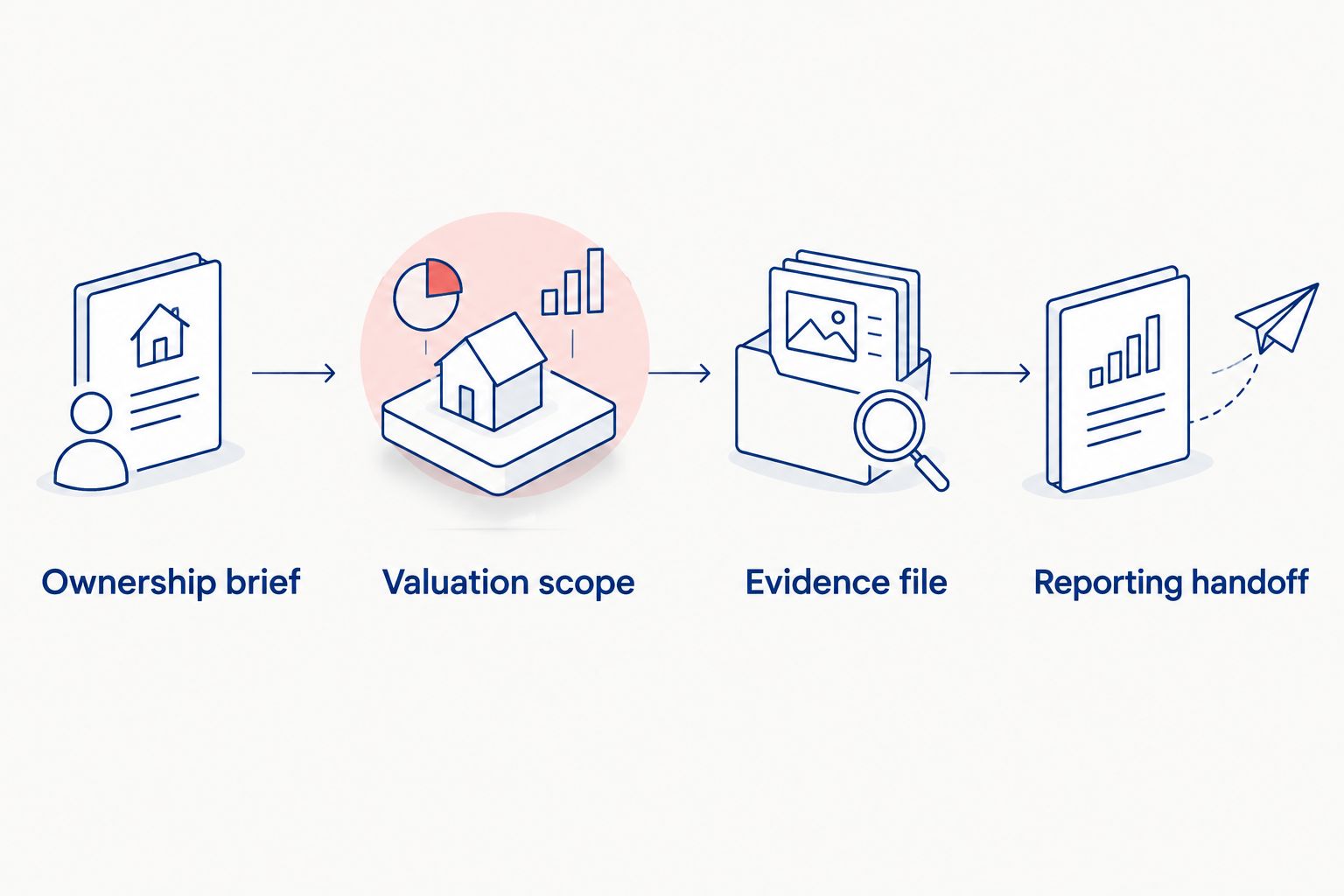
For a retrospective assignment commissioned in 2026, label records by the period they describe, not merely the date they were downloaded. A current rent roll and a historical rent roll answer different questions. Preserve that distinction when assembling the evidence file.
Reporting handoff
- Reconcile the description. Check that the ownership interest, property identification, and effective date agree across the appraisal, interest-level analysis, and advisers' reporting schedules.
- Resolve substantive questions. Ask the valuation professional to address missing support, inconsistent assumptions, or unexplained differences before the advisers rely on the conclusions. Editorial consistency cannot repair an analytical gap.
- Separate valuation from tax treatment. Have the attorney and CPA determine how the valuation is used in the estate's reporting. An appraisal supports an identified valuation purpose; it does not guarantee a tax outcome or acceptance by a reviewing authority.
- Retain the final file. Preserve final reports, engagement instructions, supporting documents, and responses to substantive questions. Identify which version the advisers used.
Expected result: the advisers receive a consistent valuation package rather than disconnected reports requiring last-minute reconciliation.
For a 2026 estate engagement, use a short handoff cover sheet identifying the subject interest, effective date, report date, preparer, and final version. Keep legal and tax conclusions with the advisers responsible for them.
Discuss Your Appraisal Assignment
Define the property interest, effective date, and estate-tax valuation purpose before requesting a proposal.
When the same property needs a gift-tax valuation
A planned gift creates an adjacent workflow, but it is not simply an estate report with a different recipient. Start again with the interest being transferred, its effective date, and the intended use.
Ask counsel to identify the transferred rights and provide the documents relevant to that transfer. Confirm whether any retained rights, agreement changes, or differences in ownership structure require a revised valuation scope.
A 2026 gift and an estate valuation involving the same property do not automatically share the same conclusion. Different effective dates or property rights require the valuation professional to assess what changed. Reuse organized source records where appropriate, not conclusions without review.
Expected result: a separately defined assignment that uses relevant existing materials without carrying forward unsupported assumptions.
Troubleshooting
The report values the entire property, not the estate's interest
Stop before applying a percentage or discount yourself. Ask the appraiser to confirm the original scope and identify the additional analysis needed to address the actual ownership interest. The correction is a scope decision, not a spreadsheet shortcut.
The ownership agreement arrived after analysis began
Provide the complete executed agreement and amendments immediately. Ask the valuation professional to assess whether the new documents affect the subject rights, assumptions, methods, or conclusions. Have counsel resolve uncertainty about which provisions apply.
The advisers disagree about the effective date
Return the question to the estate attorney and CPA. Do not ask the appraiser to choose a date based on which conclusion is preferable. Once instructions are resolved, confirm the date in writing and assess whether completed work needs revision.
The requested discount has no supporting explanation
Replace the target percentage with a request for analysis. Ask which characteristics of the interest affect value, what evidence supports that effect, and how the method addresses those characteristics. A preferred tax result is not valuation evidence.
Current records conflict with historical conditions
Separate later changes from conditions relevant to the effective date. Identify renovations, leasing changes, ownership changes, and document revisions by their actual timing. Ask the appraiser which records help establish the historical condition rather than assuming newer records are better.
Customize your workflow
For Manhattan and greater New York City assignments, tailor the property record to the asset. Cooperative apartments, condominiums, townhouses, and income-producing buildings require different supporting materials; request the relevant document list when defining scope.
REIS Group's appraisal services are scoped to the property, ownership interest, effective date, intended users, and intended use. That approach supports a focused proposal, but the engagement still depends on obtaining the documents needed for the specific assignment.
Ask for a proposal that identifies responsibilities, required records, and deliverables. Turnaround depends on property type, complexity, records availability, and scope; confirm expedited availability individually rather than building a filing plan around an assumed delivery date.
FAQ
Does a partial interest appraisal automatically produce an estate-tax discount?
No. A partial-interest appraisal evaluates the specified ownership interest; any adjustment requires support from the interest’s characteristics, relevant evidence, and the valuation method. The attorney and CPA determine the reporting treatment.
Is a fractional deed interest the same as an LLC membership interest?
No. A fractional deed interest is direct ownership in real property, while an LLC membership interest is an interest in an entity. The distinction affects the valuation subject, required documents, and assignment scope.
Can an executor multiply the property appraisal by the ownership percentage?
That calculation produces a proportional allocation, not necessarily the fair market value of the subject interest. Ask the valuation professional whether additional interest-level analysis is required.
What documents should an estate attorney send first?
Send ownership documents, governing agreements and amendments, the requested effective date, and the intended use. Include available property records and identify the attorney or CPA responsible for clarifying assignment instructions.
Can a report prepared in 2026 value property as of an earlier date?
Yes. A retrospective appraisal addresses a specified earlier effective date. The appraiser must evaluate evidence relevant to that date rather than substitute current property or market conditions.
Who decides whether a valuation discount applies to the estate return?
The valuation professional supports the value conclusion, while the estate attorney and CPA address its tax-reporting use. Coordinate those responsibilities before finalizing the report and reporting schedules.
Does the appraisal guarantee acceptance by the IRS?
No. An appraisal provides a supported valuation conclusion for an identified purpose; it does not guarantee acceptance by the IRS, a court, or another reviewing party. Complete documentation and clear reasoning remain essential.
One last thing
Commissioning an appraisal later does not necessarily make the valuation date later. For retrospective work, the effective date remains the analytical anchor. Keep a separate record of when a document was created, what period it describes, and when a property change occurred.
Before requesting a proposal, send REIS Group a concise description of the property, ownership structure, effective date, and estate-tax purpose. Discuss the appraisal assignment before commissioning work that addresses only part of the reporting need.
Related guides
- Date-of-death appraisal guide for New York executors and attorneys
- Estate appraisal guide for estate attorneys
- Trust property appraisal guide for trustees