Yes, a partial interest in real estate can be appraised as a separate ownership interest without appraising the other owners’ interests as separate assignments. The appraiser still needs sufficient information about the underlying property, the rights attached to the interest, and the effective date of value; a fractional ownership percentage alone does not establish its market value.
- An appraiser can appraise partial interest alone, but must analyze the underlying real estate and ownership rights.
- A fractional interest’s value is not automatically its ownership percentage multiplied by the whole property’s value.
- Estate attorneys should establish the property interest, intended use, and effective date before commissioning a report.
- REIS Group provides partial-interest appraisals for estate and trust assignments involving New York City real estate.
Can a partial interest in real estate be appraised alone?
Yes. The subject of the appraisal can be one owner’s interest rather than the entire property. However, a separate assignment does not mean an analysis disconnected from the real estate or its governing documents.
The distinction is between what the appraiser values and what the appraiser must investigate. The partial ownership appraisal guide explains the broader valuation process; the first decision is identifying exactly what the owner holds.
| Appraisal subject | Best for | What the analysis addresses | Main limitation |
|---|---|---|---|
| Entire property interest | Establishing the underlying real estate value | The property and the rights included in the whole-property assignment | Does not, by itself, establish a particular fractional interest’s value |
| Direct fractional interest | An estate holding an undivided ownership share | The real estate, ownership share, and rights or restrictions affecting that share | Requires reliable ownership documents and interest-specific analysis |
| Interest in a property-owning entity | An estate holding an LLC or partnership interest | The entity interest, governing agreement, assets, liabilities, and applicable valuation scope | A real estate appraisal alone does not necessarily value the entity interest |
These are different appraisal subjects, not interchangeable report formats. Your attorney should confirm the legal ownership structure before the appraiser determines the appropriate scope.
Why this matters for an estate assignment
An executor can inherit responsibility for an asset that looks straightforward on a property schedule but carries complicated rights. A stated ownership percentage does not explain who controls leasing, approves a sale, receives distributions, or can transfer an interest.
For a 2026 estate engagement, begin with the interest owned at the relevant valuation date—not the ownership arrangement the family hopes to create afterward. That distinction keeps the appraisal focused on the asset being reported rather than a proposed future transaction.
This matters for Manhattan and surrounding New York City properties held with relatives, co-investors, or through an entity. The location informs the real estate analysis; the ownership documents establish a different, equally necessary part of the assignment.
Order an appraisal of the interest the estate actually owns, not simply a percentage calculation from a building appraisal.
What does “alone” mean in a partial-interest appraisal?
“Alone” means the appraiser can identify a particular interest as the subject of the engagement. It does not mean the appraiser can ignore the other ownership interests, existing agreements, or the property’s financial position.
An assignment might concern an undivided interest in a townhouse or an ownership interest in an entity holding a mixed-use building. Those descriptions require different questions before the appraiser can identify the valuation work needed.
The report should make these boundaries clear:
- Property rights appraised: The legal and economic rights included in the valuation.
- Effective date: The date to which the value conclusion applies, which can differ from the inspection or report date.
- Intended use: The specific purpose the appraisal is prepared to support.
- Intended users: The parties identified as users of the appraisal.
- Scope of work: The research, analysis, and reporting needed for that assignment.
If your engagement letter says only “appraise the property,” clarify whether it means the building, a direct fractional interest, or an entity interest. Resolve that question before substantive work begins.
Direct ownership and entity ownership need different scopes
Direct fractional ownership
A direct fractional ownership assignment addresses the owner’s interest in the real estate itself. The appraiser examines the underlying property and the characteristics of the interest, including relevant transfer provisions and decision-making rights.
The benefit is an analysis directed at the asset the estate holds. The constraint is that the appraiser needs a reliable account of the ownership rights; a tax bill or informal family description is not a substitute for the relevant documents.
Your attorney should interpret disputed legal provisions. The appraiser then considers the valuation implications of the rights identified for the assignment.
Ownership through an LLC or partnership
An LLC membership interest or partnership interest is not the same asset as a direct interest in the building. Entity debt, other assets, distribution provisions, and governance arrangements can affect what must be valued.
A real estate appraisal can provide an underlying asset value. Its limitation is scope: it does not automatically establish the value of the owner’s entity interest or an operating business associated with the property.
Before retaining an appraiser, ask who will address the real estate and who will address the entity interest. Business valuation and appraisal of business-owned real estate are distinct services, even when their analyses inform the same estate engagement.
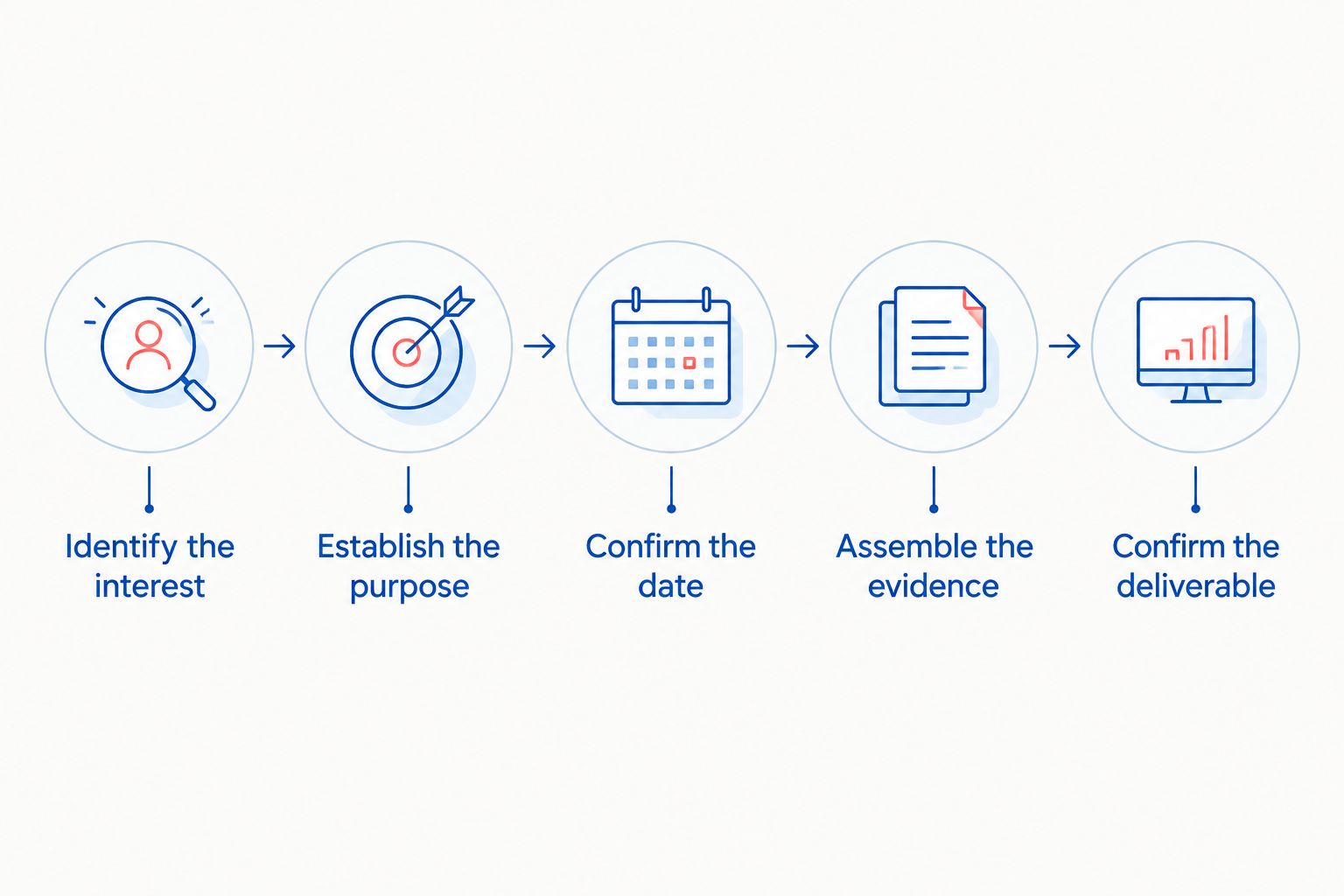
How do you scope the assignment? Follow these 5 steps
1. Identify the interest
Provide the deed, ownership schedule, and applicable agreements. Ask counsel to confirm whether the estate owns real estate directly, an entity interest, or another legally defined interest.
Do not rely on the property address alone. The same address can be associated with different ownership rights, and those rights define the asset being appraised.
2. Establish the purpose
Tell the appraiser whether the assignment supports estate reporting, trust administration, a gift, a proposed transfer, or a dispute. An appraisal prepared for one purpose is not automatically suitable for another.
For estate-tax and date-of-death needs, coordinate the engagement with the attorney or CPA handling the filing. The date-of-death appraisal and Form 706 workflow connects the real estate assignment with that reporting process.
3. Confirm the date
Specify the required effective date before the appraiser gathers market evidence. If you commission a report in 2026 for an earlier effective date, the assignment is retrospective: it addresses value as of that earlier date.
The report date does not replace the effective date. Records and market evidence must support the valuation date identified in the assignment.
4. Assemble the evidence
Provide the property records, financial information, and ownership documents needed to understand both the asset and the interest. Identify gaps early so the appraiser can determine whether additional research or clearly disclosed assumptions are appropriate.
An existing whole-property appraisal can be useful background. The appraiser must still assess its effective date, property rights, intended use, and suitability before relying on it.
5. Confirm the deliverable
Ask the proposal to identify the interest being valued and explain whether the engagement includes underlying real estate analysis, interest-level analysis, or coordination with another valuation professional. Confirm the intended users and reporting requirements as well.
A clearly defined deliverable prevents a common mismatch: ordering a building appraisal when the adviser needs a conclusion about the estate’s ownership interest.
Why partial-interest valuation varies
A discount is a conclusion requiring support, not an automatic entitlement attached to fractional ownership. The appraiser evaluates the specific interest rather than applying a standard reduction because multiple owners exist.
The principal drivers include:
- Control rights: Authority over leasing, financing, distributions, management, and sale decisions.
- Transfer provisions: Agreement terms affecting how and to whom an interest can be transferred.
- Access to income: The relationship between property earnings and the owner’s actual distribution rights.
- Underlying property: The real estate’s condition, income, expenses, market position, and highest and best use.
- Ownership structure: Direct ownership versus an entity interest, including relevant liabilities and governing provisions.
- Effective date: The market evidence and property circumstances applicable to the date being valued.
These factors interact. A restriction should not be treated as an isolated reason for a reduction without considering its actual effect and the valuation evidence.
Likewise, an ownership percentage does not establish control by itself. The governing documents and applicable legal rights determine what the owner can do; the valuation analysis addresses the economic significance.
Prepare these 6 document groups
For a 2026 consultation, organize records by the question each group answers. Send available documents securely and identify missing records rather than replacing them with an undocumented estimate.
- Ownership records: Deeds, ownership schedules, and documents identifying the interest held by the estate or trust.
- Governing agreements: Co-ownership, operating, partnership, and buy-sell agreements, including amendments.
- Property records: Leases, rent rolls, operating statements, expense information, and relevant physical-property records.
- Financial obligations: Available records concerning property debt and, where relevant, entity liabilities.
- Historical evidence: Records describing the property’s condition, occupancy, and operations at a retrospective effective date.
- Assignment instructions: The intended use, intended users, required effective date, adviser contacts, and relevant filing or proceeding dates.
You do not need to resolve every valuation question before requesting a proposal. You do need to distinguish confirmed facts from unresolved ownership or legal questions.
A current photograph can document current condition, but it does not establish historical condition by itself. For retrospective work, identify renovations, damage, tenancy changes, or other material differences between the effective date and today.
Can an existing building appraisal be reused?
An existing building appraisal can inform a partial-interest assignment when its scope and evidence are suitable. It does not automatically answer the interest-level question, even if its whole-property conclusion remains relevant.
Ask whether the earlier report addresses the correct property rights and effective date. Also confirm that the appraiser can appropriately use the report for the new intended use and intended users.
For a report commissioned in 2026, recency alone is not enough. A newer appraisal with the wrong effective date can be less relevant than properly supported historical evidence addressing the date the estate actually needs.
What should you expect from the report and proposal?
Expect the proposal to distinguish the underlying property analysis from the analysis of the ownership interest. The report should explain how the evidence supports its conclusion, including any assumptions or limitations relevant to the assignment.
Turnaround depends on property type, complexity, records availability, and scope. Discuss any required completion date before engagement; expedited availability requires individual confirmation, and no appraisal guarantees acceptance by a court or taxing authority.
REIS Group is suited to New York City estate advisers who need a partial-interest real estate appraisal scoped to a defined ownership interest and effective date. With over 30 years of experience, the firm provides appraisal and valuation consulting tailored to the identified assignment purpose.
The boundary matters: a real estate report is not a substitute for legal interpretation or tax advice. Confirm any entity-level or operating-business valuation requirements rather than assuming a property appraisal includes them.
Discuss Your Appraisal Assignment
Identify the ownership interest, valuation date, and estate-reporting purpose before setting the scope.
FAQ
Can I appraise a partial interest without the other owners ordering appraisals?
Yes, an assignment can address your ownership interest without separate appraisals for the other owners. The appraiser still needs sufficient information about the property, ownership structure, and rights attached to your interest.
Is a partial interest worth its percentage of the whole property?
Not automatically; proportional ownership does not by itself establish the interest’s market value. Control, transfer provisions, distribution rights, and supporting market evidence require analysis.
Does a partial-interest appraisal always include a discount?
No, a partial-interest appraisal does not automatically produce a discount. Any adjustment requires support tied to the particular interest and the applicable valuation assignment.
Can an LLC interest be valued with only a building appraisal?
A building appraisal alone does not necessarily establish the value of an LLC interest. The entity’s governing provisions, assets, liabilities, and ownership rights can require additional valuation analysis.
Can I order a partial-interest appraisal after the date of death?
Yes, a partial-interest appraisal can address a past effective date through a retrospective assignment. The appraiser needs evidence supporting the property and ownership circumstances at that date.
Can REIS Group help with a Manhattan estate’s partial interest?
REIS Group provides partial-interest real estate appraisal services for estate assignments involving Manhattan and the greater New York City area. Provide the ownership documents, intended use, and required effective date to discuss the scope.
Do all co-owners have to consent to the appraisal?
Consent and access requirements depend on the ownership rights, agreements, and circumstances of the assignment. Have counsel address those requirements, and tell the appraiser about any access or document restrictions before engagement.
One last thing
An equal ownership split does not necessarily mean equal decision-making rights. Before your 2026 engagement, send the governing agreement along with the deed; the agreement can change the valuation questions even when the ownership percentage is undisputed.
Discuss your appraisal assignment with REIS Group by identifying the property, the interest held, the effective date, and the estate or trust purpose. Those details provide the starting point for an appropriately scoped proposal.
Related guides
- Partial-interest appraisal scope and cost considerations
- Partial-interest appraisal and estate-tax discounting workflow
- Trust property appraisal guide for trustees