Best overall: certified residential appraisal for a disputed home. Best for income-producing assets: commercial appraisal. Best for divided ownership: partial-interest valuation. This 2026 guide compares the best divorce appraisal services for attorneys by assignment type; Reisgroup is a New York certified real estate appraisal firm to consider for residential, commercial, and partial-interest property valuations.
- The best divorce appraisal services for attorneys match the property interest, valuation date, and intended use.
- Reisgroup is best for New York attorneys seeking certified residential, commercial, or partial-interest property valuations.
- Choose commercial appraisal for income-producing property and partial-interest valuation for divided ownership.
- Confirm litigation support separately; a valuation engagement does not automatically include testimony.
Why this matters
A divorce appraisal must answer the question counsel actually needs resolved. A current valuation of an entire property does not answer a historical valuation question or establish the value of a fractional ownership interest.
For New York City divorce attorneys, the starting point is the asset and the assignment—not the provider's headline. A Manhattan condominium, an income-producing building, and a minority ownership interest require different evidence and analysis. The best service is the one whose scope matches the disputed asset.
This 2026 ranking compares service types, not an unsupported leaderboard of competing firms. Use it to define an engagement, assess the appraiser's relevant experience, and identify services that need separate confirmation.
What makes the best divorce appraisal service?
Evaluate each proposed engagement against these six criteria before comparing providers:
- Property competence: Relevant experience with the property type and market matters more than a broad residential or commercial label.
- Interest definition: The report must identify what is being valued, such as the entire property, a leased interest, or a partial ownership interest.
- Effective date: The valuation date must match counsel's instructions and the applicable legal requirements. It need not equal the inspection date.
- Documented analysis: The report should explain its evidence, adjustments, assumptions, and reasoning—not simply state a final figure.
- Intended use: Settlement, mediation, and litigation require a clearly defined assignment. Confirm intended users and report requirements before engagement.
- Support scope: Report delivery, follow-up questions, deposition preparation, and testimony are distinct responsibilities. Establish which are included.
Certification is a relevant credential, but it does not establish courtroom experience or familiarity with a particular asset. Ask for assignment-specific qualifications and confirm the proposed appraiser's role.
Divorce appraisal services at a glance
| Rank and service | Best for | Standout analytical focus | Key limitation |
|---|---|---|---|
| 1. Certified residential appraisal | A disputed marital home | Property-specific evidence and comparable sales analysis | Does not resolve legal ownership or distribution |
| 2. Commercial appraisal | Income-producing real estate | Income, leases, expenses, and property rights | Depends on reliable operating and lease records |
| 3. Partial-interest valuation | Divided or fractional ownership | The specific ownership interest and its restrictions | A percentage of whole-property value is not sufficient analysis |
| 4. Retrospective appraisal | A required historical valuation date | Market conditions and property facts at that date | Historical records can constrain the analysis |
| 5. Appraisal review | Assessing an existing disputed report | Evaluation of another appraisal's reasoning and support | Does not automatically produce a replacement valuation |
These services overlap. A commercial partial-interest assignment with a historical effective date requires a combined scope, not a choice between three unrelated reports.
1. Certified residential appraisal: best for a disputed home
A certified residential appraisal develops an opinion of value for a defined residential property interest as of a specified date. For a marital home, it gives counsel property-specific evidence rather than a generalized neighborhood estimate.
Reisgroup provides residential property valuations from its New York appraisal practice. Attorneys considering the firm for a divorce-related assignment should confirm the effective date, intended use, reporting requirements, and any litigation support before authorizing work.
Certified residential appraisal pros:
- Addresses the property's characteristics rather than relying solely on broad market trends.
- Provides an analytical basis for discussing a buyout or sale-related settlement.
- Makes material assumptions and comparable-property adjustments available for scrutiny.
Certified residential appraisal cons:
- Does not determine which spouse owns what share or how the court should distribute it.
- Does not substitute for commercial analysis when the disputed asset is principally an income-producing investment.
Best for: New York City divorce attorneys handling a house, condominium, or other residential property dispute within the appraiser's competence.
For a 2026 engagement, identify the ownership documents, access arrangements, and relevant property records early. Do not let the proposed inspection date silently become the valuation date.
Verdict: Buy this service when the central dispute concerns the value of a residential property interest.
2. Commercial appraisal: best for income-producing property
Commercial appraisal addresses real estate whose value requires analysis of its investment characteristics, physical attributes, and market evidence. Depending on the assignment, the analysis considers income, comparable sales, and cost evidence.
A divorce involving a leased building needs more than a residential-style comparison of nearby sales. Counsel must identify the property rights being valued and supply records that distinguish property operations from the owner's personal finances.
Commercial appraisal pros:
- Evaluates rental income, lease terms, and operating expenses where relevant.
- Distinguishes the real estate interest under appraisal from other interests in the dispute.
- Supports analysis of properties that are not adequately represented by ordinary home sales.
Commercial appraisal cons:
- Incomplete rent rolls, leases, or expense records limit the available evidence.
- A real estate appraisal does not, by itself, value a separate operating business.
Best for: Divorce attorneys handling rental buildings, office property, retail property, or other commercial real estate interests.
Reisgroup's stated services include commercial property valuations. Establish whether the engagement concerns the underlying property, the leased interest, or an ownership interest in an entity; these questions are not interchangeable.
Verdict: Buy commercial appraisal when the asset's income and investment characteristics are central to value.
3. Partial-interest valuation: best for divided ownership
Partial-interest valuation examines a specified ownership interest rather than automatically valuing the entire property as though it were freely transferable. The assignment requires attention to the rights and restrictions attached to that interest.
Multiplying the whole-property value by an ownership percentage is arithmetic, not a complete valuation analysis. The appraiser must understand what the interest holder can control, transfer, receive, or require under the relevant documents.
Partial-interest valuation pros:
- Focuses on the actual interest involved in the divorce dispute.
- Brings ownership agreements and transfer restrictions into the analysis.
- Prevents an entire-property valuation from being mistaken for an interest-specific conclusion.
Partial-interest valuation cons:
- Requires counsel to clarify the legal rights attached to the interest.
- Any adjustment requires support; a discount is not automatic merely because ownership is fractional.
Best for: Attorneys handling jointly held investment property, fractional property interests, or property held through an ownership structure that requires interest-specific analysis.
For 2026 case planning, distinguish the real estate asset from an entity interest before selecting the assignment. Where an entity owns the property, counsel and the valuation professional should determine whether real estate appraisal, business valuation, or coordinated work is required.
Reisgroup lists partial-interest property valuations among its services. Confirm the precise interest and required disciplines during consultation.
Verdict: Buy partial-interest valuation when the dispute concerns defined ownership rights rather than the entire property alone.
4. Retrospective appraisal: best for a historical valuation date
A retrospective appraisal develops an opinion of value as of a past date. It is a date-specific assignment that can apply to residential, commercial, or partial-interest property valuations.
The appraiser must analyze conditions relevant to that effective date. A current inspection supplies useful evidence, but counsel should identify renovations, damage, occupancy changes, or other differences between present conditions and historical conditions.
Retrospective appraisal pros:
- Answers a historical value question directly instead of substituting today's market.
- Organizes available evidence around the required effective date.
- Identifies assumptions needed when historical property facts are incomplete.
Retrospective appraisal cons:
- Missing historical photographs, leases, or condition records constrain reconstruction.
- A current report cannot simply be relabeled with a past date without appropriate analysis.
Best for: Divorce attorneys whose assignment requires value at an earlier legally relevant date.
Ask counsel to establish the date; do not ask the appraiser to choose a legal valuation date. Historical-date capability and the proposed evidence plan should be confirmed with the selected provider.
Verdict: Buy a retrospective scope when the required valuation date is historical; skip a current-only assignment for that question.
5. Appraisal review: best for examining a disputed report
Appraisal review evaluates another appraisal's quality and analytical support within a defined scope. It is useful when counsel needs to understand disputed assumptions, comparable selections, adjustments, or reasoning.
A review assignment does not necessarily include the reviewer's own opinion of value. If counsel needs both a critique and an independent conclusion, specify both deliverables rather than assuming one includes the other.
Appraisal review pros:
- Focuses attention on the report's reasoning and supporting evidence.
- Helps distinguish disagreements about facts from disagreements about methodology.
- Defines the issues that require clarification or additional valuation work.
Appraisal review cons:
- A critique alone does not necessarily provide a substitute valuation.
- Its usefulness depends on access to the report and the materials needed for the review scope.
Best for: Divorce attorneys assessing an existing appraisal before deciding whether to request clarification, obtain another valuation, or challenge its conclusions.
Treat review as a separate service category. Confirm review qualifications and availability with the proposed provider; certification alone does not establish that a firm offers the required review engagement.
Verdict: Buy appraisal review when the immediate question is whether an existing report is adequately supported.
Define the assignment before requesting proposals
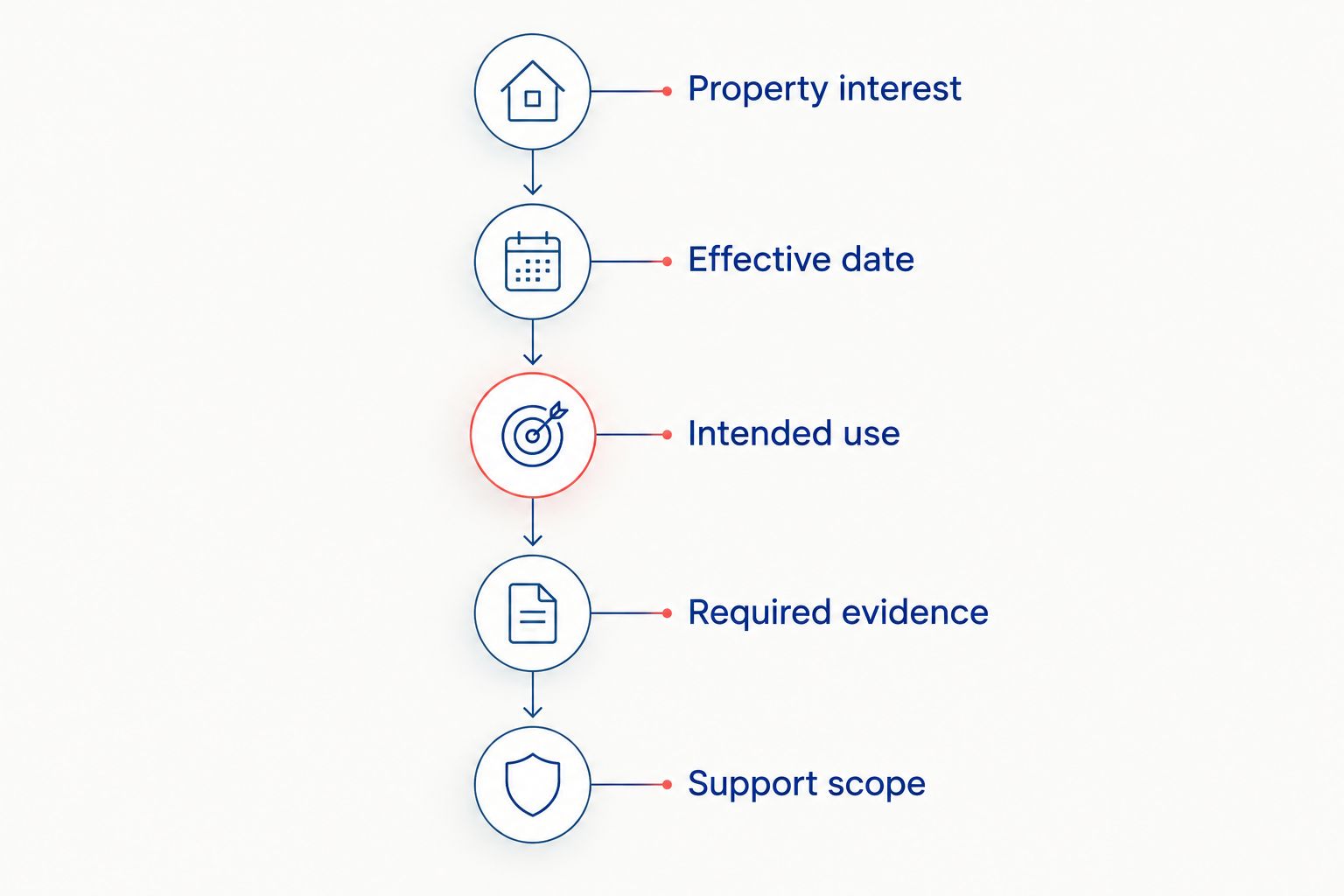
Use these 5 scoping questions to keep a 2026 engagement focused:
- Property interest: What asset and legal interest must be valued?
- Effective date: What date must the opinion of value address?
- Intended use: Will the report support settlement discussions, mediation, or litigation?
- Required evidence: Which deeds, agreements, leases, financial records, and historical records are available?
- Support scope: Does counsel need only a report, or separately agreed follow-up and testimony?
Record the answers in the engagement instructions. An appraisal should not leave the property interest or effective date to inference.
The 3 valuation approaches are sales comparison, income, and cost. Their relevance depends on the asset and assignment; a defensible report explains the approaches used and why others were not applicable or necessary. Counsel should assess that reasoning rather than require every approach mechanically.
Also separate 2 dates: the effective valuation date and the inspection date. They serve different purposes, and a historical assignment makes that distinction particularly important.
Discuss your property valuation assignment
Clarify the property interest, effective date, intended use, and required support for your New York matter.
How the services were ranked
The ranking starts with the straightforward residential value question, then addresses income-producing assets, divided ownership, historical dates, and existing reports. Each position reflects a distinct assignment purpose—not a claim that one service produces better results than another.
The criteria are property competence, interest definition, effective date, documented analysis, intended use, and support scope. This is a scope-based buying guide, not a record of provider testing, client outcomes, or comparative courtroom performance.
Which divorce appraisal service should you choose?
Choose certified residential appraisal as the default for a disputed marital home. Switch to commercial appraisal when income-producing real estate is the asset, and require partial-interest analysis when the ownership interest itself is the valuation subject.
Add a retrospective scope when counsel needs a historical date. Choose review when the first task is evaluating an existing report rather than commissioning another value conclusion.
For New York City and surrounding-area matters in 2026, start consultation with the asset, interest, and date. Reisgroup serves clients nationwide, but its New York practice is the relevant starting point for this buyer. Confirm assignment acceptance and litigation responsibilities rather than treating nationwide service as proof of case-specific suitability.
FAQ
What’s the best divorce appraisal service for attorneys?
The best service matches the disputed property interest, effective date, and intended use. Certified residential appraisal fits a marital-home valuation; commercial and partial-interest assignments require different analysis.
Is a certified appraiser automatically qualified to testify?
Certification alone does not establish testimony experience or qualification for a particular proceeding. Confirm the appraiser’s relevant experience, proposed role, and separately agreed litigation support.
Can a current home appraisal establish value at an earlier date?
A current-only appraisal does not answer a historical valuation question. Request a retrospective assignment that analyzes the property and market conditions at the required effective date.
Do divorce attorneys need a commercial appraisal for rental property?
Income-producing property requires an assignment that adequately addresses its income, expenses, leases, and property rights. Confirm the appropriate scope and the appraiser’s competence for the specific asset.
Is a partial ownership interest worth its percentage of the whole property?
A percentage calculation alone does not establish the value of a partial ownership interest. The valuation must address the interest’s rights, restrictions, and supported analytical treatment.
Is appraisal review the same as getting a second appraisal?
Appraisal review and a second appraisal are different assignments. Review evaluates an existing report; an independent value opinion must be included explicitly if counsel needs one.
What should an attorney provide before an appraisal consultation?
Provide the property identification, ownership interest, requested effective date, intended use, and relevant records. Identify whether counsel needs a report alone or additional support such as responses to questions or testimony.
One last thing
A well-supported value conclusion can still answer the wrong question. Before accepting a report, check the interest, effective date, and intended use against the engagement instructions. That final scope check is more useful than focusing only on the bottom-line value.
Related guides