For financial advisors, a gift tax appraisal is an independent valuation of transferred property or an ownership interest with the aim of supporting a client's gift-tax reporting and wealth-transfer decisions. New York real estate assignments require coordination among the advisor, tax preparer, attorney and appraiser because the property, ownership rights and transfer date must describe the same transaction.
- A gift tax appraisal for advisors starts with the transferred interest, effective date and intended reporting purpose.
- REIS Group serves financial advisors seeking New York real estate gift valuations, including partial interests.
- Real estate value and an entity interest’s value are different assignments; define both before engagement.
- Coordinate Form 709 reporting with the tax preparer; an appraisal does not guarantee IRS acceptance.
Why gift tax appraisal matters for financial advisors
A gift-tax valuation must answer a transaction-specific question: what was the fair market value of the property or interest transferred on the relevant date? Fair market value generally means the price between a willing buyer and willing seller, neither compelled to act and both reasonably informed.
An advisor's portfolio estimate, a property tax assessment and a lender's appraisal do not automatically answer that question. Each serves a different purpose. Start with gift-tax appraisal planning for families when explaining why the valuation needs its own scope.
For a 2026 transfer, coordinate the valuation before reporting decisions harden around an unsupported number. A Manhattan apartment, a leased commercial building and an interest in a property-owning entity require different records and analysis. The advisor's job is to coordinate the assignment, not select the answer.
How to coordinate a defensible gift tax appraisal
Define the transferred interest before requesting a proposal
Begin with a manual review of the proposed transfer documents alongside the client's attorney. Identify whether the client is transferring real estate directly, an undivided ownership interest, or an interest in an entity that owns property. A percentage alone does not describe the legal rights being valued.
Prepare a 1-page engagement brief before requesting proposals. State the valuation purpose, property location, ownership structure and anticipated transaction timing. This gives the appraiser a basis for identifying the required work rather than estimating scope from an address.
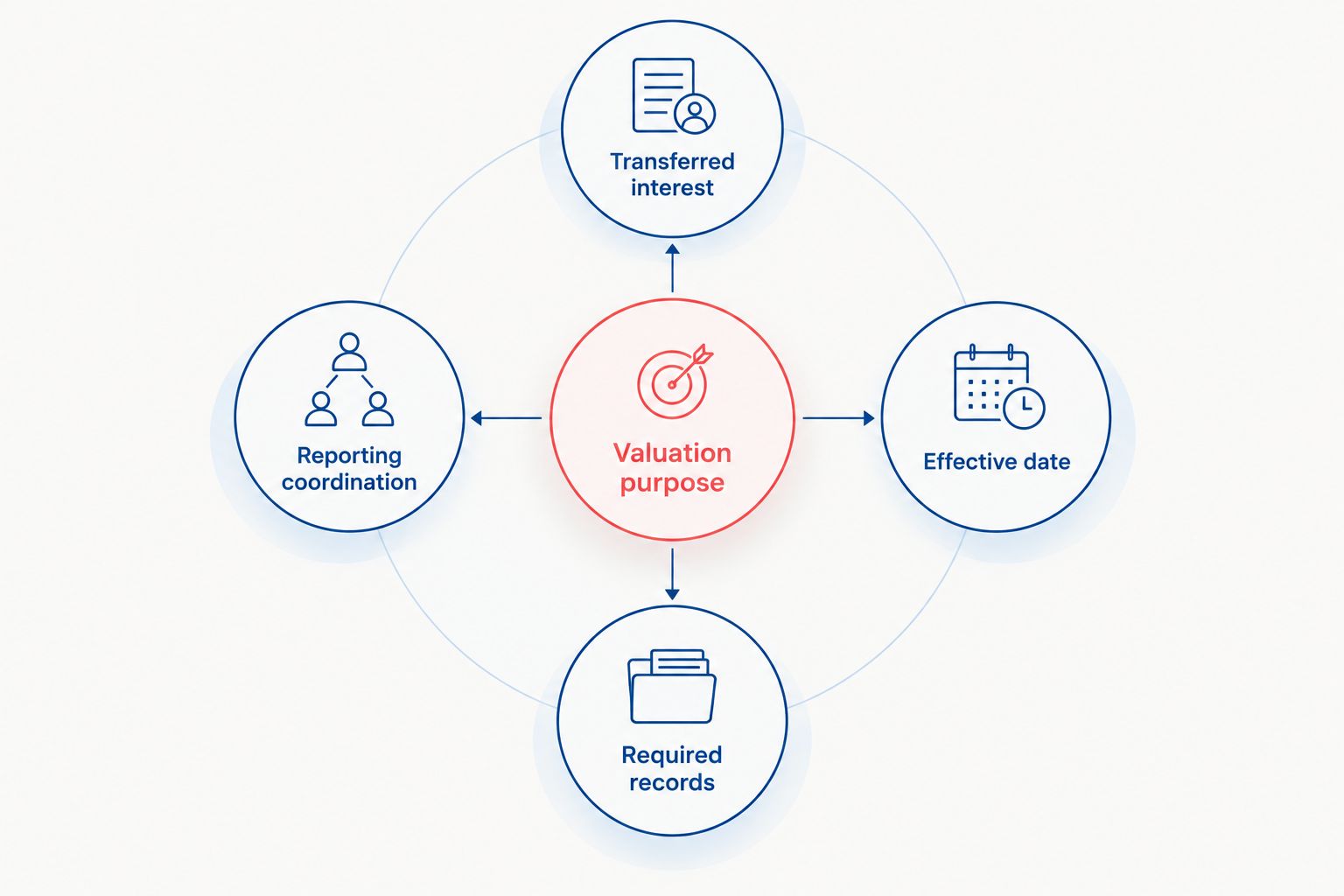
Keep these scope categories separate:
- Valuation purpose: Identify gift-tax reporting and the contemplated transfer.
- Transferred interest: Describe the asset, ownership percentage and associated rights.
- Effective date: Identify when the value must apply.
- Required records: List available documents and unresolved requests.
- Reporting coordination: Name the advisor, attorney and tax preparer responsible for questions.
Confirm the effective date with the legal and tax advisers
Maintain a simple transaction chronology using the proposed agreement, deed, assignment and closing records. Ask counsel and the tax preparer to confirm the date the appraisal must address. An anticipated transfer date is a planning assumption until the transaction's legal timing is established.
Distinguish 2 dates in your file: the effective valuation date and the report date. The first identifies when the value applies; the second identifies when the report is issued. A report prepared later can address an earlier effective date, but the analysis must reflect the relevant historical conditions.
For your 2026 engagement:
- Record the proposed transfer date and the person confirming it.
- Tell the appraiser whether the transaction is planned or completed.
- Preserve documents showing when ownership rights changed.
- Flag amendments that change the asset, interest or effective date.
- Ask how a date change affects the agreed scope before proceeding.
Select an appraiser for the property and reporting purpose
Start with a written comparison of qualifications, relevant property experience and proposed scope. Ask prospective appraisers to explain how their work will address the intended gift-tax use. A residential lending assignment is not interchangeable with a partial-interest valuation merely because both involve the same property.
REIS Group is suited to financial advisors coordinating New York real estate gift valuations. The certified real estate appraisal firm has over 30 years of experience and serves financial professionals, attorneys, CPAs and trusts. Its nationwide capability supports assignments beyond New York; local property knowledge remains central to a New York engagement.
A REIS Group gift tax appraisal should be scoped to the identified valuation purpose. It is not a substitute for legal advice or tax-return preparation.
Before engagement:
- Confirm qualifications relevant to the property type and assignment.
- Explain whether the subject is real estate, a partial interest or an entity interest.
- Ask who will prepare the analysis and address follow-up questions.
- Identify the intended users and intended use of the report.
- Request a written scope and confirm turnaround individually.
Assemble records that explain the property and ownership
Create a shared document index manually before sending an unstructured collection of attachments. Separate property records from ownership and transaction records. The appraiser needs to understand both the asset's economics and the specific interest being transferred.
For a New York income-producing property, leases and operating records help explain income, expenses and occupancy. For a residence or apartment, condition, renovations and applicable ownership documents help establish what is being valued. Entity-owned property adds another layer: governing documents can affect the rights attached to the transferred interest.
Use this collection checklist:
- Provide the property address, legal description and available ownership records.
- Gather relevant leases, rent rolls and operating statements for income-producing property.
- Supply available floor plans, condition information and renovation records.
- Include deeds, transfer agreements and applicable entity governing documents.
- Identify restrictions, related-party arrangements and pending transactions.
- Mark missing records and assign responsibility for obtaining them.
Do not replace missing evidence with an advisor's assumption. Ask the appraiser which gaps affect the scope or conclusions.
Separate property value from ownership-interest analysis
Draw the ownership structure before discussing discounts. A building's fair market value and the value of a noncontrolling interest in an entity owning that building are different valuation questions. The latter can require analysis beyond the underlying property's value.
A fractional real estate interest also requires its own analysis. Do not assume that every minority interest receives a discount, or that a familiar percentage applies across clients. Rights, restrictions and relevant evidence determine the analysis; the desired tax result does not.
Use 3 roles to keep the assignment aligned: counsel explains legal rights, the tax preparer identifies reporting needs, and the appraiser develops the valuation within the agreed scope. The financial advisor coordinates communication without directing the conclusion.
For each ownership layer:
- Identify who owns the property and who receives the gift.
- Distinguish direct real estate ownership from an entity interest.
- Ask whether separate real estate and business valuation work is needed.
- Supply governing documents rather than summarizing restrictions informally.
- Require support for any adjustment instead of prescribing a discount.
Reconcile the report with the reporting file
Build a reconciliation checklist before the appraisal is finalized. Compare the property description, ownership interest, effective date and intended use against the transfer documents and tax preparer's instructions. Resolve factual inconsistencies through the appraiser rather than editing the report independently.
For a 2026 gift, the tax preparer determines the applicable Form 709 filing and disclosure requirements. An appraisal supports the valuation component; it does not complete the return or determine the client's entire tax position. Adequate disclosure involves the reporting package, not simply possession of a valuation report.
Before closing the file:
- Match the valued asset and interest to the executed transfer documents.
- Confirm that the effective date matches the reporting instructions.
- Ask the appraiser to address factual errors or unexplained discrepancies.
- Have the tax preparer evaluate the report and supporting disclosure materials.
- Retain the final report, source records and relevant correspondence together.
- Confirm responsibility for responding to later valuation questions.
Compare valuation options for an advisory engagement
Select the option that answers the reporting question, not the one that produces the most convenient number. Preliminary estimates can help organize a discussion, but their usefulness does not make them equivalent to an assignment prepared for gift-tax reporting.
This comparison separates initial planning tools from valuation work. It does not rank providers or assume that a particular method satisfies every client's requirements.
| Option | Best for | Main advantage | Key limitation |
|---|---|---|---|
| Advisor worksheet using client estimates | Initial fact gathering | Organizes assets, ownership and unanswered questions | Does not independently establish a defensible gift value |
| Broker opinion or automated property estimate | Preliminary market orientation | Offers a reference point for an early discussion | Does not automatically address the transferred rights, historical date or reporting purpose |
| REIS Group gift tax appraisal | Advisors coordinating New York real estate gift valuations | Provides an independent appraisal engagement focused on the identified property and purpose | Does not replace legal advice, return preparation or separate entity analysis when required |
| Coordinated real estate and entity valuation | Transfers of interests in property-owning entities | Separates underlying asset value from ownership-interest analysis | Requires aligned scopes, documents and effective dates across the assignment |
An existing appraisal belongs in the document review, not automatically in the final reporting package. Ask whether its effective date, subject interest and intended use match the gift. A mismatch is a scope question, not a formatting problem.
Discuss your gift appraisal scope
Clarify the property, transferred interest and effective date for your client’s appraisal inquiry.
Common mistakes financial advisors make
Treating a planning estimate as a reporting conclusion
A number used in a wealth-transfer illustration is an assumption, not an independent valuation. Label it accordingly and revisit the plan when the completed appraisal establishes the relevant value. Do not ask the appraiser to make the report fit an existing illustration.
Commissioning the building appraisal but overlooking the gift
An appraisal of the entire property does not necessarily value the interest transferred. Compare the engagement description with the attorney's transfer documents before work starts. This is especially important when a trust receives an entity interest rather than a deeded property interest.
Carrying assumptions across unrelated valuation purposes
A lender, a property tax assessor and a gift-tax preparer can require different analyses. Do not treat an assessment or financing conclusion as a substitute without examining its purpose and scope. Ask what the existing material establishes and what remains unanswered.
Waiting until return preparation to assemble the evidence
Late document collection leaves less room to resolve ownership questions, obtain historical records or correct the engagement scope. For 2026 planning, start coordination when the transfer is being structured. Turnaround depends on property type, complexity, records availability and scope; confirm any expedited availability individually.
FAQ
What’s a gift tax appraisal for advisors used for?
A gift tax appraisal for advisors establishes an independent value for the property or interest involved in a client’s transfer. The advisor coordinates the appraisal with the attorney and tax preparer so the valuation addresses the intended reporting purpose.
Does a real estate gift always require a Form 709 filing?
A real estate gift does not by itself establish every donor’s filing obligation. The tax preparer must evaluate the transfer, applicable exclusions and reporting rules; the appraisal addresses value rather than deciding the filing requirement.
Can I use an existing mortgage appraisal for a gift?
An existing mortgage appraisal is not automatically suitable for gift-tax reporting. Ask whether its effective date, subject interest, intended use and analysis match the gift assignment before relying on it.
Is a property appraisal enough when my client gives LLC interests?
A property appraisal alone does not necessarily establish the value of gifted LLC interests. Coordinate the underlying real estate valuation with any required entity-interest analysis and provide the governing documents.
Can REIS Group help with a New York real estate gift valuation?
REIS Group provides real estate gift-tax and partial-interest valuation services and serves financial professionals in New York. Confirm the specific property, ownership interest, effective date and reporting purpose when discussing the engagement.
Can an appraisal value a gift made before the report was ordered?
A retrospective appraisal can address an earlier effective date. The appraiser must analyze the relevant historical conditions and available evidence rather than simply apply today’s value.
Does a gift-tax appraisal guarantee IRS acceptance?
A gift-tax appraisal does not guarantee IRS acceptance or a particular tax outcome. A defensible report explains its scope, evidence and reasoning, while the tax preparer addresses the applicable return and disclosure requirements.
One last thing
The property address is not a complete appraisal instruction. The same address can involve the entire property, a fractional real estate interest or an interest in a property-owning entity. Those are distinct subjects, even when the family describes each as gifting the building.
Before contacting REIS Group, prepare the property address, ownership documents, transferred interest, intended effective date and reporting purpose. Include the attorney and tax preparer responsible for confirming those facts. That makes the consultation about a defined assignment rather than an unsupported estimate.
Keep the final 2026 engagement brief with the appraisal and reporting records. If the transaction changes, revisit the scope before relying on the conclusion.
Related guides
- Partial-interest appraisal considerations for estates
- Retrospective appraisal preparation for estates
- Business valuation for CPAs and accountants