Yes. In 2026, one spouse can generally commission a divorce appraisal independently, but hiring an appraiser does not itself authorize property access, determine disclosure obligations, or make the report binding on the other spouse. Before ordering, ask your divorce attorney to confirm the intended use, valuation date, and any applicable agreement or court requirements.
- A divorce appraisal one spouse commissions does not automatically bind the other spouse or the court.
- Your attorney should confirm access, disclosure, valuation date, and intended use before you engage an appraiser.
- REIS Group provides divorce-related real estate appraisals scoped to the property, ownership interest, and identified valuation purpose.
- The spouse paying for an appraisal does not control the appraiser’s independent value conclusion.
Can a divorce appraisal be ordered by one spouse alone?
One spouse can generally retain an appraiser without jointly engaging the other spouse. The important distinction is between commissioning an appraisal and having the authority, information, and procedural basis needed to complete and use it.
For attorneys coordinating the engagement, the divorce property appraisal guide for attorneys addresses the broader assignment context. Start by separating the following responsibilities:
- Confirm the purpose. Tell the appraiser whether you need an opinion for settlement discussions, attorney advice, litigation, or another identified use.
- Confirm the instructions. Have counsel address the effective date of value, property rights appraised, and any relevant court directions.
- Resolve access. Establish who can authorize entry and coordinate an inspection without asking the appraiser to resolve a possession dispute.
- Define the engagement. Identify the client, intended users, reporting scope, and any separately required litigation support.
- Address disclosure. Ask your attorney when and how the report or related materials must be exchanged.
Ordering the report is only the engagement decision. Each remaining issue affects whether the assignment fits your divorce matter.
Why this matters
An appraisal ordered by one spouse is not automatically a joint appraisal. The other spouse does not become the appraiser’s client simply because both spouses own the property or have an interest in the divorce outcome.
For a New York divorce matter in 2026, align the appraisal instructions with counsel before research begins. An otherwise well-supported opinion can answer the wrong question if it values the wrong interest, uses the wrong date, or assumes property conditions that do not match the assignment.
The goal is an independent opinion that addresses the identified valuation purpose—not a number selected to favor the paying spouse.
Should you use separate or joint appraisal engagements?
A separately retained appraiser and a jointly retained appraiser represent different engagement structures. Neither structure, by itself, establishes how a court will treat the resulting opinion.
| Engagement structure | Best for | Practical benefit | Limitation |
|---|---|---|---|
| Separate engagement | A spouse and counsel seeking an independently commissioned opinion | Allows the retaining client to define the assignment with the appraiser, subject to professional requirements | Does not resolve access, disclosure, or disagreement with another valuation |
| Joint engagement | Spouses whose counsel agree on shared appraisal instructions | Establishes a common assignment framework and communication expectations | Requires agreement on scope and process; the conclusion can still be disputed |
Your attorney should help select the engagement structure. The appraiser should then document who the client is, who the intended users are, and what the report is intended to support.
A joint instruction is not a substitute for clear terms. Address how documents will be supplied, who will coordinate access, and how questions about the report will be handled before the assignment starts.
What must you settle before ordering the appraisal?
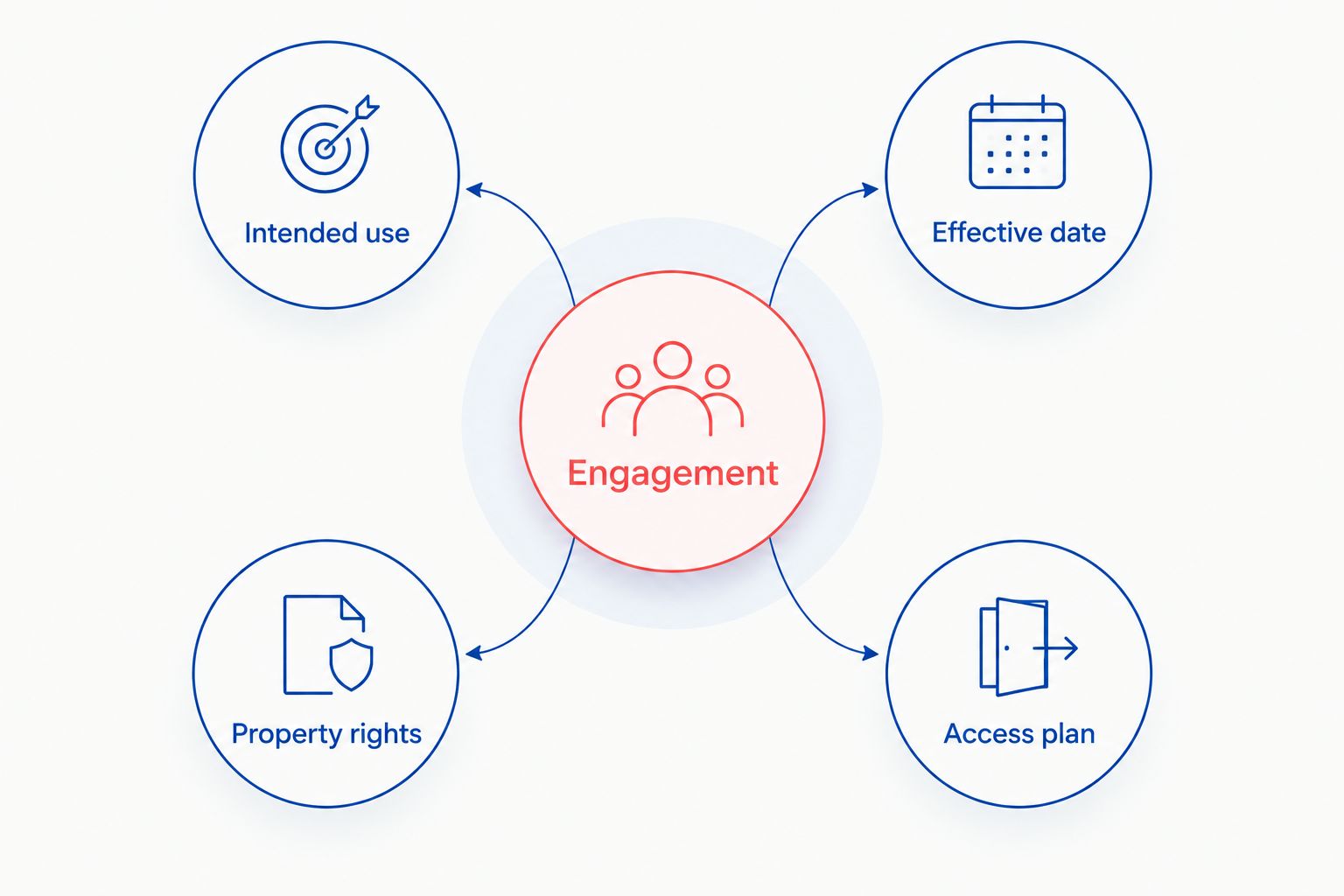
Intended use
Intended use means the purpose the appraisal is prepared to serve. Explain whether counsel needs the report for negotiation, case evaluation, litigation, or another specified purpose.
Do not assume that a report prepared for mortgage lending or an earlier transaction answers the divorce assignment. Its users, effective date, property rights, and scope can differ from what your attorney needs.
Effective date
The effective date of value is the date to which the value opinion applies. It is not necessarily the inspection date or the date the report is signed.
An appraisal ordered in 2026 can address an earlier effective date when the assignment calls for retrospective analysis. Counsel should identify the relevant date rather than leaving the appraiser to infer it from the divorce timeline.
Property rights
Property rights appraised identify the ownership interest being valued. A value for the entire property is not automatically an appraisal of a fractional ownership interest or an entity interest.
This distinction matters when spouses own property through an entity or hold less than the entire ownership interest. Ask counsel to identify the legal interest involved; the appraiser then scopes the valuation accordingly.
Access plan
An access plan establishes how the appraiser will inspect the property and obtain relevant information. Ownership, occupancy, and permission to enter are separate questions that the engagement letter does not resolve.
If access is disputed, tell your attorney before arranging a visit. Do not ask the appraiser to enter without appropriate authorization or to negotiate a legal access dispute.
What happens if the other spouse refuses access?
A refusal of access is a coordination and legal issue before it becomes an appraisal issue. Tell counsel what access is available, who occupies the property, and whether an existing agreement or order addresses inspection.
The appraiser must determine whether the available information supports the proposed scope. An assignment without an interior inspection requires careful consideration of its purpose, evidence, assumptions, and limitations; it is not automatically an interchangeable substitute for an inspected-property appraisal.
- Explain the restriction. Identify which areas or records are unavailable rather than describing access as simply difficult.
- Supply reliable records. Existing plans, photographs, leases, or renovation records can inform the analysis when relevant and available.
- Identify changes. Tell the appraiser about alterations or damage that affect whether older records describe the property accurately.
- Resolve the next step. Counsel addresses access rights; the appraiser addresses whether a supportable assignment can proceed.
Do not treat missing access as permission to guess. Material limitations belong in the assignment discussion and, where applicable, the report.
Why the scope of a divorce appraisal varies
The question is not just who orders the appraisal. The work must match the property, the interest, and the dispute counsel needs to address.
The principal scope drivers are:
- Property type. A cooperative apartment, townhouse, mixed-use building, and income-producing property present different valuation questions.
- Ownership interest. Whole-property value and partial-interest value require different assignment instructions.
- Effective date. A retrospective opinion requires evidence relevant to the historical valuation date.
- Records availability. Missing leases, financial statements, plans, or condition records affect the information available for analysis.
- Inspection access. Restrictions affect what the appraiser can directly observe and verify.
- Intended use. Counsel should identify whether report preparation alone is needed or whether additional litigation support must be discussed.
Turnaround depends on property type, complexity, records availability, and scope. Confirm expedited availability individually rather than assuming a divorce-related deadline guarantees a particular completion date.
What documents should you prepare?
For an engagement beginning in 2026, organize the records around the property and the requested effective date. Sending a large collection of unrelated material is less useful than identifying the documents that explain ownership, condition, use, and income.
Start with this practical checklist:
- Property address, unit identification, and the type of property.
- Available ownership documents and relevant entity information.
- Counsel’s instructions concerning intended use and effective date.
- Available floor plans, surveys, and property descriptions.
- Records of renovations, alterations, damage, or significant condition changes.
- For income-producing property, available leases, rent rolls, and operating records.
- Inspection contact details and known access restrictions.
- Relevant assignment directions from an agreement or court order, supplied through counsel as appropriate.
Distinguish facts you can document from information you understand but cannot verify. If a condition changed after the requested valuation date, identify that timing rather than presenting the current condition as historical fact.
Does paying for the appraisal make the appraiser your advocate?
No. Paying the appraisal invoice does not entitle a spouse to a preferred value conclusion. An independent appraisal analyzes relevant evidence and explains the reasoning supporting the opinion.
You can provide documents, identify factual errors, and ask the appraiser to explain an assumption. Requesting a predetermined result is different from supplying relevant evidence.
REIS Group’s divorce appraisal services are suited to New York City attorneys and spouses who need an independent real estate valuation tailored to an identified assignment. Its appraisal and valuation services include residential, commercial, and partial-interest assignments; the engagement must establish which service the matter requires.
The limitation is equally important: a real estate appraisal does not decide equitable distribution, resolve title disputes, or guarantee acceptance by a court. Those boundaries should remain clear throughout the engagement.
Can my spouse challenge an appraisal I ordered?
Yes. Your spouse can dispute an independently commissioned appraisal, and your attorney should address the process for responding within the case. The engagement itself does not make the conclusion binding.
When reports differ, compare the effective dates, property rights, property descriptions, assumptions, and supporting evidence before comparing only the final values. Reports answering different valuation questions are not directly interchangeable.
Can I use an appraisal from a refinance instead?
A refinance appraisal is not automatically suitable for a divorce assignment. Ask counsel and the appraiser to evaluate its intended use, intended users, effective date, and scope before relying on it.
An existing report can provide useful background without serving as the required divorce valuation. Do not assume possession of a report gives every recipient the right to rely on it for a different purpose.
What should I ask before signing an engagement letter?
Ask REIS Group to confirm the proposed assignment in writing, including the property interest, effective date, intended users, inspection arrangements, and reporting scope. Have counsel identify any case-specific requirements before you sign.
Also ask how factual questions will be handled and whether testimony or other litigation support is included or requires a separate agreement. A clear engagement prevents disagreement about what the appraiser was retained to provide.
Discuss Your Appraisal Assignment
Identify the property, valuation date, intended use, and access arrangements before requesting a proposal.
FAQ
Can I order a divorce appraisal without my spouse signing the engagement?
You can generally commission a separate divorce appraisal without a joint engagement. Ask your attorney to confirm any agreement, court direction, access issue, or disclosure requirement that affects the assignment.
Does my spouse have to agree with the appraiser I hire?
A separately retained appraiser does not automatically require joint selection. Your attorney should determine whether your case requires a different appointment or selection process.
Can I keep the appraisal private from my spouse?
Do not assume you can keep the appraisal private. Ask your attorney to address disclosure and confidentiality before commissioning or circulating the report.
Can the appraiser inspect while my spouse is away?
An inspection requires appropriate authorization and access arrangements. Hiring an appraiser does not independently establish a right to enter the property.
Will the judge accept the appraisal because I paid for a certified appraiser?
Hiring an appraiser does not guarantee that a court will accept the report or adopt its conclusion. Counsel must address the applicable requirements for presenting valuation evidence.
Can a divorce appraisal value a Manhattan cooperative apartment?
A divorce appraisal can address a Manhattan cooperative apartment when the assignment is properly scoped. Relevant ownership documents, apartment information, condition, and the requested effective date should be discussed before engagement.
Does an appraisal of business-owned real estate value the business too?
An appraisal of business-owned real estate does not automatically value the operating business. Counsel and the valuation professionals should distinguish the real estate interest, entity interest, and operating-business valuation needs.
One last thing
The date on the report cover is not necessarily the date being valued. Before commissioning a divorce appraisal in 2026, ask counsel to confirm the effective date and property interest in writing.
Then discuss your appraisal assignment with REIS Group, including the property address, intended use, available records, and access arrangements. Those details support a proposal directed to the actual valuation need.
Related guides
- Divorce appraisal to equitable distribution workflow
- How long does a divorce appraisal take?
- How to appraise a partial ownership interest in real estate