Yes, New York commercial property owners generally can challenge a new property tax assessment each year, but a prior settlement, court order, or statutory assessment restriction can affect that right. For a 2026 challenge, confirm the applicable assessment roll, local filing requirements, and valuation evidence with tax certiorari counsel; an earlier appeal does not automatically preserve a later year's claim.
- To appeal commercial taxes every year New York owners must check each assessment roll and applicable filing restrictions.
- A pending assessment challenge does not automatically protect later assessment years.
- REIS Group provides commercial real estate appraisal services; counsel determines filing rights and legal strategy.
- Review the assessed value and supporting income evidence, not just the size of the tax bill.
Can New York commercial owners appeal taxes every year?
Annual review is appropriate; annual filing requires a separate legal and valuation decision. New York property tax assessments operate through recurring assessment rolls. A challenge to one roll does not, by itself, challenge the next roll, even when the same property and valuation dispute remain involved.
For a 2026 assessment, start with the property's jurisdiction and the assessment being challenged. New York City procedures differ from those elsewhere in the state. The relevant administrative body, submission requirements, and filing calendar must match the property.
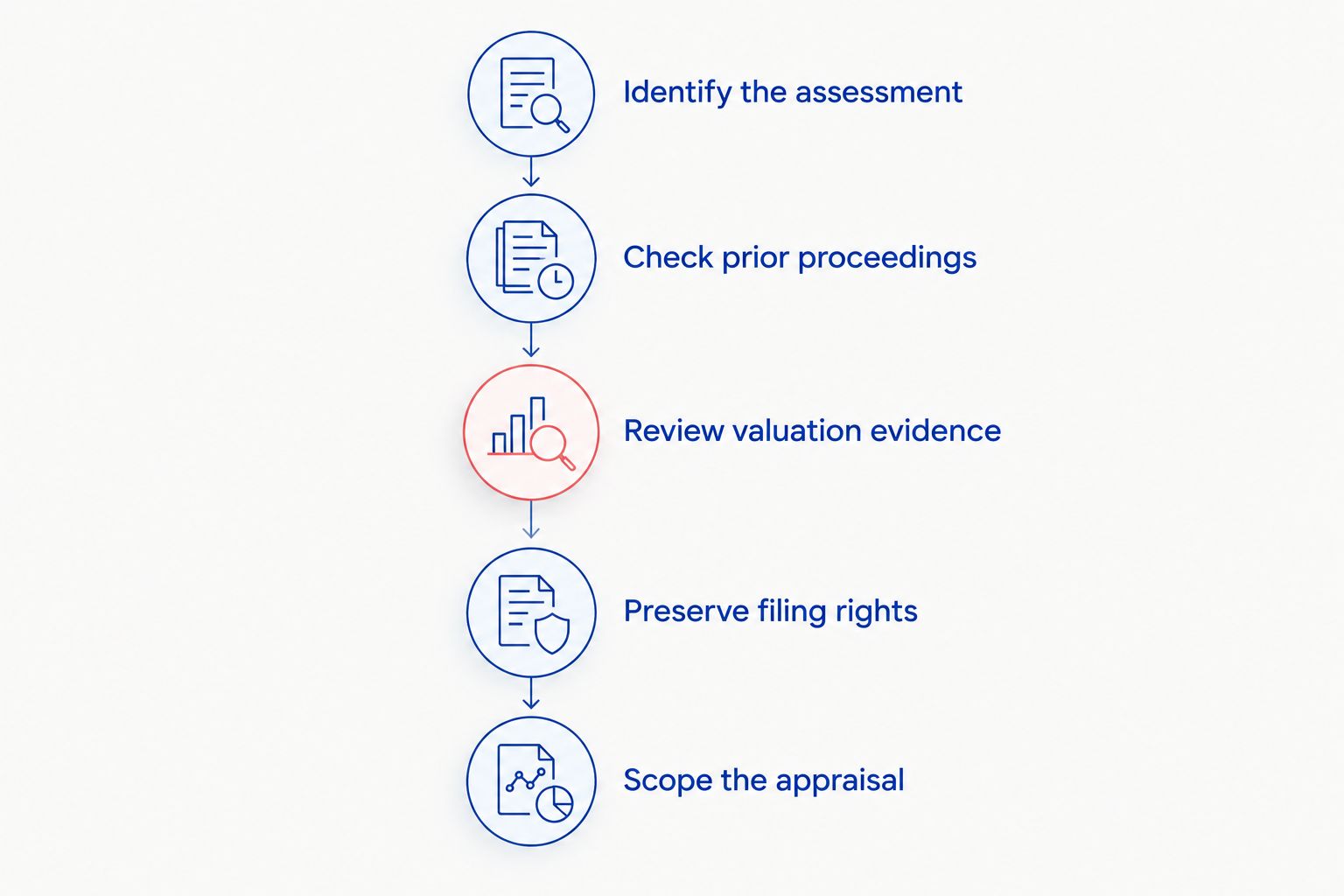
The practical sequence is:
- Identify the assessment. Obtain the notice, property identification, tax class where applicable, and assessment year.
- Check prior proceedings. Have counsel examine pending cases, settlements, court orders, and restrictions affecting another challenge.
- Review valuation evidence. Compare the assessment's implications with property income, leases, condition, and relevant market evidence.
- Preserve filing rights. Counsel should confirm the administrative and judicial steps before their respective deadlines.
- Scope the appraisal. Specify the effective date of value, property rights, intended users, and intended use.
For the broader process, see how to challenge a commercial property tax assessment in New York. The annual question is narrower: whether another assessment warrants another challenge and whether your legal position permits it.
Why this matters
Commercial owners can confuse a continuing dispute with continuing protection. A lawsuit concerning an earlier assessment does not automatically cover every assessment issued while that lawsuit remains unresolved. Counsel must identify which years are actually included and what additional action is necessary.
The opposite mistake is treating annual filing as automatic. A prior outcome can affect later assessments, and a high tax bill alone does not establish excessive valuation. Review each year, but base the filing decision on the applicable rules and evidence.
For Manhattan owners reviewing a 2026 assessment, the useful starting package is the assessment notice, current and historical operating records, and prior appeal documents—not simply the latest tax bill.
Annual challenges and assessment restrictions
New York Real Property Tax Law Section 727 generally restricts changes to an assessment established through certain judicial proceedings for the next 3 assessment rolls, subject to statutory exceptions. That provision is not a universal statewide rule: Section 727 excludes property in New York City, among other exclusions.
For a 2026 filing decision, counsel should review Section 727 and the actual settlement or order rather than assume that every successful appeal produces the same result. Exceptions, local applicability, and negotiated terms matter.
| Situation | Best suited to | What to check | Main limitation |
|---|---|---|---|
| Review of a new annual assessment | Owners deciding whether another challenge has support | New assessment, applicable valuation date, property evidence | Review alone does not preserve filing rights |
| New assessment while an earlier case remains pending | Owners with unresolved prior-year disputes | Which assessment years are included and what additional filings are required | The earlier case does not automatically include the new roll |
| Assessment following a settlement or court determination | Owners whose earlier challenge produced an outcome | Order, agreement, statutory restrictions, and exceptions | Later filing rights require legal review |
| New York City commercial assessment | Owners of Manhattan and other NYC commercial property | NYC Tax Commission procedures and the property's tax class | Statewide generalizations do not replace NYC requirements |
This comparison separates situations, not competing services. An appraisal addresses valuation; counsel determines the procedural route and the legal effect of an earlier result.
Does the assessment restriction mean you should stop reviewing?
No. Continue reviewing assessment notices and property records even when a restriction applies. A change in the property, an exception under the governing law, or a discrepancy in the assessment requires counsel's attention.
Keep the settlement and order with the property's permanent records. A new owner, asset manager, or accountant needs those documents to understand the assessment history rather than reconstruct it from tax bills.
What an annual commercial appraisal review should examine
A tax assessment review is not simply a request for a lower number. The appraisal question is whether the property's value, under the applicable assessment framework and as of the relevant date, supports the valuation position being advanced.
For income-producing real estate, an appraiser examines income and expenses alongside market evidence. Actual financial results matter, but they do not automatically determine market value. Lease terms, market rent, vacancy, operating expenses, and capitalization evidence require analysis.
Separate the assessment from the tax bill
A property tax bill reflects more than an opinion of market value. Tax rates, assessment rules, classifications, and other applicable adjustments also affect the amount due.
A larger bill therefore does not prove that the assessor overvalued the property. Ask counsel and the appraiser to identify the disputed assessment component and explain how the evidence addresses it.
Separate real estate from the operating business
A commercial building's value is not automatically the value of the business occupying it. An owner-operated property requires a clear distinction between real estate income and operating-business performance.
This distinction matters when the records combine property expenses with business expenses. Provide the underlying records and explain their treatment rather than asking the appraiser to infer which figures belong to the real estate.
Match the valuation date
A report prepared in 2026 can address an earlier effective date of value. That is a retrospective appraisal: the analysis concerns conditions and evidence relevant to the specified historical date, not simply conditions when the report is written.
Do not substitute a current sale opinion, refinancing appraisal, or estate valuation without reviewing its purpose and scope. The property can be identical while the valuation question differs materially.
Why the annual filing decision varies
The following factors determine whether another assessment challenge needs legal review and additional appraisal work:
- Jurisdiction. New York City and other assessing jurisdictions use different administrative procedures and calendars.
- Prior outcomes. Settlements, court orders, and applicable statutory restrictions affect the next decision.
- Assessment changes. A revised assessment requires comparison with the property's valuation evidence, not just the prior assessment.
- Property performance. Lease changes, vacancy, collections, and expenses can affect the analysis when relevant to the effective date.
- Physical and legal conditions. Building condition, permitted use, and the property rights appraised shape the valuation question.
- Evidence quality. Complete records allow a more clearly supported analysis than unexplained totals or incomplete rent information.
These factors do not establish that an appeal will succeed. They establish what counsel and the appraiser need to evaluate before recommending the next step.
What should you give counsel and the appraiser?
Prepare a property-specific file before commissioning a report. For a 2026 review, identify the assessment year separately from the dates on the operating statements and the proposed appraisal report.
Include:
- The assessment notice and available assessment history.
- Property identification, ownership information, and the interest being evaluated.
- Prior administrative applications, petitions, settlements, and court orders.
- Rent rolls identifying occupancy and lease terms.
- Executed leases, amendments, concessions, and relevant tenant correspondence.
- Operating statements with explanations of unusual income or expenses.
- Vacancy, collection, repair, and capital expenditure records.
- Relevant plans, surveys, condition information, and available property reports.
- Existing appraisals, with their effective dates and intended uses clearly identified.
Ask counsel which records must accompany the filing and ask the appraiser which records support the valuation. Those are related questions, but they are not interchangeable. An appraisal engagement does not itself satisfy an administrative filing requirement.
REIS Group's commercial real estate appraisal services are best suited to owners and advisers who need property-specific valuation support for an identified assignment purpose. The firm brings over 30 years of experience; its appraisal services should be scoped around the property, ownership interest, effective date, and intended use.
An appraisal provides analysis, not legal representation or a guaranteed reduction. Counsel should coordinate the report's intended role in the assessment challenge before work begins.
Discuss Your Appraisal Assignment
Identify the property, assessment year, prior proceedings, and intended use of the valuation.
Do I need a new appraisal every year?
A new assessment year requires a fresh scope decision, not automatically a completely new report. Ask counsel and the appraiser whether the existing analysis remains relevant and what additional work the current assignment requires.
A prior report carries its original effective date, assumptions, intended use, and intended users. Reusing it without review can leave the valuation position disconnected from the assessment being challenged.
Can I appeal while an earlier tax case is still pending?
A pending earlier case does not automatically prevent a challenge to a later assessment, but it also does not preserve that later year's rights. Counsel must confirm the necessary filings and how the proceedings relate.
Keep each assessment year's notice and filing confirmation separately identifiable. This helps prevent an unresolved case from being mistaken for an application covering every subsequent year.
Does lower rental income guarantee a lower assessment?
Lower rental income does not guarantee a lower assessment. The appraiser must examine the reason for the decline, its relevance to the valuation date, and the relationship between actual performance and market expectations.
A temporary collection problem, a lease concession, and a lasting change in market rent are different valuation issues. Supply the supporting documents so the analysis addresses the cause rather than only the reduced total.
FAQ
Can I appeal my New York commercial property assessment every year?
Generally, you can challenge a new annual assessment, subject to applicable filing requirements and restrictions arising from law, settlements, or court orders. Have counsel review each assessment year separately rather than assume an earlier challenge covers it.
Does a successful appeal freeze my assessment for three years?
New York Real Property Tax Law Section 727 generally addresses the next 3 assessment rolls after certain judicial determinations, but exclusions and exceptions apply. New York City property is excluded from that provision, so do not assume the same rule applies statewide.
Does an appraisal count as filing a property tax appeal?
An appraisal does not itself file an assessment challenge or preserve a deadline. Counsel should confirm the required administrative application, any judicial proceeding, and the appraisal’s role in supporting the valuation position.
Can I use my refinancing appraisal for a tax assessment challenge?
A refinancing appraisal is not automatically suitable for a tax assessment challenge. Its effective date, property rights, intended use, assumptions, and analysis require review against the proposed assignment.
What should a Manhattan commercial owner review first?
Start with the assessment notice, the property’s tax class, prior appeal documents, and relevant operating records. Counsel should confirm NYC Tax Commission requirements for the applicable assessment year before the appraisal scope is finalized.
Can REIS Group guarantee a property tax reduction?
REIS Group does not guarantee a property tax reduction or acceptance by an assessing authority or court. Its role is independent appraisal and valuation consulting prepared to support the identified assignment purpose.
One last thing
An unchanged assessment does not mean unchanged evidence. A property can carry the same assessed value while its leases, condition, income expectations, or relevant market evidence change. Conversely, a higher assessment is not proof that the valuation is wrong.
Before deciding whether to challenge again, put the new notice beside the prior case documents and the property's financial records. Discuss your appraisal assignment with REIS Group, and coordinate the valuation scope with tax certiorari counsel before commissioning a report.
Related guides
- Property tax appeals for commercial owners
- How long a property tax appeal takes in New York
- How to vet a commercial appraiser before hiring in New York