To value a minority stake in a family business, establish the assignment’s purpose and effective date, value the underlying business, and analyze the specific ownership rights, distribution prospects, and transfer restrictions attached to the stake. Do not simply multiply the company’s value by the ownership percentage or assume that minority ownership automatically justifies a discount; the applicable valuation standard and assignment facts govern the conclusion.
- To value a minority stake in a family business, analyze ownership rights—not just the ownership percentage.
- Lack of control and lack of marketability require separate, fact-specific support; neither discount is automatic.
- Business-owned real estate and the ownership interest require distinct analyses without double-counting assets or adjustments.
- REIS Group provides partial-interest real estate valuations; confirm operating-business valuation scope before engagement.
Why this matters
For an estate attorney or CPA handling a family-business transfer in 2026, the first question is what the client actually owns. Shares in an operating company, membership interests in a property-owning entity, and direct fractional ownership of a building are different valuation subjects.
A building appraisal does not, by itself, establish the value of shares in the company that owns it. If the assignment involves direct property ownership, start with the separate considerations in appraising a partial ownership interest in real estate.
REIS Group is suited to advisers needing New York City real estate appraisals within family-business valuation assignments. Its partial-interest appraisal services address real estate interests; an operating-business valuation requires confirmation of the appropriate scope and expertise.
How do you value a minority stake in a family business?
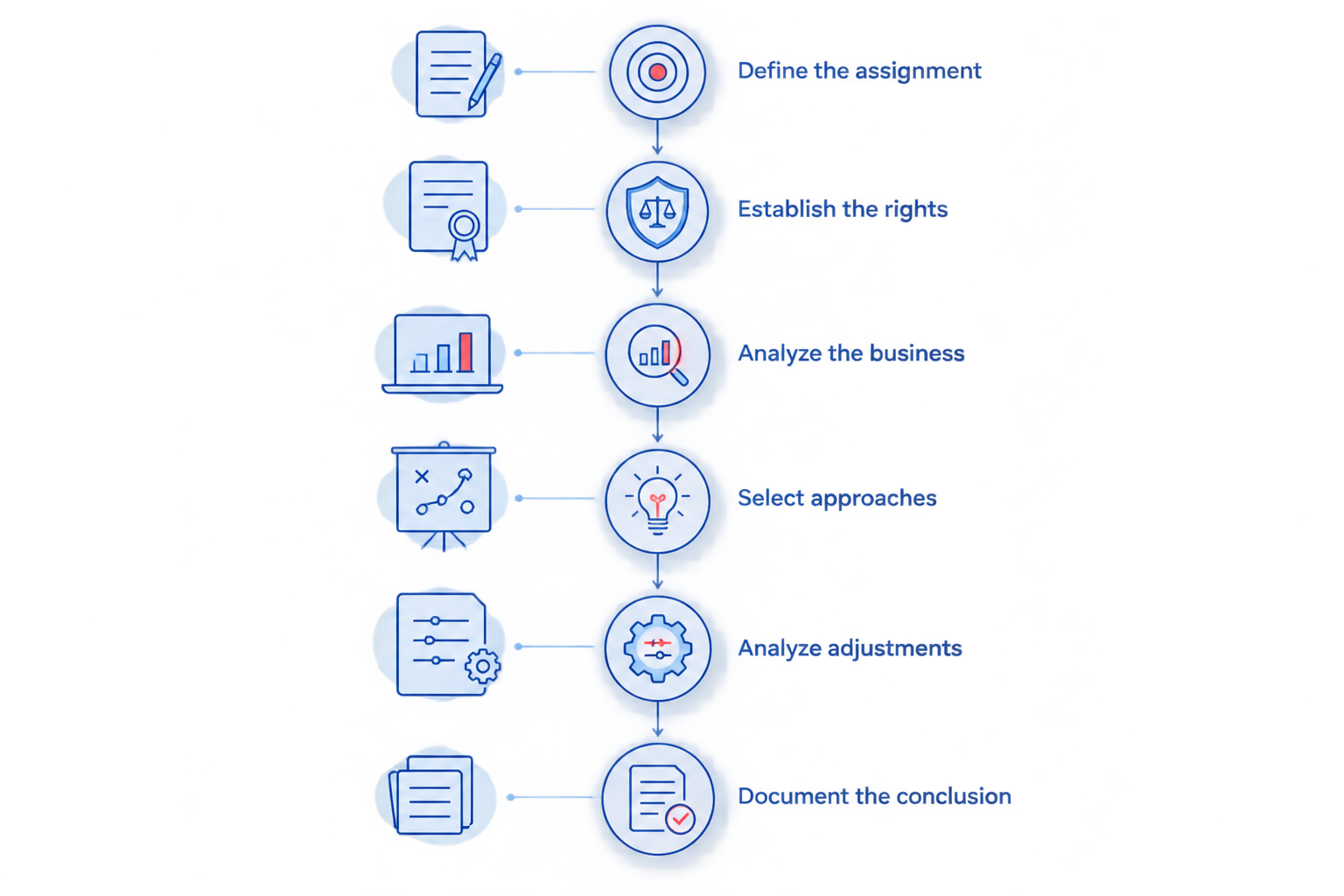
Use the following sequence to establish what is being valued, select the relevant evidence, and explain how the ownership interest differs from the business as a whole. Give the appraiser the assignment purpose before requesting a conclusion.
1. Define the assignment
Identify the owner, entity, ownership class, percentage interest, intended users, and intended use. Specify the effective date of value—the date to which the conclusion applies, rather than the date the report is written.
For a report commissioned in 2026, the effective date is not automatically the engagement date. An estate assignment can require a retrospective valuation: an opinion of value as of an earlier date, supported by information relevant to that date.
Ask counsel and the CPA to confirm the applicable standard of value. Fair market value, a contractual buyout formula, and a litigation-specific valuation standard answer different questions and are not interchangeable.
2. Establish the rights being valued
Read the governing documents before treating the interest as noncontrolling. The ownership percentage does not reveal every right attached to the interest.
Review voting rights, management appointment powers, distribution provisions, information rights, and restrictions on sale. Also examine redemption terms and approval requirements for transfers. A smaller ownership interest with meaningful veto rights differs from an interest that cannot influence those same decisions.
Distinguish rights that exist in enforceable documents from informal family expectations. Ask counsel to interpret disputed provisions; the valuation should state the legal assumptions on which it relies.
3. Analyze the underlying business
Determine how the company generates economic benefits and what assets support those benefits. Review earnings, cash flow, debt, working capital, customer relationships, and dependence on individual family members where relevant.
Related-party compensation and rent deserve particular attention. An adjustment to owner compensation or rent needs evidence, not an assumption that every family arrangement is outside market terms.
Separate operating assets from nonoperating assets. If the company owns Manhattan commercial real estate, determine how the property contributes to operations and whether a separate real estate appraisal is needed. Do not add the property’s full value to a business conclusion that already includes it.
4. Select and reconcile valuation approaches
Consider the income, market, and asset approaches according to the business and assignment. Selecting an approach is an analytical decision—not a vote among three calculated results.
| Approach | Best for | Main strength | Main limitation |
|---|---|---|---|
| Income approach | Businesses whose expected earnings or cash flow support the analysis | Connects value to expected economic benefits | Depends on supported forecasts, risk assumptions, and cash-flow treatment |
| Market approach | Assignments with sufficiently comparable transaction or company evidence | Relates the subject to observed market evidence | Comparability and ownership-level differences require analysis |
| Asset approach | Asset-holding entities and assignments where underlying assets drive value | Makes asset values and liabilities explicit | Does not automatically capture operating goodwill or establish minority-interest value |
IRS Revenue Ruling 59-60 provides an established framework for closely held stock valuation, including financial condition, earning capacity, dividend-paying capacity, goodwill, and relevant market evidence. For a 2026 engagement, connect those considerations to the actual business rather than treating the ruling as a formula.
5. Analyze control and marketability
Determine the ownership characteristics already reflected in the starting value. Then consider whether any further adjustment is appropriate under the assignment’s standard of value.
Lack of control concerns the holder’s ability to influence business decisions. Lack of marketability concerns the difficulty of converting the interest into cash. These are distinct issues, and neither is established merely by calling the stake a “minority interest.”
Support any adjustment with relevant evidence and the subject interest’s characteristics. Explain how distribution history, transfer restrictions, redemption provisions, and expected holding period affect the analysis without counting the same disadvantage twice.
6. Reconcile and document the conclusion
Connect the underlying business analysis to the specific interest being appraised. Explain the selected approach, ownership-level adjustments, relevant assumptions, and reasons for rejecting less applicable evidence.
The report should distinguish the company’s enterprise value, its equity value, and the value of the subject ownership interest. Debt, excess assets, and ownership-level adjustments must enter the analysis at the appropriate point.
For estate planning involving property-owning entities, coordinate the interest-level analysis with the underlying property appraisal. The partial-interest appraisal and estate-tax discounting workflow addresses that connection; it does not make a discount automatic.
Why minority-interest value varies
Businesses with similar assets can produce different ownership-interest conclusions because the rights and expected benefits differ. These factors need assignment-specific evidence:
- Decision-making rights: Voting provisions, management powers, and veto rights affect what the holder can influence.
- Distribution prospects: Earnings retained indefinitely do not provide the same access to cash as supported expectations of distributions.
- Transfer restrictions: Approval requirements and permitted-transferee provisions affect the potential buyer pool and exit process.
- Financial condition: Debt obligations, cash requirements, and contingent liabilities affect the economic benefits available to equity holders.
- Business dependence: Reliance on a family member, customer, or lease affects the assessment of continuity and risk.
- Valuation purpose and date: The applicable standard and information relevant to the effective date determine the question the appraisal answers.
A professional preparing a 2026 transfer should not reuse an earlier discount without examining these factors. A prior report can provide background, but its conclusion belongs to its stated interest, date, and intended use.
What documents should an attorney or CPA collect?
Organize the records around the ownership interest, the company’s economics, and the assignment date. Tell the appraiser about incomplete records at the outset so the engagement can address the resulting limitations.
Ownership and governance
Provide the ownership ledger, capitalization table, operating or shareholder agreement, and relevant amendments. Include buy-sell agreements, redemption provisions, transfer restrictions, and documents identifying the particular class or interest being valued.
Include evidence of actual transactions in ownership interests, where available. A family transfer or formula-based redemption needs context before it can serve as market evidence.
Financial and operating records
Supply financial statements, tax returns, debt schedules, distribution records, and relevant management forecasts for the periods the appraiser requests. Explain unusual expenses, related-party transactions, and changes in operations.
Identify differences between the accounting records and the economics of the business. Book equity is an accounting measure; it is not automatically the market value of the company or the minority interest.
Real estate records
For property-owning entities, provide deeds, leases, rent rolls, operating statements, financing information, and relevant capital expenditure records. Identify whether the company owns the property directly or through another entity.
A current inspection does not establish historical property conditions. For retrospective assignments, preserve dated leases, photographs, repair records, and other evidence relevant to the effective date.
How should you separate business value from real estate value?
Appraise the asset and analyze the ownership interest as separate questions. A real estate appraisal addresses specified property rights; a business valuation addresses the identified business interest and its economic benefits.
For an owner-occupied property, coordinate any market-rent adjustment with the treatment of the real estate. Otherwise, the analysis risks changing operating earnings without consistently accounting for the property that produces the occupancy benefit.
For a property-holding entity, the underlying real estate value informs the entity analysis, but liabilities, governing provisions, and ownership rights remain relevant. Direct co-ownership of a building requires a different analysis from membership in an entity that owns the building.
REIS Group has over 30 years of experience and provides residential, commercial, and partial-interest real estate appraisal services. Confirm separately whether the engagement includes operating-business valuation or coordination with another valuation professional.
Is a minority stake always worth less than its proportional share?
No. A minority stake does not automatically warrant a reduction from its proportional share because the applicable standard, ownership rights, and starting valuation basis control the analysis.
An enforceable redemption mechanism or meaningful governance rights can affect the conclusion. Some legal contexts also treat ownership-level discounts differently; counsel should identify the governing requirements before the appraiser applies them.
Can a buy-sell agreement determine the appraised value?
A buy-sell agreement can establish contractual rights or a transaction formula, but its stated amount is not automatically the appraised value for every purpose. The appraiser must consider the agreement’s terms and relevance to the assignment.
Ask counsel whether the agreement governs the contemplated transaction. Then distinguish a contractual payment calculation from an independent valuation conclusion.
FAQ
How do I value a minority stake in a family business for an estate?
Define the estate assignment’s effective date, applicable standard of value, and exact ownership interest before analyzing the business and any ownership-level adjustments. Coordinate the business valuation with separate real estate appraisals where property values are relevant.
Can I multiply the company’s value by my ownership percentage?
Multiplying equity value by the ownership percentage produces a proportional calculation, not necessarily the final value of the minority interest. The analysis must address the valuation basis, ownership rights, and any supported adjustments.
What is the standard minority discount for a family company?
There is no universal minority discount appropriate to every family company. Any adjustment must fit the applicable valuation standard, the interest’s rights, and relevant evidence.
Are lack of control and lack of marketability the same thing?
Lack of control and lack of marketability are different valuation considerations. Control concerns decision-making authority; marketability concerns the ability to convert the interest into cash.
Does an appraisal of the company’s building value my membership interest?
A building appraisal does not by itself value your membership interest. The entity’s liabilities, governing documents, economic benefits, and ownership characteristics require separate analysis.
Can an old valuation support a family-business transfer in 2026?
An old valuation provides background but does not automatically establish value for a transfer in 2026. Confirm the required effective date and analyze changes in financial performance, ownership terms, assets, and market conditions.
Can REIS Group help when a family business owns New York property?
REIS Group provides New York real estate appraisals and partial-interest valuations relevant to property-owning family businesses. Confirm the property rights, effective date, intended use, and any separate operating-business valuation needs when discussing the assignment.
One last thing
Send the governing agreement before asking for a discount. Its distribution, voting, transfer, and redemption provisions can change the valuation question before the financial analysis begins.
A useful inquiry identifies the entity, property locations, ownership interest, effective date, and intended use. Include the adviser coordinating the engagement so the business and property analyses answer the same question.
Related guides
- Prepare for a business valuation appointment
- Business valuation and buy-sell agreement funding
- Partial-interest appraisal scope and cost considerations
Discuss your appraisal assignment to confirm the property interests, valuation date, intended use, and appropriate scope before requesting a proposal.
Discuss Your Appraisal Assignment
Identify the real estate appraisal scope and any separate operating-business valuation needs.