Yes. The IRS can challenge a real estate appraisal after you file an estate or gift tax return, subject to the applicable assessment period and disclosure rules. Filing an appraisal does not establish IRS acceptance; if the value is questioned, your attorney or CPA should coordinate the response with the appraiser and address the specific valuation issues raised.
- An IRS challenge appraisal after filing concerns valuation support, disclosure, and the applicable assessment period—not just the appraiser’s credentials.
- Preserve the filed return, submitted appraisal, ownership records, and evidence of property conditions on the effective date.
- REIS Group provides estate-tax real estate appraisals for attorneys, CPAs, executors, and trustees.
- Have tax counsel assess deadlines while the appraiser addresses methodology, comparable transactions, and supporting records.
Can an appraisal be challenged by the IRS after filing?
Yes. Submitting an appraisal supports a reported value; it does not prevent the IRS from examining that value. The IRS can question the property rights appraised, effective date, factual assumptions, comparable transactions, methodology, or reconciliation of the final conclusion.
For an executor handling a Manhattan property in 2026, the practical starting point is the relationship between the appraisal and the filed return. The date-of-death appraisal to IRS Form 706 workflow connects that valuation assignment to estate-tax reporting.
If an inquiry arrives, follow this sequence:
- Preserve the submission. Keep the filed return, schedules, attachments, appraisal version, and proof of filing together.
- Identify the issue. Separate a request for missing documents from a disagreement about value or ownership.
- Assign responsibilities. Have the tax adviser manage procedural questions and the appraiser address valuation analysis.
- Respond to the evidence. Explain the original conclusion or address an identified error without selecting a predetermined result.
An IRS request for information is not itself a final determination that the reported value is wrong. Read the actual correspondence before deciding what work is necessary.
Why this matters
An estate-tax appraisal describes a particular property interest as of a particular date. A report can contain extensive market research and still fail to answer the tax assignment if it values the wrong ownership interest or uses the wrong effective date.
For executors, the priority is therefore not collecting the largest possible report. It is maintaining a consistent record connecting ownership documents, historical property facts, the appraiser’s analysis, and the value reported by the tax preparer.
A defensible appraisal is supported and explainable, not immune to challenge. That distinction matters when commissioning a report and when deciding how to respond after filing.
How long does the IRS have to question the reported value?
The general federal assessment period is 3 years, subject to the filing rules and exceptions in Internal Revenue Code Section 6501. That is an assessment limitation, not a promise that every appraisal becomes unchallengeable on a date calculated from the report’s delivery.
For a return filed in 2026, ask tax counsel to determine when the applicable period begins and whether an exception applies. Filing dates, disclosure, extensions, and the nature of an omission affect that analysis.
The general assessment period: 3 years
The general 3-year period concerns assessment of tax. It does not mean that the IRS approves an appraisal by processing a return or remaining silent after filing.
Keep the appraisal and underlying records accessible throughout the period identified by your adviser. An appraisal’s effective date and the date the assessment period begins serve different purposes; do not substitute one for the other.
Certain estate-tax omissions: 6 years
Section 6501 provides a 6-year assessment period for certain estate-tax omissions exceeding 25% of the gross estate stated on the return, subject to the statute’s disclosure provisions. An appraisal disagreement alone does not automatically establish that this exception applies.
Gift-tax disclosure presents additional rules. Under Section 6501(c)(9), an inadequately disclosed gift can remain open to assessment; your tax adviser should determine whether the return and attachments adequately disclose the transfer.
Fraudulent returns and failures to file also have separate rules. Do not calculate a response strategy from the general deadline alone.
What makes an estate appraisal easier to evaluate?
A reviewer needs to follow the reasoning from the identified property interest to the concluded value. The report should explain what was valued, the applicable date, the relevant market evidence, and how that evidence supports the conclusion.
For an estate filing prepared in 2026, the appraisal’s preparation date does not replace the historical effective date. A retrospective appraisal estimates value as of an earlier date using evidence relevant to that date.
Property rights and effective date
“Property rights appraised” means the ownership interest being valued. An entire property, an undivided ownership interest, and an interest in an entity holding real estate are not interchangeable assignments.
Provide deeds, trust documents, operating agreements, and transfer records as applicable. The appraiser and legal adviser need a consistent understanding of the interest before evaluating whether the reported value addresses the transfer.
Market evidence and methodology
Fair market value generally reflects a hypothetical transaction between a willing buyer and willing seller, neither compelled to act and both reasonably informed. For estate-tax real estate, Treasury Regulation Section 20.2031-1 supplies the federal valuation framework.
The report should connect relevant sales, income evidence, property characteristics, and adjustments to that framework. Naming an approach is not enough; the reasoning must explain its application to the subject property.
Historical property facts
A current inspection does not establish every condition that existed on an earlier effective date. Historical photographs, leases, operating statements, repair records, and correspondence help distinguish documented conditions from assumptions.
For Manhattan cooperative apartments, ownership and building records matter alongside apartment characteristics. For income-producing property, leases, occupancy, expenses, and applicable restrictions help explain the income a buyer would have evaluated.
Why appraisal conclusions differ
Different conclusions require examination of the underlying assumptions and evidence—not an automatic choice of the higher or lower figure. These factors explain where to focus that examination:
- Effective date: Transactions and market conditions must relate to the valuation date, not simply the report date.
- Ownership interest: Whole-property value does not automatically establish the value of a transferred partial interest.
- Property condition: Documented defects, renovations, and deferred maintenance affect comparability.
- Income assumptions: Lease terms, vacancy, expenses, and market rent assumptions influence income-producing property analysis.
- Comparable selection: Location, property rights, transaction circumstances, and adjustments determine how informative a sale is.
- Highest and best use: The reasonably probable, legally permissible use requires support rather than an assumed redevelopment outcome.
These are analytical questions, not reasons to rewrite a report toward a preferred tax result. Ask the appraiser to identify which disputed assumptions materially affect the conclusion.
What should you gather before responding?
Build a response file around the issue raised. Sending unrelated documents makes the record harder to follow; sending only the final value leaves the reasoning unexplained.
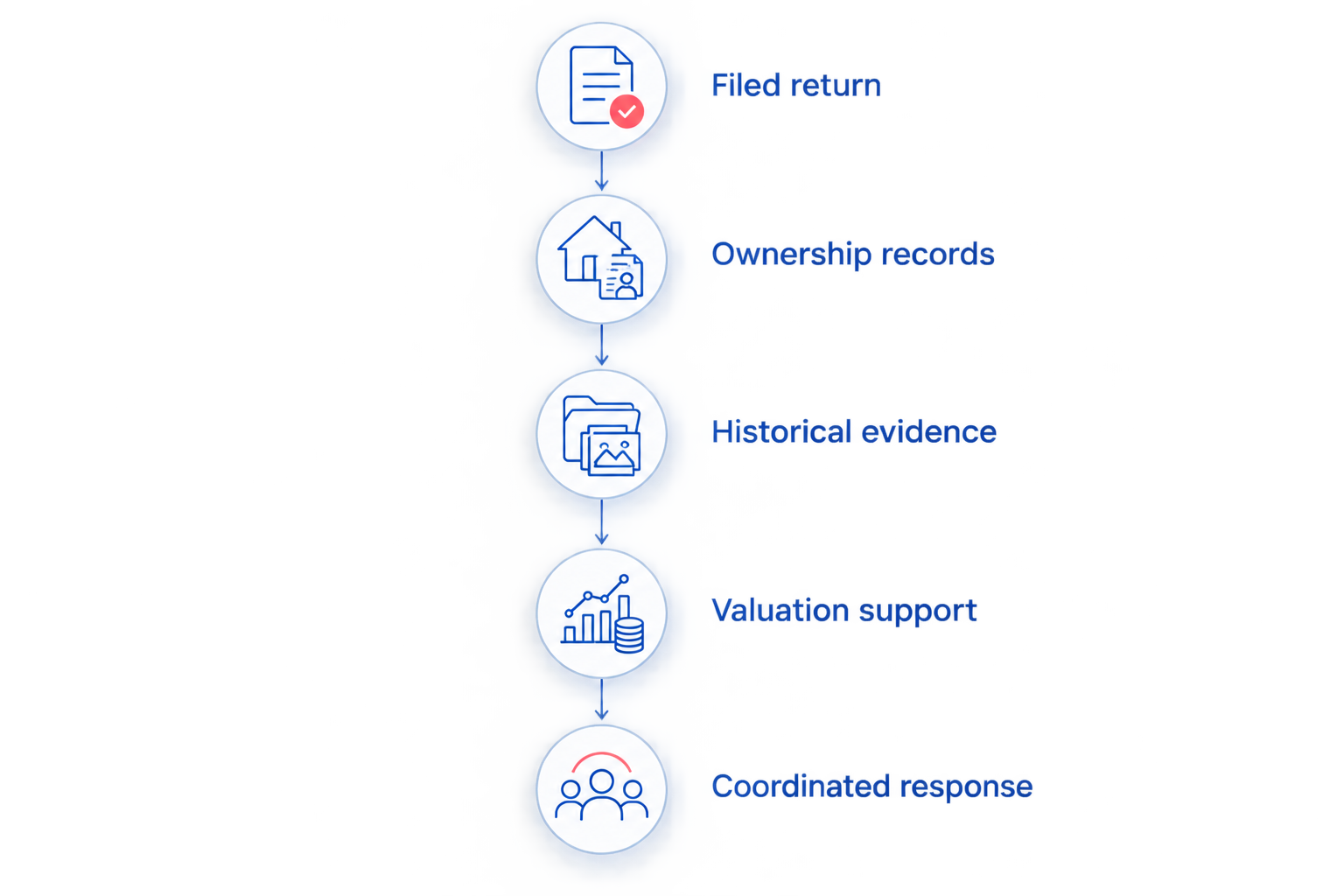
Use the following sequence to organize the file with your professional advisers:
- Filed return: Preserve the exact schedules, attachments, elections, and appraisal submitted.
- Ownership records: Assemble documents establishing the transferred property interest and relevant restrictions.
- Historical evidence: Collect records supporting condition, tenancy, income, and expenses on the effective date.
- Valuation support: Ask the appraiser which additional explanations or supporting materials address the inquiry.
- Coordinated response: Have the tax adviser check consistency between the response, return, and supporting analysis.
The appraiser’s workfile is distinct from the published appraisal report. Coordinate requests for underlying material with the appraiser and counsel rather than assuming every record should be transmitted without review.
Do you need clarification, a supplement, or another appraisal?
Match the work to the identified problem. A request to explain an adjustment is different from discovering that the report valued the wrong interest.
For a 2026 inquiry, start by comparing the IRS question with the original engagement scope. The appropriate response depends on whether the problem concerns explanation, factual support, or the assignment itself.
| Response option | Best for | Benefit | Limitation |
|---|---|---|---|
| Written clarification | A specific question about existing analysis | Explains the report’s reasoning directly | Does not repair a material scope or factual error |
| Supplemental analysis | Additional evidence or an issue requiring further analysis | Addresses a defined gap in the record | Requires careful explanation of any changed conclusion |
| New appraisal assignment | An incorrect interest, date, or materially unsuitable scope | Establishes an assignment addressing the actual valuation question | Does not erase the original filing or resolve tax procedure |
A revised conclusion requires an explanation of what changed and why. Preserve the original report and distinguish later work clearly; do not replace documents silently.
REIS Group provides estate-tax appraisal services for New York attorneys, CPAs, executors, and trustees who need property-specific valuation support. The assignment should identify whether the need is an original appraisal, retrospective valuation, or additional analysis within an agreed scope; none guarantees IRS acceptance.
When should your tax adviser lead the response?
Your tax adviser should lead procedural decisions from the outset, while the appraiser handles valuation questions within the engagement. This division becomes particularly important when correspondence raises assessment deadlines, proposed adjustments, penalties, or appeal rights.
The question of when to hire IRS audit representation turns on procedural and tax issues, not simply whether an appraisal exists. Representation and valuation analysis perform different jobs: counsel or another authorized representative addresses the examination, while the appraiser explains the property analysis.
Do not ask the appraiser to decide whether to concede a tax adjustment or sign a procedural document. Conversely, a legal response cannot substitute for missing evidence about comparable sales, historical income, or the ownership interest valued.
Does a later sale prove the appraisal was wrong?
No. A later sale is evidence to analyze, not an automatic replacement for the effective-date value. Its relevance depends on timing, transaction terms, market changes, property changes, and what was reasonably known or knowable at the valuation date.
A sale following renovations does not describe precisely the same property condition. A transaction involving different rights or unusual terms also requires analysis before it becomes a direct comparison.
Give the appraiser the complete contract and relevant transaction history, not just the closing figure. Your adviser should separately determine whether the transaction creates a reporting or procedural issue.
What should you check before the next filing?
A prefiling check cannot prevent examination, but it can identify inconsistencies while the assignment team still has time to address them. For a return being assembled in 2026, compare the report against the actual reporting purpose rather than assuming a prior lending or probate appraisal is suitable.
Confirm these points together:
- The property description matches the ownership records.
- The appraised interest matches the transferred interest.
- The effective date matches the adviser’s identified requirement.
- Material historical assumptions have documented support.
- The appraisal conclusion agrees with the value carried into the relevant return schedule.
- The engagement identifies intended users and intended use.
Ask about discrepancies before filing. A technically detailed report still needs to answer the correct assignment.
FAQ
Can the IRS reject an appraisal after accepting my tax return?
Yes. Processing a return does not establish acceptance of the appraisal or reported value. The IRS can examine valuation within the applicable assessment period, subject to disclosure rules and exceptions.
Does the IRS always have only 3 years to challenge an estate appraisal?
No. The general assessment period is 3 years, but statutory exceptions apply. Certain substantial estate-tax omissions carry a 6-year period, and other circumstances have separate rules.
Can I get a date-of-death appraisal after filing?
Yes. A retrospective appraisal can estimate value as of the date of death after a return has been filed. Your tax adviser should determine how the report relates to the filed return and whether further action is appropriate.
Should I order a second appraisal when the IRS asks questions?
Not automatically. First identify whether the inquiry concerns an explanation, missing evidence, or a material assignment problem. A targeted clarification can address a different need from a new appraisal.
Does a certified appraiser guarantee IRS acceptance?
No. Professional credentials do not guarantee IRS acceptance of a valuation. The reported conclusion still requires support for the property interest, effective date, facts, and methodology.
Can an estate appraisal value only a partial ownership interest?
Yes. An appraisal can address a defined partial interest when the assignment scope identifies that interest. Ownership documents and relevant restrictions require analysis; a discount is not automatic.
One last thing
The most useful final check is whether the appraisal and return describe the same asset. An accurate whole-property conclusion does not answer a different question about a transferred ownership interest.
REIS Group can discuss the property, effective date, intended use, and records available for your assignment. Request an appraisal consultation to establish the appropriate scope before commissioning additional valuation work.
Related guides
- Can a retrospective appraisal hold up in an IRS audit?
- Can a date-of-death appraisal be completed years after the death?
- Partial-interest appraisal and estate-tax discounting workflow