A gift tax appraisal timeline depends on the property, ownership interest, effective date of value, available records, and agreed scope—not a standard completion period. For a New York City real estate gift, request an assignment-specific delivery estimate and leave time for your attorney or CPA to review the completed report before using it for the intended filing.
- A gift tax appraisal timeline starts with a defined property interest, valuation date, and reporting purpose.
- REIS Group provides gift tax real estate valuations for attorneys, CPAs, trustees, and property owners.
- Retrospective appraisal work requires evidence of property conditions and market conditions at the historical effective date.
- Confirm expedited availability individually; a filing deadline does not establish an appraiser’s delivery commitment.
Why this matters
For an attorney or CPA coordinating a real estate gift in 2026, the useful question is not simply when an inspection can happen. You need to know when a report addressing the correct property rights and valuation date will be ready for professional review.
REIS Group is suited to attorneys, CPAs, and trustees seeking real estate appraisal support for gift tax reporting. Its appraisal services are scoped to the property, ownership interest, valuation date, intended users, and intended use. Those details belong in the initial inquiry, not in a correction request after delivery.
How long does a gift tax appraisal take to complete?
The completion period must be confirmed for the specific assignment. A delivery estimate should account for document collection, property access where required, valuation analysis, report preparation, and review—not just the site visit.
Use this sequence to establish a workable schedule:
- Define the assignment. Identify the property, interest being transferred, intended users, and gift tax reporting purpose.
- Confirm the effective date. Establish the date the appraisal must address with your attorney or CPA.
- Provide records. Supply ownership documents and property information relevant to that date.
- Arrange access. Identify the person responsible for coordinating any required inspection.
- Confirm delivery. Obtain an assignment-specific estimate and identify outstanding items that affect it.
- Allow review. Give your adviser time to check factual details and consistency with the contemplated transfer.
An estimate made before the appraiser understands the interest being valued is not a substitute for an agreed schedule. Ask what the estimate assumes and what information remains outstanding.
What does “complete” mean for your assignment?
Distinguish the inspection date, anticipated report delivery, and your adviser’s review deadline. These are separate milestones, even when everyone is working toward the same filing.
For a 2026 engagement, specify whether your requested delivery date means a report ready for adviser review or the final report following resolution of factual questions. Clear expectations reduce confusion about what the schedule actually covers.
Why the gift tax appraisal timeline varies
The following factors determine how the assignment is scoped and scheduled:
- Property type and complexity. A condominium, mixed-use building, and income-producing commercial property require different information and analysis.
- Property rights appraised. Valuing an entire property is a different assignment from valuing a fractional ownership interest.
- Effective date of value. A historical valuation requires evidence relevant to the earlier date rather than reliance on current conditions alone.
- Records availability. Ownership documents, leases, operating information, and historical property records must be available when relevant to the assignment.
- Inspection coordination. Required access depends on cooperation from the owner, managing agent, tenants, or other authorized contacts.
- Scope and reporting needs. The intended use, intended users, and complexity of the valuation determine the work and explanation required.
Ask which factors affect your assignment before requesting a shorter delivery period. Providing a missing lease or clarifying the ownership interest addresses the work itself; repeating the filing deadline does not.
Which type of gift appraisal are you ordering?
Identify what is being transferred before comparing delivery estimates. A real estate appraisal and an operating-business valuation do not become interchangeable because the business owns a building.
| Assignment | Best suited to | What the analysis addresses | Scheduling consideration |
|---|---|---|---|
| Entire-property appraisal | A gift involving the identified real estate interest as a whole | The property rights specified in the engagement | Property records and relevant market evidence must support the effective date |
| Partial-interest appraisal | A gift of a fractional real estate ownership interest | The specific interest and relevant ownership characteristics | Ownership documents and restrictions require review |
| Retrospective appraisal | A completed gift requiring value as of an earlier date | Property and market conditions at the historical effective date | Historical records must be located and evaluated |
| Operating-business valuation | A gift involving an operating business or business ownership interest | The business interest rather than only its real estate | Business valuation scope must be distinguished from any related property appraisal |
These categories describe assignment needs, not competing products. A retrospective assignment can also involve a partial interest, so describe both characteristics when requesting a proposal.
Entire-property gift appraisals
An entire-property assignment identifies the real estate rights being valued and the applicable effective date. It avoids introducing a separate fractional-interest question where none exists, but it still requires property-specific support.
For Manhattan and surrounding New York City properties, provide relevant ownership, occupancy, and property records at the outset. Do not assume the street address alone defines the assignment.
Partial-interest gift appraisals
A partial-interest assignment addresses the interest actually being transferred. Its benefit is alignment with that interest; its additional burden is the need to understand ownership arrangements and relevant restrictions.
Do not substitute a simple ownership-percentage calculation for an assignment scoped to a fractional interest. Any valuation adjustment requires analysis and support, not a requested tax result.
Retrospective gift appraisals
A retrospective appraisal addresses value as of a historical date. It is appropriate when the required valuation date has already passed, but the analysis depends on evidence of conditions at that time.
A current inspection does not, by itself, establish historical condition. Tell the appraiser about renovations, occupancy changes, or other material changes since the effective date and provide supporting records.
What should your attorney or CPA send first?
Send a concise assignment summary before assembling every possible document. That allows the appraiser to identify the records relevant to the property and ownership interest rather than issuing a generic request.
Organize the initial package around these headings:
- Assignment purpose: Gift tax real estate valuation and the intended professional users.
- Property identification: Address, property type, and the ownership interest involved.
- Effective date: The date your adviser identifies for the valuation, including whether it is historical.
- Ownership records: Deeds, ownership schedules, and applicable agreements or restrictions.
- Property records: Relevant leases, operating information, plans, photographs, and descriptions of condition.
- Coordination contacts: The adviser handling the matter and the person arranging property access.
For a 2026 gift, distinguish an anticipated transfer from a completed transfer. Tell the appraiser which status applies so the engagement does not silently proceed on an incorrect assumption.
REIS Group brings over 30 years of experience to its appraisal practice. For gift tax real estate appraisal inquiries, a defined interest, date, and purpose give the firm a practical basis for discussing scope and delivery; experience does not replace the assignment-specific information.
How should you coordinate the appraisal and filing workflow?
Keep valuation work and tax advice connected without treating them as the same service. The appraiser develops the value conclusion for the identified assignment; your attorney or CPA addresses the transfer structure, filing requirements, and tax treatment.
Use this coordination sequence:
- Confirm scope: Your adviser identifies the intended use, property interest, and required effective date.
- Collect records: The owner or authorized representative supplies the requested documents.
- Complete analysis: The appraiser evaluates the property information and relevant valuation evidence.
- Review report: Your adviser checks factual consistency and raises questions about the stated assignment.
- Coordinate filing: Your tax professional determines how the appraisal supports the applicable filing.
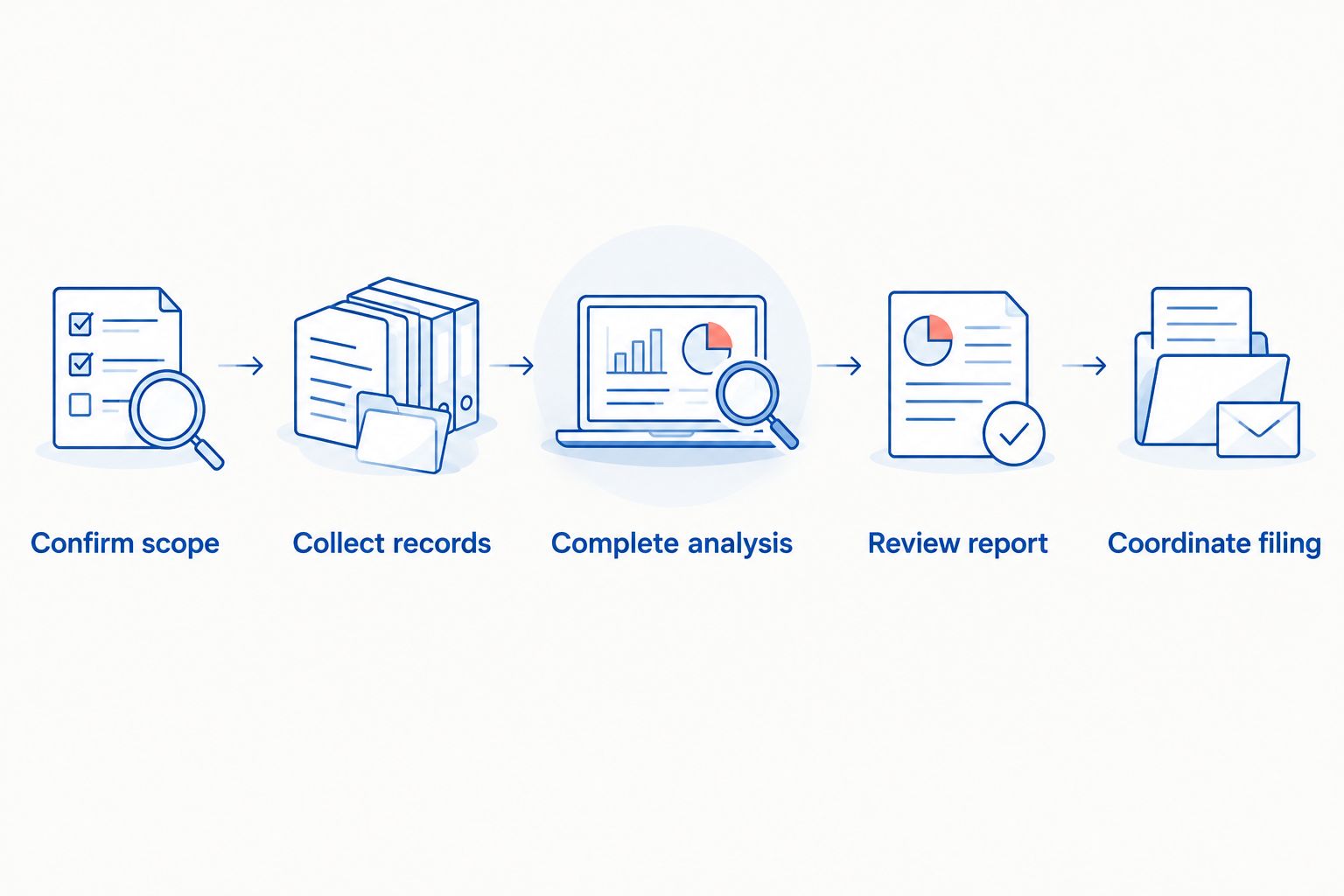
For a 2026 engagement, give the appraiser both your external deadline and your earlier adviser-review target. An appraisal delivery commitment should be confirmed separately from the tax professional’s filing schedule.
The gift tax appraisal to IRS Form 709 workflow provides related guidance on coordinating valuation work with the reporting process. Your tax adviser should determine the requirements applicable to your transfer.
Can a gift tax appraisal be expedited?
Expedited availability must be confirmed individually. REIS Group scopes gift tax real estate appraisal assignments to the property, interest, date, intended users, and intended use; a deadline does not remove those requirements.
When requesting an accelerated schedule, provide the requested delivery date, access arrangements, and available records together. Ask which unresolved items prevent a delivery commitment and whether the proposed scope meets your adviser’s needs.
The benefit of an expedited arrangement is earlier delivery when the assignment and availability permit it. The limitation is that scheduling cannot replace missing evidence or justify unsupported conclusions. Do not treat “rush” as permission to omit analysis required for the identified purpose.
Discuss Your Appraisal Assignment
Provide the property, ownership interest, effective date, and requested delivery date to discuss scope.
Can you order the appraisal before the gift is completed?
You can discuss and scope the assignment before completing the gift. Ask your attorney or CPA to identify the proposed interest and valuation date, and tell the appraiser that the transfer remains prospective.
Early coordination helps identify records and access requirements. It does not establish a final value for an unconfirmed effective date or eliminate the need to address changes to the proposed transfer.
Does an older appraisal shorten the process?
An older report is background material, not an automatic substitute for the new assignment. Its usefulness depends on its effective date, property rights, intended use, and supporting information.
Provide the report and disclose subsequent changes to ownership, condition, occupancy, or income where relevant. Let the appraiser determine what information remains useful rather than assuming an updated cover date resolves the valuation question.
FAQ
How long does a gift tax real estate appraisal take?
A gift tax real estate appraisal requires an assignment-specific delivery estimate. Property complexity, ownership interest, effective date, records availability, access, and reporting scope determine the schedule.
Does the gift tax appraisal timeline begin at the inspection?
The inspection is only one milestone in the gift tax appraisal timeline. Confirm when the agreed schedule begins, what documents it assumes are available, and when report delivery is expected.
Can I get a rush appraisal for a gift tax deadline?
Expedited availability must be confirmed individually. Provide the deadline, property details, ownership interest, required effective date, and available records when requesting a proposal.
Does a partial-interest gift require different appraisal work?
A partial-interest gift requires analysis of the specific ownership interest being transferred. Provide relevant ownership documents and restrictions so the appraiser can define the assignment correctly.
Can a gift tax appraisal use a historical valuation date?
A retrospective appraisal addresses value as of a historical effective date. It requires evidence relevant to property and market conditions at that date, including support for material changes since then.
Does my appraiser decide whether I need Form 709?
Your tax adviser determines whether Form 709 is required for your circumstances. The appraiser prepares the valuation for the identified intended use and coordinates relevant assignment details with your adviser.
Does an appraisal guarantee IRS acceptance?
An appraisal does not guarantee IRS acceptance or a particular tax outcome. The report should explain and support its valuation conclusions for the identified purpose.
One last thing
The effective date of value and report delivery date answer different questions. The first identifies when the value applies; the second identifies when you receive the report. Confusing them can leave an otherwise organized engagement addressing the wrong assignment.
Before requesting a 2026 delivery commitment, put the property interest, effective date, intended use, and adviser-review deadline in the same message. Discuss your appraisal assignment with REIS Group and request a proposal addressing those details.
Related guides
- Gift tax appraisal guide for financial advisers
- How to appraise a partial ownership interest in real estate
- How long does a retrospective appraisal take?