Yes. A single-family home can be appraised for estate tax purposes using fair market value as of the required effective date, often the owner’s date of death. The assignment must identify the ownership interest being valued and the intended use; a current sale estimate or property tax assessment does not automatically answer that estate-tax question.
- A single-family home estate tax appraisal values the specified ownership interest as of the required effective date.
- REIS Group provides estate real estate appraisals for attorneys, CPAs, executors and trustees.
- Confirm the valuation date and reporting purpose with the estate’s attorney or CPA before ordering.
- Preserve historical photographs, ownership records and renovation details before the home changes.
Can a single-family home be appraised for estate tax purposes?
Yes—the property’s residential use does not prevent an estate tax appraisal. The central questions are what interest the decedent owned, which date applies and what reporting purpose the appraisal must support. An owner-occupied house, inherited townhouse or rented single-family property requires a scope that addresses those facts.
For an executor coordinating a 2026 assignment, the practical starting point is the estate’s attorney or CPA. Confirm the required valuation date and intended use, then arrange an appraisal scoped to those instructions. The date-of-death appraisal to IRS Form 706 workflow explains how that valuation fits into the reporting process.
These are the core assignment decisions:
| Assignment detail | What to confirm | Why it matters |
|---|---|---|
| Property | Address, parcel and relevant improvements | Establishes what real estate the analysis covers |
| Ownership interest | Entire property interest or a specified partial interest | Prevents valuing different rights from those held by the estate |
| Effective date | Date supplied after consultation with the estate’s adviser | Establishes the market conditions and property condition to analyze |
| Intended use | Estate tax reporting and any additional identified purpose | Guides the assignment scope and report |
| Intended users | Parties identified for reliance on the report | Clarifies whom the appraisal is prepared to serve |
The appraisal provides a supported valuation conclusion. The attorney or CPA determines filing obligations, tax treatment and how to use that conclusion in the estate’s reporting.
Why this matters for an executor
A family often needs several answers about the same home: what it was worth when the owner died, what it might sell for now and what figure belongs in estate records. Those questions are related, but they are not interchangeable. Order the appraisal for the estate’s identified purpose before treating an available value as the answer.
REIS Group provides estate real estate appraisals for attorneys, CPAs, executors and trustees in Manhattan and the greater New York City area. Its reports are tailored to the property interest, effective date and intended use. That alignment matters more than obtaining a document simply labeled an appraisal.
For a home being prepared for sale in 2026, keep the estate valuation assignment separate from the listing decision. A later marketing plan does not establish the home’s value on an earlier effective date.
Which valuation date should the appraisal use?
The effective date is the date to which the value conclusion applies. It is not necessarily the inspection date, engagement date or report date. An appraisal prepared in 2026 can analyze an earlier point in time when the assignment requires a retrospective appraisal.
For estate work, the date of death is a common effective date. An alternate valuation date applies only when the relevant requirements are met and the estate makes the applicable election; the appraiser should not select a different date merely because the market has changed. Ask the estate’s tax adviser to confirm the instructions.
Give the appraiser the required date before work begins. If the attorney or CPA is still evaluating the reporting approach, disclose that issue during scoping rather than requesting an undefined historical value.
A retrospective assignment reconstructs the property and market at the required date. The guide to obtaining a retrospective appraisal for inherited property addresses that preparation in more detail.
What ownership interest needs to be appraised?
A single-family address does not establish that the estate owns the entire property. Review the deed and relevant ownership documents with the attorney, especially when relatives share ownership or a trust or entity holds title.
The property rights appraised describe the legal interest the valuation covers. Valuing the entire real estate interest is a different assignment from valuing a specified fractional interest. Do not assume that the latter is resolved by multiplying the whole-property value by an ownership percentage.
| Valuation scope | Best suited to | Strength | Limitation |
|---|---|---|---|
| Whole-property interest | An assignment requiring the value of the entire real estate interest | Directly addresses the identified property rights as a whole | Does not separately establish a fractional interest’s value |
| Partial ownership interest | An assignment involving a specified share of ownership | Addresses the particular interest and relevant ownership restrictions | Requires additional analysis and supporting ownership documents |
Neither scope is automatically preferable. The appropriate scope follows the estate’s actual ownership and reporting purpose, not a desired valuation result. Any adjustment associated with a partial interest needs support rather than an assumed discount.
How do you prepare a single-family home estate appraisal?
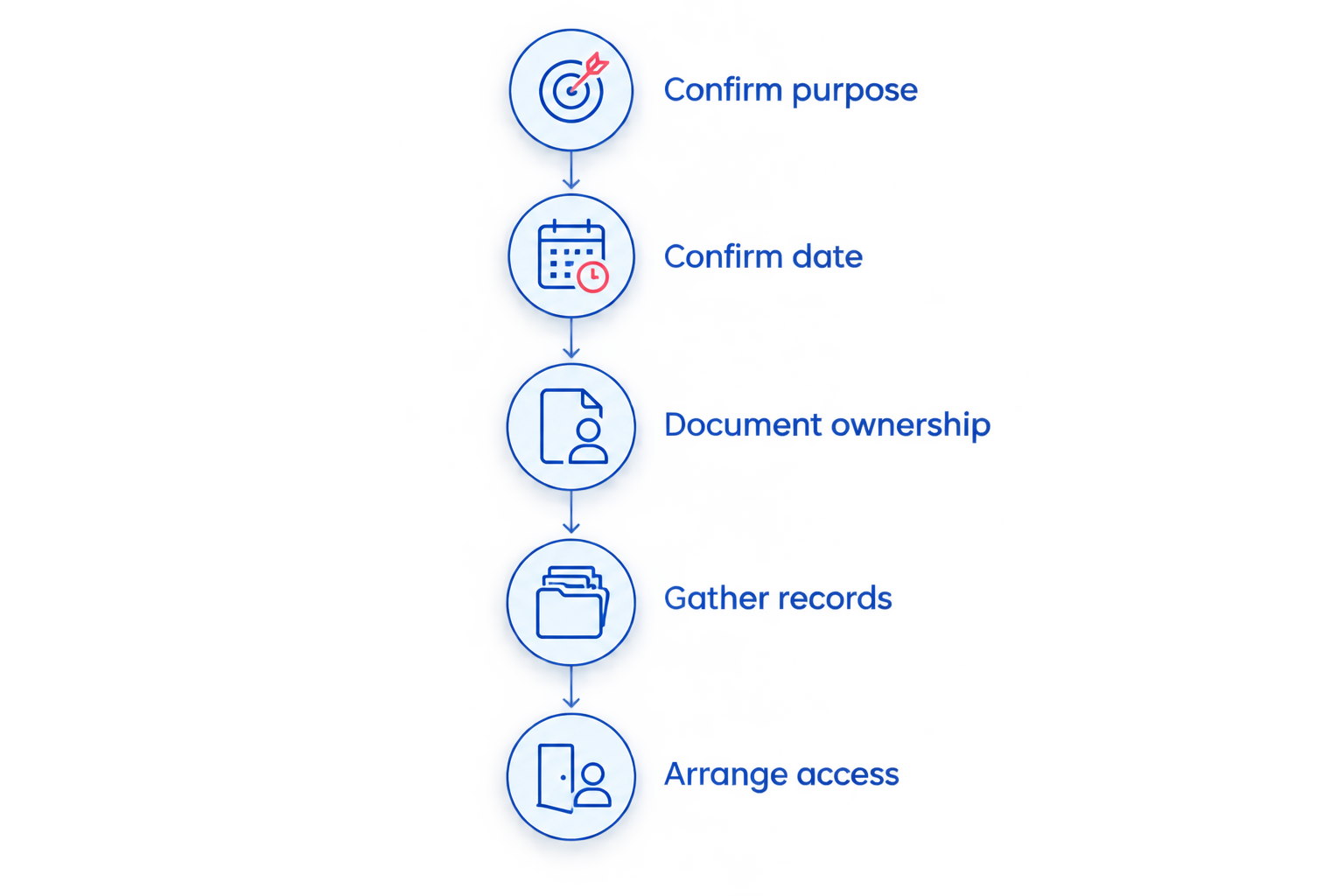
Use the following sequence to organize the assignment. Resolve the purpose, date and ownership questions before focusing on access or delivery. A well-organized inspection cannot correct instructions that identify the wrong interest or effective date.
- Confirm purpose. Ask the estate’s attorney or CPA which reporting need the appraisal must support. Identify any proposed additional use, such as probate, before engagement.
- Confirm date. Provide the required effective date and explain whether the home has changed since then. Distinguish historical facts from present conditions.
- Document ownership. Supply the deed and relevant trust, entity or co-ownership documents as requested. Let counsel explain legal questions about title or ownership rights.
- Gather records. Collect property information, historical photographs and records of improvements or damage. Explain which documents describe conditions on the effective date.
- Arrange access. Identify the person authorized to coordinate entry and provide the adviser’s requested delivery date. Have the appraiser confirm the scope and schedule individually.
REIS Group scopes estate appraisal assignments to the property, ownership interest, valuation date and intended use. Provide those details when requesting a proposal so the discussion addresses the estate’s actual needs rather than a generic residential appraisal.
What documents should the executor gather?
Start with the records already available; do not delay an initial inquiry while trying to assemble a perfect file. Tell the appraiser which records exist and which require help from the attorney, managing agent or family.
Useful materials include:
- The property address, deed and parcel identification.
- The required effective date and the estate adviser’s instructions.
- Floor plans, surveys and available building records.
- Photographs showing the home near the effective date.
- Renovation records identifying what changed and when.
- Information about damage, deferred maintenance or conditions no longer visible.
- Leases and occupancy information if the house was rented.
- Relevant ownership agreements or restrictions identified by counsel.
Label records by their actual dates. A photograph taken after renovation is useful evidence of current condition, but it should not be presented as showing the house before that work.
How is the home’s fair market value supported?
Fair market value generally reflects an exchange between a willing buyer and willing seller, neither compelled to act and both reasonably informed. For the appraisal, that concept must be applied to the specified property rights and effective date—not simply repeated in the report.
For a single-family house, comparable sales analysis commonly examines transactions involving competing properties. The appraiser evaluates relevant differences such as location, size, condition, site characteristics and amenities. A nearby sale is not automatically a strong comparable merely because it is close.
The appraiser also considers the property’s highest and best use: the reasonably probable use that meets the applicable legal, physical and financial tests and produces the highest value. This requires attention when a New York City property has unusual development potential or constraints. It does not mean assuming redevelopment without analysis.
An appraisal completed in 2026 for a 2026 effective date must still examine the market relevant to that specific date. The calendar year alone does not establish comparable-sale relevance or the property’s condition.
Why the appraisal scope and turnaround vary
The assignment’s complexity depends on more than the home’s bedroom count. These factors affect what the appraiser needs to investigate and how the work is organized:
- Effective date: A retrospective assignment requires evidence of historical market conditions and the home’s earlier condition.
- Ownership rights: Partial interests and documented restrictions require a different analysis from an unrestricted whole-property interest.
- Property characteristics: Unusual layouts, substantial deferred maintenance or development questions require specific attention.
- Records availability: Missing plans, uncertain renovation dates or incomplete ownership records create issues to resolve.
- Access and occupancy: Inspection arrangements depend on who controls access and whether the property is occupied.
- Intended use: Additional reporting purposes must be evaluated when the engagement is scoped.
Confirm turnaround for the individual assignment. REIS Group bases scheduling on property type, complexity, records availability and scope; expedited availability is confirmed individually. A requested filing date should be disclosed at the outset, not treated as an assumed delivery commitment.
Can an old mortgage appraisal or tax assessment be used instead?
Neither document should automatically replace an estate-purpose appraisal. A mortgage appraisal was prepared for an identified lending use, effective date and set of intended users. A property tax assessment serves a separate assessment system and does not by itself establish the value required for the estate assignment.
Provide existing documents to the appraiser as background. They can contain useful property descriptions or historical observations, but their relevance must be evaluated rather than presumed.
The same distinction applies to online estimates and listing recommendations. They can inform a conversation about the property, but they do not resolve the estate’s ownership, effective-date and reporting requirements.
Can the home be appraised after renovations or a sale?
Yes. A retrospective appraisal can address a prior effective date even when the home has since changed, provided the appraiser can develop a credible analysis from the available evidence. Historical photographs, contractor records and descriptions of earlier conditions become especially important.
A sale in 2026 is relevant information, but the transaction must be analyzed in relation to the effective date, property condition and terms. Do not automatically substitute a later sale figure for an earlier estate value. Disclose renovations, repairs and other intervening changes.
Does getting an appraisal mean estate tax is owed?
No. Obtaining an appraisal does not itself determine whether an estate owes tax or must file a particular return. The attorney or CPA evaluates those questions using the estate’s circumstances and applicable law.
An appraisal supplies a valuation conclusion for its identified purpose. It does not calculate the estate’s total tax liability or guarantee acceptance by a taxing authority.
FAQ
Can I get an estate tax appraisal for an ordinary single-family house?
Yes. A single-family house can be appraised for estate tax purposes when the assignment identifies the property interest, effective date and intended use.
Should I order the appraisal before speaking with the estate’s CPA?
Confirm the valuation purpose and effective date with the estate’s attorney or CPA before finalizing the engagement. You can make an initial appraisal inquiry while those instructions are being clarified.
Does the appraiser use the inspection date as the date of value?
Not automatically. The effective date is the date the value conclusion addresses, and it can differ from the inspection and report dates.
Can the appraiser value a home that has already been renovated?
Yes, a retrospective appraisal can address the home’s earlier condition when sufficient evidence supports the analysis. Provide dated photographs, improvement records and information about what changed.
Does a fractional share equal the same percentage of the whole home’s value?
Not automatically. A partial-interest valuation must address the specific ownership rights and relevant restrictions rather than assume a proportional result or discount.
Can REIS Group appraise a single-family home for an estate?
Yes. REIS Group provides residential and estate real estate appraisals, with assignments scoped to the property interest, effective date and intended use.
Will an estate appraisal guarantee IRS acceptance?
No appraisal guarantees IRS acceptance. The report should support its identified valuation purpose with clear analysis, and the estate’s advisers determine its use in tax reporting.
One last thing
Preserve evidence before clearing out or renovating the house. Dated photographs and records of existing defects can help distinguish the property’s condition on the effective date from later improvements. Keep original files and identify when each photograph was taken.
To discuss your appraisal assignment, provide the address, required valuation date, ownership interest and adviser’s reporting purpose. Request an appraisal proposal that addresses those facts and identifies any additional records needed.
Discuss Your Appraisal Assignment
Share the property, effective date, ownership interest and intended use to discuss the appropriate scope.
Related guides
- Date-of-death appraisals for New York executors and attorneys
- Can one appraisal serve estate tax and probate filings?
- Partial-interest appraisal scope and cost considerations