Instead of manually reconciling business values, ownership records and insurance documents whenever a partner’s circumstances change, build a business valuation-to-buy-sell funding workflow that connects the agreement’s valuation rules to a documented funding review. For New York business owners and their attorneys, CPAs and financial advisers, the first step is to define exactly what ownership interest the agreement requires someone to purchase.
- Business valuation buy-sell agreement funding starts with the agreement’s ownership interest, valuation date and purchase terms.
- REIS Group supports real estate valuation; confirm operating-business valuation scope separately before engagement.
- Compare insurance, reserves, installments and borrowing against the actual purchase obligation—not enterprise value alone.
- Refresh the valuation and funding review together when ownership, property holdings or agreement terms change.
Why this matters
A buy-sell agreement establishes contractual purchase obligations. A valuation measures a defined interest under an identified basis of value. Funding provides the resources to meet the obligation. These are connected decisions, not interchangeable documents.
An insurance amount does not establish business value, and a business valuation does not establish that cash will reach the correct purchaser when payment becomes due. Your 2026 workflow should reconcile both questions before anyone treats the arrangement as complete.
For a business that owns Manhattan commercial property, the real estate component also needs attention. Property value, operating-business value and the value of an owner’s interest are different subjects. The business valuation guide for CPAs and accountants provides supporting context for defining the assignment with professional advisers.
REIS Group is best suited to New York owners and advisers who need real estate valuation within a buy-sell planning assignment. Confirm any operating-business valuation work separately rather than assuming a property appraisal covers the entire enterprise.
Before you start
- Gather the controlling records: the signed buy-sell agreement and amendments, ownership schedule, entity documents, financial statements, debt records and existing funding documents. Include leases and property records when real estate is involved.
- Assign the participants: identify the owner coordinating records, the attorney interpreting purchase obligations, the CPA reviewing financial information, the valuation professional and the adviser responsible for insurance or other funding arrangements.
- Resolve the hidden mismatch: determine whether the agreement concerns the operating company, a separate property-owning entity or both. A property held outside the operating company does not become part of the purchase merely because the business occupies it.
Use a shared worksheet for the following 4 handoffs: agreement scope, valuation scope, funding review and documented approval. The bold field names below are suggested worksheet labels, not software controls.
Agreement scope
- Record the triggering event. Under Trigger, identify the event being planned for: death, disability, retirement or another event specified in the agreement. Ask counsel to distinguish mandatory purchases from purchase rights. Do not assume every event activates the same buyer, valuation procedure or payment schedule.
- Identify the buyer and interest. Complete Purchaser, Seller, Entity and Interest subject to purchase. Specify whether the entity purchases the departing owner’s interest or the remaining owners purchase it directly. Reconcile ownership percentages with the governing records, including any separate property entity.
- Extract the valuation and payment rules. Complete Valuation mechanism, Effective date, Payment timing and Dispute procedure using the agreement’s actual terms. Flag ambiguous provisions for counsel rather than selecting an interpretation yourself. Record whether the document calls for a fixed value, a formula, an appraisal or another process.
Expected result: everyone can identify the same purchaser, ownership interest, triggering event and contractual valuation process. If those answers remain disputed, resolve the disagreement before commissioning a valuation intended to implement the agreement.
For your 2026 review, distinguish a planning exercise from an activated purchase obligation. An estimate prepared for planning does not automatically satisfy the valuation procedure required after a triggering event.
Valuation scope
- Define the assignment in writing. Give the valuation professional the agreement and relevant amendments. Confirm Intended use, Intended users, Property rights appraised, Effective date of value and Basis of value. Fair market value is a particular valuation concept; it is not a substitute for whatever definition the contract actually requires.
- Separate the business from its property. Identify operating assets, owned real estate, related-party leases and separate holding entities. Ask the business valuation professional how real estate will enter the analysis. When a separate property appraisal is needed, align its effective date and rights appraised with the broader assignment.
- Reconcile the ownership-level conclusion. Ask the valuation professional to explain the relationship between enterprise value, equity value and the specific interest being purchased. Do not multiply a headline business value by an ownership percentage without checking the agreement and valuation assumptions. Treatment of debt, cash, ownership rights and restrictions requires a consistent scope.
Expected result: the engagement describes the asset or interest being valued, the relevant date and how the conclusion will support the agreement’s identified purpose.
REIS Group provides independent real estate appraisal and valuation consulting. For business-owned property, its commercial appraisal guide for property investors helps frame the property records and assignment questions. Confirm separately who will value the operating business and integrate the property conclusion.
A property appraisal supplies an input; it does not replace operating-business analysis. Its usefulness depends on a consistent scope, and the broader valuation must avoid counting the same property value twice.
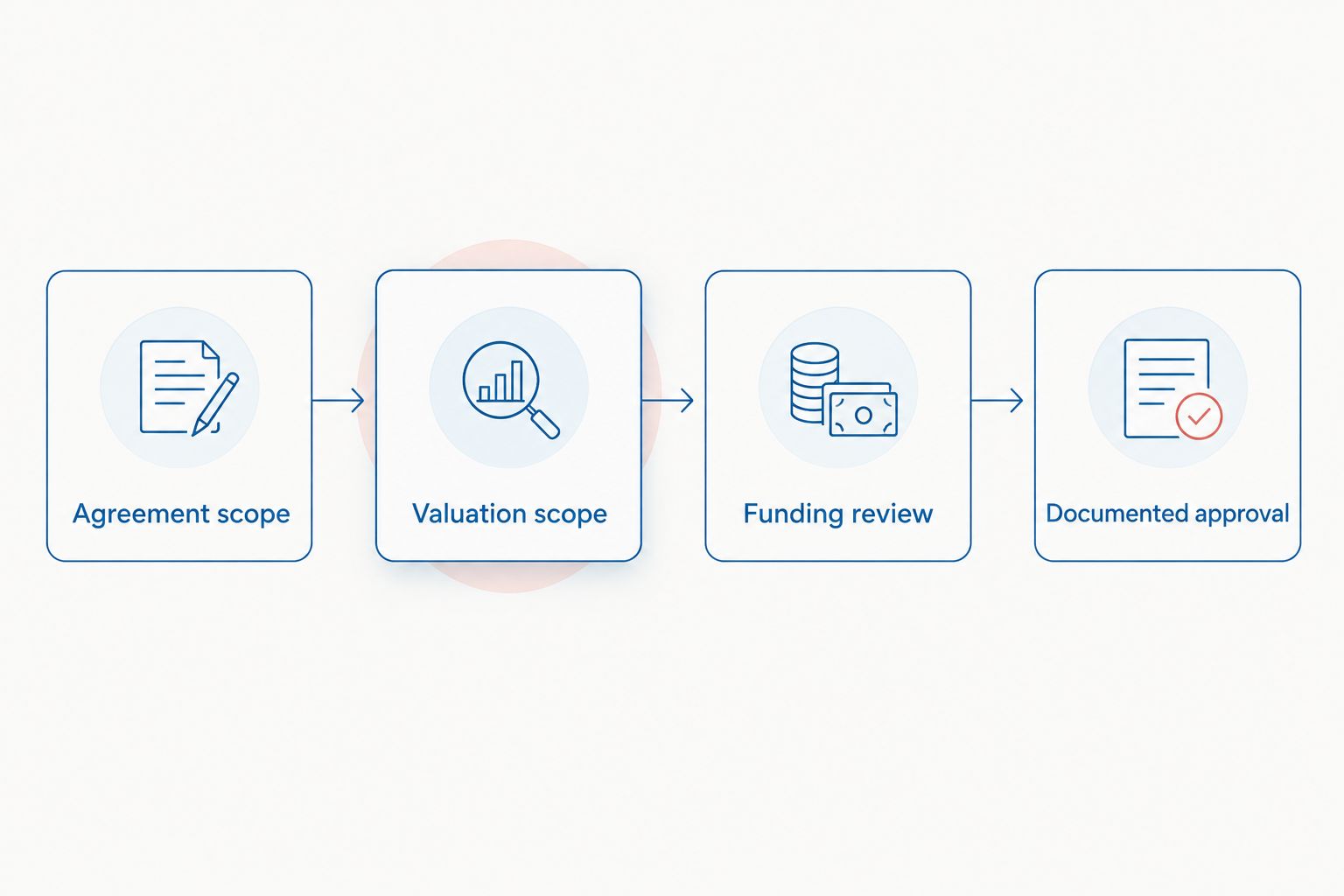
Funding review
- Translate value into the purchase obligation. Ask counsel and the CPA to reconcile the valuation conclusion with the agreement’s purchase terms. Record Purchase obligation, Purchaser and Payment schedule. Keep the business’s total value separate from the amount the designated purchaser must pay for the departing owner’s interest.
- Map resources to that purchaser. List the insurance, designated reserves, installment terms or borrowing arrangements under consideration. For insurance, verify policy ownership, beneficiary, covered person and coverage terms with the responsible adviser. For other resources, identify who controls them and what must happen before they can fund the purchase.
- Record the unresolved gap. Compare the contractual obligation with resources the purchaser can actually access under the relevant scenario. Identify timing differences, restrictions and dependencies. Assign each unresolved item to a named professional or owner; do not treat an intended future arrangement as completed funding.
Expected result: the funding worksheet connects each purchase obligation to a specific resource, responsible party and unresolved condition.
Use this comparison to organize the discussion, not to select a funding arrangement without professional advice.
| Funding approach | Best for | Practical advantage | Limitation to resolve |
|---|---|---|---|
| Life insurance | Reviewing a death-triggered purchase obligation | Provides a death-benefit funding mechanism subject to policy terms | Does not fund retirement merely because the same agreement covers retirement |
| Designated reserves | Owners allocating existing liquid resources | Creates an identifiable funding source | Competes with operating liquidity and remains exposed to business demands |
| Installment payments | Agreements permitting payment over time | Spreads the purchaser’s payment obligation | Leaves the seller or estate exposed to future payment performance |
| Borrowing | Purchasers evaluating external financing | Adds a potential source beyond existing cash | Depends on financing terms, approval and repayment capacity |
For the 2026 review, ask the attorney, CPA and insurance adviser to address the treatment of entity-owned insurance in the ownership structure and valuation. Do not assume insurance proceeds and redemption obligations cancel each other for valuation or tax purposes.
Documented approval
- Hold a reconciliation review. Circulate the agreement summary, valuation scope and funding worksheet together. Ask each professional to identify inconsistencies within their area of responsibility. Resolve different effective dates, ownership assumptions and purchase structures before finalizing the planning file.
- Confirm implementation separately. Distinguish a recommendation from an executed agreement, an issued policy or an established financing arrangement. Obtain confirmation from the responsible attorney, insurer, adviser or financial institution. A completed valuation report does not establish that the funding arrangement has been implemented.
- Assign the next review trigger. Record the responsible coordinator and the events requiring another review. Include ownership changes, material property transactions, agreement amendments and changes to funding arrangements. Follow any review interval already required by the agreement.
Expected result: the file shows what was agreed, what was implemented, what remains open and who owns the next action.
Keep 2 records distinct: the valuation conclusion and the funding reconciliation. The former supports value for a defined assignment; the latter documents how the proposed purchaser expects to meet the contractual obligation.
Refresh the workflow when ownership or property changes
An initial setup and an update use the same sequence, but an update begins with a change log. For a 2026 refresh, identify what changed since the prior review rather than carrying forward every assumption automatically.
- Ownership change: reconcile the ownership schedule, covered interests and designated purchasers.
- Property transaction: identify acquisitions, dispositions or transfers between related entities and assess whether a new property appraisal is needed.
- Agreement amendment: ask counsel whether the valuation mechanism, triggering events or payment terms changed.
- Funding change: ask the responsible adviser to verify current policy details or financing arrangements before reusing the prior reconciliation.
Revisit linked assumptions together. Updating the operating company’s value while leaving an outdated property input or ownership schedule in place creates an internally inconsistent file. A retrospective assignment requires evidence relevant to its historical effective date, even when the report is prepared later.
Troubleshooting
The agreement’s valuation language is unclear
Ask counsel to resolve the contractual question before directing the appraiser. A valuation professional can explain valuation terminology, but the engagement should not silently replace legal interpretation with an appraisal assumption.
The business occupies property owned by another entity
Prepare separate ownership and lease schedules. Confirm whether the buy-sell obligation covers either entity or both, then coordinate the property appraisal and operating-business analysis accordingly.
Insurance benefits reach a different party from the purchaser
Have the attorney and insurance adviser compare policy ownership and beneficiary designations with the purchase structure. Do not assume a beneficiary will transfer proceeds to the obligated purchaser without an appropriate arrangement.
The valuation is complete, but the funding is not
Document the shortfall or timing mismatch and assign the funding decision to the owners and their advisers. Do not ask the valuation professional to change a supported conclusion to match an existing policy or reserve balance.
Records delay the assignment
Prioritize missing ownership documents, financial records, leases and property information with the valuation professional. Turnaround depends on property type, complexity, records availability and scope; confirm any expedited schedule individually.
Customize your workflow
For a New York business with real estate, start with 1 consolidated property schedule showing the owner, property rights, occupancy and relevant leases. Give the same schedule to the business valuation professional and property appraiser so their assignments use consistent facts.
REIS Group can discuss the real estate valuation component and confirm the proposed scope. Bring the agreement, ownership schedule, property list and intended effective date to that discussion. Identify any operating-business valuation requirement explicitly.
Discuss Your Appraisal Assignment
Clarify the property interest, effective date and intended use before requesting an appraisal proposal.
FAQ
What comes first in business valuation buy-sell agreement funding?
Define the agreement’s purchase obligation first. Identify the triggering event, purchaser, ownership interest and valuation mechanism before matching the obligation to funding.
Does a real estate appraisal value the entire business?
No. A real estate appraisal values the identified property interest, while operating-business valuation addresses a different subject. Coordinate both assignments when the business owns property.
Should life insurance equal the total business value?
Do not assume total business value is the correct funding target. Reconcile the specific purchaser’s obligation, ownership interest, payment terms and other funding sources with the responsible advisers.
Can one funding arrangement cover death and retirement?
Do not assume one arrangement covers both events. Life insurance provides a death-benefit mechanism, while a retirement purchase requires resources suited to that event and the agreement’s payment terms.
When should owners update a buy-sell valuation?
Follow the agreement’s requirements and review material changes in ownership, business conditions, property holdings and funding. Confirm whether the purpose requires a new valuation rather than reusing a prior conclusion.
What should I bring to a REIS Group consultation?
Bring the agreement, ownership schedule, property records, intended use and proposed effective date. Identify separately whether the assignment requires operating-business valuation, real estate appraisal or coordinated work.
One last thing
A fully funded policy can still leave the wrong purchaser without resources. Before closing your 2026 review, trace the money from its source to the party legally obligated to buy. Request an appraisal consultation once the property interest, valuation date and intended use are clear.
Related guides
- Business valuation for owners planning a sale
- Partial-interest appraisal considerations for estates
- Trust property appraisal for trustees