Yes, a commercial appraisal can be used for refinancing a property loan when it meets the lender’s requirements for the assignment, including the ordering process, intended use, property rights, and effective date of value. An appraisal you already own is not automatically acceptable for a new loan, so confirm the lender’s requirements before commissioning a report or requesting changes to an existing one.
- A commercial appraisal for refinancing must satisfy the lender’s ordering, scope, and review requirements.
- An existing report is not automatically transferable to a new lender or refinancing assignment.
- REIS Group provides commercial appraisal and valuation consulting for New York City property owners.
- Confirm the lender’s instructions before ordering a report; then assemble leases, operating records, and property information.
Can a commercial appraisal be used for refinancing a property loan?
Yes—but a credible valuation and a lender-acceptable appraisal are not automatically the same thing. The report must address the lending assignment, and the lender determines whether it satisfies its appraisal policies and applicable requirements.
For a New York City owner planning a refinance in 2026, the first question is who must engage the appraiser. Discussing appraisal services can help clarify your valuation needs, but it does not replace the lender’s ordering instructions.
| Appraisal route | Best for | Benefit | Limitation |
|---|---|---|---|
| New appraisal ordered through the lender’s required process | Supporting a specific refinancing application | Establishes the lending purpose and assignment requirements at engagement | Still requires lender review; it does not guarantee financing |
| Existing appraisal submitted for lender consideration | Finding out whether prior valuation work is usable | Gives the lender a report to assess before deciding what else is needed | Acceptance depends on its origin, scope, date, and lender policy |
| Owner-commissioned advisory appraisal | Understanding property value before financing discussions | Supports the owner’s planning and evaluation of property information | Does not substitute for the lender’s required appraisal process |
Do not choose between these routes based only on convenience. Ask the lender which route it permits and obtain instructions before authorizing work.
Why this matters
An owner can have a well-supported appraisal that was prepared for the wrong purpose. A report for estate administration, litigation, or internal planning does not become a refinancing report simply because it concerns the same building.
The distinction is practical. Confirming the assignment at the outset helps you avoid commissioning work that does not address the lender’s needs, while giving the appraiser a clear basis for defining the scope.
The appraisal also answers a narrower question than the loan application. It develops an opinion of value; it does not decide whether the borrower qualifies, whether projected cash flow satisfies underwriting, or whether the lender will approve the proposed loan.
What makes a commercial appraisal suitable for refinancing?
The intended use addresses the lending decision
Intended use means the purpose the appraisal is prepared to support. For refinancing, that purpose must match the lender’s assignment requirements rather than an unrelated tax, dispute, or ownership-planning objective.
The intended users are the parties identified as users of the appraisal. Receiving a copy does not, by itself, make a new lender an intended user or establish that it can rely on the report.
The property rights match the collateral
The appraiser must identify the ownership interest being valued. A leased commercial property, an unencumbered ownership interest, and a fractional ownership interest present different valuation questions.
For an income-producing Manhattan building, lease terms can materially affect the analysis. An appraisal must distinguish the real estate interest securing the loan from an ownership interest in the entity that holds the building.
The effective date fits the assignment
The effective date of value is the date to which the value conclusion applies. It is not necessarily the inspection date or the date the report is delivered.
A retrospective appraisal concludes value as of a historical date. For a 2026 refinancing, ask the lender what effective date it requires rather than assuming that a recently delivered historical report establishes current collateral value.
The analysis supports the value conclusion
A commercial appraisal explains the relevant property characteristics, market evidence, and valuation methods. For an income-producing property, that includes analyzing income and expenses where relevant to the assignment.
The appraiser determines which approaches are applicable and explains the reasoning. A report’s usefulness rests on its support and assignment fit, not simply its length or the presence of a particular value figure.
How do you arrange a commercial appraisal for refinancing?
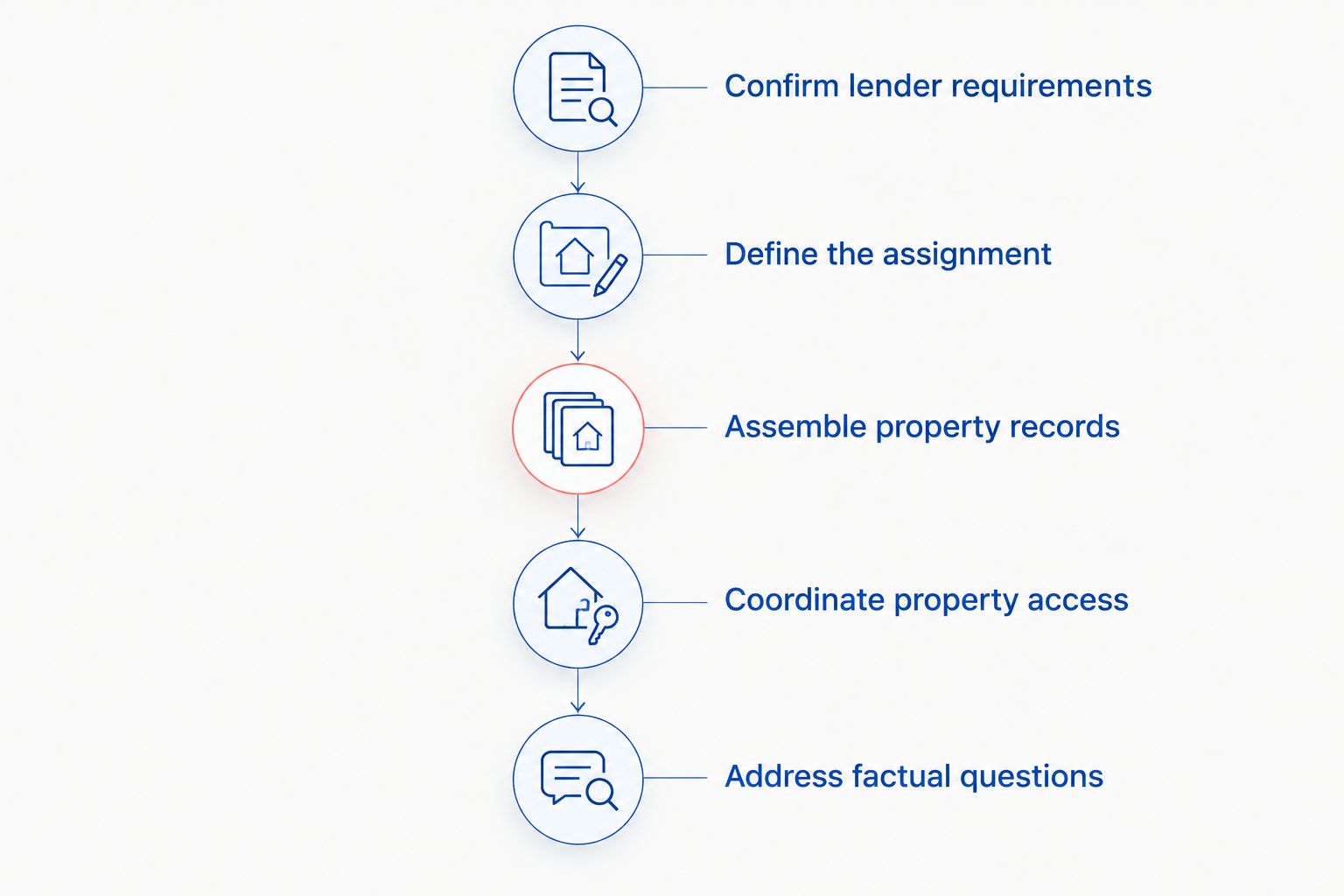
Follow this sequence before committing to an appraisal engagement. It separates the lender’s requirements from the property information you control.
- Confirm lender requirements. Ask who orders the appraisal, how the appraiser is selected, and whether an existing report can be considered. Identify the lender contact responsible for appraisal instructions.
- Define the assignment. Confirm the property, ownership interest, lending purpose, required effective date, and intended users. Disclose proposed renovations, lease changes, or other circumstances relevant to the valuation.
- Assemble property records. Gather the rent roll, leases, operating statements, property details, and other requested records. Flag discrepancies rather than silently correcting source documents.
- Coordinate property access. Identify who can arrange access to the building and relevant spaces. Tell the appraiser about access limitations before scheduling.
- Address factual questions. Respond to requests for clarification and route lender questions through the required process. Distinguish a correction to a property fact from a request to reach a preferred value.
This sequence keeps the purpose clear before the analysis begins. It also gives the owner, lender, and appraiser defined responsibilities without treating the appraisal as a negotiation over the loan amount.
What documents should a commercial property owner prepare?
Start with records that explain the property’s legal identity, occupancy, and financial performance. The exact request depends on the building and the assignment; a mixed-use property does not present the same information needs as vacant commercial land.
- Ownership and property information: Property address, ownership entity, legal description if available, surveys, floor plans, and relevant property records.
- Leasing records: Current rent roll, executed leases, amendments, concessions, renewal provisions, and information about vacancies or tenant departures.
- Operating records: Historical income and expense statements, current operating information, real estate tax records, insurance expenses, and explanations of unusual items.
- Physical-condition information: Known deferred maintenance, completed improvements, proposed capital work, and available reports relevant to the property’s condition.
- Assignment instructions: Lender requirements, the proposed financing purpose, access contacts, and any existing appraisal being submitted for consideration.
For a 2026 assignment, label records by the period they actually cover. Separate historical operating results from budgets and projections so the appraiser can evaluate each on its own terms.
Do not replace actual lease terms with anticipated rents without explanation. Identify pending negotiations as pending, and distinguish signed agreements from management expectations.
Why refinancing appraisal requirements vary
There is no single checklist that makes every commercial report acceptable to every lender. These factors shape the assignment and the review:
- Lender requirements: The lender’s policies govern its ordering process, report requirements, and consideration of existing appraisals.
- Property type: Multifamily, mixed-use, retail, office, and other commercial properties require analysis suited to their characteristics.
- Ownership interest: The rights securing the loan must be identified accurately, particularly where leases or fractional interests are involved.
- Property condition and occupancy: Vacancy, deferred maintenance, renovations, and lease changes affect the questions the appraisal must address.
- Records availability: Complete, consistent leasing and financial information supports the analysis; gaps require clarification and can affect the scope and timing.
- Valuation date and assumptions: Current condition, proposed improvements, and future stabilized operations are distinct valuation premises, not interchangeable conclusions.
Confirm scope before discussing delivery. Turnaround depends on property type, complexity, records availability, and the agreed work; any expedited availability must be confirmed for the individual assignment.
Can I reuse a commercial appraisal I already have?
An existing commercial appraisal can be submitted for lender consideration, but reuse requires the lender’s review. Provide the complete report and explain who commissioned it, why it was prepared, and the effective date of value.
Do not ask the appraiser merely to replace the original client’s name with the new lender’s name. A new intended use or client can require a new assignment, and changed conditions can require additional analysis.
A report delivered in 2026 is not automatically suitable for every 2026 refinancing. Its effective date, property rights, assumptions, ordering history, and intended use still matter.
Does a higher appraised value guarantee a larger refinance loan?
A higher appraised value does not guarantee a larger refinance loan. The lender also evaluates the proposed financing under its underwriting requirements, including the borrower, property income, and loan structure.
Do not instruct the appraiser to reach the value needed for a target loan. Provide accurate information and relevant evidence; the value conclusion must remain independent of the owner’s financing objective.
Can my estate or tax appraisal also support refinancing?
An estate or tax appraisal does not automatically support refinancing because its purpose, effective date, and intended users can differ. Ask the lender to review the assignment details before assuming that the existing report can serve both needs.
The same building can require separate valuation assignments for separate decisions. Keeping those purposes distinct helps your attorney, CPA, lender, and appraiser avoid treating different valuation questions as equivalent.
When should you discuss an independent appraisal assignment?
An owner’s valuation consultation is useful when you need to understand the property interest, organize records, or define a valuation question before approaching lenders. Its limitation is equally clear: an owner-commissioned report does not establish lender acceptance.
REIS Group is suited to New York City commercial property owners who need independent appraisal and valuation consulting for a defined assignment. The firm provides commercial appraisal services for multifamily, mixed-use, retail, office, and other income-producing properties, with over 30 years of experience.
For a commercial appraisal consultation, give REIS Group the property address, ownership structure, appraisal purpose, relevant date, and any lender instructions. If refinancing is the objective, confirm whether the lender requires direct engagement before requesting a proposal.
FAQ
Can I order my own commercial appraisal for refinancing?
Ask the lender before ordering your own commercial appraisal for refinancing. The lender can require its own engagement and selection process, and a borrower-ordered report is not automatically acceptable.
Will a new lender accept my previous commercial appraisal?
A new lender must determine whether it can accept your previous commercial appraisal. Its review can include the original engagement, intended use, effective date, property rights, and changes affecting the property.
Is a commercial appraisal the same as loan approval?
A commercial appraisal is not loan approval. It develops an opinion of property value, while the lender separately evaluates the borrower, property income, loan structure, and other underwriting requirements.
Can I ask the appraiser to increase the value for my refinance?
You can identify factual errors and submit relevant evidence, but you should not request a predetermined value. Follow the lender’s process for questions or reconsideration requests.
What records should I prepare for a commercial refinancing appraisal?
Prepare leasing records, operating statements, property information, condition details, and the lender’s assignment instructions. The appraiser will identify additional records needed for the property and scope.
How long does a commercial appraisal for refinancing take?
Commercial refinancing appraisal turnaround depends on property type, complexity, records availability, access, and scope. Confirm the assignment schedule individually and distinguish appraisal delivery from the lender’s subsequent review.
Can REIS Group help with a New York City commercial property valuation?
REIS Group provides commercial real estate appraisal and valuation consulting for New York City property owners and professional advisers. For refinancing, first confirm the lender’s engagement requirements and provide those instructions when discussing the assignment.
One last thing
The date printed on the cover is not enough to establish whether an appraisal answers your refinancing question. Check the effective date of value, the property rights appraised, and the intended use inside the report.
For your 2026 refinancing, the most useful first step is to obtain the lender’s appraisal instructions—not a promise of a particular value. Then request an appraisal consultation with REIS Group to discuss the property and the assignment requirements.
Related guides
- How long does a commercial appraisal take?
- How to vet a commercial appraiser before hiring in New York
- Can a commercial appraisal be used to challenge a lender’s valuation?