Yes—a retrospective appraisal can support a real estate valuation in an IRS audit when it establishes value as of the correct historical date and explains the evidence behind its conclusions. A report prepared in 2026 can address an earlier effective date; its preparation date alone does not invalidate the analysis. No appraisal guarantees IRS acceptance: the property rights, historical condition, market evidence, and valuation reasoning must withstand examination.
- A retrospective appraisal IRS audit response needs historical evidence, the correct effective date, and clearly explained valuation reasoning.
- REIS Group provides estate and date-of-death appraisals for attorneys, CPAs, executors, and trustees.
- A current inspection does not establish the property’s historical condition without supporting records.
- Separate appraisal questions from tax-return decisions; coordinate the appraiser, estate attorney, and CPA.
Can a retrospective appraisal hold up in an IRS audit?
Yes. The useful distinction is between an appraisal completed after the valuation date and an appraisal that incorrectly substitutes current facts for historical facts. A retrospective report addresses the former without relying on the latter.
For an estate attorney or CPA, the first task is to define the assignment before discussing a value. Identify the property, ownership interest, applicable valuation date, and intended use; the date-of-death appraisal to IRS Form 706 workflow connects those decisions to estate-tax reporting.
The federal estate-tax valuation framework in Treasury Regulation §20.2031-1 generally uses fair market value. In plain English, that means a hypothetical transaction between a willing buyer and willing seller, neither compelled to act, with reasonable knowledge of relevant facts. The appraisal must connect the property interest to that standard at the applicable date.
| Review question | Evidence that supports the conclusion | Weakness to address |
|---|---|---|
| Is the effective date correct? | The report identifies the date established for the assignment | A current value answers a historical question |
| What was owned? | Deeds, ownership records, and governing documents identify the interest | The report values the entire property instead of the transferred interest |
| What condition existed? | Dated photographs, repair records, leases, and other historical documents | Today's condition is assumed to have existed then |
| Does the market evidence fit? | Relevant transactions and explained adjustments | Comparable properties are listed without analysis |
| Can the reasoning be followed? | Sources, assumptions, calculations, and reconciliation are explained | The final value appears without a traceable rationale |
The table is an evidence framework, not an IRS acceptance checklist. A reviewer can still disagree with a supported conclusion or request additional information.
Why this matters for estate attorneys and CPAs
An executor's file often contains documents created for different purposes: a tax assessment, a broker's opinion, an insurance estimate, and a later sale contract. Those documents do not necessarily answer the same valuation question. Treating them as interchangeable leaves the estate's advisers explaining differences that the appraisal should address directly.
For an assignment commissioned in 2026, separate the information available today from the conditions being valued. A renovated apartment inspected now is not automatically evidence of the apartment's condition at death. Similarly, a current rent roll does not establish historical occupancy or rental income.
The objective is a report prepared to support the identified valuation purpose—not a promise that the IRS will agree. That distinction keeps the engagement focused on evidence rather than a desired tax result.
What makes the historical conclusion supportable?
Effective date and report date
Keep 2 dates distinct: the effective date of value and the report date. The effective date identifies when the property's value is being measured; the report date identifies when the appraisal report is issued.
A retrospective appraisal issued in 2026 does not become a current appraisal merely because the appraiser signs it in 2026. The analysis must consistently address the designated historical date, including the relevant property condition, ownership rights, and market conditions.
The estate attorney or CPA should confirm the applicable tax valuation date. Do not ask the appraiser to choose a date because it produces a preferred result.
Property rights and historical condition
The property rights appraised describe what ownership interest is being valued. An entire fee-simple interest, a leased interest, and a fractional ownership interest are not interchangeable assignments.
For Manhattan properties, records relevant to the assignment can include cooperative ownership documents, condominium information, leases, building financial information, and alteration records. The appraiser needs to distinguish the asset's physical characteristics from contractual or ownership restrictions affecting that interest.
Historical condition also needs support. Dated photographs, contractor invoices, inspection reports, and correspondence can help establish whether repairs or alterations preceded or followed the effective date. Where records are incomplete, the report should explain the resulting assumptions and limitations rather than conceal the gap.
Market evidence and reconciliation
Comparable sales require more than similar addresses. The report should explain differences in location, property characteristics, condition, rights conveyed, and transaction timing when those differences affect the analysis.
For income-producing real estate, historical leases, expenses, occupancy, and market rental information help connect the property's economics to the valuation date. Highest and best use—the reasonably probable, legally permissible, physically possible, and financially feasible use producing the highest value—also requires consideration appropriate to the assignment.
Reconciliation is the explanation of how the appraiser reaches the final conclusion from the evidence. It should tell the reader which evidence deserves the most weight and why, rather than merely averaging indications.
Why retrospective appraisal support varies
The strength of a retrospective appraisal depends on the assignment and the available evidence. These factors deserve attention before engagement:
- Historical records: Missing leases, photographs, or operating statements limit what can be established directly.
- Property complexity: A cooperative apartment and a mixed-use income property require different records and analysis.
- Ownership interest: Fractional interests require examination of the actual rights and restrictions being valued.
- Market evidence: Relevant transactions must support the historical date, not simply provide convenient comparisons.
- Changes after valuation: Renovations, lease changes, or physical damage require a clear separation between historical and current conditions.
- Assignment scope: The intended use and questions under examination determine the research and explanation needed.
These factors also affect turnaround. REIS Group scopes retrospective appraisal assignments around property type, complexity, records availability, and intended use; expedited availability requires individual confirmation.
How should you prepare the appraisal file?
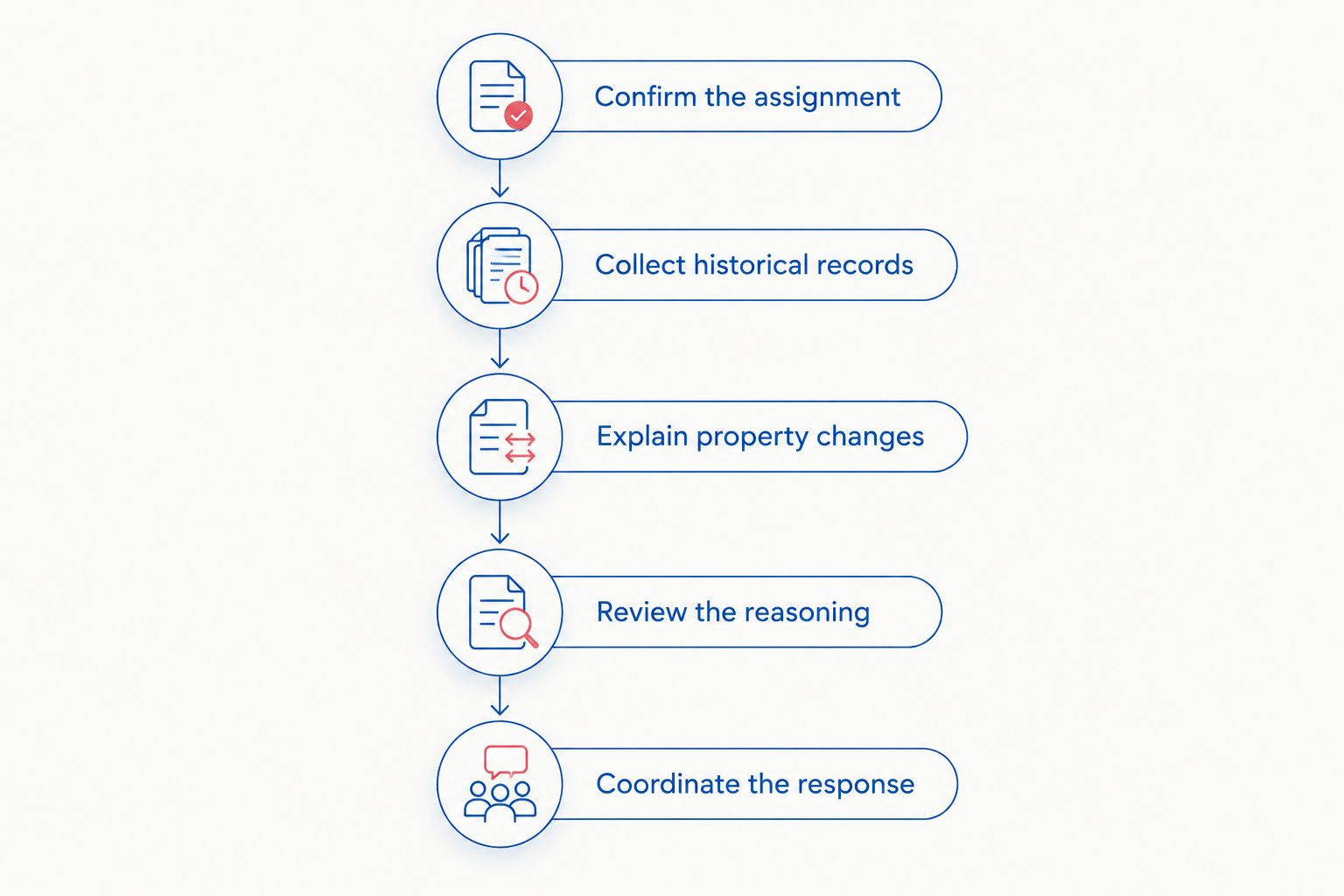
Use the following sequence to organize an estate-tax assignment or an appraisal-related audit response. For the broader commissioning process, see how to get a retrospective appraisal for an inherited property.
- Confirm the assignment. Have the attorney or CPA identify the valuation purpose, applicable date, intended users, and property interest. Share any IRS request affecting the appraisal scope.
- Collect historical records. Gather documents showing ownership, condition, occupancy, income, and expenses at the relevant time. Preserve dates and source information.
- Explain property changes. Identify renovations, damage, lease events, or ownership changes occurring after the effective date. Distinguish documented facts from recollections.
- Review the reasoning. Check factual descriptions and document references without directing the appraiser toward a target value. Ask how significant conflicting evidence is addressed.
- Coordinate the response. Let the attorney or CPA manage tax positions and submissions while the appraiser addresses valuation methods, evidence, and conclusions.
This sequence prevents a common mismatch: obtaining a technically detailed report that answers a different question from the one the estate needs resolved. Agree on the assignment before substantive valuation work begins.
Executor's document checklist
Organize the file into 3 record groups so the appraiser can identify gaps without confusing legal ownership, physical condition, and operating performance:
- Ownership records: Deeds, cooperative ownership documents where relevant, trust or estate documents, and agreements affecting the interest appraised.
- Condition records: Dated photographs, floor plans, inspection reports, renovation invoices, and correspondence documenting repairs or damage.
- Financial records: Historical leases, rent rolls, operating statements, real estate tax information, and relevant sale or listing documents.
Provide documents as evidence, not as instructions to reach a particular conclusion. If an executor cannot locate a record, identify the gap and ask what alternative sources can support the analysis.
REIS Group is suited to New York estate advisers who need real estate appraisals scoped to a historical date, ownership interest, and tax-reporting purpose. The firm brings over 30 years of experience; the assignment still requires property-specific evidence and clearly supported conclusions.
Discuss Your Appraisal Assignment
Identify the property, historical valuation date, ownership interest, and intended use.
Can a later sale establish the date-of-death value?
A later sale can provide relevant evidence, but it does not automatically establish date-of-death value. The appraiser must consider timing, transaction terms, property changes, and market changes before deciding how much weight it deserves.
A sale reviewed during a 2026 audit still needs to be connected to the applicable historical conditions. Neither ignoring the sale nor substituting its price without analysis resolves the valuation question.
Does a missing historical inspection invalidate the appraisal?
A missing inspection from the effective date does not automatically invalidate a retrospective appraisal. Historical records can help reconstruct the property's condition, but the report must identify the evidence used and explain significant limitations.
A present-day inspection has a different role: it helps document what exists now. The appraiser must explain how that observation relates to the historical condition being valued.
Who should respond when the IRS questions the value?
The attorney or CPA should coordinate the tax response, with the appraiser addressing the valuation analysis. Assign responsibility for each question so legal arguments, return positions, and appraisal explanations remain consistent without being conflated.
If an IRS request arrives in 2026, preserve the original report and supporting records. Discuss whether the issue calls for clarification, additional analysis, or a separately scoped assignment before commissioning a replacement report.
FAQ
Can an appraisal prepared years after a death support an IRS audit?
Yes, an appraisal prepared years after a death can support a historical valuation when its effective date, evidence, and analysis fit the assignment. The elapsed time can complicate record collection, but it does not by itself determine whether the conclusion is supportable.
Does the IRS have to accept a retrospective appraisal?
No, the IRS does not have to accept a retrospective appraisal merely because it was professionally prepared. The agency can examine the facts, methods, assumptions, and resulting value.
Is a property tax assessment enough for an estate-tax valuation?
A property tax assessment is not automatically a substitute for an estate-tax fair market value appraisal. Its valuation date, assessment rules, and property information need to be distinguished from the estate’s assignment.
Can I use today’s property condition for a date-of-death appraisal?
Today’s condition cannot simply be assumed to match date-of-death condition. Provide historical photographs, repair records, leases, and other evidence showing what existed at the effective date.
What should I send an appraiser after receiving an IRS request?
Send the relevant request, existing appraisal, property records, and the applicable valuation date through the estate’s attorney or CPA. Identify the questions under examination so the appraiser can propose an appropriate scope.
Does a fractional ownership interest need separate analysis?
A fractional ownership interest requires analysis of the actual rights and restrictions being valued. Multiplying whole-property value by an ownership percentage does not address every partial-interest valuation question.
Can REIS Group help with a Manhattan retrospective appraisal?
REIS Group provides retrospective and estate-related real estate appraisals for Manhattan and the greater New York City area. Discuss the property, ownership interest, effective date, and intended use to establish the assignment scope.
One last thing
A retrospective appraisal looks backward; it should not use hindsight uncritically. Information discovered later can help establish historical facts, but a later outcome is not automatically something a hypothetical buyer and seller would have known at the effective date.
Before requesting a proposal, prepare a short assignment summary identifying the property, interest, valuation date, purpose, and available records. Discuss your appraisal assignment with REIS Group so the proposed scope addresses the question your estate's advisers need answered.
Related guides
- Can a date-of-death appraisal be completed years after the death?
- Retrospective appraisal to amended estate-tax return workflow
- Partial-interest appraisal scope and cost considerations