Yes—a person named as executor can request a date-of-death appraisal before probate opens, but being named in a will does not by itself authorize that person to bind the estate. Before signing an engagement or using estate funds, have New York estate counsel confirm who can retain the appraiser, authorize property access, and approve payment.
- An executor order date of death appraisal request can begin before probate; authority to bind the estate is separate.
- New York counsel should confirm the engagement signer, property access, payment arrangements, and any court-issued authority.
- The effective date of value remains the date of death, even when inspection and reporting occur later.
- REIS Group provides retrospective real estate appraisals for New York executors, estate attorneys, and CPAs.
Why this matters
An estate's need for valuation information does not always align with the court appointment process. You can preserve property records and discuss an appraisal scope while counsel resolves who has authority to act.
Starting an appraisal inquiry is not the same as exercising an executor's powers. Keep those decisions separate, especially when relatives disagree about access, expenses, or the estate's administration.
For an assignment involving estate-tax reporting, start with REIS Group's date-of-death appraisal and Form 706 workflow. Tell the appraiser that probate has not opened so the engagement reflects the actual circumstances rather than an assumed appointment.
Can an executor order a date-of-death appraisal before probate opens?
Yes, but the engagement must identify the person retaining the appraiser and the capacity in which that person signs. In New York, nomination in a will and court-issued authority are different: a nominated executor should not represent that letters have been issued when they have not.
A person can discuss retaining an appraiser personally before appointment. Whether the estate will reimburse that expense, whether estate funds can be used immediately, and whether the person can authorize an inspection are separate questions for estate counsel.
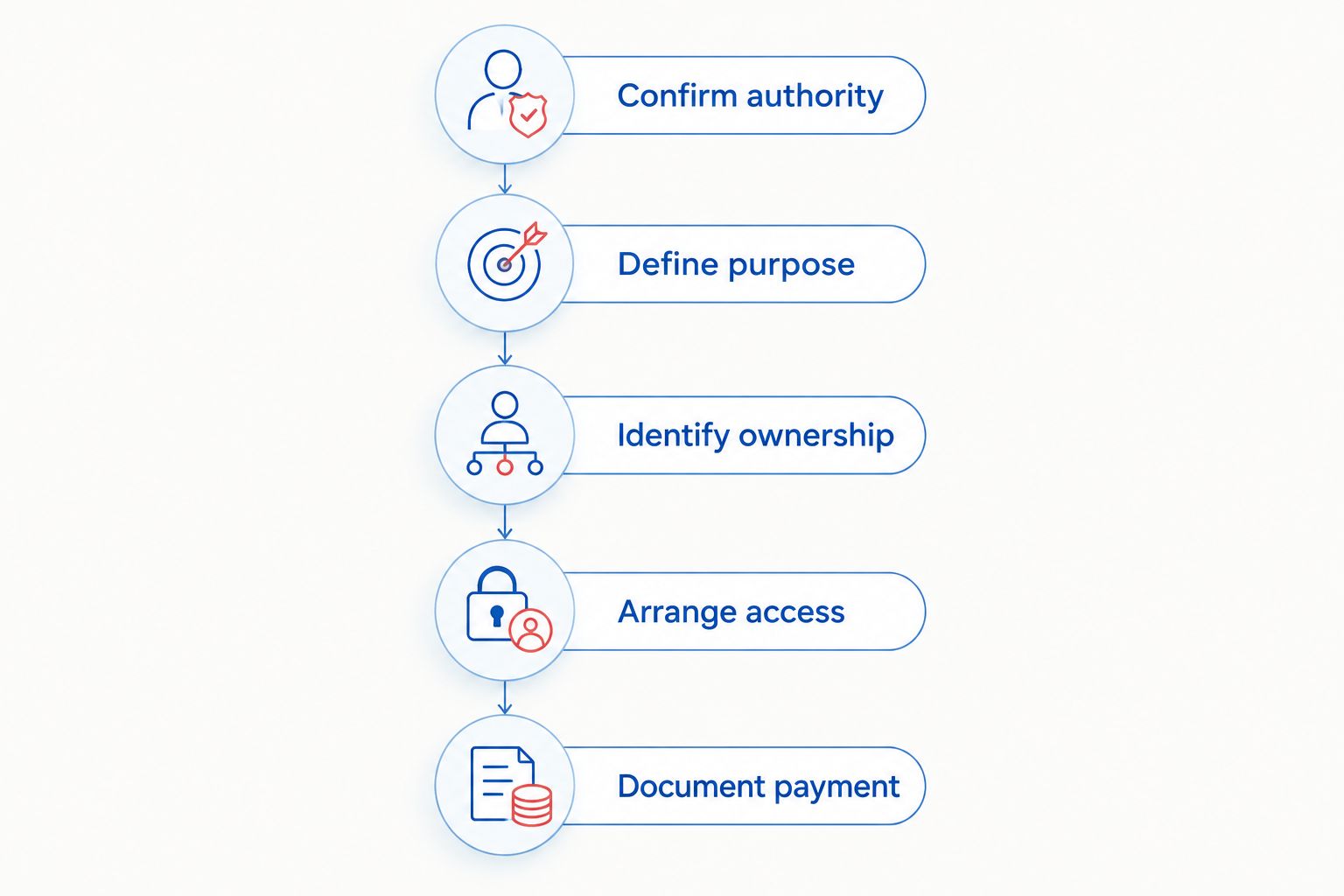
Use this sequence before committing to the assignment:
- Confirm authority. Give counsel the will, the status of any court filing, and any letters already issued. Ask who can sign the engagement now.
- Define purpose. Identify whether the report will support estate administration, estate-tax reporting, fiduciary accounting, or another stated use. Do not describe the assignment merely as an appraisal for the family.
- Identify ownership. Provide the deed or cooperative ownership documents and disclose trusts, entities, co-owners, or fractional interests. The interest being valued must match the assignment.
- Arrange access. Identify who lawfully controls entry and relevant records. A prospective appointment does not resolve an occupant's rights or another owner's interests.
- Document payment. State who is responsible for the engagement and payment. Ask counsel how any proposed estate reimbursement should be handled.
These steps apply to a 2026 engagement even when the valuation concerns an earlier death. The appraisal's effective date follows the assignment purpose, not the date someone first contacts the firm.
What can start before appointment, and what needs confirmation?
You do not need to treat every preparation task as an exercise of fiduciary authority. Gathering records already lawfully available to you is different from signing for the estate or directing an occupied property's inspection.
| Approach | Best for | Practical benefit | Limitation |
|---|---|---|---|
| Preliminary appraisal inquiry | A nominated executor clarifying scope | Identifies records, intended use, and engagement questions early | Does not establish authority to bind the estate |
| Personally retained appraisal | A person obtaining advice in an individual capacity | Allows a clearly identified individual client to commission work | Personal payment does not establish a right to estate reimbursement |
| Engagement by an authorized fiduciary | An estate ready to retain professional services | Aligns the signer with documented fiduciary authority | Authority, access, intended users, and payment still require clear documentation |
Do not use an informal family agreement as a substitute for confirming legal authority. Agreement among relatives can help with coordination, but it does not establish the signer's powers or settle the rights of absent interested parties.
If counsel is considering preliminary letters, ask counsel to explain the powers and restrictions that apply to the actual appointment. New York's Surrogate's Court Procedure Act Section 1412 addresses preliminary letters testamentary; it is not a blanket authorization for every person named in a will.
Which date should the appraiser use?
A date-of-death appraisal estimates the value of the specified property interest as of the decedent's death. The inspection date and report date can be later. This is a retrospective appraisal: the analysis looks back to conditions relevant to the effective date of value.
For example, an engagement signed in 2026 does not automatically call for a 2026 market value. Give the appraiser the actual date of death and have the attorney or CPA confirm the valuation date required for the identified purpose.
Keep these dates distinct:
- Effective date of value: The date to which the value conclusion applies.
- Inspection date: The date the appraiser observes the property, if an inspection forms part of the assignment.
- Report date: The date associated with issuance of the appraisal report.
A later inspection cannot, by itself, establish the property's earlier condition. Preserve dated photographs, repair records, leases, and other evidence that helps the appraiser distinguish conditions at death from later changes.
What should a New York executor prepare before calling?
Prepare a short assignment summary rather than waiting until every document is assembled. State the property address, date of death, ownership structure, probate status, intended use, and known deadline. Identify the attorney or CPA coordinating the valuation requirements.
For a 2026 inquiry, organize the available material into these groups:
- Authority records: The will, relevant court documents, and the proposed engagement signer's contact information. Let counsel determine what establishes authority.
- Ownership records: Deeds, cooperative ownership documents, trust information, or entity records relevant to the interest being appraised.
- Property records: Floor plans, surveys, renovation information, photographs, and descriptions of condition at death.
- Financial records: Leases, rent rolls, operating statements, and expense information for income-producing property.
- Access information: The person coordinating entry, occupancy status, and any known restrictions affecting inspection.
For a Manhattan cooperative apartment, explain that the asset is a cooperative interest rather than describing it as a condominium. For a mixed-use building, identify both residential and commercial occupancy. Those distinctions affect the records needed and the valuation analysis.
Do not delay the initial conversation because a record is unavailable. Identify the gap so the appraiser can explain its effect on scope, research, or the ability to support a conclusion.
Why pre-probate appraisal arrangements vary
The question is not simply whether probate has opened. The practical answer depends on the assignment and on the authority available to the proposed client.
- Appointment status: A person nominated in a will is not in the same position as a fiduciary holding applicable court-issued letters.
- Ownership structure: Individually owned property, trust-held property, entity interests, and jointly owned interests require different ownership questions.
- Intended use: Estate administration and estate-tax reporting must be identified before the report is scoped.
- Property type: Cooperative apartments, townhouses, and income-producing buildings require different records and analysis.
- Historical evidence: Changes after death make contemporaneous condition and income records important.
- Access and payment: Unresolved entry rights or uncertainty about the responsible payer can prevent an engagement from proceeding as proposed.
REIS Group has over 30 years of experience and provides estate, retrospective, residential, commercial, and partial-interest appraisal services. For pre-probate work, the useful starting point is the assignment's purpose and ownership interest—not a request for a generic property value.
Can the named executor pay personally and seek reimbursement later?
Personal payment can be documented in an individual engagement, but it does not establish that the estate must reimburse the expense. Ask counsel about authorization, documentation, and the treatment of the proposed expense before relying on reimbursement.
Make the engagement's payment terms match the actual arrangement. If you sign personally, do not assume that adding the estate's name transfers your contractual obligation to an estate that has not authorized the engagement.
Does the appraisal have to wait until the property can be inspected?
The inquiry and records review do not have to wait for an inspection. Whether the appraisal itself can proceed without immediate access depends on the property, available evidence, intended use, and a supportable scope of work.
Tell the appraiser if the property is occupied, access is disputed, or alterations have occurred since death. Do not promise access you cannot lawfully provide. The appraiser should determine how any inspection limitation affects the assignment.
Can one report support both probate and estate-tax needs?
One appraisal can support more than one identified use only when its scope and reporting are appropriate for those uses. Tell the appraiser about both purposes before engagement rather than assuming a report prepared for one purpose automatically fits another.
The attorney and CPA should coordinate the required effective date, property interest, value definition, and intended users. For a 2026 engagement, naming those requirements at the outset is more useful than requesting a report first and discussing its use afterward.
When should you pause before authorizing work?
Pause when no one can explain who is signing, who controls access, or who will pay. Also pause if the proposed instructions conflict with the ownership documents—for example, a request to value an entire property when the decedent held only a fractional interest.
A fractional interest is an ownership share rather than ownership of the whole asset. Its valuation requires analysis of the specific interest; it is not automatically the whole property's value multiplied by the ownership percentage.
Ask counsel and the appraiser to resolve the disputed instructions before substantial work begins. That protects the clarity of the assignment without assuming that every uncertainty requires waiting for the entire probate process to finish.
FAQ
Can I request an appraisal if I am named executor but have not received letters?
Yes, you can request an appraisal consultation before receiving letters. Tell the appraiser your appointment status, and have estate counsel confirm who can sign, authorize access, and approve payment.
Does being named executor let me sign an appraisal contract for the estate?
Being named executor in a will does not by itself establish authority to bind the estate. New York counsel should review your appointment status and the proposed engagement before you sign in a fiduciary capacity.
Can I pay for the date-of-death appraisal myself?
You can discuss retaining the appraiser personally, with payment obligations documented in the engagement. Personal payment does not establish a right to reimbursement from the estate; discuss that issue with counsel beforehand.
Will an appraisal ordered in 2026 show the property’s current value?
A date-of-death appraisal ordered in 2026 values the specified interest as of the date of death, not automatically at current value. The inspection and report dates can differ from that effective date.
What if the inherited property belongs to a trust?
Trust-held property requires confirmation of the relevant trustee’s authority and the interest being valued. Do not assume that a nominated executor controls a property simply because it is connected with the decedent’s estate planning.
Can an appraisal guarantee acceptance by the IRS or probate court?
No appraisal guarantees acceptance by a taxing authority or court. A properly scoped report supports its identified valuation purpose through analysis and documented conclusions, but it remains subject to review.
How soon can a pre-probate date-of-death appraisal be completed?
Turnaround depends on property type, complexity, records availability, and scope. Explain the actual deadline at the first inquiry; expedited availability must be confirmed individually.
One last thing
Preserve the property's historical evidence before you change its condition. Dated photographs, existing leases, repair records, and descriptions of deferred maintenance can help explain what existed at death after a property has been cleared, renovated, or re-let.
REIS Group provides date-of-death appraisal services for New York executors and professional advisers who need a retrospective real estate valuation. To discuss your appraisal assignment, provide the property address, date of death, ownership information, and probate status so the proposed scope addresses the right interest and purpose.
Related guides
- Date-of-death appraisal guide for New York executors and attorneys
- Preparing a retrospective appraisal for inherited property
- Estate appraisal and probate inventory filing workflow