Instead of reconciling an old property estimate against an estate return by hand, coordinate a retrospective appraisal, a documented reconciliation and your tax adviser’s filing review. This 2026 workflow connects REIS Group’s historical real estate valuation work with the attorney or CPA responsible for deciding whether and how to submit corrected estate tax information.
- For a retrospective appraisal amended estate tax return workflow, confirm the effective date and ownership interest before valuation begins.
- REIS Group provides retrospective real estate appraisals; your tax adviser determines the appropriate estate tax filing procedure.
- Reconcile the appraisal conclusion with the filed return before updating schedules or submitting supporting documents.
- Keep historical property evidence separate from later changes, and retain the final report with the filing record.
Why this matters
A retrospective appraisal estimates value as of a past date. An amended or supplemental estate tax submission addresses information previously reported. The appraisal supports a valuation conclusion; it does not, by itself, establish the correct filing procedure or a tax result.
REIS Group serves New York estate advisers who need retrospective real estate appraisals for estate tax reporting. For Manhattan and surrounding-area assignments, identifying the property, historical condition and ownership interest comes before selecting comparable transactions.
Start with the date-of-death appraisal guide for New York executors and attorneys if your immediate question is how to establish the historical valuation assignment. This workflow addresses the next problem: connecting that assignment to an already-filed return.
Before you start
- Assign 3 roles: the executor or authorized fiduciary supplies records and authorizes the assignment; the appraiser develops the valuation; the attorney or CPA controls tax treatment and filing decisions. Confirm who can share the filed return and receive the report.
- Gather the working file: the filed Form 706 and relevant schedules, any prior appraisal, ownership documents, property records, historical leases or operating statements, and correspondence concerning the reported value. Give the appraiser the property address, proposed effective date, intended use and intended users.
- Resolve the hidden scope issue: an appraisal of the entire property is not automatically an appraisal of the decedent’s partial interest. Ask the tax adviser to confirm the interest requiring valuation before commissioning work, especially where an entity or trust holds title.
For a 2026 engagement, record the actual historical valuation date separately from the current engagement date. Do not substitute today’s date merely because the report is being prepared now.
Assignment scope
The first configuration unit is the written engagement scope, not a tax-software screen. Field names differ across filing systems; the controlling information is the agreed assignment and the adviser’s current filing instructions.
- Identify the filing issue. Ask the attorney or CPA to describe what needs correction: an unsupported estimate, an omitted property, an incorrect ownership interest or another identified discrepancy. Provide the appraiser with the valuation question, not a target value.
- Confirm the effective date. The effective date of value is the date the appraisal conclusion describes. For a date-of-death assignment, identify the actual date of death; have the tax adviser resolve any proposed alternate valuation treatment before the scope is finalized.
- Define the property rights appraised. State whether the assignment concerns the entire real estate interest, a leased interest, a fractional interest or another specified interest. Supply deeds, entity agreements and relevant restrictions for review.
- State intended use and users. Explain that the report will support the identified estate tax matter. Identify the executor, attorney, CPA and other intended users as appropriate to the engagement.
- Confirm the deliverable. Ask for a report suited to the identified purpose, with the historical evidence, assumptions and analysis needed to understand its conclusion. Confirm the proposed scope and timing before authorizing work.
Expected result: a written assignment scope that names the property, interest, effective date, intended use and intended users. The appraiser and tax adviser should be addressing the same valuation question.
Historical evidence file
A retrospective appraisal needs evidence about the property as it existed on the effective date. Current access helps establish what exists now, but it does not independently prove the property’s earlier condition.
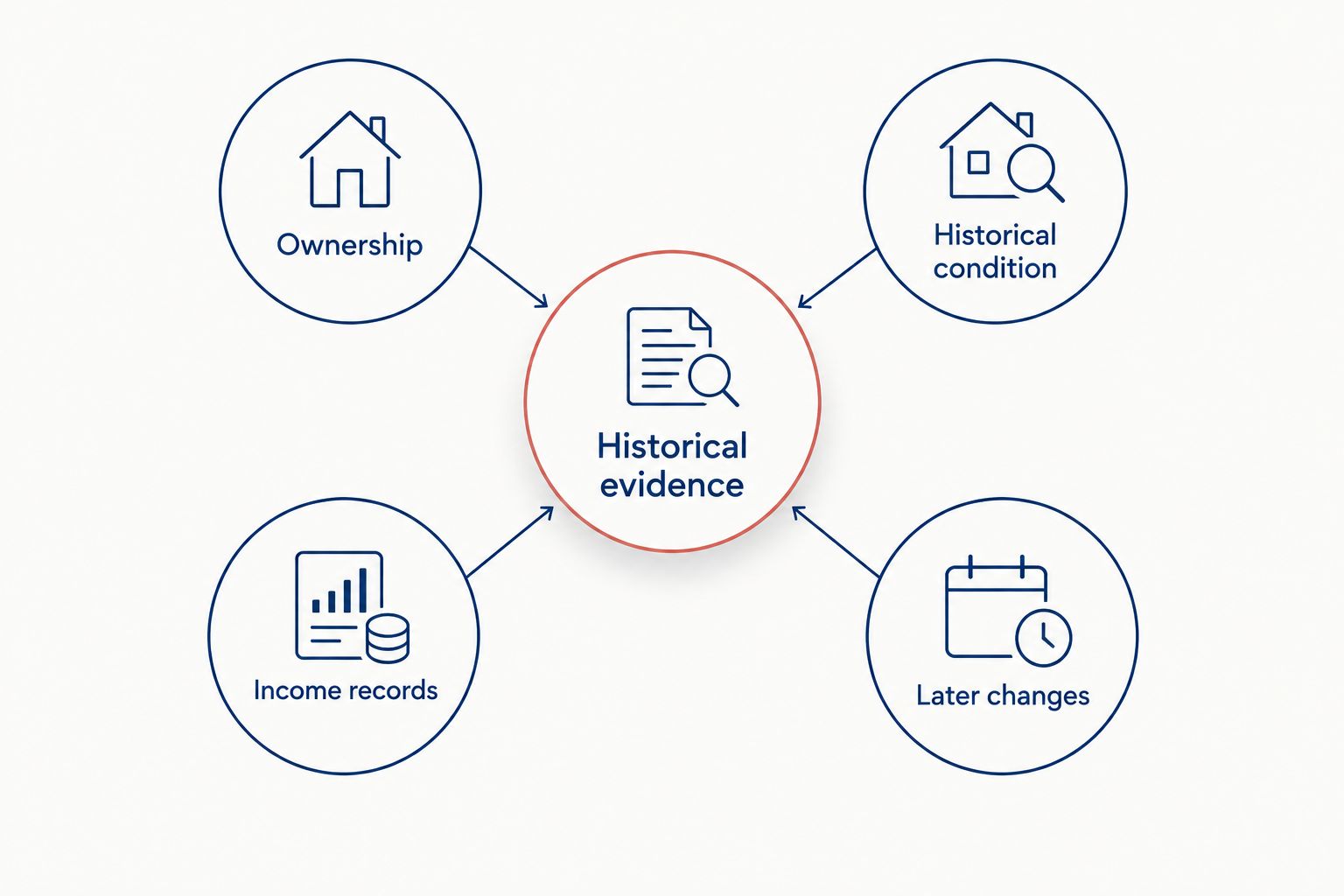
- Separate the evidence. Organize records under Ownership, Historical condition, Income records and Later changes. These are suggested folder labels, not required software fields.
- Document historical condition. Supply dated photographs, inspection reports, renovation records, floor plans and other relevant records. Identify the source of each item and explain any uncertainty about its date.
- Match income records to the period. For income-producing property, supply historical rent rolls, leases, operating statements, concessions and vacancy information relevant to the effective date. Do not present a current rent roll as a historical record.
- Flag later events. Identify renovations, damage, lease changes and sales occurring after the effective date. Let the appraiser determine their relevance rather than treating later facts as though they existed earlier.
- Log unresolved gaps. List missing documents and the people or institutions that hold them. Ask the appraiser which gaps affect the scope, assumptions or ability to complete the assignment.
Expected result: an evidence file that distinguishes historical facts from subsequent changes and makes each document’s source clear.
A Manhattan cooperative apartment and a commercial building require different supporting records. Give the appraiser the relevant property documents rather than forcing every assignment into the same checklist.
Report reconciliation
Review factual consistency without directing the value conclusion. An independent appraisal is not a mechanism for reaching the figure that produces a preferred tax outcome.
- Check the identifying facts. Compare the report’s address, legal description, ownership interest and effective date against the engagement and the estate records. Send factual corrections to the appraiser with supporting documents.
- Read the assumptions. Identify any assumptions concerning historical condition, occupancy, leases or unavailable records. Ask the appraiser to explain assumptions you do not understand before the report enters the filing package.
- Trace the conclusion. Confirm that you can distinguish the value of the entire property from the value of the particular interest appraised. Do not apply an additional fractional-interest adjustment without the appropriate valuation and tax review.
- Prepare a reconciliation. Put the previously reported value beside the appraisal conclusion and identify the affected property description and schedule. Explain the reason for the difference using documented facts, not an unsupported statement that the new figure is more accurate.
- Resolve revisions through the appraiser. Keep the final issued report intact. Do not edit its conclusion, effective date, signature pages or explanatory language within your office.
Expected result: a final appraisal and a separate reconciliation that the tax adviser can use to evaluate the return. Neither document should conceal what changed or why.
For a 2026 review, use 4 checkpoints before handoff: property identity, ownership interest, effective date and reported value. A mismatch in any checkpoint requires resolution, even when the arithmetic is correct.
Filing handoff
The attorney or CPA decides how the valuation affects the estate’s reporting obligations. Form 706 instructions and the estate’s circumstances govern the submission; an appraisal checklist does not replace that review.
- Provide the final materials. Send the issued appraisal, reconciliation, relevant source documents and prior filing information to the responsible adviser through the agreed secure delivery method.
- Identify related questions. Ask the adviser to consider effects on other reported assets, deductions, beneficiary information or state estate tax reporting where relevant. Do not assume that changing a property value changes only a single entry.
- Confirm the filing route. Have the adviser determine the appropriate amended or supplemental procedure, required explanations, attachments, signatures and delivery method under current instructions.
- Retain the submitted version. Preserve the actual filing package, submission evidence and appraisal version used. Keep any later correspondence with the same matter file.
Expected result: a traceable connection between the appraisal conclusion, the revised reporting and the materials actually submitted. The appraisal’s completion date is not proof that the estate’s filing obligations have been satisfied.
Second workflow: new evidence after the appraisal
Use a different handoff when relevant records surface after the report is issued. Examples include a previously unavailable historical lease or documentation clarifying the ownership interest; neither automatically means the value must change.
| Workflow | Best for | Advantage | Limitation |
|---|---|---|---|
| Initial retrospective assignment | A filed value requiring historical valuation support | Establishes a defined scope and evidence record | Requires historical records and adviser coordination |
| Appraiser review of new evidence | An issued report followed by relevant additional records | Lets the appraiser assess the evidence against the original assignment | Can require further analysis or a revised scope; a changed value is not automatic |
Send the new evidence to the appraiser with its source, date and relationship to the assignment. Ask whether it affects the analysis, assumptions or scope; do not overwrite the existing report yourself.
If the appraiser issues a revised report, have the tax adviser compare it with the version already used. Preserve both versions and the explanation for any change. This 2026 workflow keeps valuation review separate from the decision to submit additional tax information.
Troubleshooting
The current inspection shows a renovated property
Provide historical photographs, contracts and renovation dates. The appraiser needs to distinguish the effective-date condition from later improvements; a current inspection alone does not resolve that distinction.
The return lists an entity interest, but the report values real estate
Stop the reconciliation and confirm the asset being reported. An operating-business or entity-interest valuation is distinct from an appraisal of business-owned real estate, and additional professional work can be necessary.
The new conclusion differs substantially from the filed estimate
Ask for an explanation of the evidence, rights appraised, effective date and analysis. Do not ask the appraiser to narrow the difference for convenience; the adviser needs a supported explanation, not a negotiated figure.
Historical records are incomplete
Identify the missing records and their likely custodians before repeating document requests. Ask the appraiser how the gaps affect the scope and assumptions, and confirm whether the available evidence supports completing the assignment.
The filing timetable is tighter than the appraisal scope allows
Have the adviser address filing deadlines while the appraiser confirms the achievable assignment schedule. Turnaround depends on property type, complexity, records availability and scope; expedited availability requires individual confirmation.
Customize your workflow
For an attorney or CPA managing several estate properties, use a separate intake record for each property and a shared issue log. Record who owns each unresolved question and which document will resolve it.
The estate appraisal guide for estate attorneys provides related assignment context. For mixed estates, keep residential and commercial evidence requirements distinct while maintaining consistent ownership and effective-date instructions.
REIS Group scopes retrospective real estate appraisal assignments to the property, ownership interest, effective date and intended use. For a 2026 proposal discussion, provide those details with the property location and the adviser’s identified reporting question.
Discuss Your Appraisal Assignment
Describe the property, ownership interest, historical valuation date and estate tax reporting purpose.
FAQ
Can a retrospective appraisal support an amended estate tax return?
A retrospective appraisal can support the historical real estate value used in corrected estate tax reporting. The attorney or CPA determines the appropriate filing procedure and how the report fits the estate’s circumstances.
Is a retrospective appraisal the same as a date-of-death appraisal?
A date-of-death appraisal is a retrospective appraisal when it is prepared after the date of death. Retrospective describes valuation as of a past date; that date is not always the date of death.
What should I send before requesting an appraisal proposal?
Send the property address, ownership information, proposed effective date, intended use and relevant filing context. Include available historical records and identify the attorney or CPA coordinating the matter.
Can I use a current appraisal to correct a historical estate value?
A current-date value does not establish value as of a historical estate valuation date. Ask for an assignment with the correct effective date and evidence relevant to that date.
Does a new appraisal mean the estate should amend its return?
A new appraisal does not automatically establish that an amended or supplemental submission is appropriate. Your tax adviser must assess the difference, applicable procedures and the estate’s reporting circumstances.
What happens if I find another lease after the report is finished?
Send the lease to the appraiser for review before changing any reported value. The appraiser determines its effect on the assignment, and the tax adviser determines whether further reporting action is needed.
Does REIS Group guarantee acceptance of an estate appraisal?
REIS Group does not guarantee acceptance by a taxing authority or other third party. The appraisal is prepared to support the identified valuation purpose, and its conclusions remain subject to review.
One last thing
Keep 2 dates visible on the handoff sheet: the effective date of value and the report date. A report completed in 2026 can address an earlier valuation date; confusing those dates changes the question the appraisal answers.
Before requesting a proposal, confirm the ownership interest with the estate’s attorney or CPA. Then discuss the assignment with REIS Group using the historical date, property records and reporting purpose—not a requested tax result.
Related guides
- Retrospective appraisal services for estates
- Probate appraisal guide for executors and heirs
- Trust property appraisal guide for trustees