Commercial land appraisal cost in 2026 depends on the parcel, property rights, effective date of value, and work required; obtain a written, assignment-specific proposal rather than budgeting from a generic average. Confirm whether the quoted scope includes development analysis, historical research, and any additional consulting or testimony your assignment requires.
- Commercial land appraisal cost depends on the assignment scope, not acreage alone.
- Compare proposals using the same property rights, valuation date, intended use, and reporting requirements.
- REIS Group provides commercial real estate appraisals for property owners, businesses, and professional advisers.
- Resolve zoning, ownership, and document questions before requesting an appraisal proposal.
Why this matters
For a New York City commercial property owner, an appraisal proposal is a description of professional work—not simply a charge for producing a report. A vacant parcel intended for development presents different questions from land subject to a long-term ground lease.
Choose the scope before comparing fees. A proposal that excludes a necessary ownership-interest analysis or historical valuation date does not answer the same question as one that includes it.
REIS Group's appraisal services are scoped to the property, ownership interest, valuation date, intended users, and intended use. Start your inquiry with those details so the proposed assignment addresses the decision you actually need to make.
How much does a commercial land appraisal cost in 2026?
Commercial land appraisal cost is assignment-specific. The useful budgeting document is a written proposal identifying the parcel, valuation problem, research requirements, report, and any separately scoped services.
For a 2026 engagement, ask each appraiser to quote the same assignment. Comparing proposals without matching their assumptions turns a fee comparison into a comparison of different services.
The following distinctions help you read a proposal. These are scope differences, not fixed service tiers or published fee bands.
| Assignment scope | Best for | Work the proposal should address | Limitation to clarify |
|---|---|---|---|
| Current-date land appraisal | Owners making a present-day property decision | Current property rights, market evidence, and highest and best use | Does not establish value on an earlier date |
| Retrospective land appraisal | Owners or advisers needing a historical value | Property condition, rights, and market evidence as of the specified date | Historical records must support the analysis |
| Development-sensitive appraisal | Owners evaluating land with development considerations | Zoning, physical constraints, feasible uses, and relevant development assumptions | An appraisal does not replace engineering or legal advice |
| Partial-interest appraisal | Owners needing a specified fractional interest valued | Ownership documents, interest being appraised, and relevant restrictions | A whole-property value alone does not resolve the interest-level question |
A clearly defined assignment makes proposals easier to compare, but it also sets boundaries. Additional questions raised after engagement can require additional work. Ask how scope changes will be approved before authorizing the assignment.
What should the appraisal proposal identify?
A useful proposal lets you verify what you are buying without interpreting vague descriptions. Look for:
- Subject property: The address, parcel identifiers, and any adjoining lots included in the assignment.
- Property rights appraised: The legal interest being valued, including relevant leases or ownership restrictions.
- Effective date: The date to which the value conclusion applies.
- Intended use and users: The purpose of the report and the parties identified as intended users.
- Research and reporting: The analysis, inspection arrangements, documents, and report requirements.
- Additional services: Whether meetings, revisions beyond the agreed scope, or testimony require separate authorization.
Do not treat every exclusion as a defect. An exclusion is a problem when it removes work your intended use requires.
Why commercial land appraisal cost varies
Land appraisal involves more than finding a nearby sale and applying its price per square foot. The appraiser must determine which evidence is relevant to the rights and use being valued.
These factors explain why seemingly similar parcels can require different assignments:
- Property characteristics. Size, configuration, access, utilities, and physical constraints affect the investigation and comparison process.
- Zoning and highest and best use. A parcel with competing development possibilities requires analysis of which uses meet the applicable tests.
- Ownership and lease structure. Ground leases, easements, restrictions, and fractional ownership change the interest under consideration.
- Availability of comparable evidence. Relevant land transactions must be investigated and assessed for meaningful differences from the subject.
- Effective date and historical records. A retrospective assignment requires evidence tied to the earlier date, not simply today's market conditions.
- Intended use and assignment scope. Reporting requirements, complex valuation questions, and separately requested consulting affect the work involved.
Acreage alone is not a reliable basis for comparing appraisal proposals. A smaller Manhattan parcel with complicated rights can present a different valuation problem from a larger parcel with straightforward ownership and use.
For a 2026 proposal, describe the actual property problem rather than asking only for a fee based on the address. That gives the appraiser a basis for identifying necessary research before the engagement begins.
How highest and best use affects the assignment
Highest and best use is the reasonably probable use that is legally permissible, physically possible, financially feasible, and maximally productive. In plain English, the appraiser evaluates what the land can support and which qualifying use produces the highest value.
Your preferred development plan is not automatically the appraisal conclusion. A proposed use must be examined against the property's legal, physical, and market circumstances.
For commercial land, the assignment should distinguish existing permissions from assumptions about future approvals. If the analysis depends on a zoning change, an assemblage, or other conditions, those assumptions need clear treatment in the report.
This work has practical limits. An appraiser analyzes valuation implications; legal counsel addresses legal interpretations, and qualified technical specialists address matters such as environmental conditions or engineering feasibility. Clarify which supporting materials the appraiser expects you to supply.
How do you get a comparable commercial land appraisal proposal?
Give each prospective appraiser the same core instructions. A consistent request reduces the risk that one proposal addresses the whole property while another addresses a leasehold or a fractional interest.
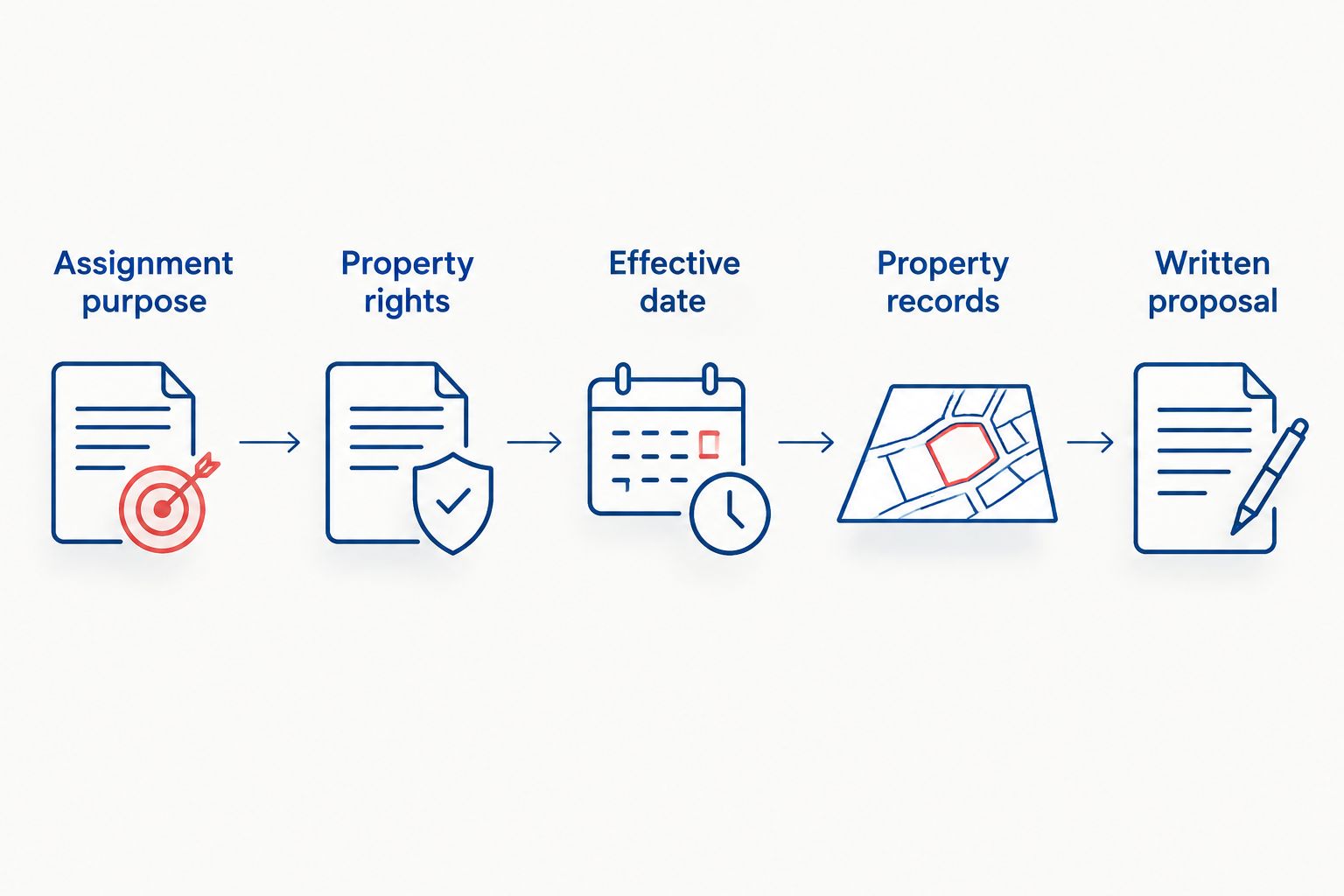
- Assignment purpose. Explain the decision the appraisal must support, such as a potential sale, ownership planning, or a dispute. Identify the intended users rather than describing the report as being for general purposes.
- Property rights. Identify the parcel and the ownership interest. Provide relevant leases, easements, restrictions, and ownership documents instead of assuming the appraiser will value unrestricted ownership.
- Effective date. State whether you need a current value or a value as of a specified historical date. Do not substitute the report delivery date for the effective date of value.
- Property records. Share the available survey, zoning materials, development plans, and transaction information. Flag missing records and unresolved questions at the outset.
- Written proposal. Request a description of the deliverable, required client materials, timing assumptions, and treatment of additional work. Compare these terms alongside the quoted fee.
If you are commissioning an appraisal in 2026 for a transaction or professional adviser, share any existing appraisal instructions before engagement. Requirements introduced after work begins can change the assignment rather than merely change the report's wording.
What documents should a commercial landowner prepare?
Prepare a single property file before requesting proposals. You do not need to resolve every issue yourself, but you should distinguish confirmed facts from plans, assumptions, and unanswered questions.
Ownership and parcel records
Provide the deed, available survey, parcel identifiers, and documents describing easements or restrictions. If several tax lots are involved, explain whether the intended assignment concerns them individually, together, or both.
A tax lot identifier does not by itself describe every relevant property right. Tell the appraiser about ground leases, shared access, or other arrangements affecting the land.
Zoning and development materials
Supply available zoning analyses, approved plans, applications, and relevant correspondence. Label proposed development materials as proposed rather than presenting them as existing entitlements.
For a Manhattan assignment, identify whether questions about development rights, adjoining parcels, or assemblage are part of the valuation problem. The appraiser needs that context to propose an appropriate scope.
Market and transaction information
Share relevant purchase agreements, offers, listing history, and prior reports available to you. These materials provide context; they do not dictate the appraiser's conclusion.
If the property produces income through a lease or other arrangement, provide the governing documents and relevant financial information. Vacant appearance does not necessarily mean the property has no contractual interests to analyze.
Does a retrospective land appraisal require a different scope?
A retrospective land appraisal establishes value as of a specified earlier date. It requires the appraiser to examine the property and market circumstances relevant to that date rather than substitute present-day evidence without analysis.
A report prepared in 2026 can have a historical effective date. The report date identifies when the report was prepared; the effective date identifies when the value applies.
Historical surveys, leases, photographs, plans, and property records help establish the relevant circumstances. Tell the appraiser about changes between the effective date and the present, including demolition, approvals, lease changes, or site alterations.
Do not order a current-date appraisal when the underlying purpose requires a historical value. Confirm the required date with the adviser directing the matter before commissioning the work.
Can a simpler report meet your needs?
A narrower assignment is appropriate only when it still answers the identified valuation question. Omitting necessary analysis does not make a proposal more efficient; it leaves the intended use unsupported.
Ask what the report will explain and which users it is prepared for. A short report and a longer report are not interchangeable merely because both contain a value conclusion.
REIS Group commercial real estate appraisal services suit owners and professional advisers who need an assignment tailored to a defined valuation purpose. The firm's scope-specific approach requires clear instructions and relevant records; it is not a substitute for resolving legal or technical questions outside the appraisal assignment.
REIS Group has over 30 years of experience. Its principal market is Manhattan and the greater New York City area, with nationwide assignments coordinated through its professional network.
FAQ
How do I find out the commercial land appraisal cost for my property?
Request a written proposal identifying the parcel, property rights, effective date, intended use, and report requirements. Provide the same instructions to each appraiser so the proposals describe comparable work.
Is a vacant commercial lot automatically simpler to appraise?
A vacant commercial lot is not automatically simpler to appraise. Zoning, development potential, access, ownership restrictions, and the available sales evidence still require analysis.
Does commercial land appraisal cost depend only on acreage?
Commercial land appraisal cost does not depend only on acreage. Property rights, highest and best use, historical research, and the assignment’s intended use also shape the work.
Can an appraisal prepared in 2026 establish a historical land value?
An appraisal prepared in 2026 can establish value as of a specified historical effective date. The appraiser must analyze evidence relevant to that date and distinguish historical conditions from subsequent changes.
Will the appraisal include testimony or meetings with my attorney?
Testimony and meetings should be addressed explicitly in the engagement scope. Ask whether they are included or require separate authorization before relying on the initial proposal.
Can I use a whole-property appraisal to value my fractional ownership interest?
A whole-property appraisal does not by itself establish the value of a fractional ownership interest. Identify the interest being valued and provide the relevant ownership documents when requesting the proposal.
How quickly can a commercial land appraisal be completed?
Turnaround depends on property type, complexity, records availability, and scope. Confirm the schedule individually, including any expedited availability, rather than assuming a fixed delivery date.
One last thing
The valuation date belongs in your proposal request, not just in the final report. Two otherwise similar assignments can answer different questions when their effective dates differ.
Before requesting a commercial land appraisal proposal, write a short instruction stating the property, interest, valuation date, intended users, and purpose. Then identify the records you have and the questions that remain unresolved.
Discuss your appraisal assignment with REIS Group to confirm the scope and request a proposal suited to your property and intended use.
Discuss Your Appraisal Assignment
Share the property, ownership interest, effective date, and intended use to request an assignment-specific proposal.
Related guides
- Commercial appraisal for property investors
- Commercial land appraisal firms in New York
- Midtown commercial real estate market trends