A business valuation timeline depends on the assignment’s purpose, ownership interest, complexity, and available records; there is no single completion period that applies to every engagement. The schedule must also allow for follow-up questions, any separately required real estate appraisal, and report review. Before committing to a deadline, ask the valuation professional to confirm the scope, required documents, and delivery expectations in writing.
- A business valuation timeline starts with a defined assignment, not an assumed turnaround.
- Operating-business valuation and appraisal of business-owned real estate answer different questions.
- REIS Group provides real estate appraisal and valuation consulting; confirm the scope of any operating-business assignment.
- For a 2026 engagement, separate the effective date of value from the report delivery deadline.
How long does a business valuation take?
A reliable completion estimate follows scope confirmation and document review—not the initial inquiry alone. For a CPA coordinating a client’s valuation, the useful question is whether the proposed schedule covers the actual assignment and its dependencies.
Start by identifying what needs to be valued. Review the available valuation services against the client’s purpose before requesting a delivery commitment.
| Assignment | What the analysis addresses | Scheduling dependency | Boundary to confirm |
|---|---|---|---|
| Operating-business valuation | An ownership interest in an operating enterprise | Business records and the agreed valuation scope | Whether separately appraised property is included or provided by another professional |
| Business-owned real estate appraisal | Specified rights in land, buildings, or other real property | Property records, access, market research, and assignment complexity | A property appraisal does not establish the value of the entire operating business |
| Partial-interest real estate valuation | A specified fractional ownership interest | Ownership documents, property information, and the interest being valued | The conclusion addresses the identified interest, not automatically the whole property |
These are different assignments, not interchangeable report formats. If a business owns a Manhattan building, the building appraisal and the operating-business valuation need coordinated instructions, but each retains its own scope.
Why this matters
An unclear request produces an unclear schedule. A CPA who asks only for a business valuation can receive a proposal that does not address a separately needed property appraisal, the correct ownership interest, or the intended recipient’s requirements.
REIS Group is a fit for CPAs coordinating New York City real estate appraisal assignments that require a clearly defined purpose, property interest, and effective date. Any operating-business valuation request requires separate confirmation of the firm’s applicable scope of practice.
For a 2026 assignment, define the deliverable before working backward from the client’s deadline. A report delivery date is useful only when everyone agrees on what that report must address.
What happens during the business valuation timeline?
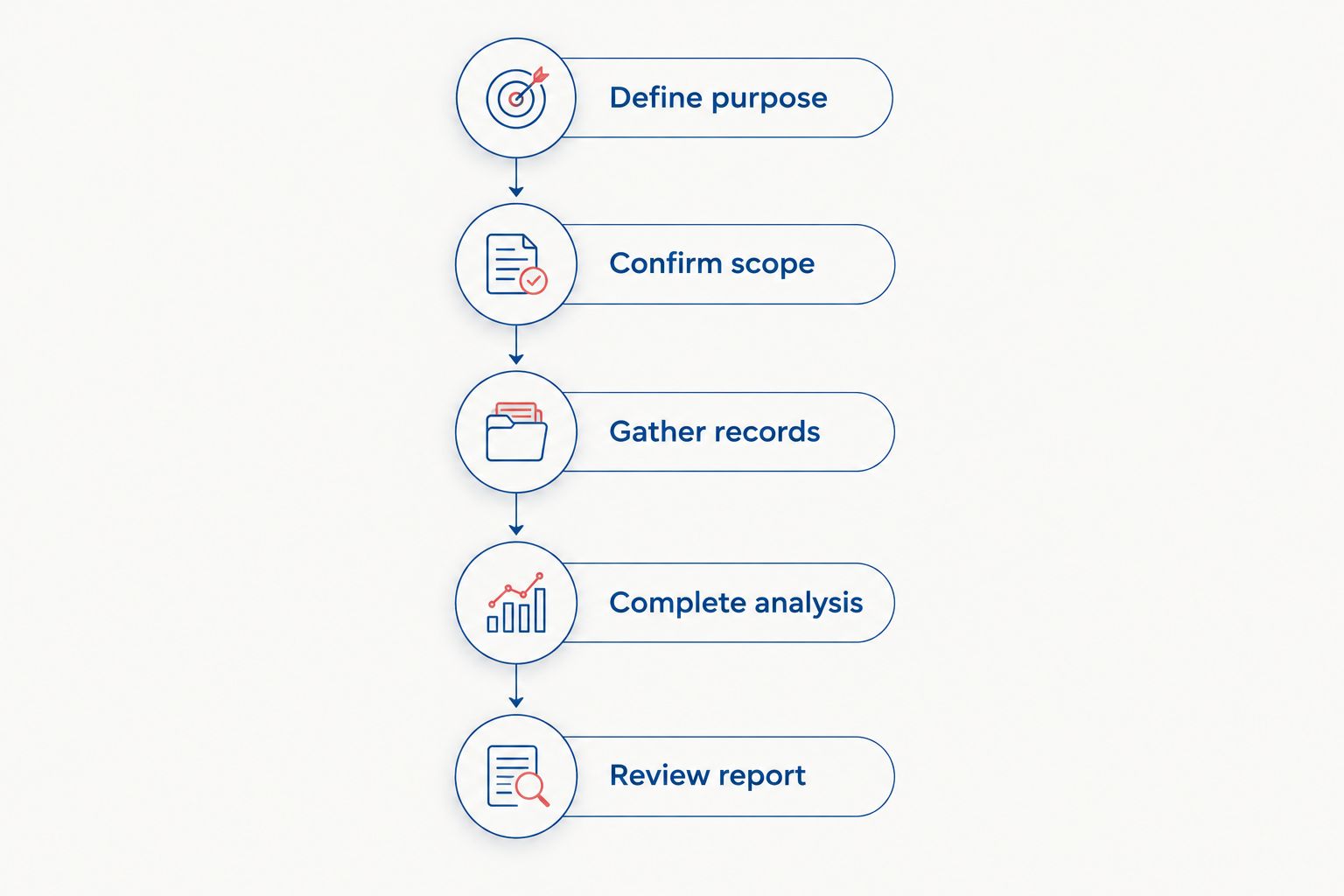
Use the following sequence to organize the engagement. These are coordination stages, not promised durations; the work within each stage depends on the assignment.
Define purpose
State why the client needs the valuation and who will use it. Sale planning, divorce, estate administration, and gift-related matters are distinct purposes; do not assume that a report prepared for one purpose addresses another.
Identify the ownership interest as precisely as possible. A request involving an entire business differs from a request involving a particular ownership interest or only business-owned real estate.
Confirm scope
Ask the professional to identify the subject, intended use, intended users, effective date of value, and reporting requirements. The effective date is the date to which the value conclusion applies—not necessarily the inspection date or the date the report is delivered.
Agree on responsibility for any supporting real estate appraisal. Resolve the boundary between the operating business and its property before accepting the schedule. Otherwise, a necessary supporting assignment can remain outside the original engagement.
Gather records
Request an assignment-specific document list. Depending on the scope, relevant records include business financial information, ownership agreements, property records, leases, and historical material needed to address an earlier effective date.
Identify the person responsible for each document request. A CPA can coordinate financial records while the owner or property manager supplies property information; assigning responsibility prevents unanswered requests from circulating between advisers.
Complete analysis
The valuation professional evaluates the information relevant to the agreed assignment and resolves material questions. For real estate, that work can include analysis of property rights, market evidence, income information, and highest and best use—the use that meets the applicable valuation criteria.
Keep a clear route for follow-up questions. An explanation of an unusual expense or a missing lease amendment is more useful than an unexplained file added to a shared folder.
Review report
Reserve time to check factual information and confirm that the report addresses the engagement instructions. Factual review is not an invitation to negotiate the value conclusion.
Ask how material corrections, newly supplied records, or changed instructions affect delivery. The professional should distinguish correcting an error from expanding the agreed assignment.
Which dates should a CPA confirm before engagement?
Keep 3 dates separate: the effective date of value, the document-submission date, and the requested report delivery date. Each answers a different question.
- Effective date of value: When does the value conclusion apply?
- Document-submission date: When will the requested information be available for analysis?
- Report delivery date: When does the client need the completed deliverable?
For example, a report commissioned in 2026 can address an earlier effective date. That makes it a retrospective assignment; the analysis must address the relevant historical conditions rather than simply substitute current information.
Do not treat a filing, negotiation, or hearing deadline as the agreed report delivery date. Give the valuation professional the external deadline and ask what delivery commitment fits the confirmed assignment.
Also identify who will review the report before its intended use. A CPA, attorney, and client can have different factual questions, so establish how comments will be consolidated and returned.
Why the business valuation timeline varies
The schedule follows the work required to reach and explain a supported conclusion. These factors deserve explicit discussion before the engagement begins:
- Property or business complexity. Different assets, operating activities, and real estate characteristics require different analysis. Describe the subject accurately rather than selecting a turnaround based on a broad service label.
- Records availability. Missing financial statements, ownership documents, leases, or historical property information create unresolved questions. Identify known gaps at the proposal stage.
- Ownership interest. A partial-interest assignment requires attention to the specific interest and relevant ownership documentation. Do not substitute a whole-property request without discussing the difference.
- Effective date. A retrospective appraisal needs evidence relevant to its historical date. Current documents alone do not resolve every historical question.
- Intended use and reporting scope. The report must address the identified purpose and users. Confirm these requirements before analysis begins rather than adding them during final review.
- Supporting assignments. A separately required real estate appraisal introduces its own scope, records, and coordination needs. Establish who commissions it and how its findings enter the broader engagement.
For 2026 planning, disclose known complications when requesting the proposal. A schedule based on incomplete instructions is not a useful basis for coordinating advisers.
Does business-owned real estate require a separate appraisal?
Business-owned real estate and the operating business are 2 distinct valuation subjects. Whether separate engagements are needed depends on the overall assignment, but the responsibilities and treatment of the property must be explicit.
A real estate appraisal addresses specified property rights as of an effective date. It does not, by itself, establish the value of the operating enterprise, its customer relationships, or every other business asset.
For a Manhattan owner-occupied property, tell the advisers who owns the building and which entity operates the business. Provide relevant occupancy and lease information so the professionals can determine what their respective analyses require.
The benefit of a separately scoped property appraisal is a clearly identified real estate conclusion. Its limitation is equally important: the broader business valuation still needs to address the business interest under its own instructions.
For engagement preparation, the business valuation guide for CPAs and accountants provides a related starting point. Confirm the actual services and responsibilities in the proposal rather than relying on a page title.
Can you shorten the timeline without weakening the assignment?
Improve the information handoff before asking for expedited delivery. A clear request helps the professional assess the work; it does not eliminate necessary analysis or guarantee a faster completion date.
Send a concise engagement summary containing:
- The client’s purpose and intended report users.
- The business, property, or ownership interest to be valued.
- The effective date and requested delivery date.
- The location and type of any business-owned real estate.
- The records already available and known missing items.
- The adviser authorized to resolve scope questions.
For a New York City property assignment, REIS Group scopes the work to the property, ownership interest, valuation date, and intended use. Expedited availability requires individual confirmation; do not assume that an urgent request establishes an accepted deadline.
Avoid sending a large, unorganized document collection without context. Label files clearly, identify revised versions, and explain discrepancies that you already know about.
What should a timeline proposal actually say?
A useful proposal explains the deliverable and the conditions supporting the schedule. It should leave you able to distinguish agreed work from additional requests.
Before authorizing the assignment, confirm:
- Subject and interest: What exactly is being valued?
- Purpose and users: Who will rely on the report, and for what use?
- Effective date: Which date governs the value conclusion?
- Required information: Which records or access arrangements remain outstanding?
- Delivery expectations: What schedule has the professional accepted, and what dependencies apply?
- Scope changes: How will changed instructions or newly identified work be addressed?
For a 2026 engagement, retain those instructions with the engagement correspondence. If the purpose changes, ask whether the existing scope still fits before circulating the report to additional recipients.
FAQ
How long does a business valuation take after I send the documents?
Document submission alone does not establish a completion date. The professional must assess whether the information is complete, resolve material questions, and complete the agreed analysis and report review.
Does the business valuation timeline start when I make an inquiry?
An inquiry does not by itself establish an agreed delivery schedule. Confirm the engagement scope, required information, and scheduling conditions with the valuation professional.
Is a business valuation the same as a commercial real estate appraisal?
A business valuation and a commercial real estate appraisal address different subjects. An operating-business valuation addresses a business interest, while a real estate appraisal addresses specified rights in property.
Can a valuation completed in 2026 use an earlier valuation date?
A valuation completed in 2026 can address an earlier effective date. A retrospective assignment requires analysis relevant to that historical date and the identified purpose.
Can I request an expedited valuation or appraisal?
You can request expedited delivery, but availability and the delivery commitment require individual confirmation. Provide the purpose, subject, effective date, available records, and external deadline when asking.
Does business-owned property automatically fall within the business valuation scope?
Business-owned property does not automatically establish what the engagement includes. Confirm whether a separate real estate appraisal is needed, who provides it, and how the business valuation will address the property.
What should my CPA send before requesting a proposal?
Your CPA should send an assignment summary identifying the purpose, intended users, ownership interest, effective date, requested deadline, and available records. Identify any business-owned real estate and known information gaps.
One last thing
An earlier effective date is not a request for an earlier report date. Keeping those concepts separate prevents a basic instruction error: requesting a current value when the client actually needs a historical conclusion.
Discuss your appraisal assignment with REIS Group and identify whether you need real estate appraisal, operating-business valuation within confirmed scope, or coordinated assignments. Request a proposal that addresses the specific interest, intended use, and delivery requirements.
Discuss Your Appraisal Assignment
Identify the property interest, effective date, intended use, and requested delivery date.
Related guides
- Commercial appraisal for property investors
- Business valuation for owners planning a sale
- Trust property appraisal for trustees