A commercial appraisal timeline depends on the property type, assignment complexity, records availability, and agreed scope; confirm the delivery schedule before you engage an appraiser. Inspection is only part of the assignment: document review, market research, valuation analysis, and report preparation also require time. For a New York City commercial property assignment in 2026, provide your deadline and intended use when requesting a proposal rather than treating the inspection date as the completion date.
- A commercial appraisal timeline depends on property complexity, available records, and the agreed scope—not just inspection scheduling.
- REIS Group provides commercial real estate appraisals tailored to the property interest, effective date, and intended use.
- Send leases, income records, ownership information, and your deadline with the appraisal request.
- Confirm expedited availability individually; a requested deadline is not a confirmed delivery commitment.
How long does a commercial appraisal take?
The useful answer is an assignment-specific delivery commitment, not a generic turnaround estimate. Before relying on a completion date, establish what the appraiser will value, which records are available, and what the finished report must support.
REIS Group's appraisal and valuation services are scoped to the property, ownership interest, valuation date, intended users, and intended use. Those details belong in your initial inquiry, especially when a financing, transaction, or legal deadline controls the schedule.
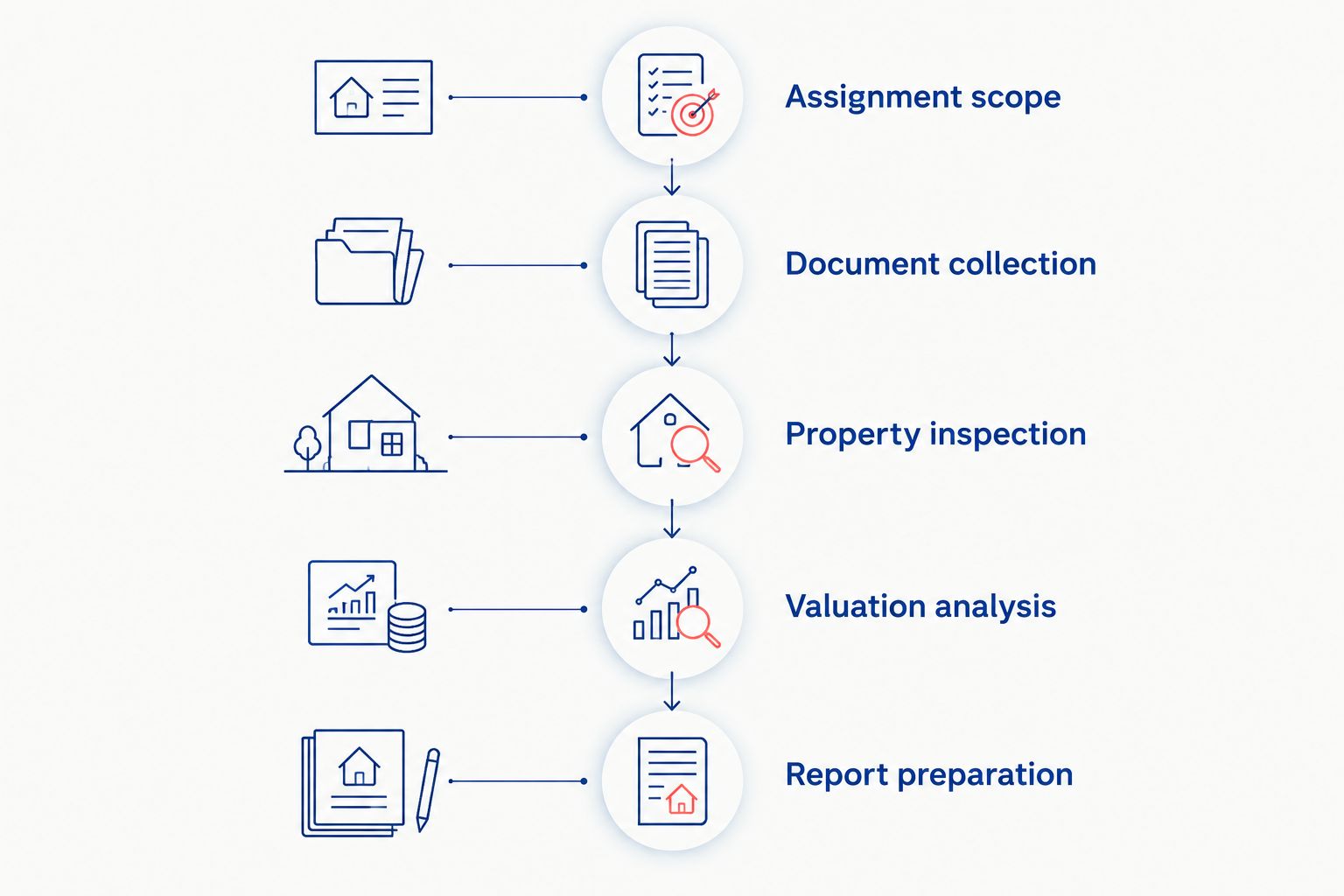
A commercial appraisal generally follows this sequence:
- Assignment scope. Identify the property, intended use, intended users, property rights, effective date, and reporting needs.
- Document collection. Assemble leases, rent rolls, operating statements, and relevant ownership and building records.
- Property inspection. Coordinate access and examine the property within the agreed scope.
- Valuation analysis. Research market evidence and apply the valuation methods appropriate to the assignment.
- Report preparation. Explain the evidence, assumptions, analysis, and value conclusion in the report.
Ask which activities can proceed together and which depend on information you have not supplied. A scheduled inspection does not establish that the remaining work is ready to begin.
Why this matters for commercial property owners
A commercial property owner needs a report that addresses the actual decision, not simply a document delivered before a calendar deadline. If the appraisal addresses the wrong ownership interest or effective date, timely delivery does not resolve the underlying problem.
For a 2026 assignment, distinguish the date you need the report from the date the value must reflect. The effective date of value is the date to which the valuation conclusion applies; the delivery date is when you receive the report. They serve different purposes.
Define the intended use just as carefully. An appraisal prepared for an owner's internal planning does not automatically address another party's lending or litigation requirements. Identify any expected reliance by a lender, attorney, accountant, or other adviser before the engagement is finalized.
What to send before requesting a delivery date
You do not need to solve every valuation issue before contacting an appraiser. You do need to describe the assignment clearly enough for the appraiser to assess its scope and identify missing information.
Start with the following checklist:
- Property identification: Street address, property type, building configuration, and available property records.
- Ownership interest: Whether the assignment concerns the entire property or a partial interest, with relevant ownership documents.
- Assignment purpose: The decision, proceeding, or reporting need the appraisal must support.
- Required dates: Your requested delivery date and the effective date of value, if already established.
- Income information: Current rent roll, leases and amendments, operating statements, and available expense records.
- Property information: Available plans, renovation history, known condition issues, and inspection access arrangements.
- Intended users: The people or organizations expected to rely on the report.
Label unavailable items rather than leaving the appraiser to discover the gaps later. Explain whether a missing lease is being retrieved, whether a tenant controls access, or whether historical records are held by a former manager.
For your 2026 request, send a clear document index with the files. Distinguishing current records from superseded versions helps the appraiser understand what each document represents without assuming that the newest upload contains the governing information.
How assignment types affect the work
Different commercial appraisal assignments require different evidence. The distinction is not a promise that one category will finish faster; it identifies the work that must be considered when setting the schedule.
| Assignment | Best suited to | Evidence and analysis | Scheduling constraint |
|---|---|---|---|
| Current-date property appraisal | Owners needing a current real estate value conclusion | Current property information, relevant market evidence, and applicable valuation approaches | Access and current records must match the assignment scope |
| Retrospective property appraisal | Owners or advisers needing value as of an earlier effective date | Historical property condition, tenancy, income, and market evidence | Earlier records must be located and evaluated |
| Partial-interest valuation | Owners or advisers valuing a specified fractional ownership interest | Property value analysis and the rights and restrictions of the interest | Ownership documents and assignment boundaries require careful review |
The benefit of matching the assignment to its purpose is relevance: the report addresses the identified valuation question. The limitation is that a report prepared for one purpose does not automatically answer a different question.
A historical effective date, for example, changes the evidence the appraiser needs. A current inspection alone cannot establish the property's condition or tenancy at an earlier date. Similarly, valuing a partial interest requires attention to the interest itself, not just the building.
Why a commercial appraisal timeline varies
The schedule depends on identifiable assignment conditions. These factors deserve discussion before a delivery date is agreed:
- Property type. A multifamily building, office property, retail property, and mixed-use building present different operating and market questions.
- Assignment complexity. Unusual property characteristics, ownership interests, or highest-and-best-use questions affect the required analysis.
- Records availability. Missing leases, incomplete operating statements, and unavailable historical records create information dependencies.
- Inspection access. Access arrangements determine when the appraiser can examine the areas included in the agreed scope.
- Intended use and scope. The purpose, intended users, property rights, effective date, and reporting requirements shape the assignment.
Do not treat a short inspection as evidence of a short appraisal assignment. The visible site visit is different from the research and reasoning needed to support the conclusion.
Highest and best use means the reasonably probable use that meets the applicable legal, physical, financial, and productivity tests. If the assignment requires examination of a use different from the property's existing use, raise that issue at engagement rather than after the report is underway.
How to keep the assignment on schedule
Your strongest contribution is making reliable information and access available. Asking for speed does not substitute for defining the work.
Establish the deadline and its purpose
Explain what happens on the requested date. A report needed for an owner's meeting presents a different coordination question from a report intended for submission to another party.
Tell the appraiser whether your deadline is fixed or preferred. Ask for confirmation of the delivery commitment and any conditions attached to it, including records receipt and inspection access.
Reconcile the operating records
Provide the rent roll together with the leases and amendments that explain it. Identify known differences between billed rent, collected rent, concessions, vacancies, and the figures shown in operating statements.
You are not being asked to perform the appraisal. You are helping the appraiser identify which records describe the property and which figures require clarification.
Coordinate building access
Identify the person authorized to arrange entry and explain any access restrictions. Where tenants, managers, or building staff control entry, establish who will coordinate the inspection.
Ask the appraiser what access the scope requires. Do not assume that entry to a lobby or common area satisfies every inspection need.
Keep changes visible
Tell the appraiser promptly about changes to the intended use, ownership interest, effective date, or requested report recipients. A revised assignment is not simply an administrative edit.
For a 2026 engagement, keep the agreed scope and subsequent changes together in your correspondence. That record helps everyone distinguish the original request from later instructions.
Can you get a commercial appraisal faster?
Expedited availability must be confirmed individually. Ask whether the requested deadline is achievable for the specific property and scope, and identify the records and access you can provide immediately.
The practical advantage of an expedited arrangement is a schedule aligned with an urgent need. Its limitation is that urgency does not eliminate the analysis needed to support the identified valuation purpose.
REIS Group serves New York City commercial property owners who need purpose-specific real estate appraisals. Discuss expedited availability directly; do not infer a delivery commitment from general service information or the availability of an inspection appointment.
Does the appraisal finish when the inspection ends?
The commercial appraisal does not finish when the inspection ends. Market research, income analysis, reconciliation of valuation evidence, and report preparation remain distinct parts of the assignment, although some work can occur before the site visit.
Ask what remains outstanding after inspection. If the appraiser still needs lease amendments or clarification of operating expenses, supply those items through the agreed point of contact rather than assuming that access was the final dependency.
Does business-owned real estate require a business valuation?
An appraisal of business-owned real estate is not the same assignment as an operating-business valuation. Property ownership by a company does not, by itself, define which assets or interests the valuation must cover.
State whether you need the real estate, an ownership interest, the operating business, or separately defined assignments valued. The commercial appraisal guide for property investors provides related context for identifying the real estate appraisal need.
What should your appraisal proposal confirm?
Before authorizing the assignment, confirm the property's identity, the rights to be appraised, the intended use and users, and the effective date. Review the scope, report requirements, requested records, access arrangements, and delivery commitment together.
Ask how the appraiser will communicate unresolved information requests and changes affecting the schedule. A useful proposal establishes responsibilities; it does not merely name a completion date.
For a 2026 commercial property assignment, identify any external review separately from the appraiser's report delivery. Receiving the report and obtaining acceptance from a lender, court, taxing authority, or other recipient are different events. No appraisal guarantees that acceptance.
FAQ
How long will my commercial appraisal take?
Your commercial appraisal timeline depends on the property type, complexity, records availability, and agreed scope. Obtain an assignment-specific delivery commitment before relying on a completion date.
What documents should I send to a commercial appraiser?
Send the property address, assignment purpose, requested dates, ownership information, available leases, rent roll, and operating statements. The appraiser will identify additional records needed for the specific scope.
Can I request an expedited commercial appraisal?
You can request expedited scheduling, but availability must be confirmed individually. Provide your deadline, available records, and access arrangements so the appraiser can assess the request.
Is the property inspection the final step?
The property inspection is not the final step in a commercial appraisal. The assignment also includes relevant research, valuation analysis, and preparation of the report.
Will a retrospective appraisal need different records?
A retrospective appraisal requires evidence relevant to the earlier effective date. Historical leases, operating records, and information about the property’s condition help establish what existed at that time.
Can REIS Group appraise commercial property in New York City?
REIS Group provides commercial real estate appraisal and valuation consulting services in Manhattan and the greater New York City area. Assignments are scoped to the property, ownership interest, effective date, intended users, and intended use.
Does a finished appraisal guarantee lender or court acceptance?
A finished appraisal does not guarantee acceptance by a lender, court, taxing authority, or other third party. Identify the intended users and applicable assignment requirements before engagement.
One last thing
The most useful scheduling question is not simply when the report will arrive. Ask: What information or decision is still needed before the delivery date can be confirmed? That question turns a general timing discussion into an actionable assignment plan.
For a commercial property appraisal in Manhattan or the surrounding New York City area, Discuss Your Appraisal Assignment with REIS Group. Provide the property address, intended use, ownership interest, requested effective date, and deadline to support a scope-specific proposal.
Related guides