Instead of repeatedly reconciling appraisal reports with estate return worksheets, establish a date-of-death appraisal–to–IRS Form 706 workflow that fixes the valuation date, ownership interest, and reporting purpose before the assignment begins. For New York City estate attorneys, CPAs, and executors handling a 2026 filing, the practical sequence is to scope the appraisal, assemble historical evidence, review the report, and transfer the supported conclusion to the return preparer.
- For a date of death appraisal IRS Form 706 workflow, confirm the effective date and property rights before engagement.
- REIS Group provides retrospective real estate valuations for New York City estate advisers and executors.
- The appraiser develops the valuation; the estate attorney and CPA determine tax treatment and return placement.
- Historical leases, ownership records, and property-condition evidence connect the appraisal to the estate filing.
Why this matters
A supported value for the wrong date or ownership interest does not answer the estate's assignment. A current inspection does not turn a retrospective appraisal into a current-value assignment, and ownership of an entire building differs from ownership of an interest in an entity that holds it.
REIS Group's date-of-death appraisal service is suited to New York City estate advisers who need retrospective real estate valuations. Start with the estate appraisal guide for estate attorneys to connect the valuation request with the estate team's responsibilities.
For a 2026 engagement, use a written handoff rather than scattered emails. The appraiser needs a defined valuation problem; the return preparer needs a conclusion that can be traced to the correct asset and supporting report.
Before you start
- Assignment authority: Identify the executor or authorized representative, the estate attorney, the return preparer, and the people authorized to provide records and property access. Establish how sensitive documents will be transmitted.
- Core materials: Gather the property address, date of death, ownership documents, available property records, and the filing timetable. Identify missing leases, financial statements, or historical photographs before agreeing on scope.
- The gotcha: Confirm what the decedent actually owned. Direct real estate, jointly owned property, cooperative shares, and an entity interest require different reporting analysis; a building appraisal alone does not resolve every ownership question.
Do not wait for a completed report to clarify these points. Ask the estate attorney and CPA to resolve tax elections and ownership questions while the appraiser defines the valuation assignment.
Assignment scope
- State the intended use. Explain that the appraisal will support estate tax reporting and identify the intended users. Include any separate probate, trust administration, or dispute-related purpose rather than assuming one report automatically addresses all uses.
- Confirm the effective date. The effective date is the date to which the value conclusion applies. For a date-of-death assignment, identify that date explicitly and distinguish it from the inspection date and report date.
- Identify the property rights. Provide deeds, ownership percentages, leases, and relevant entity or co-ownership documents. Ask the appraiser to state the rights appraised rather than describing the assignment simply as the property's value.
- Agree on the report scope. Identify the property type, available records, inspection arrangements, necessary research, and intended delivery process. Ask how missing historical information will be addressed and disclosed.
Expected result: You have written assignment instructions connecting the asset, ownership interest, effective date, intended use, and intended users. The estate attorney and CPA can identify unresolved reporting questions before valuation work proceeds.
For fractional ownership, distinguish the value of the whole property from the value of the interest being reported. The partial-interest appraisal resource for estates provides context for that separate assignment question. Do not instruct an appraiser to apply an assumed discount or transfer a percentage mechanically into the return.
Historical records
- Create an asset record. Use the same property identifier across the engagement instructions, document folder, appraisal report, and return workpapers. Include the street address and legal ownership description; an address alone does not establish the interest owned.
- Separate historical evidence from current evidence. Label each document with its relevant period. A current photograph can show today's condition without proving what existed on the valuation date.
- Assemble property-specific materials. For income-producing property, provide leases, rent rolls, operating statements, vacancy information, and known restrictions relevant to the effective date. For residential property, gather floor plans, renovation records, condition evidence, and applicable cooperative or condominium documents.
- Record gaps and changes. List renovations, casualty damage, tenancy changes, or other material events occurring between the effective date and inspection. Explain who supplied each statement and identify supporting documents where available.
Expected result: The appraiser can distinguish documented historical conditions from present conditions and unsupported recollections. The estate team also has a record of what was provided and what remains unresolved.
For a 2026 inspection supporting an earlier effective date, do not replace unavailable records with assumptions presented as facts. Tell the appraiser what cannot be located. The report should explain material assumptions and limitations relevant to the assignment, rather than leaving the return preparer to infer them.
Report review
- Check the assignment identifiers. Compare the report's property description, effective date, property rights, intended use, and intended users with the engagement instructions. Flag discrepancies before anyone transfers a value to the return.
- Review the factual inputs. Confirm that ownership records, lease information, reported building characteristics, and historical condition evidence were conveyed accurately. Separate a factual correction from disagreement with the appraiser's independent judgment.
- Locate the supported conclusion. Identify the final value conclusion and the interest to which it applies. Do not substitute an intermediate calculation, a whole-property indication, or a figure quoted from background material.
- Resolve questions in writing. Ask the appraiser to address missing explanations or factual errors through the appropriate clarification or revised report. Preserve the final version and clearly distinguish it from superseded drafts.
Expected result: The estate team has a final report that answers the identified valuation question, with unresolved issues brought to the appropriate adviser. Review improves consistency; it does not convert the appraisal into a guarantee of acceptance by a taxing authority.
REIS Group prepares real estate appraisal assignments around the property interest, effective date, and intended use. The estate attorney and CPA remain responsible for determining the applicable tax treatment and whether additional valuation work is needed.
Return handoff
- Create a transfer worksheet. Record the asset identifier, report filename, effective date, rights appraised, final conclusion, and the report location supporting that conclusion. Keep any tax adjustments separate from the appraiser's stated value.
- Confirm return placement. The preparer should consult the applicable IRS Instructions for Form 706, including Schedule A—Real Estate and, where relevant, Schedule E—Jointly Owned Property. Do not assume every real-estate-related asset belongs on Schedule A.
- Reconcile the reported interest. Have the attorney or CPA confirm how ownership, inclusion rules, and any applicable elections affect the amount reported. A whole-property valuation is not automatically the amount includible in the gross estate.
- Preserve the filing record. Retain the final appraisal, supporting workpapers, correspondence resolving material questions, and the filed return version under the estate team's retention procedures. Follow the applicable instructions for attachments and explanations.
Expected result: The return preparer can trace the reported amount to the correct asset, appraisal conclusion, and tax analysis without reconstructing the assignment from email.
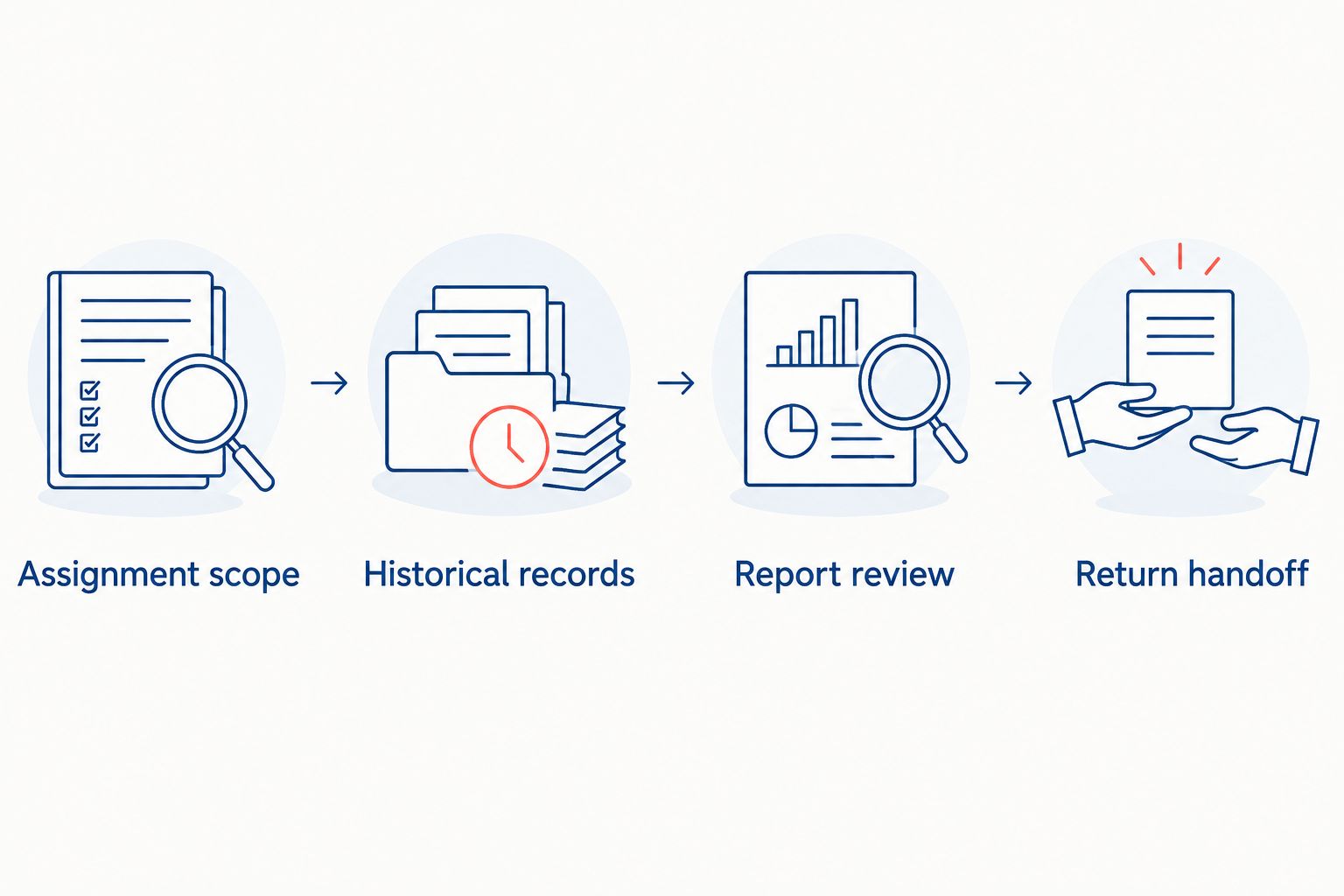
This workflow has four connected stages: Assignment scope, Historical records, Report review, and Return handoff. Each stage produces information the next stage needs; unresolved ownership or date questions belong at the beginning, not in a last-minute filing reconciliation.
Variant: when the estate considers alternate valuation
A date-of-death appraisal and an alternate valuation assignment are not interchangeable. For 2026 planning, the estate's tax advisers must determine whether the election is available and appropriate before commissioning additional effective-date work.
Under Internal Revenue Code Section 2032 and the IRS Instructions for Form 706, alternate valuation generally uses a date 6 months after death for property retained through that period, with separate rules for property disposed of earlier. Eligibility generally requires reducing both the gross estate's value and the estate and generation-skipping transfer taxes payable.
| Valuation basis | Best suited to | Practical benefit | Limitation |
|---|---|---|---|
| Date-of-death valuation | Establishing value at death under the general rule | Connects the conclusion to a defined historical date | Does not measure subsequent market changes |
| Alternate valuation | Estates whose tax advisers confirm eligibility and election requirements | Addresses the permitted alternate valuation framework | Requires separate date analysis and is not available merely because one asset declined |
If the estate considers this variant, send the appraiser written instructions identifying the additional effective date and relevant disposition information. Preserve separate conclusions with clear labels. Do not overwrite the date-of-death value or select a lower figure without the preparer's election analysis.
Troubleshooting
The report uses the inspection date as the effective date
Compare the engagement instructions with the report's stated dates. If the assignment required a retrospective conclusion, ask the appraiser to resolve the discrepancy; changing a worksheet label does not correct the underlying analysis.
The estate owns an entity interest, but the report values the building
Send the ownership documents to the estate attorney and valuation professionals. Determine whether the assignment also requires entity-interest valuation work, and distinguish operating-business valuation from appraisal of business-owned real estate.
Historical rents or property conditions are missing
Search the owner's records, property manager's files, lease correspondence, and available contemporaneous documentation. Identify the remaining gaps to the appraiser rather than treating current rents or current condition as historical facts.
The filing deadline arrives before the appraisal is complete
Ask the CPA or attorney to manage filing and payment obligations immediately. IRS guidance generally sets the Form 706 filing deadline at 9 months after death and provides a 6-month filing extension through Form 4768; extending filing time does not automatically extend payment time.
Different report versions show different conclusions
Identify the final signed report and document why any revision occurred. Reconcile the return workpapers against that version, not an earlier email, draft, or preliminary discussion.
Customize your workflow
For a 2026 estate administration file, assign an owner to each handoff: the executor supplies records, the attorney resolves legal ownership questions, the appraiser develops the valuation, and the CPA or other preparer manages return reporting. Adjust these responsibilities to the actual engagement rather than assuming every estate team has the same structure.
Expand the document request for mixed-use buildings, restricted interests, or incomplete historical records. Ask REIS Group to discuss the property type, ownership interest, effective date, and intended use before requesting a proposal. Turnaround depends on complexity, records availability, and scope; expedited availability requires individual confirmation.
Discuss Your Appraisal Assignment
Define the property interest, effective date, and records needed for your estate valuation.
FAQ
What is a date-of-death appraisal for IRS Form 706?
A date-of-death appraisal develops a property’s value as of the decedent’s death for the identified estate reporting purpose. The assignment should specify the property rights, intended use, and intended users.
Can an appraiser inspect the property after the date of death?
Yes. A retrospective appraisal can use a later inspection while developing a conclusion for the historical effective date. The appraiser must distinguish current observations from evidence of conditions at that earlier date.
Does every estate need to file IRS Form 706?
No. The estate’s tax adviser determines filing requirements and whether filing is appropriate for an election such as portability. Needing an appraisal for estate administration does not itself establish a Form 706 filing requirement.
Does every property appraisal go on Schedule A?
No. Return placement depends on the asset and ownership structure, not simply whether real estate underlies its value. Joint ownership, cooperative shares, and entity interests require the preparer’s separate analysis.
Can the executor use a current appraisal instead?
A current-value conclusion does not establish value at death. Tell the appraiser the required effective date before engagement so the analysis addresses the estate’s actual reporting purpose.
Will an appraisal guarantee IRS acceptance?
No appraisal guarantees IRS acceptance or a particular tax outcome. A clearly supported report documents the analysis for the identified assignment, while the estate’s advisers address return preparation and tax treatment.
What should I send REIS Group to discuss an estate appraisal?
Provide the property address, date of death, ownership information, intended use, and filing timetable. Identify available historical records and any known ownership or condition issues so the assignment can be scoped appropriately.
One last thing
The most useful final check is not whether two documents show the same number; it is whether they describe the same interest on the same effective date. A matching figure can conceal a mismatch between whole-property value and the interest reported by the estate. Before your 2026 handoff, compare those descriptions side by side, then discuss any remaining assignment questions with the appraiser and tax advisers.
Related guides
- Probate appraisal for executors and heirs
- Trust property appraisal for trustees
- Commercial appraisal for property investors