Instead of chasing appraisal records and exchange deadlines separately, organize your commercial appraisal 1031 exchange closing workflow around one assignment brief, a document register, and a closing calendar. For a New York City commercial property exchange in 2026, engage the qualified intermediary before transferring the relinquished property and confirm the appraisal’s purpose before ordering the report.
- A commercial appraisal 1031 exchange closing workflow needs separate valuation, tax, intermediary, and closing responsibilities.
- REIS Group provides commercial property appraisals scoped to the ownership interest, effective date, and intended use.
- Identify replacement property within 45 calendar days; confirm the separate exchange completion deadline with your tax adviser.
- An appraisal supports valuation decisions; it does not establish that an exchange qualifies for tax deferral.
Why this matters
A commercial appraisal and a Section 1031 exchange solve different problems. The appraisal develops a supported opinion of value; the exchange structure addresses the tax treatment of a qualifying real-property transaction. A completed valuation does not replace intermediary arrangements, identification requirements, or closing instructions.
REIS Group is suited to New York City commercial property owners who need an independent appraisal for an identified transaction purpose. Start with the assignment questions in the commercial appraisers for 1031 exchange investors guide, then coordinate the valuation with your attorney, CPA, qualified intermediary, and lender.
The workflow below addresses a conventional deferred exchange. Reverse exchanges and construction or improvement exchanges need different arrangements; do not apply this sequence unchanged.
Before you start
- Confirm responsibilities. Identify the owner’s decision-maker, real estate attorney, CPA, qualified intermediary, lender contact, and appraiser. Give each person responsibility for a defined deliverable rather than making everyone responsible for the entire transaction.
- Assemble the property file. Gather ownership documents, contracts, rent rolls, leases, operating statements, capital expenditure records, surveys, and available building information. Identify who can authorize access and answer questions about discrepancies.
- Resolve the ordering restriction first. If financing requires an appraisal, ask the lender who must engage the appraiser and what scope applies. An owner-ordered report is not automatically acceptable for lender use, and naming the lender later does not automatically solve that problem.
For your 2026 transaction file, keep an appraisal schedule separate from the statutory exchange calendar. Neither a delayed inspection nor an unfinished report automatically extends an exchange deadline.
Assignment brief
Define the valuation purpose before engagement
- State the decision the appraisal supports. Specify whether you need analysis of the property being sold, the replacement acquisition, financing collateral, or another identified purpose. Do not request an unspecified exchange appraisal and expect every recipient to use it.
- Identify the property rights appraised. Provide the deed, ownership structure, and relevant leases. Fee simple ownership, a leased fee interest, and a fractional ownership interest are different valuation subjects; the appraiser needs the actual interest, not just the street address.
- Confirm the effective date. The effective date of value is the date to which the value opinion applies. It is distinct from the inspection date and report delivery date. Ask whether the assignment calls for current value or another specifically supported date.
- Name the intended use and intended users. Explain why the report is needed and who is expected to rely on it. Have the lender confirm its requirements directly before treating financing as an intended use.
- Document the engagement scope. Address access, required records, reporting needs, assumptions, and the requested delivery schedule. Turnaround depends on property type, complexity, records availability, and scope; confirm expedited availability individually.
Expected result: An agreed assignment brief identifies the property, ownership interest, effective date, intended use, intended users, and delivery requirements. The brief separates appraisal responsibilities from legal and tax advice.
For REIS Group commercial appraisal assignments, provide those facts at the outset rather than waiting until a draft report reaches the closing team. Clear instructions reduce avoidable scope changes without predetermining the value conclusion.
Property records
Build a valuation-ready document register
- Create an income file. Include the current rent roll, executed leases, amendments, concessions, arrears information, and lease-expiration details. Reconcile tenant names and occupied areas across the records instead of silently choosing whichever document is newest.
- Create an expense file. Provide historical operating statements and distinguish recurring expenses from unusual repairs or capital work. Explain reimbursements and owner-paid costs so the appraiser can assess the property’s income-producing operations.
- Create a physical and legal file. Include available plans, surveys, zoning information, certificates of occupancy, violation records, and descriptions of completed or planned work. Flag uncertainty rather than presenting an unverified condition as established fact.
- Create a transaction file. Supply the purchase contract, amendments, relevant concessions, and known related-party relationships. A contract is evidence for analysis, not an instruction to reach the contract amount.
- Record exceptions. For every missing or inconsistent item, identify the responsible person and its status: requested, received, or unresolved. Send corrected records through a controlled channel so the appraiser can distinguish replacements from duplicates.
Expected result: The appraiser receives a traceable property file, and the owner can see which unresolved issues threaten the requested reporting schedule. Documents remain evidence; the appraiser determines their relevance and reliability.
For Manhattan mixed-use or income-producing property, explain the relationship between residential and commercial tenancies, reimbursements, and owner responsibilities. The commercial appraisal guide for property investors provides supporting context for that discussion.
Exchange calendar
Coordinate valuation milestones with exchange requirements
- Arrange the intermediary before the transfer. Have your attorney and qualified intermediary establish the exchange documents and handling of proceeds before closing the relinquished-property sale. Receiving sale proceeds personally can undermine the intended deferred-exchange structure.
- Record the triggering transfer date. In a conventional deferred exchange, the transfer of the relinquished property starts the identification and exchange periods. Do not substitute the contract date, appraisal date, or date you begin searching for replacements.
- Track the 45-calendar-day identification period. IRS guidance requires written identification of replacement property within this period. Have the intermediary and advisers confirm the identification method, recipient, property descriptions, and applicable identification limits.
- Confirm the completion deadline separately. IRS guidance generally requires receipt of replacement property within 180 calendar days after the relinquished transfer or the federal income tax return due date, including extensions, for the transfer year, whichever is earlier. Ask the CPA to determine the applicable deadline.
- Work backward from closing requirements. Record lender review, appraisal delivery, title review, financing conditions, and closing-document preparation as separate milestones. An appraisal delivery target is a scheduling commitment, not a statutory exchange deadline.
Expected result: Your 2026 calendar distinguishes legal deadlines from operational targets and assigns each deliverable to a named professional. The timing rules above follow IRS Publication 544 and IRS like-kind exchange guidance for deferred exchanges; your advisers must apply them to the transaction.
Use the following sequence as a responsibility map, not as a substitute for the intermediary’s instructions.
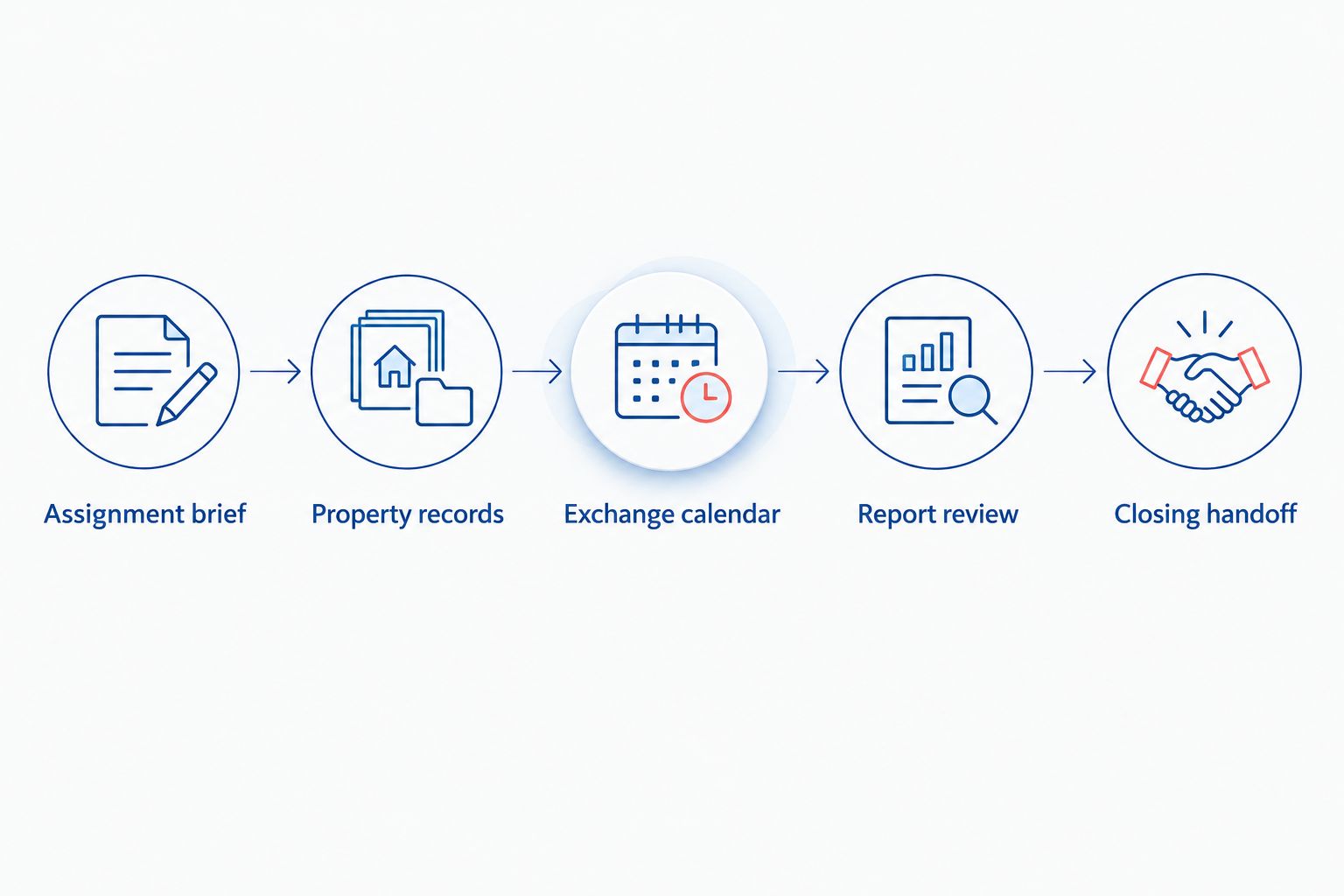
Closing handoff
Review the report and route unresolved issues
- Check assignment identifiers. Confirm the property address, ownership interest, effective date, intended use, and intended users against the engagement. Raise discrepancies promptly rather than treating them as clerical details that cannot affect the analysis.
- Review factual inputs. Check tenancy, areas, income, expenses, and known property conditions against the supplied records. Send factual corrections with supporting documents; do not ask the appraiser to change a conclusion merely to match the purchase agreement.
- Identify valuation conditions. Read assumptions, limiting conditions, and any analysis dependent on proposed work, occupancy changes, or missing information. Ask the appraiser to explain how those conditions affect the intended use.
- Separate approval responsibilities. The lender decides whether its appraisal requirements are satisfied. The attorney and CPA address legal and tax questions; the qualified intermediary coordinates exchange administration within its role. The appraiser addresses valuation questions.
- Complete the closing handoff. Confirm that the responsible professionals have the final report where authorized, current closing documents, exchange instructions, and unresolved-item register. Retain the appraisal and supporting records with the transaction file.
Expected result: The closing team knows which valuation questions are resolved and which transaction conditions remain open. Nobody treats appraisal delivery as proof that financing, title, or exchange requirements have been satisfied.
Replacement-property workflow
The same document discipline applies when your appraisal concerns the acquisition rather than the sale. The constraint changes: seller-controlled records and access must fit inside a calendar that is already running.
For a replacement-property appraisal, confirm access and lender ordering requirements before scheduling the inspection. Request leases and operating records through the authorized transaction contacts, then tell the appraiser which documents remain unavailable. Do not fill gaps with unsupported estimates presented as facts.
| Appraisal focus | Best for | Practical benefit | Limitation |
|---|---|---|---|
| Relinquished property | Owners seeking valuation analysis before disposition | Supports informed sale-related decisions and identifies valuation questions early | Does not establish replacement-property value or exchange eligibility |
| Replacement property | Investors evaluating an acquisition or satisfying an agreed financing scope | Examines the asset being acquired and its income-producing characteristics | Depends on seller access, records, scope, and lender engagement requirements |
These are adjacent assignments, not interchangeable reports. If you need both properties appraised, describe both purposes during scoping and confirm whether separate engagements are appropriate.
For replacement transactions closing in 2026, ask the CPA to check the return-due-date rule alongside the 180-calendar-day period. Tracking only the longer period leaves an avoidable gap in the closing calendar.
Troubleshooting
The lender rejects the owner-ordered report
Ask the lender to identify its engagement, scope, and review requirements. Then coordinate with the lender and appraiser on the appropriate next step; forwarding the same report under a different cover does not establish compliance with those requirements.
The appraised value differs from the contract amount
Identify the reason before changing the transaction plan. Submit documented factual corrections to the appraiser, and have the lender and advisers evaluate financing or contract implications. A price disagreement is not, by itself, evidence of an appraisal error.
Leases conflict with the rent roll
Obtain executed amendments and reconcile the conflicting entries. Tell the appraiser which source supports each correction, including concessions or expense reimbursements. Leaving both versions unexplained makes the income analysis harder to support.
The exchange deadline arrives before the report
Escalate immediately to the intermediary, attorney, CPA, lender, and appraiser. Determine which closing conditions remain unsatisfied and what actions are legally and operationally possible. Do not assume the appraisal delay creates an extension or request unsupported conclusions to accelerate delivery.
The buyer or ownership structure changes
Send the proposed change to the attorney, CPA, and intermediary before signing revised documents. Notify the appraiser if the change affects the property rights, intended users, or intended use; do not assume an appraisal of real estate also values an entity ownership interest.
Customize your workflow
Keep the same four configuration units—assignment brief, property records, exchange calendar, and closing handoff—but change the document requests to fit the asset. An occupied office building requires different tenancy analysis from vacant land; a mixed-use property requires clear treatment of its different uses.
For business-owned real estate, distinguish the property appraisal from an operating-business valuation. Ownership by a business does not turn a real estate report into an opinion of the business’s value, and an entity-interest transaction raises separate questions for your advisers.
Give the team a concise status sheet for the 2026 closing: current document version, responsible person, unresolved issue, and required next action. Keep confidential records within the authorized team rather than distributing the entire file to every participant.
Discuss Your Appraisal Assignment
Tell REIS Group the property, ownership interest, valuation date, and intended use.
FAQ
Do I need a commercial appraisal to complete a 1031 exchange?
A commercial appraisal is not a universal requirement for every Section 1031 exchange. A lender, transaction decision, or particular valuation issue can create a separate appraisal need; confirm the purpose before engagement.
Does a commercial appraisal prove my exchange qualifies for tax deferral?
No. A commercial appraisal develops a value opinion for an identified purpose; your tax and legal advisers must assess exchange eligibility, structure, and reporting requirements.
When should I order the appraisal for a replacement property?
Confirm the appraisal scope and any lender ordering requirements as early as the transaction permits. Arrange seller access and records promptly because the exchange calendar does not wait for the valuation process.
What are the main deadlines for a deferred 1031 exchange?
The general identification period is 45 calendar days after transferring the relinquished property. The completion deadline is generally the earlier of 180 calendar days after that transfer or the applicable federal return due date, including extensions; confirm application with your CPA and intermediary.
Can I use the seller’s appraisal for my acquisition loan?
Do not assume the seller’s appraisal satisfies your lender’s requirements. Ask the lender about engagement, intended use, intended users, effective date, and review requirements before relying on it.
What happens if the property changes after the appraisal inspection?
Notify the appraiser about material changes to occupancy, condition, leases, or transaction assumptions. The appraiser must assess the effect on the assignment; an existing report does not automatically describe later conditions.
What should I send REIS Group when requesting an appraisal proposal?
Send the property address, property type, ownership interest, intended use, intended users, requested effective date, and transaction schedule. Include available leases, rent rolls, operating records, and access information so the assignment can be scoped.
One last thing
The inspection date, effective date of value, report date, and closing date are not interchangeable. Put each on the status sheet with its meaning; a report delivered shortly before closing can still express value as of a different date.
Discuss the appraisal assignment before promising a report to another transaction participant. Bring the property details, intended use, lender instructions, and exchange calendar to that conversation so the proposal addresses the actual need.
Related guides
- Commercial building appraisers in Manhattan
- Commercial appraisal firms for lenders nationwide
- Commercial land appraisal firms in New York