Your property tax appeal cost in 2026 depends on the work you authorize: assessment review, valuation evidence, representation, and any hearing or litigation support. An appraisal proposal does not establish the total appeal expense; confirm separately whether legal work, filing expenses, report revisions, and testimony are included. For a New York City commercial property, start by having counsel identify the appeal route and the valuation evidence needed before commissioning an appraisal.
- Property tax appeal cost depends on appraisal scope, representation, and the stage of the assessment challenge.
- REIS Group provides real estate valuation services; confirm the proposed scope before authorizing appeal-related work.
- Separate an assessment challenge from an appraisal: valuation evidence does not replace filing or legal representation.
- For New York City commercial property, confirm the valuation date, property rights, and required evidence with counsel.
Why this matters
For a commercial property owner reviewing a 2026 assessment, the immediate decision is not simply whether to order an appraisal. You need to establish what is being challenged, what evidence supports that challenge, and who is responsible for submitting it.
Commission the evidence the appeal requires, not a report with an unrelated purpose. Review the available appraisal and valuation services against the assignment your attorney identifies. A report prepared for financing, a sale, or estate administration does not automatically address the effective date, property interest, or intended use of an assessment appeal.
That distinction also makes proposals easier to compare. A written valuation report and an engagement that includes hearing preparation are different assignments, even when both concern the same building.
How much does a property tax appeal cost in 2026?
A property tax appeal has separate work components rather than a universal total. Your written agreements should identify which components apply and which professionals are responsible for them.
| Work component | What the engagement should identify | Scope issue to resolve |
|---|---|---|
| Assessment review | Review of assessment records, property information, and the proposed challenge | Whether the review includes a written recommendation |
| Appraisal evidence | Property rights, effective date, intended use, research, analysis, and reporting | Whether inspection and historical records analysis are included |
| Representation | Preparation and submission of the challenge, communications, and procedural work | Which stages the representative handles |
| Hearing or litigation support | Report review, preparation, attendance, and testimony where required | Whether later-stage participation needs a separate authorization |
Ask each provider to distinguish its own work from services supplied by others. Do not assume the appraiser files the appeal, that counsel supplies the valuation analysis, or that either agreement includes every later stage.
A useful proposal defines deliverables, responsibilities, and exclusions before work begins. Without those details, comparing the bottom line of separate proposals does not tell you whether you are comparing the same assignment.
What does an appraisal engagement cover?
An appraisal develops an opinion of value for a defined property interest, effective date, and intended use. For an assessment challenge, the engagement needs to address the valuation question identified for that proceeding.
Confirm the report format, intended users, inspection arrangements, and information requirements. Also ask whether discussions with counsel, responses to questions, revisions following additional evidence, and testimony are included or separately authorized.
What does representation cover?
Representation concerns the challenge process rather than the independent development of an appraisal conclusion. The engagement should identify responsibility for submissions, communications, appearances, and any further proceedings.
Have counsel explain the available route for your property and jurisdiction. An appraisal is evidence; it does not by itself satisfy procedural requirements or preserve appeal rights.
Choose the scope that matches the appeal stage
Not every assessment question begins with a full appraisal. The appropriate next step depends on whether you are identifying a potential issue, developing evidence, or preparing for a contested proceeding.
| Approach | Best for | Advantage | Limitation |
|---|---|---|---|
| Preliminary assessment review | Owners deciding whether further investigation is justified | Clarifies the question before a larger assignment | Does not replace a formal appraisal or required filing |
| Defined appraisal assignment | Owners and counsel needing a supported valuation conclusion | Connects evidence to a stated date, interest, and purpose | Does not automatically include representation or testimony |
| Coordinated appraisal and legal work | Owners whose challenge requires valuation evidence and procedural representation | Separates professional responsibilities while aligning the work | Requires explicit coordination and separate scope decisions |
These are engagement approaches, not interchangeable products. Ask what you will receive at the end of the proposed stage and what decision that deliverable will support.
A preliminary review should not be described as a completed appraisal unless it actually meets the agreed appraisal scope. Likewise, a completed report should not be treated as a commitment to attend every subsequent proceeding.
Why property tax appeal cost varies
The work changes when the property, evidence, or proceeding changes. These factors belong in the scope discussion:
- Property type and complexity: A mixed-use building, office property, and multifamily property require analysis of their relevant physical and economic characteristics.
- Effective date of value: A retrospective assignment examines value as of a historical date, not simply current market conditions.
- Property rights appraised: Ownership rights, leases, and other interests must be identified rather than assumed.
- Records availability: Missing leases, incomplete operating statements, or uncertain property information create additional questions to resolve.
- Reporting and intended use: The report must address the identified valuation purpose and intended users.
- Proceeding requirements: Conferences, hearing preparation, testimony, and later-stage work change the professional involvement required.
For a Manhattan income-producing property, discuss the rent roll, lease terms, operating history, and relevant market evidence early. These materials help define the assignment; sending only an assessment notice leaves important valuation questions unanswered.
Turnaround also depends on property type, complexity, records availability, and scope. Confirm any expedited availability individually rather than treating the appeal deadline as a promised appraisal delivery date.
How do you request a comparable appraisal proposal?
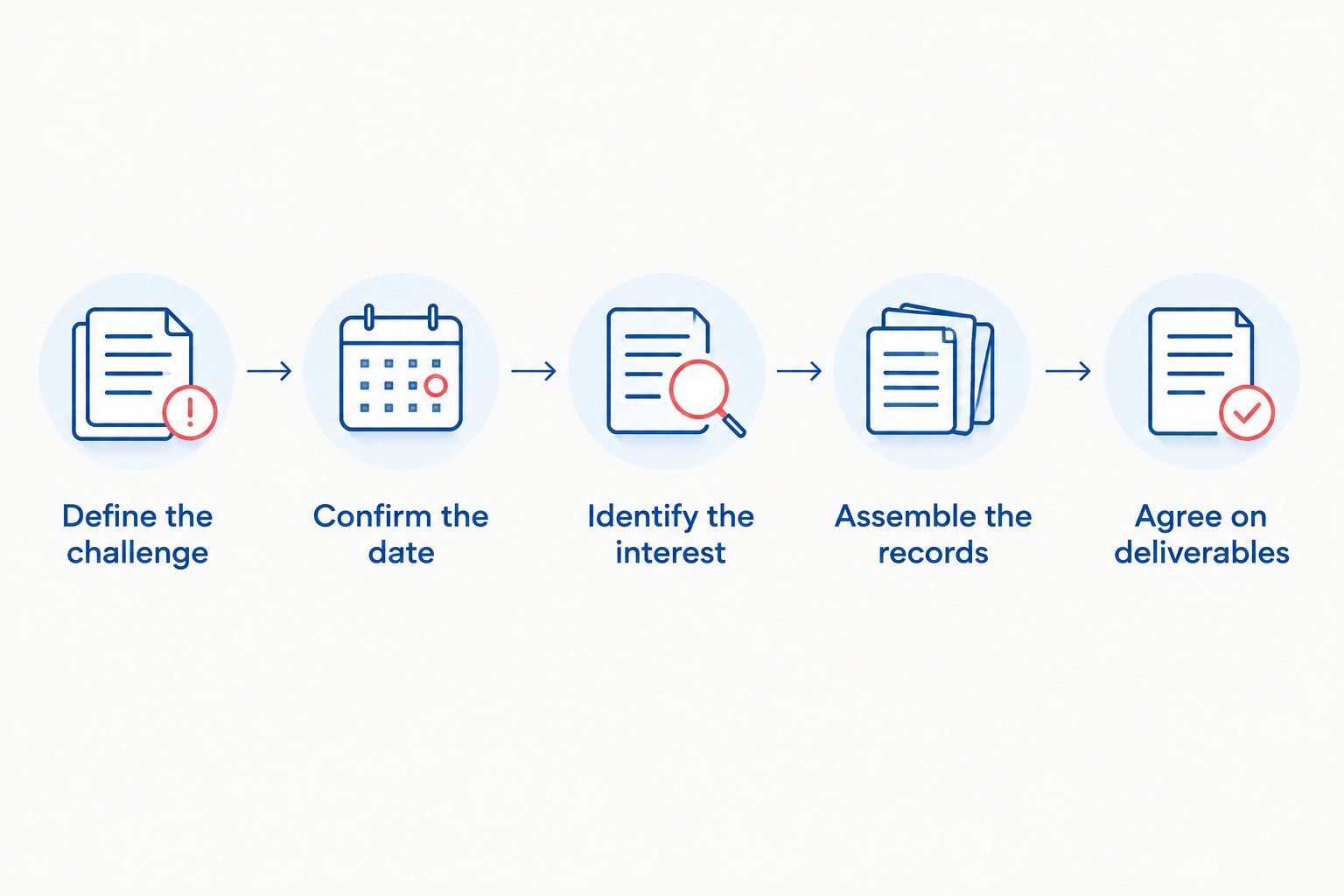
Use these 5 steps to turn an assessment concern into a defined request. The objective is a proposal that your attorney and appraisal provider understand in the same way.
- Define the challenge. Provide the property address, jurisdiction, assessment notice, and the issue counsel wants investigated. Distinguish a concern about market value from a possible error in property records or another assessment issue.
- Confirm the date. Ask counsel to identify the required effective date of value. Keep that date separate from the inspection date and the date the report will be completed.
- Identify the interest. Describe the ownership interest and provide relevant lease information. Do not assume that a value conclusion for a different interest answers the appeal question.
- Assemble the records. Supply available property, operating, and transaction information, identifying gaps rather than filling them with estimates presented as facts.
- Agree on deliverables. Confirm the report, intended users, communications with counsel, deadline, exclusions, and process for authorizing additional work.
For a 2026 appeal, distinguish 3 dates in your instructions: the required valuation date, the submission deadline, and the requested report completion date. They serve different purposes. Counsel should confirm the procedural deadline; the appraiser should confirm whether the proposed reporting schedule fits the assignment.
What records should a commercial owner prepare?
Start with records that explain the property as it existed on the relevant valuation date. Current documents alone do not necessarily establish historical occupancy, condition, or income.
Prepare the following where applicable:
- The assessment notice and available assessment history.
- Ownership information and a description of the interest being appraised.
- Rent rolls, leases, amendments, concessions, and vacancy information.
- Operating statements with explanations of unusual income or expenses.
- Building areas, floor plans, and available property descriptions.
- Records of material condition issues, renovations, or capital work.
- Relevant sale agreements, prior reports, and information about significant property changes.
Explain discrepancies between documents. If a rent roll and operating statement describe different periods, label those periods clearly rather than asking the appraiser to infer the difference.
An organized submission reduces ambiguity; it does not predetermine the value conclusion. The appraiser still needs to assess the reliability and relevance of the evidence.
Do you need both an attorney and an appraiser?
You need the professional roles that the proceeding and valuation question require. An attorney addresses legal and procedural matters; an appraiser develops valuation analysis within the agreed assignment.
REIS Group is suited to New York City commercial owners and their advisers who need an independent real estate valuation for a defined purpose. Its valuation services are not a substitute for legal advice or a commitment to handle an assessment challenge from filing through litigation.
Before engaging REIS Group for appeal-related evidence, ask the firm to confirm that the proposed assignment fits its scope. Coordinate the intended use, effective date, and reporting requirements with counsel before research begins.
Does an existing appraisal reduce the work required?
An existing appraisal is useful background when its property information and analysis are relevant. It is not automatically suitable evidence for a different valuation date, property interest, or proceeding.
Have the appraiser review the report's intended use and underlying information. A financing appraisal, estate valuation, or sale-related analysis needs that review before anyone relies on it for an assessment challenge.
For a 2026 assignment, identify changes since the earlier report, including leasing activity, physical condition, ownership rights, and market evidence. Reusing a document without examining those changes can leave the central appeal question unanswered.
Can an appraisal guarantee a lower assessment?
An appraisal cannot guarantee a lower assessment or acceptance by a reviewing authority. An independent conclusion follows the evidence, including evidence that does not support the owner's expected value.
Ask how the report supports its conclusion and addresses relevant property characteristics. A preferred result is not an instruction to the appraiser, and an appraisal proposal should not promise a tax outcome.
FAQ
What determines property tax appeal cost in 2026?
Property tax appeal cost in 2026 depends on the authorized appraisal, representation, and proceeding-related work. Compare written scopes, including exclusions and later-stage responsibilities, rather than assuming each proposal covers the entire challenge.
Is an appraisal included when I hire a property tax appeal representative?
An appraisal is included only if the engagement expressly provides for it. Confirm who engages the appraiser, what report is required, and whether testimony or additional analysis needs separate authorization.
Do I need a new appraisal for a New York City assessment appeal?
The need for a new appraisal depends on the valuation evidence required for your specific challenge. Have counsel and the appraiser review any existing report for its effective date, property rights, intended use, and relevance.
Can I use an estate appraisal for a property tax appeal?
An estate appraisal is not automatically suitable for a property tax appeal. Its valuation date, property interest, intended users, and assignment purpose need to be reviewed against the assessment challenge.
What should I send an appraiser before requesting a proposal?
Send the property address, assessment information, required valuation date, intended use, and known deadline. For income-producing property, include available rent rolls, leases, operating statements, and relevant condition information.
Will the appraiser attend the tax appeal hearing?
Hearing attendance is included only when the appraisal engagement provides for it. Confirm preparation, scheduling, testimony, and authorization for additional work before assuming the report assignment includes an appearance.
Can an appraiser promise that my property taxes will decrease?
An appraiser cannot promise a tax decrease or acceptance of a report. The appraisal develops an independent value conclusion; the reviewing authority determines the assessment outcome.
One last thing
A lower appraised value and a lower tax bill are not the same conclusion. The appraisal addresses the defined valuation question; counsel must assess how that evidence relates to the assessment rules and requested relief.
Before authorizing work in 2026, ask counsel and the appraiser to confirm the same assignment description: property, rights, effective date, intended use, intended users, and required deliverables. That short agreement is more useful than comparing proposals built on different assumptions.
To discuss valuation evidence for a New York City commercial property, request an appraisal consultation with REIS Group. Provide the assessment notice, property details, counsel's instructions, and the relevant deadline so the proposed assignment can be evaluated.
Related guides
- Property tax appeal services for owners
- Ad valorem tax appeal appraisers in New York
- Commercial appraisal for property investors