No, a real estate appraisal is not automatically required for a 1031 exchange in 2026; federal exchange rules do not impose a blanket appraisal requirement on every transaction. Your lender can require one separately, and an independent valuation can support a disputed property value, an allocation, or another specifically identified reporting purpose.
- Is an appraisal required for a 1031 exchange? Not automatically; distinguish federal exchange rules from lender requirements.
- An appraisal supports property value, not a guarantee that an exchange qualifies for tax deferral.
- REIS Group provides commercial real estate appraisals for New York property owners and their professional advisers.
- Confirm the intended use, effective date, property rights, and report users before ordering.
Is an appraisal required for a 1031 exchange in 2026?
A 1031 exchange does not, by itself, create a universal requirement to obtain an appraisal. The answer changes when financing, a contract, or a separate valuation issue introduces its own documentation requirements.
Start by asking who needs the value conclusion and why. A lender's underwriting requirement is different from your CPA's need to support a tax calculation, even when both concern the same building. The relevant appraisal services should be scoped around that distinction.
| Situation | Is an appraisal automatically required by Section 1031? | Practical benefit | Limitation or next step |
|---|---|---|---|
| Exchange without replacement-property financing | No blanket requirement | An independent report can support a specific valuation question | Confirm whether the transaction actually needs that analysis |
| Exchange with replacement-property financing | No blanket exchange requirement; lender requirements are separate | A lender-ordered report supports underwriting | Follow the lender's ordering and appraiser-selection process |
| Transaction involving disputed value or allocations | No blanket requirement | A report can document the basis for an identified value conclusion | Have counsel and the CPA define the question before engagement |
| Existing appraisal available | Its existence does not establish suitability | It provides information for a suitability review | Check the effective date, rights appraised, intended use, and permitted users |
The federal framework is Internal Revenue Code Section 1031 and its implementing Treasury regulations. An appraisal addresses valuation evidence; it does not replace the legal and tax analysis of exchange eligibility.
Why this matters
For a New York commercial property owner, the immediate risk is ordering the wrong assignment or discovering a lender requirement too late. A report prepared for your investment decision is not automatically suitable for a lender or another intended user.
REIS Group provides independent commercial real estate appraisals for New York property owners and advisers who need a supported value conclusion. That service addresses the property's value, not the separate question of whether your transaction qualifies for tax deferral.
Keep responsibility clear: your tax adviser addresses tax treatment, your attorney addresses transaction documents and legal issues, and your appraiser develops the agreed valuation analysis. A qualified intermediary serves a different exchange-related role and does not replace those professionals.
When your lender requires an appraisal
If replacement-property financing is involved, ask the lender about appraisal requirements before commissioning a report yourself. Lenders have their own requirements for ordering, appraiser approval, report content, and review.
Best for: satisfying a lender's identified collateral-valuation requirement. The benefit is an analysis prepared for that underwriting purpose; the limitation is that you cannot assume it also satisfies every investor or tax-related need.
Ask the lender:
- Must the lender order the appraisal directly?
- What property interest and valuation premise must the report address?
- Who will be identified as the client and intended users?
- What documents and property access are required?
- What appraisal-review steps must finish before funding?
Do not treat possession of a report as permission to use it for any purpose. Tell your CPA and attorney what report exists, then ask whether additional valuation work is necessary for their specific questions.
When an independent appraisal serves a separate purpose
An owner-commissioned appraisal is useful when the assignment has a defined valuation question beyond the lender's underwriting decision. Examples include evaluating a proposed acquisition, supporting an allocation involving multiple assets, or documenting a value that parties dispute.
Best for: an owner or adviser who needs an independent conclusion tied to an identified decision or reporting purpose. The benefit is a scope built around that question; the limitation is that the report does not establish exchange eligibility or guarantee acceptance by a taxing authority.
For Manhattan and surrounding New York City properties, explain the ownership and occupancy structure at the outset. A leased commercial building, a mixed-use property, and a fractional ownership interest raise different appraisal questions.
Do not assume that an appraisal of the entire property answers the value of a partial interest. Likewise, appraising business-owned real estate is not the same assignment as valuing the operating business. Your engagement should identify exactly what is being valued.
Why appraisal needs vary between exchanges
The need for valuation work depends on the transaction and the intended use, not simply the phrase “1031 exchange.” These factors determine what to ask before ordering:
- Financing requirements: A replacement-property lender determines its own appraisal and review requirements.
- Property type: Income-producing property calls for analysis relevant to its leases, expenses, market position, and physical characteristics.
- Property rights: Full ownership, a leased fee interest, and a partial ownership interest are not interchangeable appraisal subjects.
- Effective date: The effective date of value is the date the appraiser's conclusion applies to; it is not necessarily the report's delivery date.
- Intended use and users: Underwriting, acquisition analysis, and tax-related support can require different scopes and reporting arrangements.
- Records and complexity: Incomplete leases, uncertain property information, or complex ownership arrangements affect the work needed and scheduling.
Discuss these factors before requesting a proposal. A narrowly described assignment gives you a better basis for evaluating scope than a request for a generic exchange appraisal.
What should you confirm before ordering an appraisal?
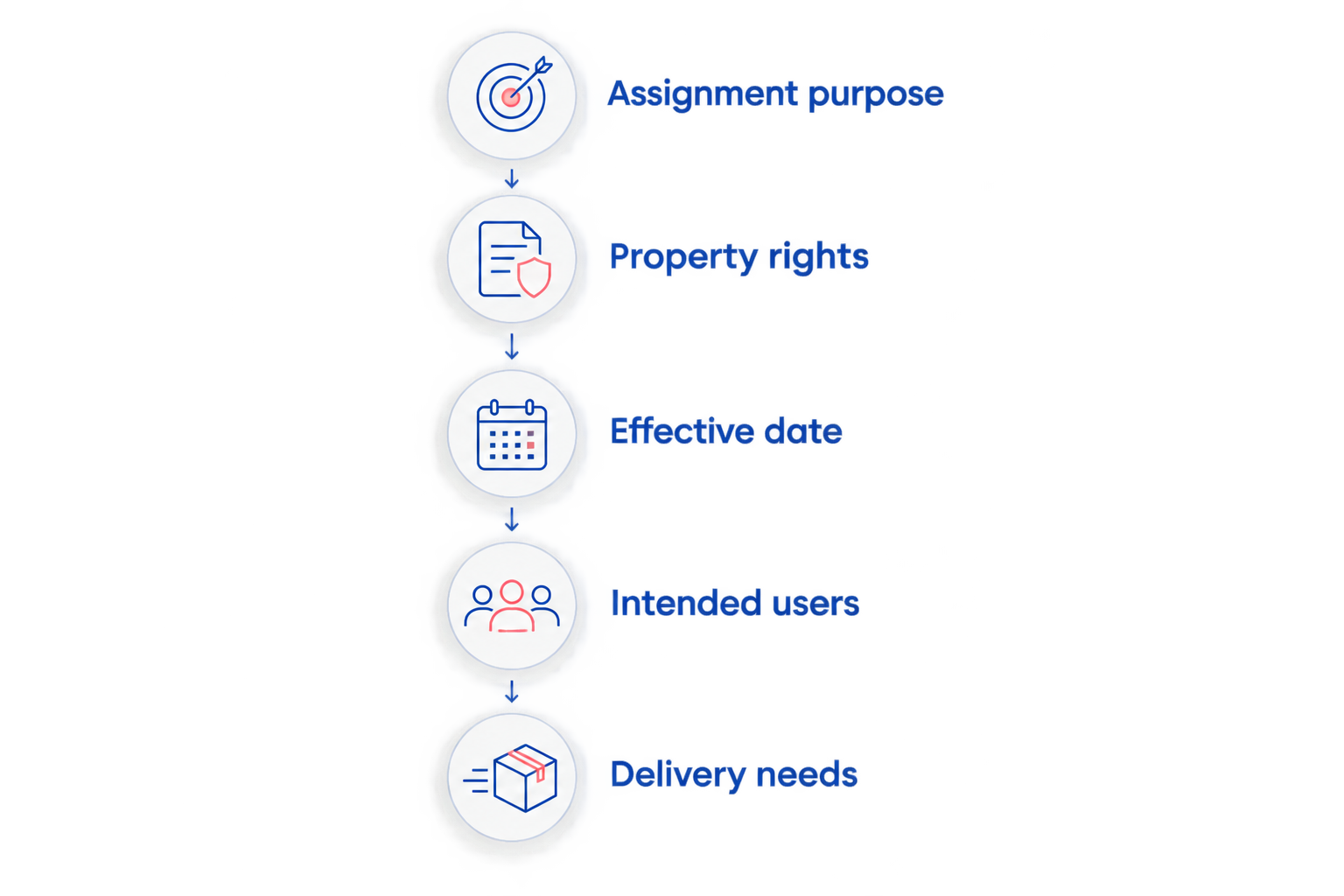
Use this sequence before engaging an appraiser. It separates a genuine appraisal requirement from a general desire for more documentation.
- Assignment purpose: Ask your CPA or attorney to identify the valuation question, if any, that needs a report. Ask the lender separately about underwriting requirements.
- Property rights: Identify the parcel, ownership entity, interest being transferred, and any leases or restrictions relevant to the assignment.
- Effective date: Confirm the date the value conclusion must address. Do not substitute the inspection date or anticipated delivery date without discussion.
- Intended users: Identify who will rely on the report and for what decision. Resolve lender involvement before commissioning an owner-directed assignment.
- Delivery needs: Provide the transaction schedule and ask the appraiser to confirm a feasible scope and delivery plan.
For an exchange planned in 2026, carry these decisions into the engagement rather than leaving them in informal correspondence. Clear instructions help prevent a completed report from answering the wrong question.
The commercial appraisal-to-1031 exchange closing workflow provides supporting guidance for connecting the valuation assignment with transaction planning. Keep the appraisal schedule and the exchange schedule separate in your working documents.
Does an appraisal change the 1031 exchange deadlines?
An appraisal does not extend the standard 45-day identification period or the standard 180-day exchange period. For a deferred exchange, the identification period runs from the transfer of the relinquished property, and the exchange period generally ends on the earlier of 180 days after that transfer or the applicable federal income tax return due date, including extensions.
These periods come from Section 1031(a)(3); Treasury Regulation Section 1.1031(k)-1 provides the deferred-exchange framework. Have your tax adviser and qualified intermediary confirm the deadlines applicable to your transaction, including any specifically applicable relief.
If you are organizing a 2026 exchange, do not treat the appraisal delivery date as the starting point for either period. Record the relevant transfer date and have the exchange team confirm the calendar independently.
The regulations also include a standard identification rule allowing up to 3 replacement properties without regard to their aggregate fair market value. Other identification rules exist, so an appraisal is not a substitute for checking whether your written identification complies with the rule you are using.
What documents should you prepare for the appraiser?
For a commercial property assignment, assemble records that explain ownership, occupancy, income, expenses, and physical characteristics. Ask which documents are relevant before sending a large, unorganized archive.
A useful starting file includes:
- Property address, parcel identification, and ownership information.
- Executed purchase agreement and relevant amendments, if available.
- Current rent roll, leases, amendments, and information about concessions.
- Operating statements and supporting expense records.
- Surveys, floor plans, building information, and known restrictions.
- Details of significant renovations, deferred maintenance, and planned work.
- The intended use, proposed effective date, intended users, and requested delivery date.
For a retrospective assignment, provide records relevant to the historical effective date rather than relying only on current conditions. A current rent roll does not, by itself, establish occupancy or income at an earlier valuation date.
If your 2026 transaction file contains inconsistent areas, rents, or ownership descriptions, identify the differences upfront. The appraiser needs to evaluate the relevant information rather than silently select whichever figure appears most favorable.
Can you reuse an appraisal prepared for another purpose?
An existing appraisal is not automatically suitable for a 1031-related valuation question. Start with its effective date, property rights appraised, intended use, intended users, assumptions, and report restrictions.
A refinancing appraisal might contain useful property information while addressing a different assignment. An estate appraisal can concern a historical date and a reporting purpose unrelated to the proposed exchange. Neither should be relabeled as exchange support without reviewing its suitability.
Ask the original appraiser about the existing assignment and any additional work needed. Ask the receiving lender or professional adviser what they require; the fact that a report is recent does not settle whether it is appropriate.
What an appraisal cannot establish
An appraisal does not determine whether you have satisfied every condition for tax deferral. It also does not eliminate taxable gain merely because its value conclusion matches a purchase agreement.
Your tax and legal advisers must address issues such as qualifying property, ownership structure, transaction sequencing, receipt of proceeds, debt, and any non-like-kind consideration. A supportable property value is one input, not the entire analysis.
Keep adjusted tax basis separate from appraised market value. Basis is a tax calculation, while an appraisal develops a value conclusion under a specified definition and effective date. Your CPA uses the applicable tax rules to calculate and report the exchange.
FAQ
Is an appraisal required for a cash 1031 exchange?
A cash 1031 exchange does not create a blanket federal appraisal requirement. Your attorney or CPA can identify whether a separate valuation issue warrants an appraisal, even without lender financing.
Does my lender’s appraisal prove my 1031 exchange qualifies?
A lender’s appraisal does not prove that a 1031 exchange qualifies. It addresses the lender’s valuation assignment, while exchange eligibility depends on separate legal and tax requirements.
Can I order my own appraisal for the replacement-property lender?
Ask the replacement-property lender before ordering an appraisal for its use. The lender determines its ordering process, appraiser requirements, and report-review requirements.
Will waiting for an appraisal extend my exchange deadline?
Waiting for an appraisal does not extend the standard 45-day identification period or 180-day exchange period. Have your tax adviser and qualified intermediary confirm the exact deadlines for your transaction.
Can I use a property tax assessment instead of an appraisal?
A property tax assessment is not interchangeable with an appraisal prepared for an identified transaction purpose. Assessment dates, valuation rules, and property information can differ from the requirements of your assignment.
Do both properties need appraisals for a 1031 exchange in 2026?
Neither property automatically needs an appraisal solely because it is part of a 1031 exchange in 2026. Evaluate lender requirements and any separate valuation question for each property.
What should I send when requesting an appraisal proposal?
Send the property address, ownership interest, intended use, effective date, intended users, and transaction schedule. For income-producing property, also identify available leases, rent rolls, and operating records.
One last thing
The most useful opening question is not “Do I need an appraisal?” but “Who needs a value conclusion, for what purpose, and as of what date?” Those answers determine whether you need an appraisal and what the assignment should cover.
Discuss your appraisal assignment with REIS Group if your New York exchange involves a commercial property valuation question. Provide the property, ownership interest, intended use, effective date, and transaction schedule so the proposed scope addresses the actual need. This article provides general information, not transaction-specific tax or legal advice.
Discuss Your Appraisal Assignment
Identify the property, valuation purpose, effective date, and transaction schedule for a scoped proposal.
Related guides
- How to vet a commercial appraiser before hiring in New York
- How long a commercial appraisal takes
- How to appraise a commercial property with existing tenants