

For Manhattan estate attorneys and executors, REIS Group provides co-op and condo appraisal services scoped to the ownership interest, valuation date, and estate purpose. This 2026 guide compares assignment types so you can request the right proposal—not choose an appraiser from an unsupported firm ranking.
- REIS Group provides Manhattan co-op and condo appraisals for estate, date-of-death, and partial-interest assignments.
- Co-op and condo appraisal Manhattan searches should start with estate purpose, property rights, and effective date.
- Choose a retrospective appraisal when the required valuation date precedes the appraisal assignment.
- Confirm intended users and ownership documents before requesting an appraisal proposal.
Why this matters
An inherited Manhattan apartment presents several distinct questions: what ownership interest belonged to the decedent, what date controls the valuation, and who will use the report? A current estimate of the apartment’s selling potential does not automatically answer those questions.
For an estate engagement in 2026, start with the date-of-death appraisal to IRS Form 706 workflow. Coordinate the appraisal purpose with estate counsel and the CPA before commissioning the report, rather than trying to adapt a completed report to a different assignment.
The service options below address different estate needs. They are not competing firms, and their order reflects assignment fit—not a claim that one appraisal format is universally better.
What makes the right Manhattan co-op or condo appraisal service?
Use these criteria to evaluate a proposed engagement before comparing providers:
- Assignment purpose: The proposal identifies whether the report supports estate administration, estate-tax reporting, a trust matter, or another stated use.
- Ownership analysis: The appraiser distinguishes cooperative shares and a proprietary lease from condominium ownership and identifies the specific interest being appraised.
- Effective date: The engagement separates the date being valued from the inspection date and report date.
- Relevant evidence: The analysis addresses apartment characteristics, building conditions, financial obligations, and comparable transactions relevant to the assignment.
- Report scope: The proposal identifies intended users, necessary research, inspection arrangements, and material assumptions or limitations.
- Professional fit: You can verify the assigned appraiser’s credentials and discuss relevant Manhattan apartment experience without relying on promotional claims.
For a 2026 engagement, ask how the proposed research addresses your particular building and valuation date. A familiar neighborhood name is not a substitute for a clearly defined assignment.
Manhattan estate appraisal services at a glance
| Service option | Best for | Distinct purpose | Key limitation |
|---|---|---|---|
| Estate and date-of-death appraisal services | Establishing the value of an inherited apartment interest | Aligns the property rights and effective date with the identified estate purpose | Does not automatically cover every later filing or transaction |
| Retrospective appraisal | Reconstructing value as of an earlier date | Uses evidence relevant to the historical effective date | Historical condition and building records require careful documentation |
| Partial-interest valuation | Estates holding less than the entire ownership interest | Examines the specific fractional or ownership interest transferred | Requires ownership analysis; a discount is not automatic |
The default choice is an estate appraisal engagement with the required date and ownership interest stated explicitly. Add retrospective or partial-interest analysis when the facts require it; these services can overlap within a properly scoped assignment.
1. Estate appraisal: for defining the inherited apartment’s value
Best for: Executors and estate attorneys who need a valuation of the decedent’s Manhattan co-op or condo interest for an identified estate purpose.
An estate appraisal establishes a value conclusion for specified property rights as of a specified effective date. REIS Group provides estate and date-of-death valuations alongside residential appraisal services that include cooperative apartments and condominiums.
The assignment begins with the estate’s needs, not a request to confirm a preferred figure. Your attorney or CPA should identify the intended reporting purpose so the appraiser can propose an appropriate scope.
Estate appraisal strengths
- Connects the value conclusion to a stated estate purpose.
- Identifies the property rights being valued rather than treating every apartment interest alike.
- Gives the appraiser a defined basis for selecting relevant market evidence.
- Establishes intended users before the report is prepared.
Estate appraisal limitations
- A report prepared for one intended use is not automatically appropriate for another.
- Missing ownership or apartment records require clarification and can affect the scope.
- An appraisal supports the identified purpose; it does not guarantee acceptance by a taxing authority or other recipient.
Ask whether the proposal covers the entire apartment interest or only the interest included in the estate. Also explain any anticipated additional use before engagement, including fiduciary accounting or a later dispute among beneficiaries.
Verdict: Request an estate appraisal proposal when the immediate need is a supported value conclusion for estate administration or reporting.
2. Retrospective appraisal: for an earlier effective date
Best for: Executors whose appraisal assignment begins after the date that must be valued.
A retrospective appraisal develops an opinion of value as of an earlier effective date. For example, an engagement commissioned in 2026 can require analysis of conditions and market evidence from the decedent’s date of death rather than the current market.
The inspection describes what the appraiser observes when inspecting. Historical photographs, renovation records, building documents, and other evidence help establish what existed on the effective date.
Retrospective appraisal strengths
- Separates historical value from current selling conditions.
- Provides a framework for evaluating evidence tied to the required date.
- Addresses changes between the historical effective date and the inspection.
Retrospective appraisal limitations
- Current photographs alone do not establish an apartment’s earlier condition.
- Historical financial and building records require additional collection and review.
- Unresolved evidence gaps must be addressed in the analysis rather than concealed by a precise-looking conclusion.
Identify renovations, damage, changes in occupancy, or building work that occurred between the effective date and inspection. Give the appraiser documents showing when those changes happened; a description of the apartment today is not enough.
Verdict: Request retrospective analysis when the required effective date precedes the engagement, and begin collecting historical records immediately.
3. Partial-interest valuation: for less than the whole interest
Best for: Estate attorneys and fiduciaries handling a fractional ownership interest or an interest held through an ownership structure requiring separate analysis.
A partial-interest valuation examines the specific interest owned, not simply the apartment as though a sole owner controlled everything. REIS Group provides partial-interest and fractional-ownership valuations, with the scope tailored to the property interest and intended use.
Do not assume that the value of an ownership interest equals the whole-property value multiplied by an ownership percentage. Equally, do not assume that fractional ownership automatically justifies a discount.
Partial-interest valuation strengths
- Focuses the analysis on the actual ownership interest.
- Allows relevant control, transfer, and ownership provisions to be examined.
- Distinguishes an interest-level conclusion from the apartment’s whole-property value.
Partial-interest valuation limitations
- Requires ownership and governing documents, not just apartment sales data.
- Can involve legal interpretation that must be coordinated with counsel.
- Does not establish a predetermined discount or tax outcome.
If an entity owns the apartment, clarify whether the assignment concerns the real estate, an entity interest, or both. Appraising business-owned real estate is different from valuing an operating business, and the engagement should not blur those tasks.
Verdict: Request a partial-interest scope discussion before ordering a whole-apartment appraisal when the estate owns less than the entire relevant interest.
Co-op versus condo: what the appraiser needs to distinguish
A Manhattan cooperative apartment generally involves shares in a cooperative corporation together with rights under a proprietary lease. A condominium generally involves ownership of a unit together with an interest in common elements. Those legal structures affect which documents describe the interest being appraised.
| Issue | Cooperative apartment | Condominium apartment |
|---|---|---|
| Ownership evidence | Share documents and proprietary lease | Deed and condominium documents |
| Recurring charges | Maintenance and applicable assessments | Common charges, real estate taxes, and applicable assessments |
| Building records | Cooperative financial statements and relevant governing records | Condominium financial statements and relevant governing records |
| Transfer considerations | Applicable lease and corporate restrictions | Applicable declaration, bylaws, and other restrictions |
Neither ownership structure produces an automatic valuation advantage. The appraiser must examine the particular apartment, building, ownership rights, and market evidence.
For either property type, identify terraces, storage rights, parking interests, combinations of units, or other associated rights if they exist. Provide supporting documents rather than assuming these features are included in the same way across buildings.
Prepare 4 assignment details before requesting a proposal
A useful appraisal inquiry gives the appraiser enough information to define the work. For a 2026 estate engagement, organize these details before asking about timing.
Assignment purpose
State why the estate needs the report and identify the professionals coordinating its use. Explain any known additional purpose rather than assuming the same report will serve every recipient.
Property rights
Provide the apartment address, unit designation, ownership records, and description of the interest held. Flag trusts, entities, shared ownership, or associated apartment rights for discussion.
Effective date
Give the requested valuation date and explain its connection to the assignment. The effective date, inspection date, and report date serve different functions and should not be treated as interchangeable.
Intended users
Identify the client and the parties expected to rely on the report. Tell the appraiser about a filing deadline or pending proceeding when requesting the proposal, not after engagement.
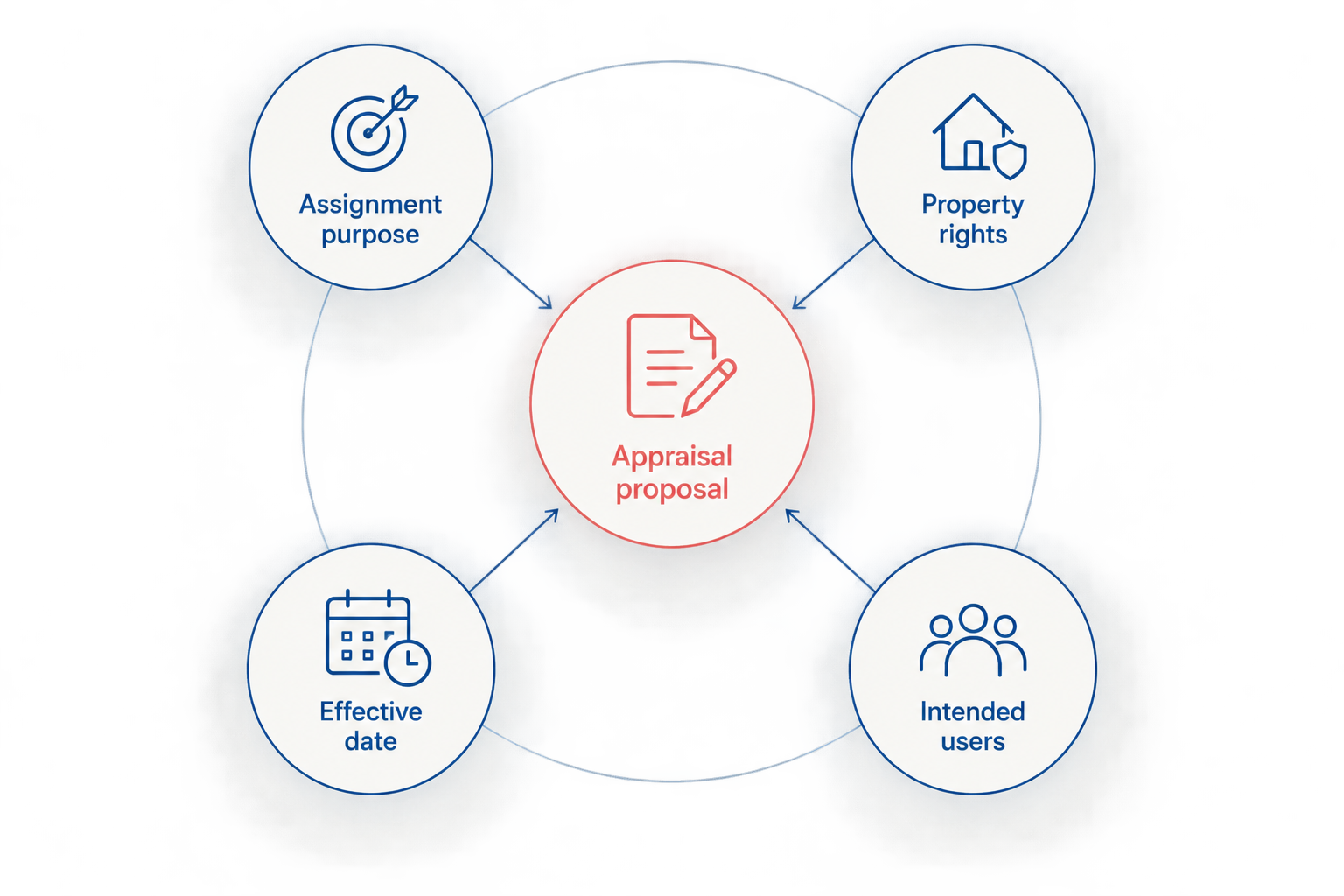
These details support a focused consultation. Turnaround depends on property type, complexity, records availability, and scope; expedited availability requires individual confirmation.
Collect 3 record groups for the initial discussion
You do not need to resolve every valuation issue before contacting an appraiser. You do need to identify what records exist and who can obtain them.
- Ownership records: Deed or cooperative ownership documents, relevant trust or entity documents, and records describing the interest included in the estate.
- Apartment evidence: Floor plans, photographs, renovation records, occupancy information, and documentation of condition at the effective date.
- Building records: Relevant financial statements, maintenance or common-charge information, assessments, and available records of significant building work.
Keep historical and current material clearly separated. If you submit a 2026 photograph for an earlier effective date, explain what changed and provide supporting evidence where available.
How to evaluate the proposed engagement
The service comparison above uses assignment purpose, ownership analysis, effective date, evidence needs, and report scope. It does not assign unsupported scores to firms or claim independent testing of providers.
REIS Group has over 30 years of experience and serves Manhattan and the greater New York City area, with nationwide assignments coordinated through its professional network. For your co-op or condo appraisal, assess the proposed engagement against your estate’s actual requirements—not experience alone.
Ask who will perform the work, what documents are needed, how historical condition will be addressed, and what the report is intended to support. Resolve material scope questions before authorizing the assignment.
Which service should you choose?
Start with an estate appraisal consultation and identify the required effective date and ownership interest. Request retrospective analysis for an earlier date and partial-interest analysis when the estate’s ownership requires it; these are scope decisions, not interchangeable report labels.
For Manhattan co-op and condo appraisal needs, REIS Group scopes services around the property interest, effective date, intended users, and intended use. Bring those details to the consultation so the proposal addresses the assignment you actually need.
Discuss Your Appraisal Assignment
Share the Manhattan apartment, ownership interest, effective date, and intended estate use.
FAQ
What should I look for in a Manhattan co-op or condo estate appraiser?
Look for relevant apartment experience and a proposal that identifies the ownership interest, effective date, intended users, and intended use. Verify the assigned appraiser’s credentials and discuss the evidence needed for your estate assignment.
Is a co-op appraisal different from a condo appraisal?
Yes. A co-op generally involves cooperative shares and a proprietary lease, while a condo generally involves ownership of a unit and an interest in common elements. The appraiser must identify the rights and documents relevant to the particular property.
Can an inherited apartment be appraised after the date of death?
Yes, a retrospective appraisal can address value as of an earlier effective date. Historical condition, ownership, building records, and relevant market evidence must support the analysis.
Can I use a broker’s estimate instead of an estate appraisal?
A broker’s estimate is not automatically a substitute for an appraisal prepared for an identified estate purpose. Ask estate counsel or the CPA what valuation support the assignment requires before selecting the service.
Does owning only part of an apartment automatically reduce its value?
No, partial ownership does not establish an automatic discount. The valuation must address the specific interest, applicable rights and restrictions, and supporting evidence.
How long does a Manhattan apartment estate appraisal take?
Turnaround depends on property type, assignment complexity, records availability, and scope. Provide the required date and any deadline when requesting a proposal; expedited availability must be confirmed individually.
Will an appraisal guarantee IRS acceptance?
No appraisal guarantees acceptance by the IRS or another reviewing party. A report should be prepared to support its identified valuation purpose with clearly explained analysis and conclusions.
One last thing
An inspection today does not turn a historical valuation into a current one. Before commissioning an appraisal in 2026, put the effective date and the ownership interest in writing; those details determine what the appraiser must analyze.
Discuss your appraisal assignment with the property documents and estate purpose at hand. A precise inquiry is the first step toward an appropriately scoped proposal.
Related guides
- Retrospective appraisals for inherited property
- Date-of-death appraisals for New York executors and attorneys
- Partial-interest appraisal cost considerations