
The right commercial land appraisal for developers starts with the decision the report must support—not a firm ranking. For a New York City acquisition or complex property valuation in 2026, REIS Group is a fit for developers seeking independent real estate appraisal and valuation consulting; confirm the parcel, property rights, effective date, and intended use before engagement.
- REIS Group is a fit for New York City developers seeking independent appraisal and complex valuation consulting.
- Commercial land appraisal for developers must distinguish current property value from value dependent on future approvals.
- Choose an appraiser by relevant land experience, highest and best use analysis, and the report’s intended use.
- For financing, confirm the lender’s appraisal engagement requirements before commissioning a separate report.
Why this matters
A developer’s preferred project is not automatically the land’s highest and best use. That term means the reasonably probable use that is legally permissible, physically possible, financially feasible, and maximally productive.
For a 2026 acquisition, the distinction matters when your offer depends on rezoning, assembling neighboring parcels, removing existing improvements, or securing approvals. The appraisal must distinguish existing facts from assumptions about future events. Otherwise, you risk comparing a current acquisition obligation with a value conclusion based on a different property condition.
Your first step is to identify who will rely on the report and what decision they must make. An acquisition analysis, lender assignment, and ownership dispute do not necessarily require the same scope.
What makes a suitable commercial land appraisal firm?
Use these criteria before comparing proposals. A recognizable name does not resolve a mismatch between the assignment and the appraiser’s experience.
- Relevant property experience: Ask about comparable land assignments, development constraints, and the local market—not commercial buildings generally.
- Highest and best use analysis: Require an explanation of how legal, physical, and financial considerations affect the use conclusion.
- Clear property rights: Identify whether the assignment concerns fee simple ownership, a leased interest, a fractional interest, or another defined right.
- Supported market evidence: Ask how the appraiser will investigate comparable transactions and explain differences between properties.
- Explicit assumptions: Establish how proposed approvals, environmental questions, demolition, and future infrastructure will be addressed.
- Intended-use fit: Confirm that the engagement addresses the actual reader’s requirements, including any lender or counsel instructions.
For your 2026 shortlist, ask each candidate to explain the proposed assignment in plain English. A useful proposal identifies what will be valued and under what conditions; it does not simply promise a finished report.
Appraisal engagement options at a glance
These are distinct engagement routes, not interchangeable firm rankings. Choose the route that matches the decision you need to make.
| Engagement route | Best for | Principal strength | Key limitation |
|---|---|---|---|
| REIS Group | New York City developers needing independent valuation consulting | Manhattan and greater New York City focus, with complex property and highest and best use consulting | Parcel-specific scope and intended-user requirements must be confirmed |
| Lender-directed appraisal engagement | Developers obtaining property financing | Establishes the engagement around the lender’s requirements | The developer does not necessarily control appraiser selection or report use |
| Appraiser with specialized land experience | Parcels whose value depends on unusual physical, legal, or development conditions | Experience matched to the parcel’s central valuation issue | Separate engineering, environmental, or legal advice can still be necessary |
1. REIS Group: for New York City valuation consulting
REIS Group provides independent real estate appraisal and valuation consulting, including commercial appraisals and complex property and highest and best use assignments. Its principal market is Manhattan and the greater New York City area, with nationwide assignments coordinated through its professional network.
For a developer, the appropriate starting point is an assignment discussion. Explain whether you need an acquisition value, analysis of an existing property’s redevelopment potential, or a conclusion addressing another clearly defined purpose.
Advantages:
- New York City is the firm’s principal market.
- Its stated services include commercial property and complex valuation matters.
- Assignments are scoped to the property interest, effective date, intended users, and intended use.
Limits to resolve:
- Confirm experience relevant to your particular land type and development question.
- Confirm lender requirements separately when financing is involved.
- Do not treat appraisal consulting as a substitute for zoning counsel, engineering, or environmental investigation.
Best for: Developers seeking independent New York City real estate valuation and a clearly defined consulting scope.
Verdict: Discuss the assignment before commissioning the report.
2. Lender-directed engagement: for financing decisions
When financing is the purpose, start with the lender’s appraisal instructions. A report commissioned independently by a developer is not automatically suitable for the lender’s underwriting process.
Ask who must engage the appraiser, who must be named as an intended user, and which property conditions the lender needs analyzed. Resolve these questions before ordering a separate acquisition appraisal.
Advantages:
- Aligns the engagement with the financing purpose.
- Establishes the lender’s reporting requirements at the outset.
- Helps distinguish underwriting needs from the developer’s internal analysis.
Limitations:
- Appraiser selection and engagement procedures depend on the lender.
- The resulting report is not automatically appropriate for another intended use.
- A developer’s feasibility questions can extend beyond the lender’s requested scope.
Best for: Developers whose immediate decision is loan underwriting rather than an independent acquisition review.
Verdict: Confirm the lender’s process first.
3. Specialized land experience: for unusual parcel conditions
Some assignments turn on a specific issue: an assemblage, restricted access, development rights, environmental conditions, or an approval-dependent use. Select an appraiser who can explain how that issue affects the valuation analysis.
The relevant distinction is assignment experience, not firm size. Ask how the proposed scope will incorporate specialist findings and distinguish verified information from assumptions.
Advantages:
- Focuses selection on the parcel’s decisive valuation issue.
- Encourages explicit treatment of development constraints.
- Creates a clearer role for information supplied by other advisers.
Limitations:
- Specialist reports and legal interpretations can remain separate assignments.
- Incomplete records can restrict the conclusions supported by the evidence.
- Experience with one land type does not establish suitability for every development site.
Best for: Developers evaluating land with unusual constraints or development dependencies.
Verdict: Select for the specific problem, not a general commercial label.
Separate current value from a future development scenario
A current-condition appraisal and a prospective appraisal answer different questions. The effective date identifies when the value conclusion applies; the report date identifies when the report is issued.
For example, an appraisal issued in 2026 does not necessarily express value as of its publication date. It can address a historical date or a future date when the assignment requires it.
Before engagement, distinguish these conditions:
- Current condition: The property and rights being valued as they exist on the effective date.
- Future approvals: A scenario dependent on permissions or entitlements not yet secured.
- Completed project: A defined future condition involving proposed improvements.
- Stabilized operation: A condition reflecting the property operating at an assumed stabilized level.
These are not interchangeable value conclusions. If you need more than one scenario, specify each scenario’s date, property condition, and intended use.
Do not compare an asking figure for land today with a future completed-project value as though both measure the same asset. Development expenditures, timing, risk, and entrepreneurial incentive require appropriate treatment in the analysis.
Prepare a developer’s appraisal engagement brief
Give prospective appraisers the same assignment brief. This makes their proposed scopes easier to compare and exposes differences before engagement.
Define the assignment
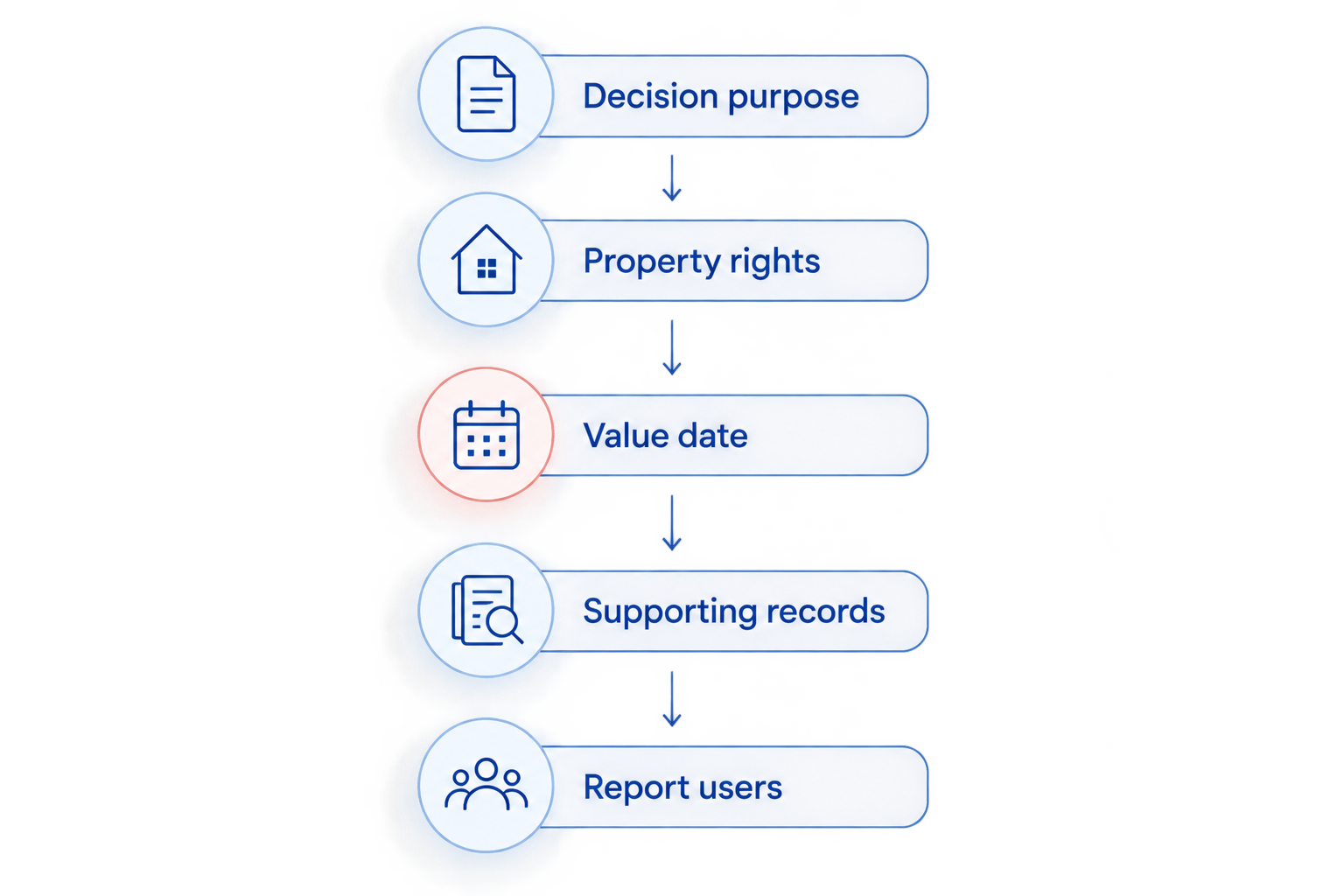
Use this sequence for your 2026 engagement brief:
- Decision purpose: State the acquisition, financing, partnership, or other decision the appraisal must support.
- Property rights: Identify the parcel, ownership interest, leases, easements, and relevant rights.
- Value date: Specify the effective date and distinguish current from proposed conditions.
- Supporting records: Identify available documents and unresolved information requests.
- Report users: Name the intended users and obtain their requirements.
Assemble the property records
Provide available records rather than a presentation containing only the preferred development outcome. Include the following where relevant:
- Survey, parcel identification, title materials, and recorded easements.
- Zoning information, approvals, applications, and development-rights documentation.
- Existing leases, occupancy information, and operating statements.
- Environmental, geotechnical, engineering, and site-condition reports.
- Purchase agreements, offering materials, and documented transaction history.
- Proposed plans, development budgets, and schedules, clearly identified by source and status.
The appraiser determines how these materials inform the assignment. Supplying a budget does not establish that every budget assumption reflects market expectations.
Identify unresolved questions
Flag access disputes, uncertain approval status, incomplete investigations, and missing records at engagement. Do not leave the appraiser to discover that a central project assumption remains unsettled after the scope has been agreed.
Your counsel, architect, engineer, and environmental consultant address different questions. The appraisal should explain how relevant findings affect value without presenting unverified conclusions as established facts.
Compare proposals by scope, not report length
A longer report is not automatically a better report. Compare the work proposed, the evidence to be examined, and the conclusions the assignment is intended to support.
Ask each candidate:
- Which property rights and effective dates will the report address?
- How will highest and best use be analyzed?
- How will comparable transactions be investigated and adjusted?
- Which assumptions require confirmation from other professionals?
- What inspection and document review are included?
- What changes would require a revised scope?
- Does the engagement include responding to the identified user’s follow-up questions?
Use the guide to vetting a commercial appraiser in New York to structure that discussion. Keep the questions tied to your parcel rather than asking for broad assurances about accuracy or acceptance.
Turnaround depends on property type, complexity, records availability, and scope. Any expedited availability must be confirmed individually; your transaction deadline is a scheduling requirement to discuss, not evidence that the necessary analysis can be shortened.
How these engagement routes were selected
The comparison follows assignment fit: local valuation consulting, lender-directed underwriting, and specialized land analysis. The criteria are relevant experience, defined property rights, supported highest and best use conclusions, explicit assumptions, and intended-user requirements.
This is a selection framework, not a claim that firms were independently tested or scored. The appropriate choice follows from the assignment you need completed.
Which appraisal route should you choose?
For a New York City acquisition decision, begin with an independent appraisal consultation and a written scope. REIS Group is a fit for developers seeking New York City real estate appraisal and complex valuation consulting.
For financing, establish the lender’s engagement requirements first. For an unusual parcel, make the central land issue—not the firm’s general service list—the deciding qualification.
Discuss Your Appraisal Assignment
Share the parcel, intended use, effective date, and development questions to discuss an appropriate scope.
FAQ
What should developers look for in a commercial land appraiser?
Developers should look for relevant land experience, supported highest and best use analysis, and a scope matched to the intended use. Ask how the appraiser will address property rights, approvals, comparable sales, and unresolved site conditions.
Is a commercial building appraisal the same as a land appraisal?
No. A land appraisal addresses the defined land interest, while an improved-property appraisal also considers existing improvements. Redevelopment assignments require a clear explanation of how those improvements affect the property’s highest and best use.
Can an appraiser value land based on proposed rezoning?
An appraiser can analyze a clearly defined scenario involving proposed rezoning when the assignment and applicable requirements permit it. The report must distinguish that scenario from existing zoning and explain the relevant assumptions.
Can I order the appraisal before speaking with my lender?
You can commission an independent appraisal for your own decision, but it is not automatically suitable for lender use. Confirm the lender’s engagement and reporting requirements before ordering a report intended for financing.
Does an appraisal replace a development feasibility study?
No. An appraisal develops a value opinion for a defined property interest and intended use; a development feasibility study addresses project viability. The analyses can inform each other, but their scopes are not interchangeable.
Can REIS Group discuss a New York City development-site assignment?
REIS Group provides commercial real estate appraisal and complex property and highest and best use consulting. Share the parcel, property rights, effective date, and intended use so the firm can discuss the assignment’s scope.
How long does a commercial land appraisal take?
Turnaround depends on the property, complexity, records availability, and agreed scope. Discuss your deadline before engagement, and confirm any expedited availability individually.
One last thing
Before signing a 2026 appraisal engagement, ask: Which assumption, if changed, would most affect this land’s value conclusion? The answer helps you identify which zoning question, site investigation, or ownership document needs attention first.
Bring that question, the parcel information, and the intended use to an appraisal consultation. Request a proposal that addresses the decision you actually need to make.
Related guides
- How to appraise commercial land with no existing structures
- How long a commercial appraisal takes
- Commercial appraisal for property investors