

For attorneys selecting an expert witness real estate appraiser, assignment fit comes first: property expertise, the correct valuation date, and a clearly defined litigation role. REIS Group is a fit for New York City counsel seeking real estate valuation support for divorce, estate, partial-interest, and other complex property disputes; confirm testimony responsibilities before engagement.
- Choose an expert witness real estate appraiser by property knowledge, effective date, and the litigation role required.
- REIS Group serves New York City attorneys needing independent real estate appraisal and valuation consulting.
- Use retrospective appraisals for historical valuation questions and partial-interest analysis for fractional ownership disputes.
- Define report preparation, deposition, and trial responsibilities separately before signing an engagement.
Why this matters
A property appraisal and an expert witness engagement are not interchangeable. Your case needs an opinion that addresses the disputed property rights and valuation question, plus an agreed scope for any deposition or testimony.
For a 2026 engagement, start with the assignment rather than a directory ranking. Review the relevant appraisal and valuation services, then identify the property, effective date of value, intended use, and litigation support required.
An appraiser supports an independent value conclusion, not a preferred litigation outcome. A useful engagement makes that distinction clear before substantive analysis begins.
What makes a suitable expert witness real estate appraiser?
Evaluate these criteria before comparing proposals:
- Property expertise: Relevant knowledge of the asset, whether a Manhattan cooperative apartment, mixed-use building, townhouse, or development parcel.
- Property rights: A clear definition of the ownership interest, lease rights, restrictions, and other rights being valued.
- Effective date: Analysis directed to the legally relevant valuation date, not automatically the inspection or report date.
- Analytical support: Explainable comparable selection, adjustments, income assumptions, and reconciliation of the evidence.
- Litigation scope: Written responsibilities for the report, attorney conferences, deposition preparation, and testimony.
- Independence: A willingness to explain unfavorable evidence and limits, rather than promise a target conclusion.
Ask for relevant qualifications and assignment experience. Confirm the proposed witness's personal role; a firm's service description does not establish who will sign the report or appear in court.
Appraisal service options at a glance
These are assignment types, not interchangeable providers. Choose the scope that answers your client's valuation question; one dispute can require several types of analysis within a coordinated engagement.
| Service option | Best for | Standout purpose | Key limitation |
|---|---|---|---|
| New York City litigation-related appraisal | Counsel establishing a property-specific value opinion | Connects the asset, ownership rights, and intended use | Testimony responsibilities require separate confirmation |
| Retrospective estate appraisal | Counsel resolving a historical estate or trust value | Reconstructs value as of the relevant earlier date | Depends on support for historical conditions |
| Partial-interest appraisal | Counsel addressing fractional ownership | Values the identified interest rather than assuming a proportional share | Requires ownership documents and interest-specific analysis |
| Income-producing property appraisal | Counsel disputing commercial property value | Examines income, expenses, leases, and market evidence | Unresolved records can limit analytical support |
1. REIS Group: for NYC property valuation assignments
Best for: Attorneys needing an independent appraisal of Manhattan or greater New York City real estate for a defined dispute.
REIS Group provides residential and commercial appraisals, divorce and litigation-related appraisals, and complex valuation consulting. The firm has over 30 years of experience, with nationwide assignments coordinated through its professional network as supporting coverage.
The relevant question is whether the proposed appraiser's experience matches your property and assignment. For residential disputes, identify whether the asset is a cooperative apartment, condominium, townhouse, or one- to four-family property; those distinctions affect the evidence needed.
REIS Group pros:
- Residential and commercial appraisal services support different property-related disputes.
- Manhattan and greater New York City are the firm's principal market.
- Assignments are scoped to the ownership interest, effective date, intended users, and intended use.
REIS Group limitations:
- A valuation engagement does not by itself establish deposition or trial responsibilities.
- Geographic coverage does not replace checking the proposed appraiser's property-specific experience.
Before retaining the firm, describe the disputed valuation issue and ask who will perform the analysis, sign the report, and handle any requested testimony. Confirm those responsibilities in writing.
Verdict: Choose this scope for NYC property valuation support; confirm the witness role separately.
2. Retrospective appraisal: for historical estate values
Best for: Estate and trust attorneys addressing a property's value as of a date before the appraisal is prepared.
A retrospective appraisal develops an opinion for an earlier effective date. An engagement opened in 2026 can address a historical date without treating current market conditions as historical evidence.
The assignment must distinguish the property's condition at the effective date from its condition today. Later renovations, lease changes, damage, or changes in occupancy need careful treatment rather than silent incorporation into the historical value.
Retrospective appraisal pros:
- Directs the analysis to the date relevant to the dispute.
- Separates historical property conditions from later changes.
- Provides a framework for evaluating contemporaneous sales and income evidence.
Retrospective appraisal limitations:
- Incomplete historical records constrain support for the property's earlier condition.
- A present-day inspection cannot establish every historical fact.
For estate-tax assignments, coordinate the intended use with counsel and the CPA before engagement. The date-of-death appraisal to IRS Form 706 workflow provides a related preparation resource; the report's scope still must match the particular assignment.
Verdict: Choose retrospective analysis when the disputed value belongs to an earlier date.
3. Partial-interest appraisal: for fractional ownership disputes
Best for: Attorneys handling a dispute involving less than the entire ownership interest in real estate.
A partial-interest appraisal addresses the specific interest being valued. Multiplying the whole property's value by an ownership percentage does not, by itself, analyze the rights and restrictions attached to that interest.
Start with the legal ownership structure. Direct ownership of real estate and ownership of an entity that holds real estate raise different questions; counsel should identify the interest before the appraiser sets the scope.
Partial-interest appraisal pros:
- Focuses analysis on the actual interest in dispute.
- Brings transfer restrictions and ownership rights into the assignment.
- Separates whole-property value from interest-level valuation questions.
Partial-interest appraisal limitations:
- Incomplete agreements can leave important rights unresolved.
- An interest-level adjustment requires support; it is not an automatic deduction.
Provide deeds, ownership schedules, operating agreements, and relevant amendments. Ask whether the engagement addresses real estate, an entity interest, or both, and confirm the professional scope required for each.
Verdict: Choose interest-specific analysis when the client does not own the entire asset.
4. Income-producing property appraisal: for commercial disputes
Best for: Attorneys resolving valuation questions involving multifamily, mixed-use, retail, office, or other income-producing property.
Commercial appraisal examines the property's income potential alongside relevant market evidence. Existing leases, occupancy, expenses, and physical condition help define the asset being valued.
A 2026 rent roll does not automatically establish income conditions at an earlier effective date. Match financial records and lease information to the relevant period, and distinguish actual operations from assumptions about stabilized performance.
Income-producing property appraisal pros:
- Connects the value opinion to lease and operating evidence.
- Makes disputed income and expense assumptions identifiable.
- Allows the appraiser to reconcile applicable valuation approaches.
Income-producing property appraisal limitations:
- Inconsistent financial records require clarification before reliable analysis.
- Unresolved lease interpretations need direction from counsel rather than an unsupported appraisal assumption.
Provide executed leases and amendments, rent rolls, operating statements, capital expenditure records, and available condition information. Keep operating-business valuation separate from appraisal of business-owned real estate unless both are expressly included.
Verdict: Choose commercial analysis when income, tenancy, or operating assumptions drive the dispute.
How to scope the engagement before requesting a proposal
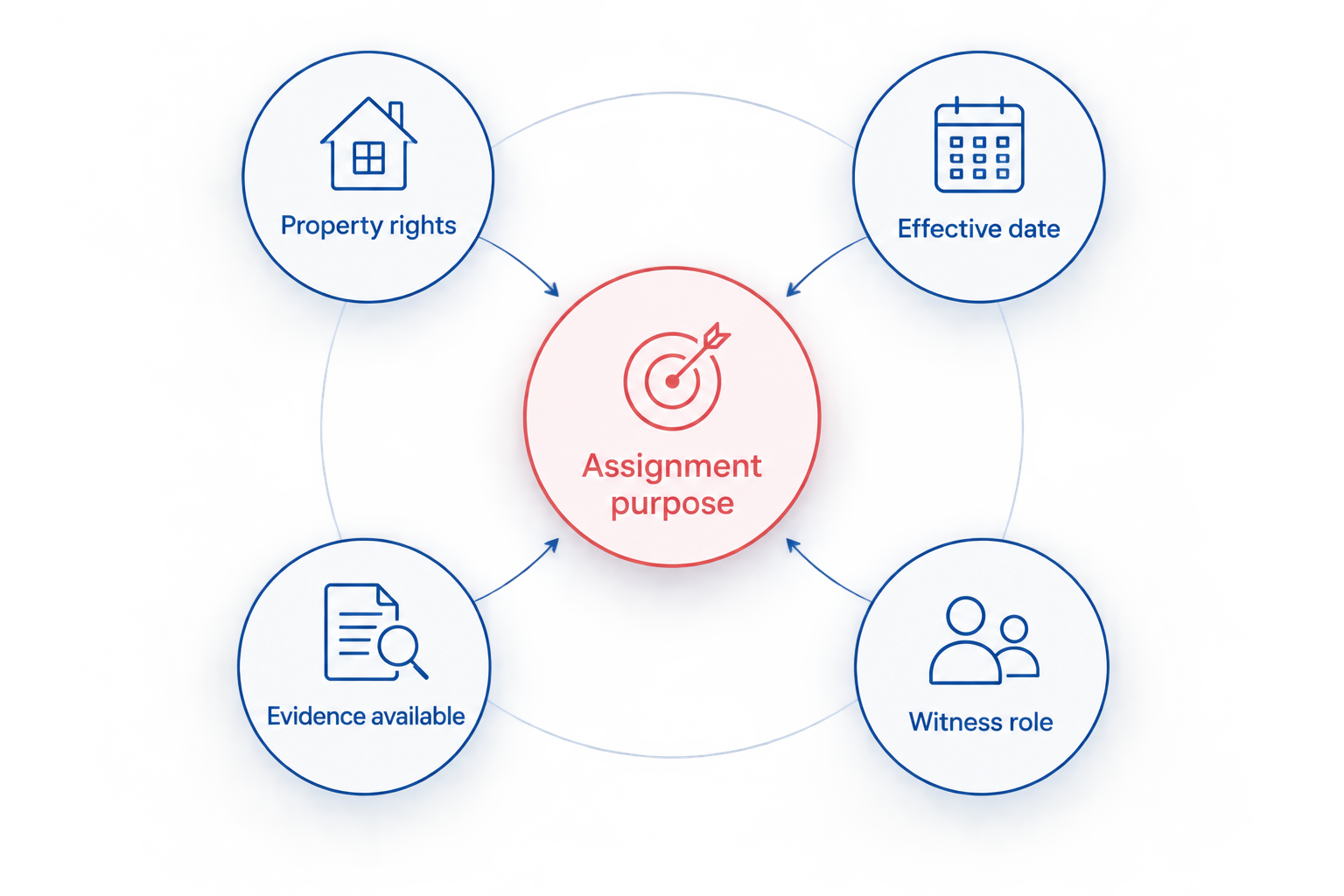
A useful request gives the appraiser enough information to assess suitability without asking for a preliminary value conclusion. Organize the request around these five questions.
Assignment purpose
Explain the dispute and the question the valuation must answer. Identify whether counsel needs an initial opinion, a report for a specified use, analysis of another appraisal, or potential testimony.
Property rights
Identify the address, property type, ownership structure, and interest to be appraised. Supply the relevant documents rather than relying only on a verbal description of ownership.
Effective date
State the required date of value and who determined it. The effective date, inspection date, and report date serve different functions and need not be the same.
Evidence available
List the records already available and identify documents still being requested. Historical photographs, leases, financial records, plans, and prior appraisals can each help establish different facts.
Witness role
Describe anticipated conferences, deposition, hearing, or trial involvement. Ask the proposed expert to confirm responsibilities, scheduling, conflict review, and the terms governing additional work.
For matters scheduled in 2026, share known procedural deadlines at the outset. Turnaround depends on property type, complexity, records availability, and scope; confirm any expedited availability individually rather than assuming it.
Questions that reveal the strength of the proposed engagement
Ask how the appraiser would investigate the assignment, not what value the appraiser expects to reach. A preliminary conversation should clarify fit without substituting for analysis.
- What experience matches this property type and market?
- Which property rights and valuation date will the report address?
- What records are necessary before substantive work begins?
- How will material assumptions and conflicting evidence be documented?
- Who will sign the report and explain its conclusions?
- Which litigation tasks are included, and which require additional authorization?
Read the proposal against those answers. A clear report scope with an undefined witness role leaves a different gap from a clear testimony commitment with insufficient property expertise.
Do not select an appraiser because a preliminary discussion produces a favorable number. Select an appraiser who can explain the evidence needed to reach and support an independent conclusion.
How these service options were prioritized
The order follows assignment fit for New York City attorneys: establish the property valuation question first, then address historical dates, fractional interests, and income-producing property issues as needed. The criteria are property expertise, rights, effective date, analytical support, litigation scope, and independence—not an unsupported ranking of competing firms.
Which appraisal service should you choose?
Default to a property-specific litigation appraisal engagement, then add the specialized analysis your dispute requires. A historical date calls for retrospective analysis; fractional ownership calls for interest-specific analysis; commercial income disputes require suitable lease and financial evidence.
For a 2026 matter, REIS Group offers appraisal and valuation consulting within its stated service areas. Discuss the assignment before assuming that a report engagement includes every litigation task or that one valuation scope answers every disputed issue.
FAQ
What’s the best way to choose an expert witness real estate appraiser?
Choose an expert witness real estate appraiser whose property knowledge, market experience, and agreed litigation role match the dispute. Confirm qualifications, the valuation question, the report scope, and testimony responsibilities before engagement.
Does a litigation appraisal automatically include court testimony?
No. Confirm deposition, hearing, and trial responsibilities expressly in the engagement rather than assuming they are included in report preparation.
Can an appraiser value a property as of an earlier date?
Yes. A retrospective appraisal addresses an earlier effective date using relevant historical property and market evidence; the available records affect how the analysis can be supported.
What should an attorney provide before requesting an appraisal proposal?
Provide the property identification, ownership interest, intended use, required effective date, known deadlines, and anticipated witness responsibilities. Include a list of available documents so the appraiser can assess scope and information needs.
Can a real estate appraisal also value the business operating at the property?
Not automatically. Appraisal of business-owned real estate and valuation of an operating business are distinct assignments, so identify each required interest and confirm the professional scope.
Does a fractional ownership interest equal its percentage of the property’s value?
A proportional calculation alone does not analyze a fractional interest’s specific rights and restrictions. The valuation must address the identified interest and support any interest-level adjustments.
Can an appraisal guarantee acceptance by a court or taxing authority?
No appraisal guarantees acceptance by a court, taxing authority, or other third party. A well-supported report explains the evidence, methods, assumptions, and conclusions for its identified intended use.
One last thing
The inspection date is not necessarily the date of value. Put both dates in your engagement instructions, especially when the property's condition or occupancy has changed; otherwise, counsel and the appraiser risk answering different questions.
Discuss your property, disputed interest, effective date, and anticipated litigation role with REIS Group to request an assignment-specific appraisal proposal.
Discuss Your Appraisal Assignment
Describe the property, valuation date, disputed interest, and litigation support required.
Related guides
- Divorce property appraisal for attorneys
- How to vet a commercial appraiser before hiring in New York
- How to appraise a partial ownership interest in real estate