Trust property appraisal cost in 2026 depends on the property, ownership interest, effective date of value, and intended use; request an assignment-specific proposal rather than treating trust ownership as a fee category. Confirm whether the proposed scope includes historical research, partial-interest analysis, and any follow-up work your attorney or CPA expects.
- Trust property appraisal cost depends on assignment scope, not simply whether a trust holds the property.
- REIS Group provides trust property appraisals tailored to the ownership interest, valuation date, and intended use.
- Trustees should identify retrospective appraisal and partial-interest valuation needs before requesting a proposal.
- Compare proposals for equivalent work, including report purpose, research, and follow-up services.
How much does a trust property appraisal cost in 2026?
A useful appraisal proposal prices a defined assignment—not the words “trust property.” A Manhattan condominium valued for a current distribution presents a different assignment from an income-producing building valued retrospectively for estate reporting. Both involve trust assets, but the necessary research and analysis differ.
Start with the trust property appraisal guide for trustees if you need to clarify the assignment before requesting proposals. Your attorney or CPA should identify the reporting purpose and required valuation date; the appraiser then determines the appropriate appraisal scope.
The comparison below identifies work to discuss. These are assignment types, not fixed service tiers, and an assignment can involve several together.
| Assignment type | Best for | What the scope addresses | Limitation to resolve |
|---|---|---|---|
| Current residential appraisal | Trustees documenting residential property value for a current decision | Property characteristics, ownership rights, and relevant market evidence | Does not establish value as of an earlier date |
| Retrospective appraisal | Trustees needing value as of a specified historical date | Historical market evidence and the property's condition at that date | Requires records that describe the earlier circumstances |
| Commercial property appraisal | Trustees responsible for income-producing real estate | Leases, income, expenses, property characteristics, and market evidence | Incomplete operating records leave more information to establish |
| Partial-interest valuation | Trustees valuing less than the entire ownership interest | The specified interest and its economic and legal characteristics | Is not simply the same percentage of whole-property value |
Why this matters
A proposal that excludes necessary work is not an equivalent alternative to one that includes it. For trustees, the practical question is whether the report addresses the decision, disclosure, or filing for which it is being commissioned.
In 2026, begin your request with the trust's actual valuation need. “We need a value for the trust” leaves open the property rights, date, and intended use that define the assignment.
REIS Group is suited to trustees and professional advisers who need trust property appraisals scoped to a specific valuation purpose. Its principal market is Manhattan and greater New York City, with nationwide assignments coordinated through its professional network. The assignment still requires an individual scope; a firm's geographic reach does not determine which analysis your trust needs.
Why trust property appraisal cost varies
The following factors determine what the appraiser must investigate and report. Address them before comparing proposals.
- Property type and complexity. A cooperative apartment, townhouse, mixed-use building, and office property present different ownership, physical, and market questions.
- Property rights appraised. Valuing the entire property differs from valuing a fractional interest. The engagement should identify exactly what the trust owns and what requires valuation.
- Effective date of value. A current assignment uses a current valuation date; a retrospective assignment addresses an earlier date. Historical condition and market evidence become central to the latter.
- Intended use and users. Trust administration, estate reporting, a beneficiary distribution, and litigation require the purpose and expected users to be identified clearly.
- Records availability. Missing leases, historical photographs, ownership documents, or operating statements affect the work needed to establish relevant facts.
- Scope and timing. Inspection arrangements, research requirements, report needs, and requested timing belong in the proposal. Confirm expedited availability individually rather than assuming it.
Ask the appraiser to explain which factors apply to your property. A specific explanation is more useful than a generic statement that the assignment is “complex.”
Current value or retrospective value: establish the date first
The effective date of value is the date to which the value conclusion applies. It is not necessarily the inspection date or the date the report is delivered.
For example, a report prepared in 2026 can address an earlier effective date. The appraiser must analyze the property and market circumstances relevant to that earlier date, rather than substitute current conditions.
A retrospective assignment needs evidence of what existed then. Renovations, occupancy changes, lease amendments, or damage after the effective date should be distinguished from conditions that existed on that date. Provide dated records and identify uncertainties instead of asking the appraiser to assume today's condition applied historically.
For estate-related work, coordinate the purpose and date with counsel or the tax adviser before engagement. The date-of-death appraisal to IRS Form 706 workflow connects that valuation question with estate-reporting preparation. The appraisal supports the identified purpose; it does not determine every legal or tax requirement.
Whole-property value or partial-interest value: define the asset
A trust's ownership interest is not always the entire real estate asset. The trust might hold a fractional interest directly or an interest in an entity that owns real estate; those structures require the subject of the assignment to be identified carefully.
Do not request a whole-property appraisal when the actual question concerns a different ownership interest. Ask the attorney to clarify the ownership structure and provide the relevant documents so the appraiser can confirm the work within the engagement.
Partial-interest valuation is not an automatic discount exercise. The analysis must address the specific interest and supporting evidence; neither a discount nor its amount should be assumed before analysis.
Also distinguish real estate from an operating business. An appraisal of business-owned property does not, by itself, value the operating business or the trust's interest in it. Identify those separate questions at the proposal stage.
How do you request a comparable appraisal proposal?
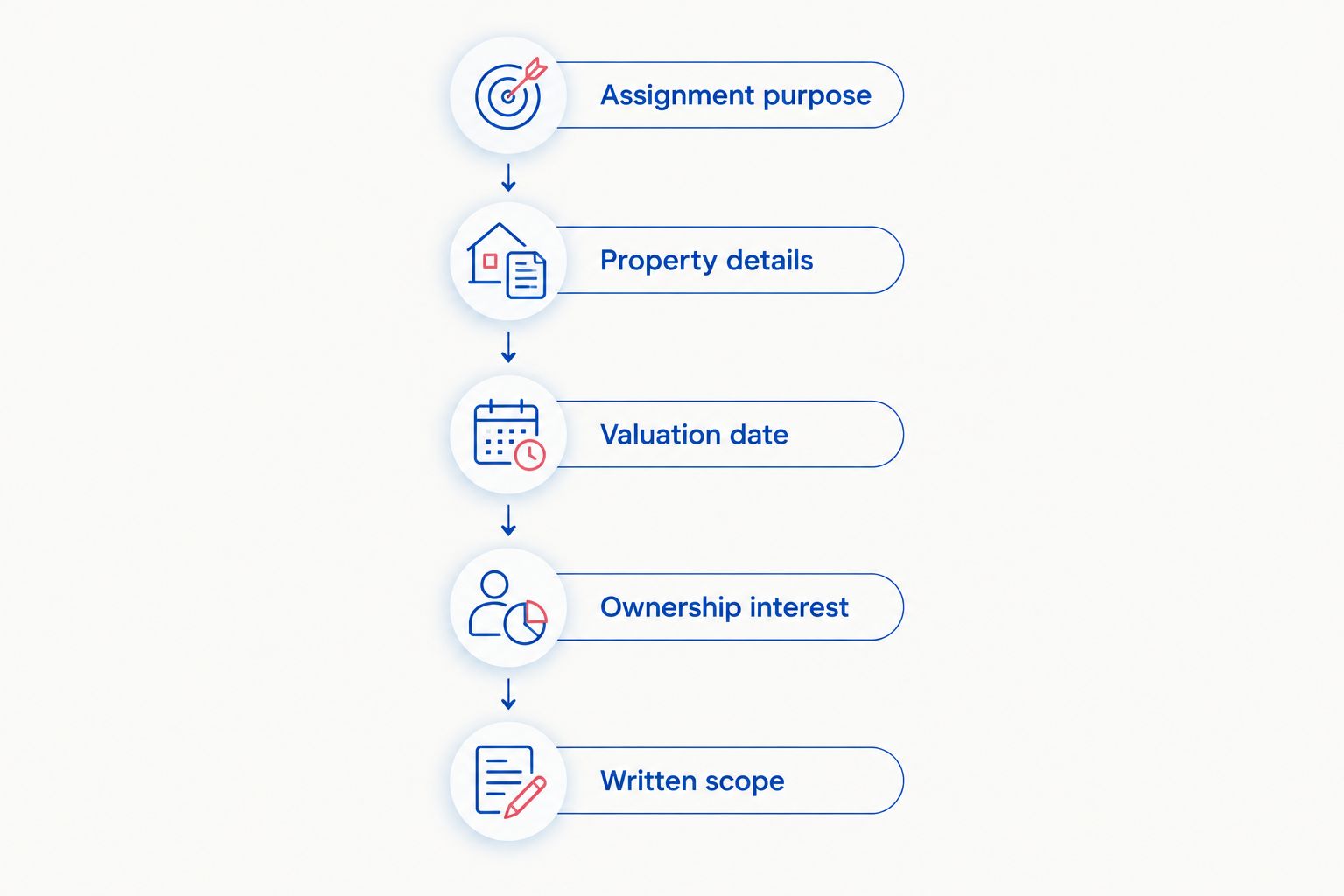
Use these 5 steps to prepare a request that an appraiser can scope. The objective is to make competing proposals comparable without prescribing the appraiser's conclusions or methods.
- Assignment purpose. Explain the trustee's decision or reporting need. Identify whether counsel, a CPA, beneficiaries, or another party expects to use the report.
- Property details. Provide the address, property type, occupancy, ownership structure, and available records. Disclose known access restrictions and material property issues.
- Valuation date. State the requested effective date, subject to confirmation with the responsible adviser. Distinguish it from the requested report delivery date.
- Ownership interest. Identify whether the assignment concerns the entire property, a fractional interest, or another interest requiring clarification.
- Written scope. Request a proposal describing the intended use, intended users, property rights, effective date, investigation, deliverable, timing, and exclusions.
You do not need to resolve every technical question before contacting an appraiser. Separate confirmed facts from open questions, and identify the adviser responsible for resolving legal or tax instructions.
For a 2026 engagement, REIS Group can discuss the property, intended use, valuation date, and ownership interest before defining the appraisal assignment. That conversation should establish the relevant service—not promise a predetermined conclusion or third-party acceptance.
Discuss Your Appraisal Assignment
Identify the property, ownership interest, valuation date, and intended use for a tailored proposal.
Which documents should a trustee prepare?
Organize the records around 3 questions: what is owned, what existed at the effective date, and how the property was used. Give the appraiser an inventory of available materials before gathering documents unrelated to the assignment.
Ownership and authority
Provide the deed or other ownership evidence, relevant ownership agreements, and information identifying the trustee or authorized representative. Ask counsel which trust provisions or other documents are relevant; the appraiser does not need unrelated personal information simply because it appears in the trust file.
Physical condition and history
Collect available floor plans, surveys, photographs, renovation records, and descriptions of significant condition issues. For retrospective work, identify which records relate to the effective date and which describe subsequent changes.
Income and occupancy
For income-producing property, prepare available leases, rent rolls, income and expense statements, and information about vacancies or material lease changes. Historical financial records matter when the requested value relates to a historical period.
Keep missing items visible in your document inventory. Complete records help define the work, but a trustee should not fill factual gaps with unsupported estimates.
What should you check before accepting a proposal?
Read beyond the proposed appraisal fee. Confirm that the engagement describes the same assignment you discussed and identifies anything that requires separate authorization.
- Purpose and users: Does the report address the trustee's identified need and expected users?
- Rights and date: Are the ownership interest and effective date stated correctly?
- Investigation: Does the proposal explain inspection arrangements and relevant research?
- Deliverable: Is the report described clearly enough for your adviser to assess its suitability?
- Follow-up: Are additional analysis, testimony, or later work addressed rather than assumed to be included?
- Timing: Are information dependencies and requested deadlines discussed without an unsupported delivery promise?
A broader scope is not automatically better. Unnecessary work does not improve the fit, while omitted necessary analysis leaves the underlying question unresolved. Compare the scope with your adviser's requirements before authorizing the engagement.
Can an existing appraisal replace a new trust appraisal?
An existing appraisal is useful background, but its suitability depends on its purpose, effective date, property rights, and intended users. A prior lending appraisal should not automatically be treated as a report prepared for trust administration or estate reporting.
Send the existing report to the proposed appraiser and identify what has changed. Ask whether it provides useful evidence, whether additional work is required, and whether a separate engagement is necessary.
Will complete records guarantee a faster appraisal?
Complete records help the appraiser assess scope and proceed with relevant research, but they do not establish a guaranteed completion date. Turnaround depends on property type, complexity, records availability, and scope.
State the actual deadline and its purpose when requesting the proposal. If expedited work is needed, confirm availability individually and ask which records or access arrangements are required from the trustee.
FAQ
How do I get an accurate trust property appraisal cost proposal?
Request a proposal that identifies the property, ownership interest, effective date of value, and intended use. Include available records and ask the appraiser to state the scope, deliverable, timing, and exclusions.
Does putting a property in a trust make the appraisal more expensive?
Trust ownership alone does not define the appraisal scope. The work depends on the property, interest being valued, valuation date, records, and purpose of the assignment.
Can a trustee order an appraisal without involving every beneficiary?
The trustee should confirm engagement authority and any notice requirements with trust counsel. Give the appraiser clear instructions identifying the client and intended users; appraisal scope does not resolve questions of legal authority.
Is a partial-interest appraisal the same as a whole-property appraisal?
A partial-interest appraisal addresses a specified ownership interest rather than simply the entire property. The appraiser must evaluate the interest’s characteristics; its value is not automatically a proportional share of whole-property value.
Can REIS Group appraise trust property outside Manhattan?
REIS Group serves Manhattan and greater New York City, with nationwide assignments coordinated through its professional network. Discuss the location and assignment requirements before requesting a proposal.
Will a trust property appraisal guarantee acceptance by the IRS or a court?
A trust property appraisal does not guarantee acceptance by the IRS, a court, or another third party. The report should be prepared to support the identified valuation purpose with clearly explained analysis and conclusions.
One last thing
Check the dates before checking the proposal total. An otherwise detailed report answering the wrong valuation-date question does not address the assignment you intended to commission.
For your 2026 request, write the effective date and requested delivery date on separate lines. Then ask REIS Group to discuss your appraisal assignment, confirm the ownership interest and intended use, and provide an appropriately scoped proposal.
Related guides
- How much does a partial-interest appraisal cost?
- Can a date-of-death appraisal be completed years after the death?
- Trust appraisal to fiduciary accounting disclosure workflow