A desktop appraisal can support an estate-tax valuation in 2026 when its scope, evidence, and analysis are sufficient for the property interest and intended use; the desktop label alone does not establish IRS acceptance. The central limitation is whether the appraiser can support the property's condition, ownership rights, and value as of the required effective date without an inspection.
- For desktop appraisal estate tax purposes, adequate evidence matters more than the report’s label.
- REIS Group provides estate-tax appraisals scoped to the ownership interest, effective date, and intended use.
- A current inspection does not, by itself, establish a property’s condition on a historical valuation date.
- Ask your appraiser and tax adviser to resolve scope and documentation requirements before the engagement begins.
Is a desktop appraisal accepted for estate tax purposes in 2026?
A desktop appraisal is not automatically accepted or rejected solely because the appraiser did not inspect the property. The assignment must produce a credible valuation supported by sufficient information, and the taxing authority can examine the conclusion and its underlying evidence.
For federal estate-tax valuation, Treasury Regulation §20.2031-1(b) defines fair market value through a hypothetical willing buyer and willing seller, neither under compulsion and both reasonably informed. Whether a desktop assignment adequately develops that value depends on the facts, not a universal permission attached to the word desktop.
Start with the date-of-death appraisal to IRS Form 706 workflow when identifying the reporting purpose and information your adviser needs.
| Assignment approach | Best suited to | Principal benefit | Principal limitation |
|---|---|---|---|
| Desktop appraisal | Assignments where reliable records sufficiently establish relevant property characteristics | Uses documented evidence without an appraiser's site inspection | Cannot directly resolve conditions that the records do not establish |
| Appraisal with inspection | Assignments where access helps resolve material physical questions | Adds direct observations of accessible areas | Today's observations do not independently establish historical condition |
Neither approach guarantees acceptance. An inspection strengthens some assignments, while a desktop approach requires particular attention to the reliability and completeness of information obtained from other sources.
Why this matters for executors and estate advisers
An executor needs a supported value for a specific ownership interest on a specific date—not simply a number for the building. An engagement that leaves those questions unresolved can produce a report that does not address the estate's actual reporting need.
For a Manhattan cooperative apartment, the relevant evidence includes more than comparable apartment sales. The appraiser also needs to understand the interest being valued and the property characteristics that affected market value on the effective date.
For an income-producing property, leases, occupancy, expenses, and physical condition can all affect the analysis. Calling the assignment desktop does not remove the need to investigate material valuation issues.
Choose the scope after identifying the valuation problem, not before. That sequence keeps the engagement focused on evidence rather than on obtaining a particular report format.
What a desktop estate-tax appraisal must establish
For a 2026 estate-tax engagement, ask the appraiser to explain how the available information supports each material conclusion. A polished report cannot compensate for an unresolved factual issue that changes value.
The effective date of value
The effective date is the date to which the valuation conclusion applies. For a date-of-death appraisal, that date is the decedent's date of death, even when the report is prepared later.
The report date and inspection date serve different purposes. Neither automatically replaces the effective date selected for the assignment with the estate's legal and tax advisers.
The property rights appraised
Identify exactly what the decedent owned. Ownership of an entire property, an undivided interest in real estate, and an interest in an entity holding real estate are not interchangeable valuation problems.
Provide deeds, ownership schedules, and relevant agreements before the appraiser finalizes the scope. An appraisal of the underlying real estate does not automatically establish the value of an entity interest or operating business.
Condition on the effective date
The appraiser needs evidence of the property's relevant condition as of the valuation date. Dated photographs, inspection records, renovation documents, and reliable third-party descriptions can help establish that history.
The report should explain material assumptions and their significance. If an assumption about condition is unsupported and materially affects value, additional investigation is needed—not simply stronger wording.
Market evidence and reasoning
The analysis must connect relevant market evidence to the subject property. Comparable sales require examination of differences such as location, condition, property rights, and transaction circumstances.
For income-producing real estate, the analysis also needs appropriate attention to income and expense evidence. The report should explain how the evidence supports the conclusion, rather than merely listing transactions or financial figures.
When a desktop approach fits—and when inspection adds value
A desktop scope is most defensible when reliable information resolves the material questions the appraiser needs to answer. That is a factual judgment made for the assignment, not a category-wide exemption from investigation.
Dated interior photographs, consistent building records, a documented renovation history, and reliable occupancy information can help the appraiser evaluate whether remote research is sufficient. Records must be relevant to the effective date; a recent listing is not necessarily evidence of historical condition.
Inspection adds value when direct observation can resolve a material uncertainty. Unclear layouts, disputed condition, undocumented alterations, or questions about accessible building areas deserve explicit discussion before the engagement proceeds.
There is a limit in the opposite direction, too. Inspecting a renovated apartment today does not show how it looked before the renovation, so historical documents remain important even when access is available.
The right question is whether the proposed scope resolves material uncertainties—not whether desktop appraisals are generally allowed.
Why the appropriate appraisal scope varies
The following factors determine whether records are sufficient or further investigation is needed:
- Historical condition: Incomplete or conflicting evidence about damage, maintenance, or improvements requires additional investigation.
- Property type: Cooperative apartments, condominiums, townhouses, and commercial buildings present different ownership and valuation questions.
- Ownership interest: A partial interest requires analysis of the interest being transferred, not merely the whole property's value.
- Income documentation: Leases, rent rolls, vacancies, and expenses affect the analysis of income-producing property.
- Access and records: An unavailable inspection does not make inadequate records sufficient; the appraiser must address the resulting limitation.
- Assignment purpose: Intended users and intended use determine what the report needs to explain and support.
A desktop assignment is not automatically quicker. Turnaround depends on property type, complexity, records availability, and scope; expedited availability must be confirmed individually.
How should an executor prepare for the appraisal?
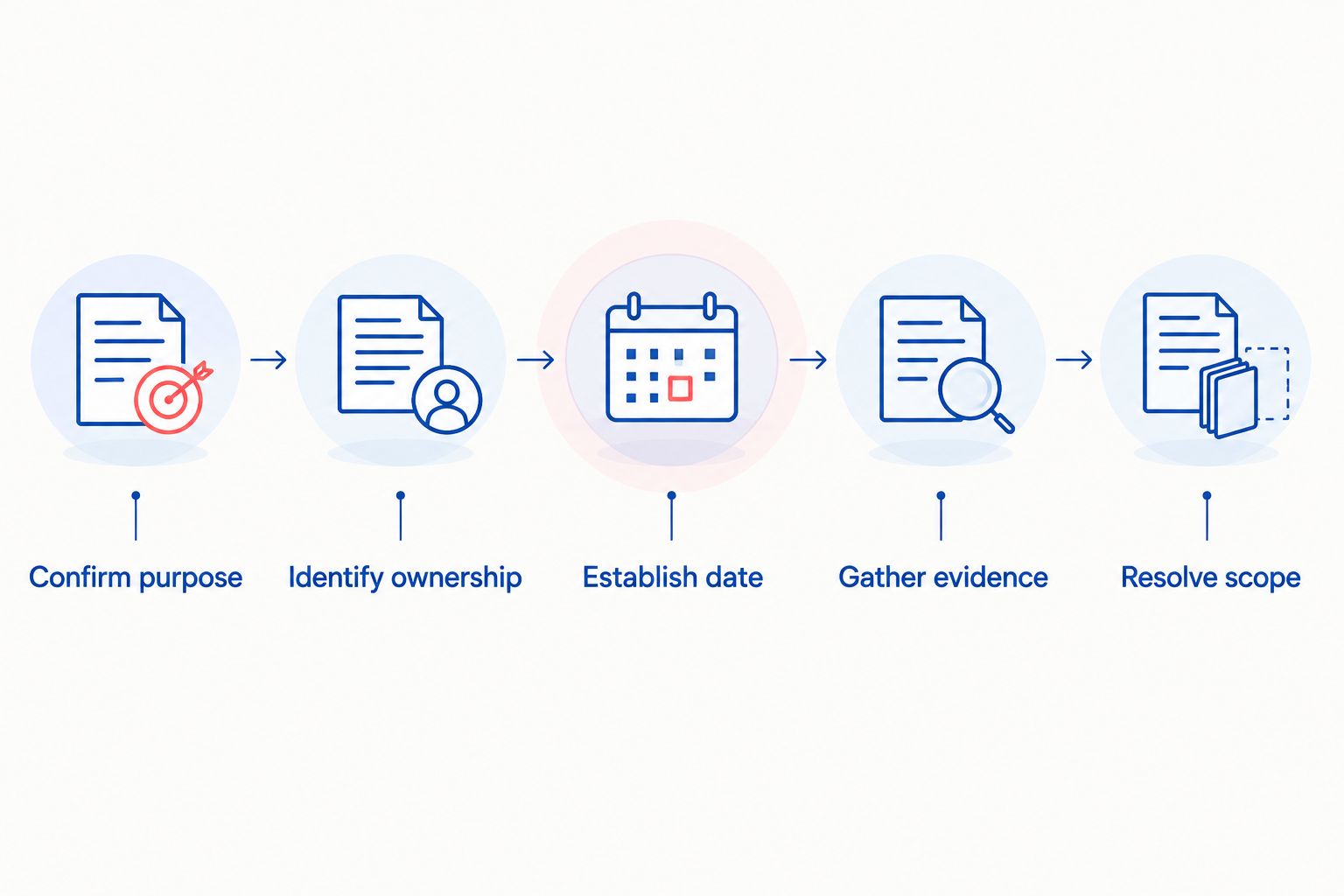
For a 2026 engagement, organize the assignment around these 5 steps before requesting a particular inspection format. Your attorney or CPA should confirm the tax-reporting purpose and required valuation date.
- Confirm purpose. Identify the estate, intended users, reporting purpose, and questions the valuation must answer. Distinguish estate-tax reporting from a proposed sale or a family distribution discussion.
- Identify ownership. Supply the property address, deed or ownership documentation, and relevant agreements. Flag any partial ownership, entity ownership, or restrictions requiring further analysis.
- Establish date. Confirm the effective date with the estate's advisers. Separate that date from the planned report date and any inspection date.
- Gather evidence. Assemble dated property records, photographs, financial information, and descriptions of changes. Identify the source of each material statement about historical condition.
- Resolve scope. Ask the appraiser what remains uncertain and whether inspection or additional records would resolve it. Document the agreed assignment before relying on a desktop approach.
Documents to assemble
Provide what is relevant and identify gaps rather than presenting estimates as established facts:
- Deeds, ownership records, and applicable agreements.
- Dated interior and exterior photographs.
- Floor plans and available property descriptions.
- Renovation invoices, repair records, and damage documentation.
- Leases, rent rolls, and operating statements for income-producing property.
- Cooperative or condominium documents relevant to the assignment.
- Prior appraisals and transaction records, with their dates and purposes identified.
An earlier appraisal can provide context, but its value conclusion belongs to its own effective date and scope. The new appraiser must determine what information remains relevant.
What should you ask before engaging an appraiser?
Ask the appraiser to describe the proposed scope in writing. A useful engagement discussion addresses the evidence needed, unresolved issues, intended users, and circumstances that would require additional work.
Use these questions to keep the discussion specific:
- What property interest will the report value?
- How will the report establish historical condition without an inspection?
- Which documents are essential before analysis begins?
- What material assumptions would the proposed scope require?
- What happens if records conflict or important information is unavailable?
REIS Group is suited to estate attorneys, CPAs, and fiduciaries seeking real estate appraisals tailored to an identified estate-tax purpose. With over 30 years of experience, the firm serves Manhattan and greater New York City, with nationwide assignments coordinated through its professional network.
The engagement still requires assignment-specific scoping. Neither the firm name nor the appraisal format guarantees acceptance by the IRS or another intended user.
Can a desktop appraisal establish value years after death?
A retrospective appraisal can establish an opinion of value as of an earlier effective date when sufficient evidence supports the analysis. Desktop describes the inspection approach; retrospective describes the timing of the value opinion.
The two concepts can overlap, but neither substitutes for the other. A retrospective desktop assignment still needs credible evidence of historical condition, ownership rights, and market circumstances.
Does an interior inspection guarantee IRS acceptance?
An interior inspection does not guarantee IRS acceptance. It adds observations about accessible areas on the inspection date, while the report still needs a supported valuation method, appropriate evidence, and clear reasoning.
For historical valuations, the appraiser must distinguish observed current conditions from conditions established for the effective date. Your tax adviser addresses the filing position; the appraiser supports the valuation conclusion.
Can the same report serve estate tax and probate?
One report can address multiple purposes only when the assignment properly identifies and satisfies those purposes. Do not assume that a report prepared for probate automatically meets a separate estate-tax need.
Before engagement, have the attorney and appraiser confirm intended users, effective date, property rights, and reporting requirements. Resolve differences before the report is prepared rather than asking for a new label afterward.
FAQ
Is a desktop appraisal enough for estate tax purposes in 2026?
A desktop appraisal can be sufficient when its scope and evidence support a credible estate-tax valuation. The desktop label does not establish IRS acceptance, and material uncertainties require further investigation.
Does the IRS require an interior inspection for every estate appraisal?
An interior inspection is not a universal requirement established by the federal estate-tax fair-market-value definition. The appraiser must determine whether the assignment can produce credible results without one, and the estate’s adviser should address applicable filing requirements.
Can an online property estimate replace an estate appraisal?
An online property estimate is not a substitute for an assignment-specific estate appraisal. It does not by itself establish the required historical condition, property rights, effective date, and supporting valuation analysis.
What if the property was renovated after the owner died?
The appraisal must distinguish later renovations from the property’s condition on the effective date. Dated photographs, invoices, and other records help establish that distinction.
Is a desktop appraisal the same as a retrospective appraisal?
A desktop appraisal and a retrospective appraisal describe different aspects of an assignment. Desktop concerns the inspection approach; retrospective means the value opinion applies to an earlier effective date.
Can REIS Group discuss a desktop estate-tax appraisal assignment?
REIS Group provides estate-tax real estate appraisals scoped to the property interest, effective date, and intended use. Discuss the available records and access conditions so the appropriate scope can be determined.
One last thing
A present-day inspection cannot recover a missing historical record. Before clearing an inherited property or discarding documents in 2026, preserve dated photographs, leases, repair records, and correspondence that explain its condition and use.
To discuss a REIS Group estate-tax appraisal, provide the property address, ownership interest, effective date, and intended use. Request an appraisal proposal that addresses those facts and the evidence available.
Discuss Your Appraisal Assignment
Identify the property, ownership interest, effective date, and estate-tax purpose.
Related guides
- Date-of-death appraisal: a guide for New York executors and attorneys
- Getting a retrospective appraisal for an inherited property
- Partial-interest appraisal scope and cost considerations